LA city attorney race puts rights enforcement and neighborhood prosecution in focus
Marissa Roy and John McKinney offer different emphases for the legal office. Its powers and limits will shape how campaign promises become public action.
Los Angeles' city attorney election puts the next administration's legal priorities in the spotlight. Marissa Roy and John McKinney advanced to the November 3 runoff after the incumbent did not reach the general election. Their campaigns offered different emphases for an office that represents the city, helps shape local law and prosecutes misdemeanors. The choice is broader than a contest over a single category of crime.
LAist's reporting on the race sets out that contrast: Roy stresses public-interest litigation and protections for workers and renters; McKinney emphasizes neighborhood prosecution and public safety. Those descriptions identify the candidates' cases, not a finding that either goal excludes the other. This report analyzes what the office can do without declaring a final election result.
Readers should use the Los Angeles County election office for official counting information. Early returns, a media projection and certification are distinct stages. Our Los Angeles politics desk will follow the powers and decisions of the office without treating a campaign promise as a legal outcome already achieved.
A legal office with several roles
The City Attorney's official description identifies the office as general counsel to the city government, responsible for legal advice, ordinances, contracts, litigation and misdemeanor enforcement. The county district attorney is a different office. A debate that treats the city attorney as responsible for every criminal case in the region would misstate the job.
The mix of duties creates a genuine priority-setting problem. Lawyers who advise departments, defend the city, pursue civil enforcement and prosecute misdemeanors do not all perform the same task. A candidate can seek to expand one function, but residents should ask what staff and resources support it and what happens to the rest of the workload.
The office also acts within law and through courts. An elected lawyer can choose a strategy and argue for a position. A judge can reject it. A city policy can be constrained by state or federal law. Campaign rhetoric should not erase those boundaries, especially when a candidate promises a rapid remedy for a difficult public problem.
Roy's public-interest case
Roy's published platform calls for stronger action on workers' rights, renters' rights, environmental and consumer protection and civil rights. Her argument is that the office can use legal tools to address harms that may be difficult for an individual resident to challenge alone. These are her proposed priorities, not an independent finding about the volume or merit of every possible case.
Public enforcement can matter when a violation affects many people but each person faces barriers to bringing a claim. A worker may fear losing a job; a tenant may lack money for a prolonged dispute. An office with enforcement authority can sometimes pursue a broader remedy. Whether a particular case is appropriate depends on the governing law and evidence, not only on the public appeal of the issue.
A serious version of the public-interest argument also needs a test for selecting cases. An office cannot pursue every complaint with the same intensity. Residents should be able to understand what makes a matter a priority, how patterns are identified and whether the requested remedy addresses the harm. A press announcement about filing is not the same as a recovery, an order or a change in conduct.
The approach has tradeoffs. Complex litigation can take time and involve uncertainty. A lawsuit can serve a legitimate public purpose without producing an immediate budget benefit. It can also absorb resources without securing the hoped-for remedy. The public should see those possibilities clearly rather than receive a promise that vigorous litigation guarantees a win.
McKinney's neighborhood-prosecution case
McKinney's issues platform proposes a neighborhood-prosecutor program that would work with residents, businesses, police and city departments on persistent local problems. He emphasizes identifiable responsibility and public reporting. The aim, in his account, is to address recurring conditions rather than wait for them to become a larger crisis.
That approach asks the office to connect legal enforcement with the experience of a neighborhood. A recurring nuisance or pattern of violations can fall between several agencies, each handling one part. Assigning a prosecutor or team can make it clearer whom residents should contact and who must explain the response. That is an organizational claim worth testing, not proof that every problem needs prosecution.
A strong implementation plan would also explain how the office distinguishes conduct that is criminal from a condition requiring a different public service. People can experience the same place as unsafe, inaccessible or neglected for different reasons. A legal response should identify the actual violation and the appropriate remedy rather than treat a broad complaint as sufficient evidence against a person.
The tradeoff here concerns discretion and proportionality. Enforcement can protect residents from real harm. It can also impose consequences that do not solve an underlying problem if the response is poorly matched. A public record should therefore include what the program resolved, how it selected cases and what alternatives it used when prosecution was not the right tool.
The two approaches overlap more than campaign labels suggest
Public-interest litigation and neighborhood enforcement are not mutually exclusive categories. A repeated violation in one neighborhood may reveal a wider pattern. A citywide case can affect a specific block. The question is how the office organizes those connections and allocates its limited legal capacity.
Likewise, public safety is not the sole concern of one candidate, and rights protection is not the sole concern of the other. Both legal functions require evidence, fair procedures and a remedy within the office's authority. Reporting should preserve the differences the candidates state without turning them into an artificial choice between order and rights.
Annenberg Media's candidate interviews offer another account of the contenders' own explanations. Reading candidates in their own words can expose qualifications lost in an endorsement or attack. It does not remove the need to test their factual claims against records.
Our editorial standards require that campaigns be treated as speakers, not neutral sources of proof about their opponents. This article does not repeat unverified allegations, donor insinuations or claims about motives. Those would require separate investigation, responses and evidence of the specific connection being alleged.
Defending the city is also public-interest work
The elected attorney will inherit matters in which Los Angeles is the defendant, not only decide which lawsuits to bring. Legal defense can affect public money, institutional practice and the rights of people bringing claims. It should not disappear from coverage because proactive enforcement produces more visible campaign promises.
A lower settlement total is not automatically evidence of better legal management. It could reflect the timing or type of cases. A higher total is not automatically evidence that the current office caused the underlying conduct. Residents need the relevant period, case context and explanation of what the office could control before comparing administrations.
Preventing future liability can involve advice and training before a dispute reaches court. That work may be less visible than a trial, but it belongs in the evaluation of the office. The public-interest question is whether legal guidance helps departments act lawfully and avoid preventable harm, not only whether lawyers win after something has gone wrong.
What a transparent priority plan would contain
An early plan from the next city attorney could show how the office intends to balance its branches and assess progress. Useful information would include staffing responsibilities, criteria for taking cases and the distinction between a filing, a completed action and a continuing obligation. Those are suggested accountability tests, not a claim that either candidate has adopted this exact reporting plan.
The office must also protect legitimate confidentiality and the fairness of legal proceedings. Transparency does not mean publishing every detail of an active case. It does mean explaining policy choices and providing aggregate information where appropriate, rather than invoking confidentiality as a reason to say nothing about how public resources are used.
A public complaint system needs similar clarity. Residents should know what the office can consider, where matters outside its remit belong and what an acknowledgment of a complaint does or does not mean. Receiving a complaint is not a finding. Declining a case does not necessarily establish that no harm occurred. The reason may concern jurisdiction, available evidence or a different legal route.
The governing test after the election
The local politics section follows how the choices made in an election become institutional decisions. For the city attorney, the record will include both the cases pursued and the less visible legal work supporting city government. A complete assessment will examine priorities, outcomes and fair process together.
Our methodology distinguishes a candidate's promise from evidence that a policy worked. Applied to this race, that means giving Roy's rights-enforcement case and McKinney's neighborhood-prosecution case a serious hearing while reserving conclusions for the record. Neither the breadth of a platform nor the force of a slogan shows how the office will perform.
Whoever wins will need to explain how the legal powers of Los Angeles serve residents within the limits of the law. The public should be able to trace those choices, compare them with the campaign's commitments and question them without being asked to accept a partisan label as an answer.
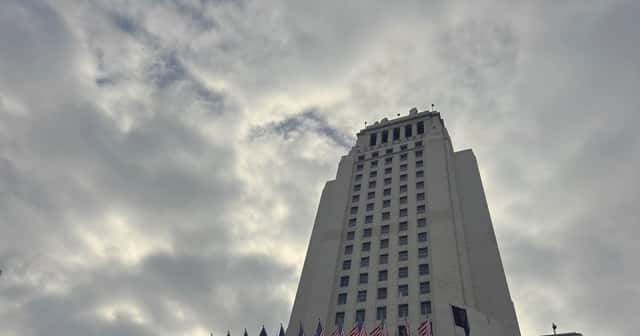
Photo: Los Angeles City Hall, April 2025, by Busition / Wikimedia Commons, CC BY 4.0. Representative civic image; cropped for display.
A useful first-year review would compare the adopted legal budget with vacancies, case backlogs and the office's stated priorities. Those figures would not answer every question about justice, but they would show whether promised work has staff and time behind it. Residents should also look for explanations when a priority changes. An elected lawyer may encounter new evidence or binding court decisions; explaining those limits is part of the job rather than proof that every campaign commitment was empty.
Differing perspectives
What should the next Los Angeles city attorney prioritize?
Each position is summarized as its supporters make it, with equal weight and in alphabetical order. A summary is not an endorsement; the evidence for each is weighed in the story above.
Expand public-interest enforcement
Who holds it: Marissa Roy and her campaign
The city attorney should use the office to protect tenants, workers, consumers and residents affected by environmental harm. Roy favors a more active public-interest litigation role and a tailored approach to criminal cases. Her argument is that legal power should reach the institutions and practices that harm communities, with the office serving as a public advocate as well as municipal counsel.
In their words: Marissa Roy campaign, platform ↗
Strengthen neighborhood prosecution
Who holds it: John McKinney and his campaign
Residents need identifiable prosecutors who understand recurring problems in their neighborhoods and work with local partners. McKinney argues that more consistent misdemeanor enforcement and stronger management can improve public safety. His neighborhood-prosecution approach emphasizes a clear point of contact, local knowledge and accountability for follow-through, rather than leaving residents unsure who is responsible for addressing persistent offenses.
In their words: John McKinney campaign, issues ↗
READ BEYOND 567POLITICS
Alternate sources & perspectives
Independent coverage and primary evidence to help you compare arguments. A link is not an endorsement; perspective labels describe the linked material.
- primary evidence
About the City Attorney ↗
Los Angeles City Attorney
Official legal duties and jurisdiction.
- other perspective
The people’s platform ↗
Marissa Roy campaign
Rights-enforcement proposals, not factual proof of attacks on opponents.
- other perspective
Campaign issues ↗
John McKinney campaign
Neighborhood-prosecution proposal.
- independent analysis
City attorney race guide ↗
LAist
Race and office context.
- independent analysis
Candidates share their visions ↗
USC Annenberg Media
Direct candidate interviews; controversial crime statistics not repeated.
Reviewed 2026-11-04. Reviewed November 4, 2026. The article compares documented campaign positions using original candidate sources and independent local reporting. It makes no winner call, certified-result claim, inference about voter motives or representative polling claim. Governing proposals are distinguished from enacted policy and measured outcomes. The licensed City Hall photograph is an archive illustration, not a campaign-event image.