LA fire tax debate turns on new capacity and the cost of paying for it
Measure FD proposes a dedicated sales-tax increase for LAFD. Its financing rule and promises about emergency services require different kinds of evidence.
Los Angeles' Measure FD asks residents to connect two questions that are often debated separately: what the Fire Department needs and how the city should pay for it. The November 3 initiative would add a half-percentage-point sales tax dedicated to LAFD functions. Its supporters argue that a dependable new stream is needed for emergency capacity. Opponents argue that the city should meet that duty within existing resources instead of adding to the cost of purchases.
This report examines the ordinance and the competing claims. It does not call the election or present an early lead as a certified result. Counting information belongs to the Los Angeles County election office. The Los Angeles politics desk will distinguish voter approval from the later budget, hiring and purchasing decisions that would turn a revenue measure into services.
A dedicated tax, with a separate question about delivery
The official ordinance directs the proposed revenue toward the Fire Department's core functions, including personnel, vehicles, equipment, stations and preparedness. It also provides for audits and public oversight. Those are legal features of the proposal. A campaign claim about the response-time improvement the tax would produce is a different kind of statement and requires additional evidence.
The difference matters because money is necessary for many improvements but is not the same thing as an improvement delivered. A department may need to recruit and train people, place equipment where it is useful and maintain what it buys. A new station is a physical asset; an operating response system also needs staff, scheduling and readiness. A responsible account should follow the path from tax receipts to those practical steps.
The tax's geographic scope matters as well. This is a City of Los Angeles measure for the city department. It should not be described as a new revenue source for every fire agency in Los Angeles County. The county contains other jurisdictions and agencies. Confusing the city and county would misstate both who is deciding and which institution would receive the money.
The supporters' case
The Fund LA Fire campaign, sponsored by United Firefighters of Los Angeles City, argues that more personnel, equipment and stations are needed to improve emergency response. Its published explanation of the ordinance emphasizes that revenue would supplement city spending rather than replace it. Those are the campaign's stated case and description, not independent proof of every predicted service gain.
A dedicated revenue stream can make it easier to plan an ongoing public function. If the city wants to maintain staff and equipment over time, it needs to consider recurring costs rather than only the initial purchase. The argument for a dedicated tax is that emergency capacity should not depend entirely on annual competition with unrelated programs.
Supporters also ask residents to think about a service whose value is not limited to the people using it on a particular day. Fire suppression and emergency medical readiness require capacity before an incident happens. Judging the system only by calls already completed can miss the role of preparedness. Yet that is not a reason to accept every spending proposal without scrutiny. It is a reason to define the capacity the city is trying to achieve and to explain how proposed purchases serve it.
The strongest supporting case therefore goes beyond a total revenue target. It connects specific needs with a realistic sequence of action, identifies what can be done first and explains what depends on training or construction. That would let residents assess whether the new funding is addressing a demonstrated problem rather than simply enlarging an agency budget.
The opposition's case
The Howard Jarvis Taxpayers Association's own voter guide opposes FD, arguing that city officials should fully fund fire protection from the existing budget and that residents already face high sales taxes. The Los Angeles Area Chamber's Jobs PAC guide also opposes the measure. Their positions should be treated as arguments about taxes and priorities, not as evidence that the department has no needs.
A sales tax changes the price of taxable purchases. It can collect from visitors as well as residents, but that does not remove the burden on local households. Whether the burden is justified depends in part on the value of the service and the alternatives available. A claim that the tax is small should not substitute for analysis of cumulative costs. A claim that any tax increase is unaffordable should likewise address the consequences of leaving a service need unmet.
The existing-budget argument has its own evidentiary demand. If officials could fund the same improvement without new revenue, the public should be shown which spending would change or what other source would cover it. A very large total budget does not mean all of it is freely available for any purpose. Some money can be restricted or committed. The right comparison identifies funds that could actually be redirected and the services that would then receive less.
Opponents can also question whether a permanent earmark is the best way to govern changing needs. A future city may face a different distribution of risks and costs. The policy choice is between a more durable commitment to one service and the flexibility to adjust priorities. It is legitimate to value either, provided the tradeoff is stated honestly.
What a spending safeguard can establish
The campaign's emphasis on preventing substitution addresses a familiar problem with earmarked revenue: a government could receive new money for a service and reduce the ordinary funding it supplies. A maintenance requirement is intended to protect against that outcome. The measure's actual rule, rather than a slogan about extra money, should govern the public's expectations.
Evaluating such a rule requires a baseline. Residents need to know which expenditures count, which period is used and how changes in accounting affect the comparison. An apparent increase can reflect a reclassification rather than more capacity. An apparent decline can reflect a one-time project ending rather than a permanent service cut. Public financial reports should explain those differences instead of leaving readers to infer them from totals.
An audit can test whether money was used as authorized. It does not necessarily establish that every authorized purchase was the best available choice. Spending compliance and service effectiveness answer different questions. Both matter, and neither should be offered as a substitute for the other.
Why response-time claims require care
Emergency response is a sequence, not one uniform number. A public claim may refer to dispatch, travel or a complete interval. It may describe an average, a target or a share of calls meeting a benchmark. Those are not interchangeable measures. Any assertion that the tax will improve response needs a defined starting point and a clear measure of success.
The campaign website presents a model of coverage and explains assumptions about resource availability. A model can illustrate a problem without guaranteeing what will happen during an actual incident. Conditions such as simultaneous calls can differ from its assumptions. This report does not treat the campaign's map as an independent evaluation or reproduce a projected improvement as an established result.
Nor should the January 2025 fires be used to make an unsupported claim about what this particular ordinance would have prevented. A disaster can motivate scrutiny of capacity. Establishing that a different budget would have changed a specific outcome requires a much more detailed record of conditions and decisions. The distinction protects both survivors and the public from claims that go beyond the evidence.
Our methodology requires forecasts to remain labeled as forecasts. That is especially important when the stakes of the argument are lives, homes and emergency readiness. A valid concern should not need an exaggerated certainty to be taken seriously.
The decisions after the vote
If FD takes effect, the city should be able to explain when collections begin, when funds become available and which actions follow. Voter approval would not mean a fully staffed expansion appears immediately. A clear implementation schedule could help residents distinguish legitimate lead times from avoidable delay.
The timing of collections is also distinct from the effective date of the legal measure. The ordinance and the campaign explanation describe steps between voter approval and the tax becoming operative. Businesses and residents should rely on the official implementation notice for the applicable date rather than an election-night headline. A mandate to prepare for a new tax does not mean every taxable purchase changes price the morning after the vote. Clear notices would help separate those events and reduce confusion about compliance.
A public oversight process also needs usable information. Reports should identify obligations already made, cash received, money spent and services delivered. Those categories reveal different stages of a program. Announcing a planned purchase as if the equipment is already in service would obscure progress rather than demonstrate it.
The local politics section follows how cities turn revenue decisions into public services. For Los Angeles, the post-election test is concrete: whether the additional resources, if adopted, produce the capacity residents were promised, and whether the city accounts for the household cost honestly.
Our editorial standards do not treat support for firefighters as automatic support for any tax mechanism, or opposition to a sales tax as automatic opposition to emergency readiness. FD poses a real financing choice. The public deserves to see the need, the cost, the alternatives and the record of delivery without any of those being hidden by the appeal of the others.
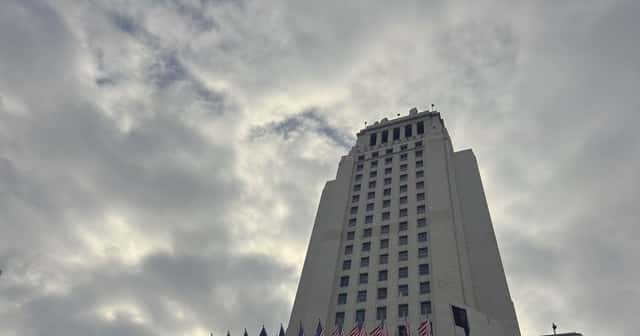
Photo: Los Angeles City Hall, April 2025, by Busition / Wikimedia Commons, CC BY 4.0. Representative civic image; cropped for display.
Differing perspectives
Should Los Angeles add a dedicated sales tax to fund Fire Department capacity?
Each position is summarized as its supporters make it, with equal weight and in alphabetical order. A summary is not an endorsement; the evidence for each is weighed in the story above.
Add dependable emergency-service resources
Who holds it: Fund LA Fire campaign, sponsored by United Firefighters of Los Angeles City
The department needs dependable funding for firefighters, paramedics, equipment and stations so emergency capacity can keep pace with public needs. Supporters argue that a dedicated tax, protected against replacing ordinary city spending, creates a sustained investment rather than another uncertain annual request. Audits and public oversight are intended to keep the money focused on Fire Department functions.
In their words: Fund LA Fire, campaign FAQ ↗
Prioritize fire services within existing resources
Who holds it: Howard Jarvis Taxpayers Association
Fire protection is a core city duty that should be funded through existing resources rather than a further sales-tax increase. Opponents argue that residents already face a substantial tax burden and that officials should identify other budget choices before asking households to pay more. They also question making a new dedicated tax continue without a fixed end date.
In their words: Howard Jarvis Taxpayers Association,2026 guide ↗
READ BEYOND 567POLITICS
Alternate sources & perspectives
Independent coverage and primary evidence to help you compare arguments. A link is not an endorsement; perspective labels describe the linked material.
- primary evidence
FD official ordinance and arguments ↗
Los Angeles City Clerk
Tax purpose and legal safeguards.
- other perspective
Campaign funding and implementation explanation ↗
Fund LA Fire
Supporter claims; modeled service promises not treated as results.
- other perspective
2026 voter guide,FD opposition ↗
Howard Jarvis Taxpayers Association
Direct opposition reasoning; no inference of wider public views.
- independent analysis
FD sales-tax reporting ↗
LAist
Independent background and competing arguments.
Reviewed 2026-11-04. Reviewed November 4, 2026. The analysis uses official ballot materials and the documented positions listed below. The standalone measure files retain proof markings and were cross-checked against the final voter pamphlet. No certified outcome, voter motive or representative polling result is claimed. Forecast effects are distinguished from measured outcomes. The licensed City Hall photograph is an archive illustration, not an image of the election.