New York carriage phaseout puts worker transition promises to the test
The Council-approved bill sets a 2028 cutoff. The next test is a funded, usable transition for workers and humane arrangements for horses.
New York City's horse-carriage debate has moved from whether the Council can assemble a majority to whether the city can deliver a credible transition for workers and horses. The Council approved Romanch's Law on October 22, setting out a phaseout by June 2028 and a process for planning what comes next.
The Council's announcement says the bill passed with 40 votes. That is a major political step, but it does not itself provide every driver with a new job, establish every horse's future home or resolve the threat of a legal challenge.
The distinction is the focus of this report for the New York politics desk. The official legislative record reviewed for this article lists approval by the Council and the mayor's desk for signature, with no enactment date or law number displayed. This report therefore describes the Council-approved bill's terms without asserting a signature that the reviewed record does not establish.
The deadline and the plan are separate commitments
The Introduction 943-A record describes a licensing cutoff on June 1, 2028. Existing licenses would expire on May 31. It also describes a transition plan due by April 1, 2027, covering drivers, owners and other workers, including stable workers.
The plan would include workforce help and consideration of assistance with horses, equipment and compensation. Requiring officials to consider compensation is different from setting a payment amount or guaranteeing that every worker will receive one. That difference helps explain why supporters can describe a transition framework while the union says workers lack concrete protection.
The bill also includes humane-disposition rules. Those rules concern how horses may be transferred or kept after carriage operations end. A legal restriction can set a standard, but the city and owners still need a practical way to meet it. A deadline alone does not arrange transport, veterinary care or a suitable placement.
These are parallel tasks rather than interchangeable promises. A good placement for a horse does not replace a driver's earnings. A job referral does not determine who pays for an animal's care. Public reports should track each task on its own terms so that progress in one area does not obscure a gap in another.
Supporters say regulation cannot remove the underlying risk
The ASPCA supports ending the industry, arguing that modern city conditions create risks that regulation cannot fully remove. It says it is prepared to help with humane placement through rescue partners and other resources if owners need assistance.
The Central Park Conservancy's October 22 statement also supports the phaseout. It presents the issue as a safety conflict in a heavily used park and says that safety will remain a concern during the transition.
Those positions differ in emphasis. The ASPCA focuses on the needs of horses and the limits of regulation in an urban setting. The Conservancy speaks as the park's steward about the interaction of different uses in the same public space. Neither position, by itself, establishes how much money a transition will require.
Support for ending an activity also does not erase the duty to manage it safely while it remains lawful. The city needs a clear account of which rules remain in force, who enforces them and how workers and visitors receive updated information. An announced future ban should not leave a period in which no one knows which standards apply.
A fair review would distinguish documented incidents, findings by investigators and broader arguments about risk. It would not assume that every driver has mistreated a horse. The question of whether an industry should continue is broader than whether any particular worker has violated a rule.
The union says a planning requirement is not economic security
In its October 23 response, TWU Local 100 says the fight is not over and threatens a court challenge. The union argues that the bill leaves workers and owners facing the loss of their livelihoods without firm compensation or a guaranteed path to replacement income.
That is a material objection to implementation, separate from the dispute over safety. A worker can agree that a city should protect visitors and still ask how a government-directed phaseout will affect a household budget. The Council's political majority does not answer that question for the people whose work ends.
The union's claim that the measure is unconstitutional is its legal position. This article does not treat it as a court ruling. A threat to sue also does not establish that a complaint has been filed, an injunction issued or the phaseout suspended. Those steps require their own records.
The practical concerns can be assessed before any final court decision. A workforce plan should state who qualifies for help, how workers can apply, what services are available and how long they last. It should also explain whether owners, employees and stable workers face different rules.
An offer of career counseling is useful only for a limited part of that task. A worker may also need training time, help obtaining a credential or an income bridge while moving into a new job. This report does not claim those benefits have been funded or promised; they are questions the city should answer in a concrete plan.
Counting services is different from measuring a transition
A city report could count appointments, referrals and training sessions and still leave readers unsure whether workers found stable work. Those counts measure activity. They do not establish the quality of the jobs obtained or the time spent without income.
An outcome report would follow placements, wages and retention over a stated period, while protecting personal information. It should separate a job offer from a job started and a short placement from sustained employment. It should also explain how many eligible people did not receive services and why.
Not every worker will want the same next step. Some may seek another job working with animals; others may prefer a different field. The city's role is to provide a usable path under the adopted rules, not to assume that one course or one hiring fair fits everyone.
Business owners face another set of questions about equipment, licenses and costs. A transition program needs to state how those interests are valued if compensation is offered. A general reference to business value leaves unresolved the valuation date, documents required and treatment of debt.
Those questions should be settled through published criteria rather than informal assurances. Clear rules protect both applicants and taxpayers by showing why similar cases receive similar treatment. They also give an applicant a way to challenge an error without relying on political access.
A humane placement needs follow-through
The future of the horses is not just a question of the number of available spaces. A placement must match an animal's needs, identify who is responsible for care and comply with the applicable restrictions. A pledge of help is a starting point, not proof that each arrangement is complete.
Owners who keep their horses would still need a workable plan for care after the work that helped support those costs ends. Owners seeking a new home would need clear guidance about permitted transfers. Officials should avoid presenting those two paths as though they create the same costs and duties.
The ASPCA's willingness to assist is relevant, but it is not a substitute for a public account of the government's own responsibilities. Any partnership should identify its scope, the resources committed and the way unresolved cases will be handled. That record would make it easier to distinguish a funded service from an aspiration.
A public summary can provide useful numbers without exposing private addresses or sensitive details about individual animals. It can show placements completed, cases still open and reasons for delay. The report should state what counts as a completed placement and whether there is later follow-up.
The planning period also needs a contact point that workers can actually use. A published office, a phone number and a way to correct records would help people who lack time to attend repeated meetings. Notices should explain the next deadline in plain language. Those basic steps do not settle the policy dispute, but they can prevent a person from missing help because the process is unclear.
The next milestones should be visible
The immediate record to watch is the bill's final legal status, followed by the transition plan and any appropriations needed to carry it out. A news release about passage should not be used as a substitute for those records. Nor should an announced lawsuit be confused with a judicial order.
Our local politics coverage follows that gap between a legislative decision and its delivery. In this case, the central test is whether the city can attach clear duties, dates and resources to a phaseout that has already won a Council majority.
No representative poll of workers' preferred alternatives or residents' voting motives was reviewed for this article. The views reported here are those of the identified institutions. Our methodology keeps those positions distinct from measured public opinion, and our editorial standards require the same care with legal claims and observed results.
The phaseout debate will not be settled by calling workers obstacles or treating safety advocates as indifferent to livelihoods. The public needs evidence about both the risks that prompted the measure and the support offered to people affected by it. The next plan can make those commitments specific enough to judge.
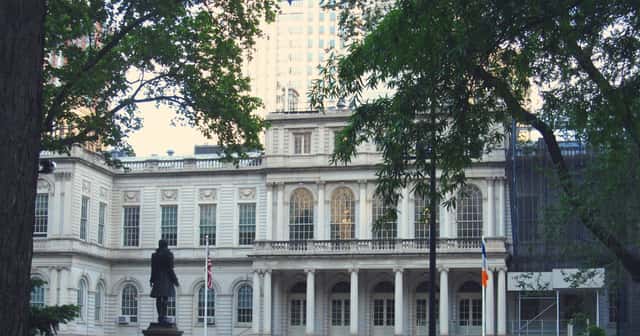
Photo: New York City Hall, May 2012, by Ken Lund, CC BY-SA 2.0, via Wikimedia Commons. Cropped; archival civic image.

Differing perspectives
How should New York balance a carriage phaseout with workers’ livelihoods?
Each position is summarized as its supporters make it, with equal weight and in alphabetical order. A summary is not an endorsement; the evidence for each is weighed in the story above.
End urban carriage operations
Who holds it: ASPCA
The ASPCA supports the phaseout because it sees risks to horses and people as built into carriage operations in a modern city. It argues that regulation cannot fully resolve those conditions and says it is prepared to support humane placement through rescue partners and other resources.
In their words: ASPCA explanation of the carriage ban ↗
Require concrete protection for workers
Who holds it: Transport Workers Union Local 100
TWU Local 100 opposes the bill and threatens a legal challenge. It says the planning framework does not guarantee replacement income or compensation for drivers and owners whose livelihoods would end. The union wants concrete economic protection rather than a requirement to consider future assistance.
In their words: TWU Local 100 October 23 statement ↗
READ BEYOND 567POLITICS
Alternate sources & perspectives
Independent coverage and primary evidence to help you compare arguments. A link is not an endorsement; perspective labels describe the linked material.
- primary evidence
Council's announcement ↗
New York City Council
Official record reviewed; distinguish a proposal, passage and implementation.
- primary evidence
Introduction 943-A record ↗
New York City Council legislative record
Official record reviewed; distinguish a proposal, passage and implementation.
- other perspective
ASPCA supports ending the industry ↗
ASPCA
Source reviewed for attributed position and relevant evidence; not a representative opinion survey.
- other perspective
Central Park Conservancy's October 22 statement ↗
Central Park Conservancy
Source reviewed for attributed position and relevant evidence; not a representative opinion survey.
- other perspective
October 23 response ↗
TWU Local 100
Source reviewed for attributed position and relevant evidence; not a representative opinion survey.
Reviewed 2026-11-04. Sources reviewed November 4, 2026. No interviews, representative opinion poll, independent election call or government-data API pull is claimed. Legislative status and source-specific limitations are stated in body. The City Hall photograph is an archival civic image, with creator, license and crop credit supplied.