Nawrocki blames Tusk at security council as parliament's judges claim a tribunal quorum
Nawrocki vows to use all his powers unless Tusk backs down by Nov. 11. Eight Sejm-elected judges declared a quorum and adopted the court's budget.
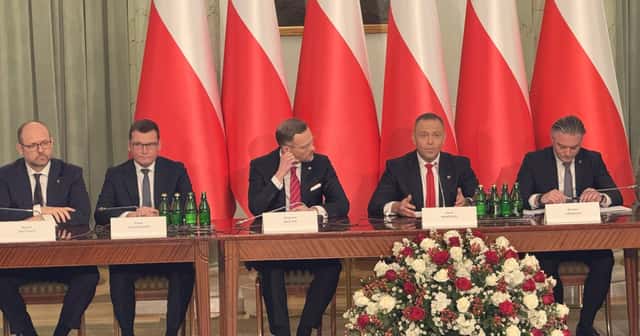
Poland's president used a televised security meeting on Tuesday to blame Prime Minister Donald Tusk for what he called the illegal takeover of the Constitutional Tribunal. At the same time, eight judges elected by the current parliament met as the court's general assembly for the first time since they took control of it. They declared that they had a quorum, adopted the court's 2027 budget and drew lots for disciplinary panels against the two court leaders suspended on Friday.
President Karol Nawrocki said he would use "all the powers available" to him to stop what he described as an attempt to overturn the constitutional order, Polish Radio reported. He told Tusk he expected him to back down before Independence Day on November 11. Tusk said after the meeting that the two men had agreed to talk one-on-one this week. He also said the government's position on the judges had not changed.
This article is current as of about 7:30 p.m. ET on Tuesday, November 3. It follows our earlier reports. Those covered the Friday suspension of the tribunal's president, the European Commission's view that parliament can appoint the court's judges and Monday's resignation of a third Polish ambassador. It covers what changed on Tuesday.
The National Security Council meeting
Nawrocki had called the National Security Council (RBN) before the court crisis broke out. Its agenda covered Poland's overall security, plans for a permanent U.S. military base and, after Friday, the conflict over the tribunal, according to the daily Rzeczpospolita.
The meeting began shortly after 3 p.m. Warsaw time, or 9 a.m. ET, at the Presidential Palace. Those present included Tusk, Sejm Speaker Włodzimierz Czarzasty, Senate Speaker Małgorzata Kidawa-Błońska, Defense Minister Władysław Kosiniak-Kamysz and Foreign Minister Radosław Sikorski. The leaders of the parliamentary groups and the chief of the general staff, Gen. Wiesław Kukuła, also attended, Rzeczpospolita reported.
Only the president's opening statement was public. Tusk was not given a chance to reply while the cameras were on, Politico Europe reported.
Nawrocki said the events of October 30 had no precedent in Poland since 1989. "By a political decision of the government, it was decided to unlawfully take over the Constitutional Tribunal," he said, as quoted by Rzeczpospolita. He said the government had tried to act while he was abroad. He said he cut short a foreign trip and returned to Warsaw as a result.
He said the government had installed "people who consider themselves judges" on the eve of All Saints' Day. He said they were not judges under the law. He added that the first president of the Supreme Court, the president of the Supreme Administrative Court and the head of the Polish Bar Council shared his view.
He then turned to Tusk. He said responsibility for the police outside the court, the suspensions and "unlawful orders" lay with "one man who is present in this room — Prime Minister Donald Tusk," in Politico's translation.
Nawrocki said Poland still had checks and balances. He listed judicial review of laws, independent courts, the presidential veto and the government's accountability to parliament. "The rule of law cannot be restored by methods that themselves blatantly breach the law," he said, according to Polish Radio.
He also tied the dispute to security. He said there is "no external security without internal security," Polish Radio reported. He added that alliances take years to build but credibility "can be lost in one night."
He set a deadline of sorts. "I expect that before [Independence Day], before the start of the week, the prime minister will be ready to rein in the ambitions of his power," he said, as quoted by Rzeczpospolita. He also said he expected an end to what he called the illegal actions of the government's representatives inside the tribunal building.
He did not say which powers he would use. Polish presidents can veto bills, refer laws to the tribunal and decline to appoint officials. He is also weighing whether to veto two government bills easing the abortion law, which Senate committees backed on Tuesday.
Tusk's response
Before the meeting, Tusk had called on the president to change course. "The president has a chance, and I hope he takes it, to stop attacking lawfully elected tribunal judges and allow them to work," he said, according to Politico. He also warned that Russia was exploiting the turmoil and urged politicians not to become "useful idiots."
After the closed session, which lasted nearly five hours, Tusk struck a calmer tone. He said he had wanted the meeting "to help defuse certain emotions" despite the president's words about him, Rzeczpospolita reported.
He said everyone in the room agreed on the seriousness of the threat from Russia. He said Gen. Kukuła's briefing had pointed to signals that Poland should prepare for the fall and winter. He also said the participants agreed that the main centers of power should work together to complete the planned permanent U.S. base.
Tusk said the meeting had not resolved the tribunal dispute. The government still holds, he said, that the judges elected by the Sejm were chosen in line with the constitution and should be allowed to rule. He said the gap between the two sides remains very deep and that a compromise will not be easy.
"This is not about anyone triumphing or anyone humiliating anyone," he said. He said he had proposed a one-on-one meeting with the president this week. He said the press would not be told when or where it takes place, so that the talks could happen without pressure.
The tribunal's general assembly
While the security council met, Judge Anna Korwin-Piotrowska chaired a general assembly of the tribunal's judges. She is the judge who on Friday declared that the court's president, Bogdan Święczkowski, and its vice president, Bartłomiej Sochański, were suspended. She says she is running the court as its longest-serving judge.
Eight judges attended. All eight were elected by the current parliamentary majority this year, Notes from Poland reported. Nawrocki still refuses to swear in five of them, Politico reported. They took their oaths in parliament instead, in a ceremony the president says was null and void. The court's seven other judges were all appointed under the former Law and Justice (PiS) government. None of them attended. Notes from Poland said the meeting was the first general assembly in the tribunal's history to be broadcast live.
Korwin-Piotrowska said every judge had been notified by phone. She said she had been unable to reach one, Stanisław Piotrowicz, after several attempts, and had also sent him two emails, Rzeczpospolita reported.
How the judges counted a quorum
The 2016 law on the tribunal says the general assembly acts by an absolute majority in the presence of two-thirds of the "general number" of the court's judges. The tribunal has 15 seats. Counted against 15, two-thirds would require 10 judges.
Judge Sławomir Patyra argued for a different count. He said the 2015 law had set a fixed quorum of 10, while the current law uses a fraction. He said the law's use of the term "general number," rather than "statutory number," means members who cannot take part for formal legal reasons should be left out.
On that reading, the judges excluded Święczkowski and Sochański because they are suspended. They also excluded Jarosław Wyrembak, whom they regard as holding a seat that was not lawfully filled. That left 12 judges eligible to attend. Two-thirds of 12 is eight. The eight judges then voted, with no one against, that they had a quorum, Rzeczpospolita reported.
Source: Notes from Poland, Rzeczpospolita
Show the numbers
| Group | Judges |
|---|---|
| Attended (elected by current Sejm) | 8 |
| Suspended (Święczkowski, Sochański) | 2 |
| Seat treated as unlawfully filled (Wyrembak) | 1 |
| Other PiS-era judges who did not attend | 4 |
What the assembly decided
With the quorum declared, the judges adopted a draft budget for the tribunal for 2027. Notes from Poland said Święczkowski had been unable to get a budget adopted. The government's side had cited that failure as one argument for removing him.
The judges also drew lots to decide who would sit on disciplinary panels for Święczkowski and Sochański over their suspension, Notes from Poland reported. Rzeczpospolita separately reported that Korwin-Piotrowska revoked the powers of attorney and authorizations of two tribunal staff members.
Doubts about the quorum
Some legal experts questioned whether the meeting was valid. Notes from Poland reported that constitutional scholar Ryszard Piotrowski called it "illegal," according to the news site Onet. It said Przemysław Rosati, president of the Polish Bar Council, also expressed doubts. In a post cited by Notes from Poland, one critic warned that lowering the quorum by suspending judges "opens a Pandora's box," as the critic put it. The argument is that a court president could suspend judges and then take decisions with very few members present.
Supporters of the count point to history. Rzeczpospolita noted in a separate piece that in 2016, Julia Przyłębska was chosen as the court's president with six votes.
Święczkowski rejected the meeting outright. He called it a "social gathering" and called Korwin-Piotrowska a "usurper" with no right to call a general assembly, Notes from Poland reported, citing Polsat News.
The Supreme Court's collegium objects
Also on Tuesday, the collegium of the Supreme Court published a resolution expressing "firm opposition" to what it called actions undermining the constitutional principles of the judiciary, Rzeczpospolita reported.
The collegium said the attempt to remove Święczkowski violates Article 7 of the constitution, which requires public authorities to act on the basis of law. It said the longest-serving judge may lead the tribunal only when both the president and vice president posts are vacant. It said that condition was not met, so the president's powers had been handed to "an unauthorized person."
The collegium called on all public authorities to respect the constitution and to refrain from steps that could deepen the crisis. Rzeczpospolita quoted an expert who said the resolution was "only an opinion" with no binding force.
Many of the Supreme Court's judges were themselves appointed through procedures that the Tusk government and European courts have questioned. That is one reason each side rejects the other's institutions as arbiters.
The government's case
The government argues that the crisis began with Nawrocki. It says he is required to swear in judges elected by parliament and has refused. It says Święczkowski then refused to let those judges take their seats, Notes from Poland reported.
Ministers also argue that the tribunal has not been legitimate for a decade. They say PiS appointed judges unlawfully and brought the court under political influence. Justice Minister Waldemar Żurek told broadcaster TVN on Tuesday that Korwin-Piotrowska's actions were the only way "to rebuild the independence of the tribunal," according to Notes from Poland.
The government's position draws on European rulings. The European Commission has said that parliament can appoint the court's judges, as we reported on Sunday. Politico said Tusk and the Commission insist the court must be overhauled to meet EU standards on impartiality.
Why it matters
The dispute is about more than one court. The tribunal rules on whether laws are constitutional. It can also rule on disputes between state institutions. If two groups of judges each claim to be the lawful court, rulings from either side may be ignored by the other.
The fight also shapes the run-up to the 2027 parliamentary election. Nawrocki, who is aligned with PiS, can block much of the government's program with his veto. The government lacks the three-fifths majority needed to override it. The opposition has also escalated its own rhetoric about Europe. Last week PiS leader Jarosław Kaczyński floated EU exit talks as a pressure tactic, while saying he does not want Poland to leave. Tusk replied that the 2027 vote would be "a prelude to a referendum" on Poland's place in the EU.
Security is the other thread. Both men said on Tuesday that the internal conflict should not weaken Poland's defenses. Both also backed work on a permanent U.S. base. Tusk said Russia could exploit Polish divisions. Nawrocki said there is no external security without internal stability. Each blamed the other for that instability.
What to watch
- whether the one-on-one meeting between Tusk and Nawrocki takes place this week, and what either side says afterward;
- whether Nawrocki acts on his threat to use "all the powers available," and which powers he chooses;
- the president's November 11 Independence Day deadline;
- whether the eight judges begin hearing cases, and whether courts and state bodies treat their rulings as valid;
- the work of the disciplinary panels drawn for Święczkowski and Sochański;
- whether more ambassadors or officials step down.
Key facts
| Item | Detail |
|---|---|
| Date | Tuesday, Nov. 3, 2026 |
| Security council | Called by Nawrocki at the Presidential Palace; closed session lasted nearly five hours |
| Nawrocki's demand | That Tusk halt the tribunal actions before Independence Day, Nov. 11 |
| Tusk's offer | A one-on-one meeting with the president this week, time and place not disclosed |
| Tribunal assembly | 8 of 15 judges attended; all elected by the current Sejm |
| Quorum claim | Two-thirds of 12 eligible judges, or 8; critics say 10 are needed |
| Decisions | 2027 budget adopted; lots drawn for disciplinary panels |
| Supreme Court collegium | Says the suspension of Święczkowski violates Article 7 of the constitution |
For how we handle sourcing and disputed claims, see our methodology.
Differing perspectives
Who is acting lawfully in the fight over Poland's Constitutional Tribunal?
Each position is summarized as its supporters make it, with equal weight and in alphabetical order. A summary is not an endorsement; the evidence for each is weighed in the story above.
Parliament's judges are restoring a captured court
Who holds it: Prime Minister Donald Tusk, Justice Minister Waldemar Żurek and the governing coalition
The government says the crisis began when the president refused to swear in judges parliament elected and the court's president refused to seat them. It argues the tribunal has not been legitimate since PiS appointed judges unlawfully a decade ago. Żurek says the steps taken by Judge Korwin-Piotrowska are the only way to rebuild the court's independence, and Tusk says the president should stop attacking lawfully elected judges and let them work.
In their words: Notes from Poland, quoting Waldemar Żurek and the government ↗
The government is unlawfully seizing the court
Who holds it: President Karol Nawrocki and the Law and Justice (PiS) opposition
Nawrocki says the judges elected by the current parliament are not lawful judges and had no power to suspend the court's president. He blames Prime Minister Donald Tusk personally for the suspensions, the orders issued inside the court and the police deployed outside it. He argues that the rule of law cannot be restored by breaking the law, and says he will use all the powers available to him unless Tusk backs down before November 11.
In their words: Polish Radio, quoting Karol Nawrocki ↗
The suspension and the quorum lack a legal basis
Who holds it: The Supreme Court's collegium, Chief Justice Bogdan Święczkowski and legal critics including Ryszard Piotrowski
The Supreme Court's collegium says the longest-serving judge can lead the tribunal only if both top posts are vacant, so removing Święczkowski violates Article 7 of the constitution. Critics say a two-thirds quorum of the 15-seat court requires 10 judges, not eight, and warn that suspending judges to shrink the quorum would let a handful of members make decisions. Święczkowski calls the assembly a social gathering run by a usurper.
In their words: Rzeczpospolita, quoting the Supreme Court collegium resolution ↗
READ BEYOND 567POLITICS
Alternate sources & perspectives
Independent coverage and primary evidence to help you compare arguments. A link is not an endorsement; perspective labels describe the linked material.
- independent analysis
Clash intensifies between Tusk and Nawrocki over Poland's top court ↗
Politico Europe
English account of the National Security Council clash, Tusk's 'useful idiots' warning and the eight judges' quorum.
- independent analysis
Disputed Polish constitutional court holds first meeting after takeover by government-backed judges ↗
Notes from Poland
Details of the general assembly, the quorum count, legal experts' doubts and Justice Minister Żurek's defense.
- independent analysis
Polish president vows to use 'all powers' in row with PM Tusk over constitutional court ↗
Polish Radio (English Section)
Public broadcaster's English report of Nawrocki's opening statement and his Independence Day deadline.
- primary evidence
Karol Nawrocki do Donalda Tuska: Daję czas do 11 listopada na ograniczenie zapędów ↗
Rzeczpospolita
Polish-language text of long passages of the president's opening statement and the list of attendees.
- primary evidence
Po posiedzeniu RBN. Tusk: Zgodziliśmy się z prezydentem na spotkanie w cztery oczy ↗
Rzeczpospolita
Tusk's press conference after the closed session, including the proposed one-on-one meeting.
- primary evidence
"Jest kworum". Zgromadzenie Ogólne zdecydowało ↗
Rzeczpospolita
Judges' own arguments on the quorum during the broadcast assembly, plus the Supreme Court collegium resolution.
- right argument
Twarde stanowisko prezydenta! To powiedział do Tuska ↗
wPolityce
Conservative outlet sympathetic to the president; carries his statement at length and frames the government's actions as an attack on the court.
- left argument
Starzy sędziowie nie zablokowali Zgromadzenia TK. Przyjęto budżet, Piotrowicz został rzecznikiem ↗
OKO.press
Liberal outlet supportive of the new judges; argues Święczkowski blocked the court's work and budget, and reports that Stanisław Piotrowicz was named disciplinary spokesman in his case.
- independent analysis
Nawrocki uderzył w Tuska. 'Pełną odpowiedzialność ponosi jeden człowiek' ↗
Euronews (Polish)
Separate account of the president's remarks at the security council.
Reviewed 2026-11-03. Automated discovery returned only generic pages about Poland, so these sources were picked by hand from pages opened while reporting, as of about 7:30 p.m. ET on Nov. 3. The president's office had not posted a full transcript of Nawrocki's National Security Council remarks by then, so his words are linked through outlets that published them at length. The Supreme Court collegium resolution is cited through Rzeczpospolita. Right and left arguments come from outlets that openly back one side of the dispute.