D.C. and Virginia join court fight over Trump's 250-foot arch as Nov. 5 construction date nears
Judge Chutkan merged their suit with a veterans' case. The government says a 1925 law authorizes the arch and that it would aid drone defense.
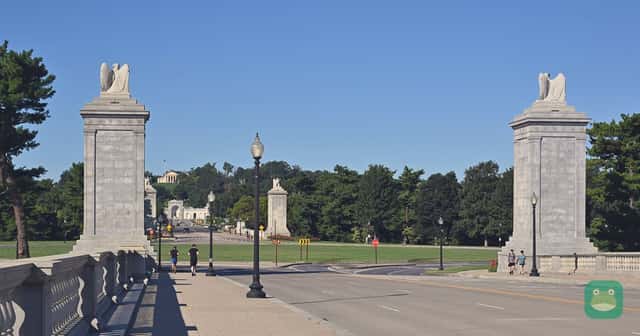
The fight over President Donald Trump's planned triumphal arch at the edge of Washington is now a race against the calendar. The federal government has told a judge that construction at Memorial Circle could begin as early as Thursday, Nov. 5. Three separate lawsuits are trying to stop it first. One of them, filed by the District of Columbia and the Commonwealth of Virginia over the weekend, joins the District and a state to a challenge already brought by veterans and by Arlington County.
The project is a 250-foot arch on Memorial Circle, the traffic circle that links Arlington Memorial Bridge to Arlington National Cemetery. The administration presents it as a tribute to the country's 250th anniversary and a gateway to the cemetery. Opponents say it is unlawful, would block a historic view and would snarl a major commuter route for years.
This story sets out where each case stands, what the government says in defense of the arch, what its opponents argue, and what could happen before and after Thursday.
The timeline to Nov. 5
On Oct. 21, Justice Department lawyers filed a short notice in the veterans' case, Lemmon v. Trump. It said the National Capital Planning Commission is scheduled to consider final plans for the arch on Nov. 5. If the commission approves them and the Interior Department then issues a final decision, the notice said, construction "could commence immediately" once the National Park Service posts that decision online. "NPS may publish such notice as early as November 5, 2026, and construction could commence as early as November 5, 2026," it said.
The planning commission has already approved preliminary plans. Its chairman, Mark Paoletta, wrote in an Oct. 5 essay in The Federalist that he "will vote to approve this project." Paoletta was appointed chairman by Trump in August and also serves as general counsel of the Office of Management and Budget. The Commission of Fine Arts gave its final approval on May 21, according to the District and Virginia complaint.
Three lawsuits, two courts
The veterans' case. Three Vietnam War veterans and an architectural historian sued in February, represented by Public Citizen. The case is before U.S. District Judge Tanya Chutkan in Washington. They argue Congress never authorized an arch on Memorial Circle and that it would obstruct the view between Arlington House and the Lincoln Memorial. Earlier this year, the government agreed to give 14 days' notice before starting construction. The Oct. 21 notice came two weeks before Nov. 5, and the plaintiffs filed a second request for a preliminary injunction the next day.
The District and Virginia case. Virginia Attorney General Jay Jones and D.C. Attorney General Brian Schwalb filed their complaint, dated Oct. 31, against the National Park Service, the Interior Department, Interior Secretary Doug Burgum and Park Service official Jessica Bowron. According to NBC News, the suit was filed Saturday. Chutkan consolidated it with the veterans' case, while letting each set of plaintiffs make its own arguments, WTOP reported. On Sunday she set a briefing schedule on a request for a temporary restraining order, according to the Executive Functions roundup.
The Arlington County case. The County Board of Arlington County sued separately on Oct. 8 in federal court in Alexandria, Virginia. Its complaint focuses on the National Environmental Policy Act. It argues the Park Service should have prepared a full environmental impact statement instead of a shorter environmental assessment.
What the District and Virginia claim
The two governments make five main legal claims.
- No congressional approval. They say the Commemorative Works Act and a separate law, 40 U.S.C. § 8106, require specific approval from Congress before the government builds a monument on federal land in the District. They say no such approval exists.
- The height limit. They cite the Height of Buildings Act, which limits most buildings in the District to 130 feet. The arch "would nearly double that statutory restriction," the complaint says.
- Environmental review. They say the Park Service's assessment compared only two options: building the 250-foot arch or doing nothing.
- Historic preservation. They say the Park Service did not begin required consultation with state historic preservation offices until June 5, almost eight months after the project was announced, and then ended it early.
- Administrative law. They argue the approvals were arbitrary and must be set aside.
The complaint also describes the practical stakes. Citing the Park Service's own revised assessment, it says more than 27,000 vehicles, 1,100 cyclists and 1,200 pedestrians pass through the circle each day. It says construction would run two to three years, up to 20 hours a day, with the south side of the circle closed. It says crews would haul away about 1,400 truckloads of soil. It also raises concerns about runoff into the Potomac, emergency evacuation routes and construction cranes of about 320 feet near the approach to Reagan National Airport.
"Construction of the Arch is flagrantly illegal and will cause serious, immediate, and irreparable harm to the District and its residents," Schwalb said in a statement quoted by NBC News. Jones called the project an "illegal vanity project" and "an affront to this hallowed ground."
The government's case for the arch
The Justice Department's fullest defense so far is its Oct. 28 opposition to the veterans' injunction request. It makes several arguments that are likely to return in the consolidated case.
First, it argues Congress did authorize construction. A 1925 law created the Arlington Memorial Bridge project, including "landscape features" on Columbia Island, where Memorial Circle sits. The original plans called for two tall columns topped by statues at that spot. The government says the law also allowed later design changes, and that new features were added to the bridge project until at least 1951.
Second, it argues the newer statutes do not block the project. It says the Commemorative Works Act "does not apply to commemorative works authorized by a law enacted before January 3, 1985." It argues § 8106 requires approval to build, not approval of a specific design. It also questions whether § 8106 applies to the Park Service at all, noting the agency has built many structures in the District without specific acts of Congress.
Third, it argues the veterans lack standing. It points to the Supreme Court's Aug. 31 order in the White House ballroom case, which stayed an injunction against that project. It says a person's objection to a changed view is not enough to sue.
Fourth, it argues timing. It says at least the first six months of work would be below ground, giving the court time to rule before anything rises into view.
Finally, it argues the public interest favors building. It attaches declarations from Defense Secretary Pete Hegseth and Homeland Security Secretary Markwayne Mullin. The brief quotes Hegseth calling the arch "a generational national defense opportunity" to counter small drones. It quotes Mullin saying the structure would, "when properly equipped," help detect and disrupt unauthorized drones over the capital.
Paoletta's essay makes the historical case in plainer terms. He wrote that "it is a national embarrassment" that a monument was never built on the circle in more than 100 years. He argued the arch's pillars would match the 166-foot height of the original columns. "Washington, D.C. is the only capital of a great nation that lacks a monumental arch," he wrote.
White House spokesperson David Ingle told NBC News the arch "will serve as a gateway to Arlington National Cemetery for veterans, the families of the fallen, and all Americans alike." He did not address a direct question about the lawsuit, NBC reported.
The opponents' answers
The challengers dispute each point. On the 1925 law, the veterans argue the authority expired long ago and never covered an arch, according to the government's summary of their brief. The District and Virginia argue that the Commemorative Works Act and § 8106 still require Congress to act. They also say the planning commission's own general counsel has explained that the arch is subject to the height law.
On national security, the opponents point to a gap in the record. Trump wrote on Truth Social on Sept. 20 that the arch would become a "Military Complex" to "house, store, and have the rapid ability to use large numbers of drones, plus Snipers." But the District and Virginia complaint says the final plans state the project "does not involve hazardous materials." WTOP reported that a 106-page plan the government submitted on Friday does not mention drones or defense.
Arlington County argues the environmental review was finished before the military use was announced. "NPS's determination did not and will not consider the additional harms" of that change, its complaint says.
What the judge has said
At a hearing on Friday, Oct. 30, Chutkan questioned the government's sense of urgency, according to WTOP. She asked how the government would be harmed "apart from the executive's desire to bedazzle the city" if she paused construction while the case proceeds. Government lawyer Robert Stander, a deputy assistant attorney general, called the arch "absolutely a high priority project." He said an injunction would impede government work.
Chutkan noted it was the first time the government had framed the arch as a defense matter, WTOP reported. Stander said he did not have details about the proposed defensive features.
Weighing the arguments
Both sides lean on claims that deserve a closer look.
The government's national security argument and its own plans point in different directions. The final plans say the project "does not involve hazardous materials," while the president described storing "sniper ammunition." The government may be arguing that the current design could host such equipment later. Interior has said the design is "capable of accommodating the national security functions," according to a Washington Post report cited in the District and Virginia complaint. If so, the defense benefit is a future possibility, not part of the approved plan. Courts usually weigh the project actually before them.
The opponents' strongest legal claim may be the height limit, since the 250-foot figure is not in dispute. But it was not part of the veterans' case, and no government response to it was available to 567 Politics. The phrase "vanity project," used by Jones and by Arlington County, describes a motive. It does not by itself show a statute was broken. Likewise, the government's statement that the veterans' complaint "has grown only weaker with time" is advocacy, not evidence.
The 1925 law is the central legal question. If Congress authorized monumental features on Columbia Island and allowed design changes, the government has a real argument that the newer laws do not apply. If that authority lapsed or never covered an arch of this size, the opponents' argument that Congress must act first gets stronger. Neither side's reading has yet been tested by a ruling.
Related projects
The arch is one of several Trump administration projects in Washington's federal parkland now in court. The Supreme Court allowed construction of the White House ballroom to continue in August. A federal judge has also been examining the administration's plans for the East Potomac golf course. More on the president's record is on Donald Trump's profile.
What to watch
- Whether Chutkan issues a temporary restraining order or preliminary injunction before Nov. 5.
- Whether the planning commission approves final plans at its Nov. 5 meeting, and whether Interior issues a final decision the same day.
- Whether any ground is broken before a ruling, and whether an appeal follows quickly.
- How the government answers the height-limit claim, which is new to this litigation.
- Whether the Alexandria court acts on Arlington County's separate environmental claim.
For background on the national political calendar, see our United States elections guide. How 567 Politics handles disputed claims is explained in our methodology.
This article was produced with AI assistance and reviewed against 567 Politics editorial standards. It is based on court filings and reporting available as of late morning Monday, Nov. 2. The government's response to the District and Virginia suit, Chutkan's Sunday order and the Hegseth and Mullin declarations were not obtained. Their descriptions come from the cited reports and the government's Oct. 28 brief. Campaign finance data is not included because 567 Politics has no verified FEC snapshot for Donald Trump's profile, and this story concerns a federal construction project and litigation rather than campaign spending.
Differing perspectives
Does the 250-foot arch need new congressional approval before construction starts?
Each position is summarized as its supporters make it, with equal weight and in alphabetical order. A summary is not an endorsement; the evidence for each is weighed in the story above.
Congress has not approved it
Who holds it: The District of Columbia and Virginia, as plaintiffs in their complaint
The complaint says the Commemorative Works Act and 40 U.S.C. § 8106 "require the federal government to obtain specific congressional authorization before building a monument on federal land in the District; it has obtained none." It adds that the Height of Buildings Act caps "[n]o building" at 130 feet and that the arch "would nearly double" that limit.
In their words: D.C. and Virginia complaint (PDF) ↗
Earlier law already covers it
Who holds it: The Justice Department, for the defendants, in its Oct. 28 filing
The department says the Commemorative Works Act "does not apply to commemorative works authorized by a law enacted before January 3, 1985," and argues a 1925 law covers the site. It says at least six months of work is below ground, leaving time to rule. It also calls the arch "a generational national defense opportunity" against small drones.
In their words: DOJ opposition to preliminary injunction, Lemmon v. Trump (PDF) ↗
READ BEYOND 567POLITICS
Alternate sources & perspectives
Independent coverage and primary evidence to help you compare arguments. A link is not an endorsement; perspective labels describe the linked material.
- primary evidence
Complaint, District of Columbia and Commonwealth of Virginia v. National Park Service (Oct. 31, 2026) ↗
U.S. District Court for D.C. filing (copy hosted by HillHeat)
Sets out the Commemorative Works Act, Height of Buildings Act, NEPA and historic-preservation claims, plus traffic and emergency-response harms drawn from the Park Service's revised assessment.
- primary evidence
Defendants' opposition to plaintiffs' second motion for preliminary injunction, Lemmon v. Trump (Oct. 28, 2026) ↗
U.S. Department of Justice filing (via CourtListener RECAP)
The government's defense: 1925 Arlington Memorial Bridge authorization, Commemorative Works Act exemption, standing under the ballroom stay order, and drone-defense benefits cited from Hegseth and Mullin declarations.
- primary evidence
Notice of NCPC meeting and possible construction start, Lemmon v. Trump (Oct. 21, 2026) ↗
U.S. Department of Justice filing (via CourtListener RECAP)
States that construction could begin as early as Nov. 5 if the planning commission approves final plans.
- primary evidence
Complaint, County Board of Arlington County v. National Park Service (E.D. Va., Oct. 8, 2026) ↗
U.S. District Court for E.D. Va. filing (copy hosted by Democracy Forward)
Arlington County's NEPA challenge seeking a full environmental impact statement before construction.
- right argument
Trump's Triumphal Arch Completes A Longstanding National Aspiration ↗
The Federalist
NCPC chairman Mark Paoletta argues the 1925 law authorizes the arch and that an empty traffic circle fails to honor veterans; says he will vote to approve.
- left argument
Lemmon v. Trump ↗
Public Citizen
Counsel for the veterans explains why they say the arch lacks congressional authorization and would obstruct the Lincoln Memorial–Arlington view, and summarizes the procedural history.
- independent analysis
Virginia and D.C. sue to stop proposed Trump arch ↗
NBC News
Oct. 31 report with statements from attorneys general Jay Jones and Brian Schwalb and White House spokesperson David Ingle.
- independent analysis
As deadline nears, judges weigh bids to stop construction of Trump arch ↗
WTOP
Nov. 2 report on consolidation, Judge Chutkan's Oct. 30 hearing and the government's 106-page plan.
- independent analysis
Executive Functions Roundup: Preparing for Election Day ↗
Executive Functions
Nov. 2 legal roundup noting the consolidation and Chutkan's Sunday briefing order on a temporary restraining order.
Reviewed 2026-11-02. discover_politics_sources returned only general Donald Trump pages, so sources were selected by hand and opened on Nov. 2, 2026. The government's response to the District and Virginia suit, Judge Chutkan's Nov. 1 order and the Hegseth and Mullin declarations were not obtained; the government's Oct. 28 brief quotes the declarations. The AP and Politico reports on the arch hearing timed out or were blocked. The right-of-center case for the arch is represented mainly by the government's own brief and NCPC chairman Mark Paoletta's essay; no other substantive right-leaning analysis of the new lawsuits was found. No federal dataset applies to this litigation story.