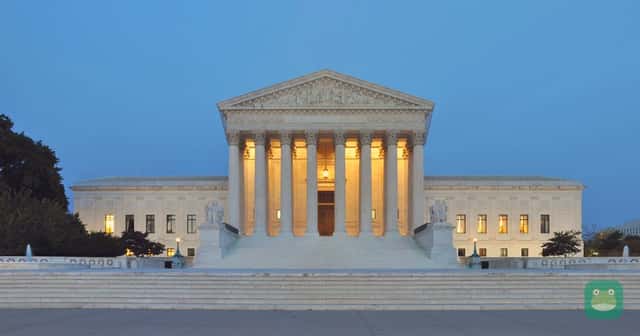
The Justice Department asked the U.S. Supreme Court on Monday, Nov. 2, to order California to set aside mail ballots cast by people on a federal list of more than 20,000 registrants the administration says are likely not U.S. citizens. The request came one day before the midterm election. A federal judge in Los Angeles and a divided appeals court panel had both refused the same relief. If the justices grant it, California and Los Angeles County would have to pull specific ballots out of a live count. By the state's tally, more than 6.4 million ballots had been cast by Sunday.
The filing is the latest step in a month-long dispute over the list. 567 Politics has covered the Ninth Circuit's earlier refusal, the Justice Department's sanctions request against a group that analyzed the list and a San Francisco judge's order on federal threats against election workers.
What the government asked the justices to do
The 19-page application for an injunction pending appeal, signed by Solicitor General D. John Sauer, asks the Court to require California "to segregate mail ballots from persons whom the United States has identified as likely noncitizens" while the government's appeal continues in the Ninth Circuit. It also asks for an immediate "administrative injunction" to the same effect while the justices consider the request. The respondents are the state, Secretary of State Shirley Weber and Los Angeles County Registrar-Recorder Dean Logan, plus several civil-rights groups that intervened. [Funding: campaign funding data not verified]
The application rests on a federal statute, 18 U.S.C. 611, which makes it a crime for a noncitizen to vote in a federal election. Sauer argues that "it follows that any ballot cast by an alien is unlawful" and that a state "may not count such an invalid ballot." He calls the request a "modest remedy," borrowing the dissenting appeals judge's phrase.
The core of the government's urgency argument is timing. "Once California commingles the challenged ballots with lawful ones, there is no way to get the challenged ballots back," the filing says. It notes that California accepts mail ballots postmarked by Election Day through Nov. 10.
According to the application, U.S. Citizenship and Immigration Services checked a publicly accessible version of California's voter roll using Accurint, a commercial platform that can find a person's Social Security number and birth date from a name and address. Investigators then reviewed names by hand, and Homeland Security Investigations did a further review. The government delivered the list to state and county officials on Oct. 13 and sued on Oct. 15.
The application went first to Justice Elena Kagan, who handles emergency matters from the Ninth Circuit, SCOTUSblog reported. She can act alone or refer it to the full Court. She "could ask for a response from California, which would take days," the Los Angeles Times reported. No order had been reported as of Monday afternoon.
What the lower courts decided
Two courts have already ruled against the government on the same request.
On Oct. 28, U.S. District Judge David Carter in Los Angeles denied a temporary restraining order. According to the government's summary, Carter found that the United States lacked standing and a right to sue. He also found it unlikely to win, and said the balance of harms favored the state. Carter also questioned the list itself. "Individuals who have met the requirements of California's voter registration laws must not be deprived of a core right merely because of unfounded allegations stemming from a procedure rife with uncertainty and errors," he wrote, as quoted by CBS News. [Funding: campaign funding data not verified] [Funding: campaign funding data not verified] [Funding: campaign funding data not verified]
On Oct. 30, a Ninth Circuit panel denied an injunction pending appeal by a 2-1 vote. Judges Mark Bennett, a Trump appointee, and Gabriel Sanchez, a Biden appointee, formed the majority. They assumed, without deciding, that the federal government could bring the suit. They then held that the Constitution's Elections Clause lets states run congressional elections unless Congress says otherwise. Nothing in Section 611, they wrote, "prescribes a process California must follow when handling challenged ballots." The majority added: "If the United States believes different procedures are necessary for vote-by-mail ballots, we believe it should take that suggestion to Congress, not the courts."
The majority gave three more reasons. The request could conflict with the National Voter Registration Act's limit on systematic voter-roll removals within 90 days of a federal election. The district court had reasonably found that the government provided "no error rates" or validation for its list. And the Purcell principle, the Supreme Court's caution against court-ordered rule changes close to an election, weighed against relief, given a county technology official's sworn warning about rebuilding systems mid-election.
Judge Patrick Bumatay, also a Trump appointee, dissented. He called the government's proposal "a modest remedy—stopping California from mixing the ballots of citizens and suspected noncitizens." He wrote that it "would not cancel any vote but would allow time to verify the eligibility of suspected noncitizens." He also criticized "California's lax system for verifying citizenship," saying Los Angeles County relies on applicants' attestations. The county said nearly 40% of a sample from the list had been born in the United States, he wrote. But when the federal government ran the same sample through its systems, "it confirmed that none were born here."
How the government answers the courts' reasons
Much of the application is a point-by-point reply to those rulings.
On standing, Sauer argues that the United States suffers an "injury to its sovereignty" when its laws are violated. On the Elections Clause, he argues that Section 611 is itself a law Congress passed, so conflicting state practice must yield. On the voter-registration law, he argues that setting ballots aside is not removing anyone from the rolls.
On Purcell, the application argues the principle protects voters from confusion about "how, when, and where" to vote, so it does not apply to ballots already cast. It quotes Bumatay: commingling decisions "can't possibly cause voter confusion." It also cites Justice Samuel Alito's November 2020 order keeping late-arriving Pennsylvania mail ballots separate. The Ninth Circuit majority called that comparison "inapt," because Pennsylvania's segregation followed the state's own guidance, while the county's system has "no function for setting aside the ballots of designated voters."
On the facts, Sauer argues the district court should have heard the government's witnesses, and that it "did not point to any evidence that any of those individuals is actually a citizen."
What the evidence on the list shows so far
That last claim is contested by material already in the court record and public statements.
According to the California attorney general's office, the Los Angeles County registrar reviewed a sample of 200 names from the list. More than half had canceled or inactive registrations, 38.9% listed a U.S. birthplace and 71.2% had no voting history. A UCLA analysis found that more than 4 in 10 names were not on California's current voter roll, the Los Angeles Times reported. The Justice Department disputes how that analysis was produced.
Two limits apply. A birthplace on a registration record does not by itself prove citizenship, and the government says its checks found no U.S. births in the sample. And no court has yet held an evidentiary hearing on how many listed people are registered, voted or are noncitizens. Judge Carter [Funding: campaign funding data not verified] appointed a technical special master, and Just Security's litigation tracker lists a Nov. 13 district court hearing on motions to dismiss and the government's preliminary-injunction motion. How many ballots are actually at stake is unknown.
The scale of the vote already cast
California mails a ballot to every active registered voter, and counties may process returned ballots before Election Day. The Secretary of State's daily reports show how far that had gone when the application was filed.
type: column
stacked: yes
title: Ballots cast in California's Nov. 3 general election, by method
note: Statewide totals as of each report date. Cast in person covers vote centers and polling places.
source: [California Secretary of State, Oct. 31 report](https://elections.cdn.sos.ca.gov/statewide-elections/2026-general/bsr-statistics-10-31-26.pdf), [Nov. 1 report](https://elections.cdn.sos.ca.gov/statewide-elections/2026-general/bsr-statistics-11-01-26.pdf)
---
Date | Mail ballots returned | Cast in person
Oct. 31 | 5,791,054 | 227,011
Nov. 1 | 6,107,024 | 299,137
By Sunday, Nov. 1, the state's report showed 6,406,161 ballots cast, or 27.32% of 23,451,219 registered voters. Of the 6,107,024 mail ballots returned, 6,050,237 had been accepted. In Los Angeles County, 1,258,142 mail ballots had been returned and 1,394,918 total ballots cast. The report counts ballots received and accepted. It does not show how many have been opened and separated from their envelopes, the step after which the government says a ballot can no longer be traced.
What supporters of the request argue
The administration's case is that federal law bans noncitizen voting. A court, it says, should act before the evidence is lost. Acting Deputy Attorney General Trent McCotter wrote on X that the state "has refused to work with the federal government to protect against non-citizen voting, which dilutes lawful votes," according to the Los Angeles Times. "We will continue pursuing every available legal avenue to protect the integrity of our elections and ensure federal law is enforced," he added.
The application cites a 2018 California DMV error that may have registered as many as 1,500 noncitizens, and a July 2026 Politico report on noncitizens on New Jersey's rolls. It argues that segregation is familiar, noting California's own rule that challenged ballots be resolved "in a segregated area" to avoid mixing.
Some administration claims go beyond the case record. President Trump said last week that "there are hundreds of thousands of bad ballots, bad votes, in California. Millions, in my opinion," according to the Los Angeles Times. The government's own filing alleges about 20,000 likely noncitizen registrants, and no court has found that any specific number of noncitizens voted in this election. Reuters reported that multiple studies and state audits have found ineligible voting, including by noncitizens, to be rare. [Funding: campaign funding data not verified]
What opponents of the request argue
California officials argue that the Constitution gives states and Congress, not the president, control over how elections are run. "This latest move reeks of desperation, and is another attempt to undermine our elections and trample on the rule of law," Attorney General Rob Bonta said Monday, according to Reuters. Gov. Gavin Newsom wrote on X that the administration "sat on this for more than three days" before seeking "'emergency' relief on the eve of the election," the Los Angeles Times reported. [Funding: campaign funding data not verified] [Funding: campaign funding data not verified]
Civil-rights groups that intervened, including the League of United Latin American Citizens and the NAACP, focus on eligible voters who could be swept in by an inaccurate list. After the Oct. 30 ruling, the NAACP's Kristen Clarke said the department "sought to throw out the voices of more than 20,000 Californians without credible evidence," in a statement.
Criticism has also come from the libertarian Cato Institute. "Unless and until Congress provides clear legal guidance to the contrary, the Constitution reserves these decisions to the states," Walter Olson said, according to the Los Angeles Times. He made similar points to Courthouse News. Election-law scholar Rick Hasen of UCLA called the filing a "Hail Mary" on his Election Law Blog. He argued that this kind of order requires a clear showing on the merits. He also said the request comes too late.
Weighing the arguments
Both sides make some claims that the record does not yet settle.
The government's point that a ballot cannot be traced back to a voter once it leaves its envelope is not disputed in the rulings. Its argument that Purcell applies only before votes are cast is a serious position the Supreme Court has not squarely resolved. But it says the district court pointed to no evidence that anyone listed is a citizen. The county's sample review and the UCLA analysis have limits, but they suggest parts of the list are wrong.
Critics who describe the request as canceling 20,000 votes overstate what was asked: the application seeks to set ballots aside, not reject them. Whether a delay would amount to disenfranchisement depends on how fast verification could happen, which the record does not show.
The justices would have to decide whether Section 611, a criminal law aimed at individual voters, lets the federal government direct how a state handles ballots. They would also have to say how Purcell applies after voting has begun. The Court separately hears RNC v. Mi Familia Vota, on the voter-registration law's 90-day rule, on Dec. 8.
Pending decisions and hearings
- Whether Justice Kagan calls for a response from California and sets a deadline, rules alone or refers the application to the full Court.
- Whether the Court acts before Tuesday, or before California's Nov. 10 deadline for receiving mail ballots postmarked by Election Day.
- The Nov. 13 district court hearing, with witness lists due Nov. 6.
- Rulings in parallel cases, including the Justice Department's appeal in the Alaska Senate certification suit.
California's statewide races and House contests are listed in our United States elections guide, and Secretary of State Shirley Weber's profile [Funding: campaign funding data not verified] covers the official named as a respondent. How 567 Politics handles contested claims is explained in our methodology.
This article was produced with AI assistance and reviewed against 567 Politics editorial standards. It is based on the government's Nov. 2 application, the Ninth Circuit's Oct. 30 order, California Secretary of State ballot reports and reporting available as of mid-afternoon Monday, Nov. 2. Judge Carter [Funding: campaign funding data not verified]'s order and California's filings were not obtained and are described through cited reports and the appeals court's order. McCotter's and Newsom's posts were not opened directly; their wording is as reported by the Los Angeles Times. Campaign finance data is not included because this story is about a court fight over election rules, not a campaign. Bonta, Newsom and Weber [Funding: campaign funding data not verified] are state officials who report campaign money to California, not the FEC.