Germany wants to tie Deutsche Bahn bonuses to 71 targets after auditors fault rail rebuilds
Transport Minister Steffen Bilger plans penalties and bonus cuts for the rail network firm after auditors said costly line rebuilds were poorly justified.
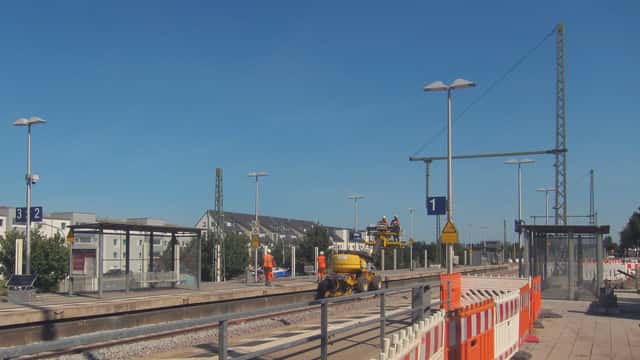
Germany's transport minister wants to hold Deutsche Bahn to 71 measurable targets in exchange for €80 billion of public money over five years. Steffen Bilger, a Christian Democrat (CDU), plans to present a new performance agreement with DB InfraGO, the state railway's network and stations subsidiary, on Wednesday, November 18. According to a report in the tabloid Bild on Monday, missed targets could bring penalty payments and smaller bonuses for InfraGO's managers. The plan lands three weeks after Germany's federal audit court told parliament that the railway's flagship line renovations show "serious" problems and that the ministry had given lawmakers too rosy a picture of them.
"Whoever receives billions in taxpayers' money must also deliver," Bilger told Bild, according to Handelsblatt's account of the report. With the agreement, he said, the government was taking back "the reins" (in German, "das Heft des Handelns"). The draft still needs the approval of the Bundestag's budget committee and of Deutsche Bahn's supervisory board. The new rules are meant to apply from January 1, 2027.
What the draft agreement would require#
The agreement is known in Germany as the LV InfraGO, short for "Leistungs- und Finanzierungsvereinbarung", or performance and financing agreement. It is meant to succeed the current funding agreement for the existing network, known as LuFV III. Bild did not publish the document. The details below come from its report as carried by Handelsblatt, WirtschaftsWoche and the rail news site Bahnblogstelle. The ministry has not yet released the text.
By the end of 2031, InfraGO would have to:
- renovate 500 stations
- renew nearly 7,300 sets of switches
- repair almost 7,600 kilometers of track
- renew more than 2,000 kilometers of overhead power lines
- rebuild 13 major lines with a combined length of more than 1,200 kilometers
Progress would be checked against 71 key figures. Forty measure performance, 20 cover reporting duties and 11 cover finances.
Source: Handelsblatt, November 16, 2026, Bahnblogstelle, November 16, 2026
Show the numbers
| Category | Key figures |
|---|---|
| Performance | 40 |
| Reporting | 20 |
| Finances | 11 |
If InfraGO looks set to miss a target, it would have to correct course in time. The ministry could then set stricter rules. If that still did not work, penalty payments could follow, the reports said. The ministry would also get direct access to key InfraGO data and could carry out checks without a specific reason.
The bonuses of InfraGO's board would be tied to the targets. Handelsblatt reported that the board received a total of €769,000 in performance-related pay in 2025. How much a missed target would cut a bonus has not been decided, according to the reports.
Why bonuses became a political issue#
Bilger first raised the idea soon after taking office. He gave an interview to Bild am Sonntag in August. "It will have a concrete effect on the bonus payments of rail managers if the targets set by the federal government are not met," he said, tagesschau reported. He added that the agreed goal for long-distance punctuality was 70 percent by 2029. About 60 percent of long-distance trains were on time in the first half of 2026, he said.
The idea was not new. Bilger's CDU predecessor, Patrick Schnieder, had announced in a strategy paper that variable pay for managers should be tied more closely to the railway's goals, tagesschau noted. Long-distance punctuality was already one test for board bonuses. Research by the ZDF program frontal, cited by tagesschau, found that the bar was low. First bonus payments would flow at 65 percent punctuality, and the target counted as fully met at 67.5 percent. Because only about 60 percent of long-distance trains were on time in 2025, no money was paid on that measure, the report said.
Source: tagesschau, August 9, 2026, citing ZDF frontal, tagesschau, August 9, 2026
Show the numbers
| Level | Punctuality |
|---|---|
| 2025 actual (about) | 60% |
| First bonus paid | 65% |
| Target fully met | 67.5% |
| 150% of bonus paid | 70% |
| Agreed goal for 2029 | 70% |
At the time, the plan drew support across party lines. Isabell Cademartori, the Social Democrats' (SPD) lead member on the Bundestag's transport committee, told Tagesspiegel she "expressly" welcomed it. Julia Verlinden, a deputy leader of the Green parliamentary group, backed it in principle. She said the main cause of delays was that the federal government had invested "far too little money" in rail for decades.
What the audit court found#
The new agreement is meant to answer a wider question: how closely the federal government, which owns Deutsche Bahn, steers the money it puts into the network. That is where the Bundesrechnungshof, Germany's federal audit court, has been pressing.
On October 26, the court sent the Bundestag's budget committee a report on the "corridor renovations". These are full rebuilds of the busiest stretches of the network, usually under complete closure, instead of piecemeal repairs while trains keep running. Deutsche Bahn and the ministry announced the program in June 2022. InfraGO has been carrying it out since 2024 and plans 41 such projects. The court said the federal government is likely to pay a sum in the three-digit billions of euros for them.
The court said the first four finished projects showed "serious undesirable developments." Its main findings:
- Costs on the Riedbahn between Frankfurt and Mannheim tripled, from €0.5 billion to €1.5 billion. On the Hamburg–Berlin line they rose from €2.2 billion to €2.7 billion.
- The railway cut its promised period without new construction work after each project from ten years to five. The court said it is already failing to keep even five years because of follow-up work and repairs.
- Nearly two years after the Riedbahn reopened, faults caused by infrastructure had fallen by only 60 percent. The target was 80 percent.
- After the Hamburg–Berlin line was finished, only one train in four was on time for weeks.
- InfraGO sometimes cut the scope of work sharply to keep to planned costs and closure times.
Source: Bundesrechnungshof, report to the Bundestag budget committee, October 26, 2026
Show the numbers
| Corridor | Original cost | Latest cost |
|---|---|---|
| Riedbahn (Frankfurt–Mannheim) | 0.5bn € | 1.5bn € |
| Hamburg–Berlin | 2.2bn € | 2.7bn € |
The court's main charge concerns the economic studies used to justify the projects. It said InfraGO's studies for eight corridors remain "not reliable." They assumed an 80 percent fall in faults and up to ten years free of construction. They did not account for risks. In one case, Troisdorf–Wiesbaden, the study found an advantage of just €0.2 million for a full corridor renovation over conventional repairs.
The court also objected to a shortcut. Early in 2026 the ministry produced a single, overall study for all corridor projects planned from 2028. Separate studies for each project would no longer be needed. The court called this "not acceptable." It said the corridors are hardly comparable and each one costs billions.
Finally, the court said the ministry's quarterly reports to the budget committee gave the impression that the economic case was sound and reliable. "That is not the case," the report said. As a result, the committee lacked key information to exercise its "parliamentary responsibility for budget and oversight."
The court recommended that the budget committee ask the ministry to:
- revise the economic studies using actual developments
- carry out proper success checks for each corridor
- drop the overall study and prove the economic case for each project separately
- inform the committee accurately in future
- June 2022Deutsche Bahn and the ministry announce full rebuilds of the busiest corridors
- InfraGO begins the first corridor renovation, on the Riedbahn
- June 2025The audit court calls the Riedbahn concept not viable
- May 2026The ministry reviews its strategy and finds serious problems itself
- August 2026Bilger says missed targets will hit managers' bonuses
- October 26, 2026The audit court reports to the budget committee
- November 16, 2026Bild reports the 71 key figures
- November 18, 2026Bilger to present the draft agreement
- January 1, 2027Planned start of the new rules
Source: Bundesrechnungshof report, October 26, 2026, tagesschau, August 9, 2026, Handelsblatt, November 16, 2026
How the ministry and the railway responded#
The court summarized the ministry's reply in its report. The ministry said economic studies are bound to rest on assumptions. It confirmed that the studies had deficits. To deal with them, it said, it had applied flat deductions, corrections "on the safe side" and sensitivity checks. It said it wanted to write binding rules into the new LV InfraGO. It also said it would keep the overall study, arguing that it saves effort and federal money. Separate studies would still be possible where there were major differences.
The court said this reply did not refute its findings. "Future rules in the LV InfraGO cannot retroactively fix flawed foundations," it wrote.
Source: Bundesrechnungshof, report to the Bundestag budget committee, October 26, 2026
Show the numbers
| Measure | Fault reduction |
|---|---|
| Target | 80% |
| Result so far | 60% |
Deutsche Bahn, according to a dpa report carried by Handelsblatt, pointed to projects that came in cheaper than planned, such as Nuremberg–Regensburg and Hagen–Wuppertal–Cologne. It said its promise still stands: build once, modernize thoroughly, and then keep the line largely free of major construction for up to ten years where possible. It said compliance would be ensured more strictly in future, but that more realism was also needed.
Bilger has himself said that the program needs fixing. "The so-called corridor renovations are basically a good idea," he told WirtschaftsWoche in an interview published by his ministry in October. "Unfortunately, the railway has too often not kept this promise." There would be fewer corridor renovations, he said. Lines would only fully reopen once everything worked. He called the performance agreement "a paradigm shift." "We have so far steered the railway too little despite huge investments," he said.
On Monday, audit court president Ansgar Heveling also spoke out. He told the Rheinische Post that the court sees "deficits in the approach to planning projects," for example in corridor renovation, tagesschau reported. He urged the federal government, as owner, to control the railway more tightly. "Our finding is: the federal government has even more ways to steer the railway more closely," he said.
Where the opposition, unions and rail groups stand#
The Greens have attacked the corridor record. Paula Piechotta, a Green member of the budget committee, responded to the court's report, according to dpa. "Spiraling costs, longer closures, reduced scope of renovation – that is the miserable record of the corridor renovations so far," she said. "The railway has completely used up the trust it was given for the corridor renovations."
Rail unions and industry groups support measurable targets, but they say secure long-term funding is just as important. The rail union EVG said in a statement in October that the LV InfraGO must not become "another bureaucracy monster." It said the agreement should be a practical steering tool. Its chairman, Martin Burkert, said plans must now be followed by "binding financial commitments."
Source: Handelsblatt, November 16, 2026, Bahnblogstelle, November 16, 2026
Show the numbers
| Item | Kilometers |
|---|---|
| Track repaired (almost) | 7,600km |
| Overhead power lines renewed (more than) | 2,000km |
| 13 major lines rebuilt (more than, combined) | 1,200km |
The Allianz pro Schiene, a nonprofit alliance that promotes rail, has long asked the government to set "legally binding central key figures" for InfraGO and to involve the Bundestag. Its managing director, Dirk Flege, said that in a 2023 position paper signed by eight associations. On November 4, the group praised Bilger for presenting the first "Infraplan," a rolling five-year plan for rail projects that the ministry released on October 6. But Flege said the government still needs a multi-year rail fund to make the plan reliable. He also urged Bilger to set a target year for finishing all 41 corridors.
Money remains tight. The budget committee finished its work on the 2027 federal budget last week. The Allianz pro Schiene said on November 13 that programs for rail freight would be cut by 12 percent compared with 2026. The ministry is also seeking new ways to fund roads, including borrowing by the motorway company.
The approval steps and the open questions#
- DraftTransport Minister Bilger presents the LV InfraGO on November 18
- Budget committeeThe Bundestag committee must approve it
- Supervisory boardDeutsche Bahn's board must approve it
- StartThe rules are meant to apply from January 1, 2027
- ChecksThe ministry monitors 71 key figures until the end of 2031
Source: Handelsblatt, November 16, 2026, WirtschaftsWoche, November 16, 2026
Bilger is expected to give details of the targets, the penalties and the bonus rules on Wednesday. The budget committee must then decide whether to approve it. The audit court has asked the committee to demand better information from the ministry on the corridor renovations. The governing coalition of the CDU, the CSU and the SPD, led by Chancellor Friedrich Merz, holds a majority in the Bundestag. The Greens are in opposition.
The text of the agreement will show whether the 71 figures include the measures the audit court asked for, such as proof of the economic case for each corridor. It will also show how hard any penalties would bite. For more on the minister, see Steffen Bilger's profile.
Differing perspectives
How should the federal government control the billions it spends on Deutsche Bahn's rail network?
Each position is summarized as its supporters make it, with equal weight and in alphabetical order. A summary is not an endorsement; the evidence for each is weighed in the story above.
Bind the money to targets and sanctions
Who holds it: Transport Minister Steffen Bilger (CDU) and the Federal Ministry of Transport
Bilger argues that the federal government has steered the railway too little despite huge investments, and calls the new performance agreement a paradigm shift. As owner, he says, the government will check Deutsche Bahn continuously, analyze progress with its management and change course where needed. If the railway breaks the agreement, sanctions up to penalty payments can follow. He says the railway too often failed to keep its promises on corridor renovations, so there will be fewer of them and lines will only fully reopen once everything works.
In their words: Federal Ministry of Transport (Bilger interview with WirtschaftsWoche) ↗
Prove the economic case for every project
Who holds it: The Bundesrechnungshof, Germany's federal audit court
The audit court argues that the corridor renovations show serious problems: costs rose sharply, promised benefits did not arrive and the economic studies behind them are not reliable. It says the ministry's single overall study cannot replace a separate study for each corridor, because each costs billions and the corridors are hardly comparable. It wants the studies revised with real data, proper success checks for each project and accurate reports to the budget committee, so parliament does not decide on incomplete or wrong information.
In their words: Bundesrechnungshof ↗
Targets need secure funding and little red tape
Who holds it: The rail union EVG and its chairman Martin Burkert
The EVG argues that a five-year rail plan and measurable key figures can bring more transparency and better planning, but only if binding financial commitments follow. It says the new performance agreement must not become another bureaucracy monster and should be a steering tool that works in practice. It wants the rail infrastructure fund promised in the coalition agreement set up and linked to the plan, and a deeper reform of track access charges so rail operators are not squeezed by rising fees.
In their words: EVG (Eisenbahn- und Verkehrsgewerkschaft) ↗
The railway has used up its credit
Who holds it: Paula Piechotta, Green member of the Bundestag budget committee
Green budget politician Paula Piechotta argues that the corridor renovations so far have a poor record: spiraling costs, longer closures and a reduced scope of work. She says the railway's promises to fix the mistakes of earlier renovations have not been kept, and that it has completely used up the trust it was given for the program. She made the case after the federal audit court reported serious problems with the renovations to the budget committee, on which she sits.
In their words: dpa via Handelsblatt ↗
Cite this article
567 Politics staff. “Germany wants to tie Deutsche Bahn bonuses to 71 targets after auditors fault rail rebuilds.” 567politics. Published 2026-11-16. https://567politics.com/news/germany-bilger-deutsche-bahn-infrago-71-targets-bonuses-audit-court-corridor-renovations-november-2026
Wikipedia citation
{{cite news |title=Germany wants to tie Deutsche Bahn bonuses to 71 targets after auditors fault rail rebuilds |url=https://567politics.com/news/germany-bilger-deutsche-bahn-infrago-71-targets-bonuses-audit-court-corridor-renovations-november-2026 |work=567politics |author=567 Politics staff |date=2026-11-16 |language=en}}CSL-JSON for reference managers
{
  "id": "https://567politics.com/news/germany-bilger-deutsche-bahn-infrago-71-targets-bonuses-audit-court-corridor-renovations-november-2026",
  "type": "article-newspaper",
  "title": "Germany wants to tie Deutsche Bahn bonuses to 71 targets after auditors fault rail rebuilds",
  "URL": "https://567politics.com/news/germany-bilger-deutsche-bahn-infrago-71-targets-bonuses-audit-court-corridor-renovations-november-2026",
  "container-title": "567politics",
  "language": "en",
  "author": [
    {
      "literal": "567 Politics staff"
    }
  ],
  "issued": {
    "date-parts": [
      [
        2026,
        11,
        16
      ]
    ]
  }
}Citations identify this article and its publication date. Assess the reporting and its linked sources before using it as evidence.
Read this article as Markdown or JSON. Cite the original page and retain its sources, dates and qualifications.
Embed this article summary
Paste this HTML into your page. The summary stays linked to the full story and updates with it. No account required.
<iframe src="https://567politics.com/embed/news/germany-bilger-deutsche-bahn-infrago-71-targets-bonuses-audit-court-corridor-renovations-november-2026?theme=auto" title="Germany wants to tie Deutsche Bahn bonuses to 71 targets after auditors fault rail rebuilds by 567politics" width="100%" height="440" style="border:0;max-width:100%" loading="lazy"></iframe>
<p style="font-size:14px">Germany wants to tie Deutsche Bahn bonuses to 71 targets after auditors fault rail rebuilds by <a href="https://567politics.com/news/germany-bilger-deutsche-bahn-infrago-71-targets-bonuses-audit-court-corridor-renovations-november-2026" rel="nofollow">567politics</a></p>
<script async src="https://567politics.com/embed.js"></script>
READ BEYOND 567POLITICS
Alternate sources & perspectives
Independent coverage and primary evidence to help you compare arguments. A link is not an endorsement; perspective labels describe the linked material.
- primary evidence
Korridorsanierung von Schienenwegen des Bundes: report to the Bundestag budget committee (German) ↗
Bundesrechnungshof
The audit court's October 26 report: cost overruns, the 60% fault reduction on the Riedbahn, flawed economic studies, the ministry's reply and the court's recommendations.
- primary evidence
Interview: Bilger with WirtschaftsWoche on the railway and the performance agreement (German) ↗
Federal Ministry of Transport
Bilger in his own words: the agreement as a 'paradigm shift', sanctions up to penalty payments and fewer corridor renovations.
- primary evidence
Bund legt mit Infraplan 2026 neuen Rahmen für die Entwicklung der Schieneninfrastruktur vor (German) ↗
Federal Ministry of Transport
The ministry's October 6 release on the first five-year Infraplan, with statements from the ministry and DB InfraGO.
- independent analysis
Verkehrsminister Bilger will die Bahn an 71 Kennzahlen messen (German) ↗
Handelsblatt
Account of Bild's November 16 report: 71 key figures, 2031 targets, penalties, data access and the €769,000 board bonus figure.
- independent analysis
Bund will Boni von Bahn-Managern an Zielvorgaben knüpfen (German) ↗
WirtschaftsWoche / dpa
Wire report on the draft agreement, Bilger's 'Heft des Handelns' quote and the November 18 presentation.
- independent analysis
Milliarden für die Bahn: Bund knüpft Boni an 71-Punkte-Plan (German) ↗
Bahnblogstelle
Rail news site's summary of the draft agreement's targets, approval steps and January 2027 start.
- independent analysis
Bundesrechnungshof beklagt Planungsmängel bei der Deutschen Bahn (German) ↗
tagesschau
Audit court president Ansgar Heveling's November 16 comments to the Rheinische Post on tighter federal steering of the railway.
- independent analysis
Rechnungshof sieht Fehlentwicklungen bei Bahn-Sanierungen (German) ↗
Handelsblatt / dpa
Wire report on the audit court's findings, with Deutsche Bahn's response and Green MP Paula Piechotta's criticism.
- independent analysis
Bilger will Boni bei der Bahn mehr an Ziele knüpfen - und bekommt Zuspruch (German) ↗
tagesschau
August reactions from the SPD, Greens, Thuringia and Pro Bahn, and ZDF frontal's research on bonus thresholds.
- other perspective
Erster Infraplan vorgestellt: EVG fordert verbindliche Finanzierung für die Schiene (German) ↗
EVG rail union
The union's warning that the LV InfraGO must not become a 'bureaucracy monster' and its call for binding funding.
- other perspective
100 Tage Bundesverkehrsminister Bilger: Was noch zu tun bleibt (German) ↗
Allianz pro Schiene
The rail alliance's November 4 assessment: praise for the Infraplan, calls for a rail fund and a target year for all 41 corridors.
- other perspective
Gemeinwohlorientierte Infrastruktur: Branche fordert vom Bund klare Ziele (German) ↗
Allianz pro Schiene and seven other associations
The 2023 position paper by eight rail associations asking for legally binding key figures for InfraGO set with the Bundestag.
Reviewed 2026-11-16. Hand-picked on 2026-11-16 for the draft DB InfraGO performance agreement and the audit court's corridor renovation report; each link was opened and read. Bild's original report was not used directly; its details are taken from outlets that carried it. The agreement text itself has not been published. German-language sources are labeled.