Schwesig wins a third term with exactly her coalition's 39 votes, and keeps the SPD guessing
Mecklenburg-Vorpommern's premier now leads a three-party government facing an AfD opposition with almost half the seats, and still won't say if she wants the SPD's top job.
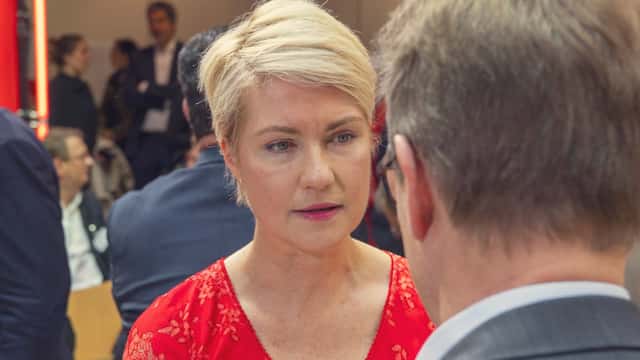
Manuela Schwesig won a third term as minister-president of Mecklenburg-Vorpommern on Monday with exactly as many votes as her new coalition holds. In a secret ballot in the state parliament in Schwerin, 39 members voted for the Social Democrat and 29 voted against her, according to NDR's live report from the chamber. All 68 votes cast were valid. She was the only candidate and needed one round.
The result settles who governs the northeastern state after an election that the Alternative for Germany (AfD) won. It does not settle the question that many in her party care about more: whether Schwesig will also run to lead the national Social Democratic Party (SPD) in January. She has not ruled it out, and on Monday she again declined to say.
Quotations from German-language sources in this article are 567politics translations.
How the vote went#
The 39 yes votes match the seats of the governing alliance of the SPD (29), the Left (5) and the Greens (5) in the 71-seat parliament, NDR reported. The 29 no votes match the number of AfD members present, tagesschau reported. The AfD holds 32 seats, but three of its members were absent because of illness, according to NDR. Because the ballot was secret, the match between seats and votes is an inference from the totals, not a record of how each member voted.
The session opened at 1 p.m. local time with the vote, as the published agenda set out, and parliament president Birgit Hesse (SPD) ran the ballot. After the count, Schwesig took the oath of office, ending with the words "So help me God." NDR reported that AfD group leader Enrico Schult congratulated her on her election.
Schwesig, 52, has led the state since July 2017. She first took office in the middle of a term, when her predecessor Erwin Sellering stepped down because of illness, and she gave up her post as federal family minister to do so. She was re-elected after the 2021 election and now begins a third term.
A three-party government facing one large opposition party#
The new government is the first three-party coalition in the state's history and the first in which the Greens take part, according to tagesschau. The three parties approved their coalition agreement at separate conventions over the weekend. The Left voted unanimously; the Greens approved it with one abstention, the state Greens said.
The arithmetic behind the alliance comes from the September 20 election. The AfD won 38.2% of the vote and 32 seats; the SPD won 35.5% and 29 seats; the Left and the Greens each won five seats, according to the final official result. The Christian Democrats (CDU), with 4.9%, and the Free Democrats (FDP), with 1.0%, fell below the 5% threshold and left parliament. That makes the AfD the only opposition party, with almost half the seats. Our earlier report covered how the SPD, the Left and the Greens built their 39-seat agreement and what it promises.
The size of that opposition gives the AfD powers of its own. With more than a quarter of the seats, it can force the creation of a parliamentary inquiry. It used Monday's session to table a motion for an inquiry into the state government's handling of the coronavirus pandemic, NDR reported. SPD group leader Julian Barlen said his group would examine the motion "with a view to the constitutional requirements." He said a review of the pandemic years was needed, but "not a tribunal."
The chart below compares each governing party's share of the coalition's seats with its share of cabinet posts. The SPD, with nearly three-quarters of the coalition's seats, holds two-thirds of the ministries. The Left gets a larger share of the cabinet than of the seats; the Greens get a smaller one.
Source: Landtag Mecklenburg-Vorpommern, NDR
Show the numbers
| Party | Share of coalition seats | Share of ministries |
|---|---|---|
| SPD | 74% | 67% |
| Left | 13% | 22% |
| Greens | 13% | 11% |
A bigger cabinet in a state that says it must save#
Schwesig's new cabinet has nine ministers, one more than before, NDR reported. The SPD keeps six posts, the Left two and the Greens one. The extra post comes from upgrading the head of the state chancellery to a full minister. Heiko Geue (SPD), until now finance minister, takes that job along with digital, European and federal affairs. His state secretary Carola Voß becomes finance minister.
Several familiar names stay. Till Backhaus (SPD) remains agriculture minister for a sixth term, Christian Pegel (SPD) stays at the interior ministry, and the non-party Wolfgang Blank stays at economics and adds science. Stefanie Drese (SPD) moves from social affairs to education. For the Left, Kerstin Mieth takes over a ministry for labor, health and social affairs, and Rostock lawyer Michael Noetzel becomes justice minister. The Greens' Claudia Müller takes a combined ministry for climate, environment, energy and transport. The average age in the cabinet rises from 52 to 56, according to NDR.
After the premier's vote, the session paused while the ministers received their certificates of appointment at the state chancellery; they were due to take their oaths in parliament later on Monday afternoon. Parliament was then scheduled to elect the state's 13 delegates to the Federal Convention, which will choose Germany's next federal president on January 30, 2027. NDR reported that the three AfD absences could produce a tie between the SPD and the AfD for one of those seats under the d'Hondt method, in which case lots would decide. That would not be expected to change the outcome of the presidential vote, the broadcaster said. The race is tracked on our next German president page.
The coalition has said it wants to save money in the state administration rather than at citizens' expense. Its plan cuts 1,000 posts in the state administration by 2031 and raises civil servants' working week to 41 hours, NDR reported. The coalition agreement says the longer week is needed to pay for constitutionally required salary adjustments for civil servants, and that part-time requests for 40 hours will be approved.
What the parties say#
The SPD's parliamentary group framed the vote as a mandate for continuity. "Manuela Schwesig is exactly the right person for Mecklenburg-Vorpommern," Barlen said in a statement after the vote. The group listed what it counts as her record: free daycare, public contracts tied to collective wage agreements, a voting age of 16, the rescue of the state's shipyards and steady growth in jobs and wages.
The AfD argues that the coalition is not saving where it could. When the cabinet was announced last week, Schult said the alliance had passed up a chance to "start with its own government" and had sacrificed savings to "coalition proportionality." The AfD wants one ministry fewer. On Monday Schult also criticized the choice of Drese for education, citing figures that 10.3% of school leavers in 2026, or 1,520 young people, left without a basic vocational school certificate. He said Drese had been part of the government for ten years and did not represent a new start. Looking at the coalition agreement, he said: "It will be five hard years for Mecklenburg-Vorpommern," NDR reported.
The Left, which has governed with the SPD since 2021, is warning about money from inside the coalition. Its new state leader, Hennis Herbst, told his party's convention that not everything could be done at once and that the state must not be "cut to pieces" by savings, NDR reported. His answer is to loosen the constitutional debt brake and bring back a wealth tax. The coalition agreement commits the state to push for a wealth tax at the federal level, though only federal legislation could bring one back. At least one Left delegate told the convention the longer working week for civil servants was unacceptable.
The Greens stress what they won. Their lead negotiator Müller said the agreement leaves "clear green traces," including climate checks on government projects and an exemption from grid fees for households close to wind turbines or solar parks, according to the party. State chair Ole Krüger pointed to a €1,000 interest-free loan for apprentices, an idea from the party's youth wing.
The parties' positions on the national spectrum, as estimated by 567politics editors, are shown below. The placements are dated editorial estimates, not measured scores.
The question Schwesig did not answer#
The re-election comes as the national SPD searches for new leaders. Bärbel Bas resigned as co-leader in mid-October, and the party will elect its full leadership at a convention in Bremen on January 16 and 17. Former labor minister Hubertus Heil became the first official candidate on November 14 and argues that the party chair should not also hold a government post, tagesschau reported. That would rule out the current arrangement, in which co-leader Lars Klingbeil is also finance minister and vice chancellor. Klingbeil has not said whether he will run again. Parliamentary group leader Matthias Miersch, Environment Minister Carsten Schneider, Justice Minister Stefanie Hubig and Construction Minister Verena Hubertz have spoken up for him, according to tagesschau.
Schwesig is widely discussed as a possible co-leader. Saarland's premier Anke Rehlinger, Defense Minister Boris Pistorius and Miersch have ruled themselves out; Schwesig has not. Asked about Heil's bid, she declined to comment, NDR reported. Through a spokeswoman she said the SPD should take its time to find the best leadership team and that talks would run until December 16. That is the date by which the party executive plans to present its proposal. An expanded meeting of the party presidium on November 19, which Schwesig is expected to attend, could bring more clarity, tagesschau reported.
Heil said on Sunday that he was in contact with Schwesig and valued her, but would not say which woman he hoped to share the leadership with, according to tagesschau. In the same interview he pointed to the party's poll numbers: "Twelve percent must not be the last word of history."
Rostock political scientist Wolfgang Muno told NDR television that Schwesig is "the central figure of hope" for the SPD. He said she could lead the party jointly from Schwerin or shape the choice of leaders from the sidelines, and that in the long run she would find it hard to avoid national responsibility. NDR's own analysis suggested that Geue, as a full minister at the head of the chancellery, could keep the government running in Schwerin if Schwesig took on a national role.
Muno also pointed to the problems waiting at home. Education ranks among residents' top concerns, he said, with a shortage of teachers and canceled lessons. Both universities that train teachers run structural deficits, he said, and new teachers take years to train. The coalition has promised better staffing ratios in daycare and is examining a mandatory pre-school year, which would also need staff, space and money.
What comes next#
Schwesig planned to hold her first citizens' forum of the new term on Tuesday, the state government said. The AfD's inquiry motion and the coalition's first budget will be the first tests of the new majority. Nationally, the next markers are the SPD presidium meeting on November 19, the executive's leadership proposal by December 16 and the Bremen convention in January.
Differing perspectives
What should Mecklenburg-Vorpommern's new government put first while state finances are tight?
Each position is summarized as its supporters make it, with equal weight and in alphabetical order. A summary is not an endorsement; the evidence for each is weighed in the story above.
Keep Schwesig's course and deliver the program
Who holds it: The SPD state parliamentary group under Julian Barlen and Minister-President Manuela Schwesig
The SPD argues that Schwesig has a record voters can check: daycare fees abolished, public contracts tied to collective wage agreements, the shipyards rescued and jobs and wages rising. It says she has won federal help for the state, from the federal infrastructure fund to a lower VAT rate for restaurants and a higher commuter allowance, and that the new coalition should build on that record to make life in the state fairer and more affordable.
In their words: SPD-Landtagsfraktion Mecklenburg-Vorpommern ↗
Protect services and raise revenue nationally
Who holds it: The Left, led in the state by party and group chair Hennis Herbst
The Left argues that the coalition must make everyday life easier and fairer: keeping all 37 hospital sites, making housing more affordable and lending to young people. Its leader Hennis Herbst says not everything can be done at once, but that the state must not be cut to pieces by savings. The party's answer to the money shortage is to loosen the debt brake and to bring back a wealth tax at the federal level.
In their words: NDR ↗
Put climate and renewable energy first
Who holds it: Alliance 90/The Greens in Mecklenburg-Vorpommern, led by Claudia Müller and Ole Krüger
The Greens argue that more wind and solar power makes the state less exposed to oil and gas price shocks and can attract well-paid, climate-friendly industrial jobs. They want households near wind turbines and solar parks freed from grid fees so residents see a direct benefit, climate checks on government projects from the start, and a €1,000 interest-free loan for apprentices so that more young people stay in the state.
In their words: Bündnis 90/Die Grünen Mecklenburg-Vorpommern ↗
Shrink the government itself first
Who holds it: The AfD parliamentary group under Enrico Schult, the only opposition party in the state parliament
The AfD argues that a state that asks its residents and employees to accept savings should start with its own government. It says the coalition kept a ninth ministry to satisfy party proportionality and wants one ministry fewer as a concrete first step. It argues that an equal number of men and women at the cabinet table says nothing about how well the government works, and that ministers should be judged on expertise, leadership and careful use of taxpayers' money.
In their words: AfD-Fraktion Mecklenburg-Vorpommern ↗
Cite this article
567 Politics staff. “Schwesig wins a third term with exactly her coalition's 39 votes, and keeps the SPD guessing.” 567politics. Published 2026-11-16. https://567politics.com/news/germany-mecklenburg-vorpommern-schwesig-third-term-39-votes-spd-leadership-november-2026
Wikipedia citation
{{cite news |title=Schwesig wins a third term with exactly her coalition's 39 votes, and keeps the SPD guessing |url=https://567politics.com/news/germany-mecklenburg-vorpommern-schwesig-third-term-39-votes-spd-leadership-november-2026 |work=567politics |author=567 Politics staff |date=2026-11-16 |language=en}}CSL-JSON for reference managers
{
  "id": "https://567politics.com/news/germany-mecklenburg-vorpommern-schwesig-third-term-39-votes-spd-leadership-november-2026",
  "type": "article-newspaper",
  "title": "Schwesig wins a third term with exactly her coalition's 39 votes, and keeps the SPD guessing",
  "URL": "https://567politics.com/news/germany-mecklenburg-vorpommern-schwesig-third-term-39-votes-spd-leadership-november-2026",
  "container-title": "567politics",
  "language": "en",
  "author": [
    {
      "literal": "567 Politics staff"
    }
  ],
  "issued": {
    "date-parts": [
      [
        2026,
        11,
        16
      ]
    ]
  }
}Citations identify this article and its publication date. Assess the reporting and its linked sources before using it as evidence.
Read this article as Markdown or JSON. Cite the original page and retain its sources, dates and qualifications.
Embed this article summary
Paste this HTML into your page. The summary stays linked to the full story and updates with it. No account required.
<iframe src="https://567politics.com/embed/news/germany-mecklenburg-vorpommern-schwesig-third-term-39-votes-spd-leadership-november-2026?theme=auto" title="Schwesig wins a third term with exactly her coalition's 39 votes, and keeps the SPD guessing by 567politics" width="100%" height="440" style="border:0;max-width:100%" loading="lazy"></iframe>
<p style="font-size:14px">Schwesig wins a third term with exactly her coalition's 39 votes, and keeps the SPD guessing by <a href="https://567politics.com/news/germany-mecklenburg-vorpommern-schwesig-third-term-39-votes-spd-leadership-november-2026" rel="nofollow">567politics</a></p>
<script async src="https://567politics.com/embed.js"></script>
READ BEYOND 567POLITICS
Alternate sources & perspectives
Independent coverage and primary evidence to help you compare arguments. A link is not an endorsement; perspective labels describe the linked material.
- independent analysis
Live ticker: Manuela Schwesig re-elected minister-president of Mecklenburg-Vorpommern ↗
NDR
Minute-by-minute report from the chamber: the 39-29 count, the three absent AfD members, the oath, the cabinet appointments and the Federal Convention seat question.
- independent analysis
SPD politician Schwesig re-elected minister-president ↗
tagesschau (ARD)
National public broadcaster's report on the vote, the first three-party government in the state and the SPD leadership speculation.
- primary evidence
Agenda for the 2nd plenary session of the state parliament ↗
Landtag Mecklenburg-Vorpommern
Official schedule for Nov. 16: election of the minister-president, oaths of the premier and ministers, and the setting-up of committees.
- primary evidence
State election 2026: final official result ↗
Landtag Mecklenburg-Vorpommern
Vote shares, turnout and the 71-seat distribution behind the 39-seat coalition and the 32-seat AfD opposition.
- primary evidence
Coalition agreement 2026-2031 (SPD, Die Linke, Bündnis 90/Die Grünen) ↗
Bündnis 90/Die Grünen Mecklenburg-Vorpommern
Full text of the governing program, including the 41-hour week for civil servants, the state development bank and the call for a federal wealth tax.
- independent analysis
New Schwesig cabinet with one more minister than before ↗
NDR
Who holds which ministry, how posts are split among the three parties and the AfD's objection to the extra ministry.
- independent analysis
Schwesig before re-election: premier leaves SPD leadership bid open ↗
NDR
Preview with the coalition's savings plan, the AfD's Covid inquiry motion and Schwesig's statement on the national SPD leadership.
- left argument
Manuela Schwesig re-elected minister-president: 'Manu is and remains our woman for MV!' ↗
SPD-Landtagsfraktion Mecklenburg-Vorpommern
The SPD group's case for Schwesig's record and her role in winning federal help for the state.
- right argument
Enrico Schult: Red-red-green sacrifices savings to coalition proportionality ↗
AfD-Fraktion Mecklenburg-Vorpommern
The opposition leader's demand for one ministry fewer and his critique of the cabinet's make-up.
- right argument
Enrico Schult: Oldenburg leaves a crushing education record ↗
AfD-Fraktion Mecklenburg-Vorpommern
The AfD's critique of the state's education results and of Stefanie Drese's move to the education ministry.
- other perspective
Left convention in MV votes for red-red-green ↗
NDR
The Left's case and internal criticism: Herbst's warning against cuts, the wealth-tax demand and delegates' objections.
- other perspective
State Greens approve coalition agreement ↗
Bündnis 90/Die Grünen Mecklenburg-Vorpommern
The Greens' own account of what they won: climate checks, grid-fee relief near wind and solar parks, the apprentice loan and Baltic protection.
Reviewed 2026-11-16. Hand-picked from pages opened in full on Nov. 16, 2026, because the automated discovery search returned only unrelated results (restaurants named Manuela). Primary evidence comes from the state parliament's agenda and final election result and from the coalition agreement text. Party positions come from the SPD and AfD parliamentary groups' own statements and the Greens' own release; the Left's state website refused access (HTTP 403), so its leaders' words are taken from NDR's convention report. The CDU and FDP, which left parliament, issued no statement on the vote that was found in this pass. Titles are translated from German.