Merz hosts Zelensky in Berlin, announces Coalition of the Willing summit for November 19
The chancellor promised more winter and energy aid before year-end and said it would be unacceptable for third countries to decide Ukraine's fate at a G20 summit without Kyiv, as Zelensky asked for more air-defense missiles ahead of talks in Abu Dhabi.
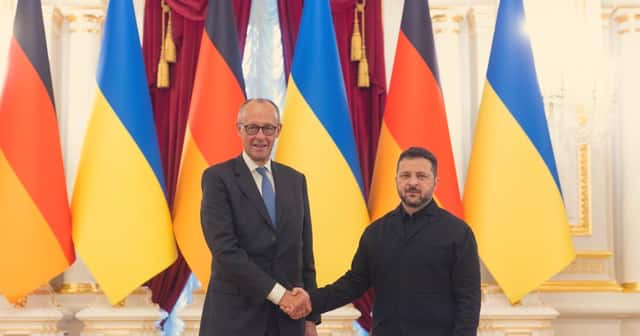
Chancellor Friedrich Merz hosted Ukrainian President Volodymyr Zelensky in Berlin on Tuesday. He said Germany will host a summit of the "Coalition of the Willing" with France and the United Kingdom later this month. He also said Germany wants to provide more winter and energy aid to Ukraine before the end of the year.
At a joint press conference at the Chancellery, Merz said Ukraine "can continue to rely on Germany, undiminished." He described German support as a matter of national self-interest. "Our support for Ukraine is therefore in the German and European interest," he said, according to the transcript published by the federal government. He added: "I am also making the case that the majority of Germans understand that we are doing this."
The visit came days before a new round of talks between Ukraine and Russia in Abu Dhabi, which Zelensky said would take place on November 10 and 11. Tagesschau reported that the talks will be mediated by the United States. It also came as the Group of 20 prepares for a summit in Miami in December. Both leaders said Europe should have a seat at any table where Ukraine's future is negotiated.
Quotations from German-language sources in this article are 567politics translations. Zelensky's remarks are quoted from the German interpretation in the government transcript.
What Merz announced
Merz said Germany, France and the United Kingdom would host a Coalition of the Willing summit in Berlin "the week after next." Later in the press conference he gave the date as November 19. The coalition is the group of countries that have said they are prepared to help Ukraine and to provide security guarantees after a ceasefire.
Merz said the summit would have three aims:
- to coordinate further aid for Ukraine;
- to reaffirm the participating countries' readiness to provide "security guarantees for Ukraine" after a ceasefire;
- to coordinate the diplomatic efforts that, in Merz's words, are under way "practically every day."
He said "a corresponding military exercise" connected to the security guarantees "begins in these days," and called it "a decisive building block of a peace solution." He did not give details of the exercise.
On aid, Merz said two things matter most before winter: air defense and the energy sector. He said further help for both had been agreed when he visited Kyiv in early October and was now being carried out. "We want, concretely, to make further winter aid and support for energy supply possible this year," he said. He did not give an amount.
Merz also said NATO members had agreed on €70 billion of military support for Ukraine in 2026, and that "all partners" must meet that commitment. "All Europeans bear responsibility, not only the Germans," he said. Asked what more Germany could do, he said: "I believe we are already doing a great deal. We are now the country with by far the largest contribution for Ukraine." He said there had been "supply difficulties now and then" and that he would try to resolve them at the November 19 meeting.
Merz said the ninth German-Ukrainian business forum will take place in Berlin on November 20. He said "not a single company from Germany" had left Ukraine since February 2022.
Ceasefire proposals and the Abu Dhabi talks
Merz said Russia should accept wider ceasefires. "The regional ceasefire in Oleshky can be a model for a ceasefire on energy and in the Black Sea," he said. "Russia has so far stubbornly refused this." He accused Russia of risking "further escalation" with attacks in the Black Sea and of risking a global food crisis.
The Oleshky arrangement was a temporary local pause in the Kherson region to allow a humanitarian mission. 567politics has reported that Russian strikes in the region resumed after it ended. Zelensky said in Berlin that Ukraine had offered Russia an extension of the Oleshky pause. "That was the answer: new attacks, new strikes, new murders of our people," he said. He said a rescue operation in Komyshuvakha in the Zaporizhzhia region had been going on for more than a day after glide-bomb attacks. Five people had been rescued and more than 50 were still missing, he said.
Merz said he welcomed a new round of talks, but that he did not yet see Russia negotiating seriously. "It is important that Russia really, seriously and finally conducts negotiations on a ceasefire and a subsequent peace agreement," he said. "I do not see that so far." He said his foreign policy adviser now spends "a large part of his working capacity" on diplomatic efforts to end the war.
Zelensky listed his priorities for Abu Dhabi:
- security guarantees and what he called a U.S.-discussed "prosperity package" for rebuilding Ukraine;
- reopening the Black Sea for grain shipments;
- broader prisoner exchanges, which he described as "all for all";
- preparation of a leaders' meeting in a trilateral format "with the unconditional participation of Europe."
567politics has separately reported on the timing of the Abu Dhabi talks and the Kremlin's comments on a possible call between Putin and Zelensky.
Asked whether he would call Russian President Vladimir Putin, Zelensky said Ukraine would not invite Putin to Kyiv. He said Russia would use a phone call "as an opportunity to no longer hold meetings." "We understand this game," he said. "If we want to end the war, we have to meet and take the first step, a ceasefire."
The G20 in Miami
Both men addressed the possibility that U.S. President Donald Trump could invite Putin to the G20 summit in Miami. "Every host is free to invite further guests," Merz said. "If President Trump should decide to invite the Russian head of state, then Ukraine must be discussed first of all, and if Ukraine is discussed, then the president of Ukraine must sit at the table." He added: "In my view it is completely unacceptable that third states talk about the fate of Ukraine without involving Ukraine. If Ukraine sits at the table, then Europe sits at the table."
Zelensky said "the USA and Russia, with all respect to the USA, cannot decide whether Ukraine will become a member state of the European Union." He said Ukraine wants to open six negotiating clusters for EU accession this year.
Air defense requests
Zelensky said the two leaders discussed what he called "a great shortage in air defense." He named PAC-2 and PAC-3 interceptor missiles for Patriot systems and the German-made IRIS-T system, and said they had discussed a new support package for Ukraine's F-16 fleet. He described the situation at the front as "not easy" but "controlled," and the situation in air defense and protection of civilians as "not so positive."
"I am grateful to Germany for strengthening the energy sector and air defense," Zelensky said. "So we give thanks, but it is not enough." He also mentioned joint drone production and an anti-ballistic missile program he called "Freyja."
Merz said Russian losses in October 2026 were "obviously the highest losses that Russia has ever suffered in this war in one month." He put them at 52,000 soldiers, about half killed and half wounded too badly to fight. A journalist's question put the figure at more than 54,000. 567politics has not independently verified either number.
A journalist noted that Germany had announced in early September it would act more strongly against Russia's so-called shadow fleet of tankers, and asked whether it had come up. Merz said: "We did not talk about that today."
Reactions in Germany
The visit drew responses from opposition leaders before Zelensky landed, according to tagesschau. Alice Weidel, the co-leader of the Alternative for Germany (AfD) and leader of the opposition in the Bundestag, shared a video on X that is said to show protesters clashing with Ukraine's National Guard on the outskirts of Kyiv. It is also said to show young men being held in a building after military recruitment. Tagesschau reported that there are doubts about the video's account and no independent confirmation. Weidel asked the chancellor to raise the matter with Zelensky. Tagesschau said Sahra Wagenknecht, the founder of the BSW party, posted something very similar.
The AfD's position on Russia was debated in the Bundestag in June. In a debate on June 11, AfD deputy Markus Frohnmaier defended attending the St. Petersburg International Economic Forum. He argued that it was not in Germany's interest to give up cheaper Russian gas. "Foreign policy is not a virtue contest, but interest politics," he said, according to the Bundestag's summary of the debate. In the same debate, Florian Hahn (CSU), a minister of state at the Foreign Office, accused the AfD of being willing to give up Ukrainian sovereignty. Irene Mihalic of the Greens accused the party of closeness to the Kremlin and said it opposes sanctions, European independence from Russian gas and aid to Ukraine.
The Left party has called for more diplomacy instead of more weapons. In a budget speech on September 9, the party's co-leader Jan van Aken told Foreign Minister Johann Wadephul that in talks on Ukraine the government was sitting "on the sidelines" watching "what Trump is doing." "Wars are almost never decided militarily," van Aken said. "Peace almost always only comes through talks, through negotiations and diplomacy."
Tagesschau reported that Merz knows "not everyone follows him" on supporting Ukraine, both abroad and among Germans. Speaking at the Berlin Security Conference, Zelensky said that no country can protect itself alone today. "Please keep Germany a country that people can believe in," he said, according to tagesschau. The role of Europe is growing, he said, "and without Germany that is impossible."
What comes next
- November 10–11: Ukraine–Russia talks in Abu Dhabi with U.S. mediation, according to Zelensky.
- November 19: Coalition of the Willing summit in Berlin, hosted by Germany with France and the United Kingdom.
- November 20: Ninth German-Ukrainian business forum in Berlin.
- December: G20 leaders' summit in Miami.
Differing perspectives
How should Germany approach Ukraine as new peace talks begin?
Each position is summarized as its supporters make it, with equal weight and in alphabetical order. A summary is not an endorsement; the evidence for each is weighed in the story above.
Germany is essential and more air defense is needed
Who holds it: President Volodymyr Zelensky
Zelensky thanks Germany for air defense and energy help but says it is not enough, as Russia targets energy and rail infrastructure. He asks partners to speed up aid and says no country can protect itself alone today. He argues Europe's role is growing and that without Germany it is impossible, urging Germans to keep their country one that people can believe in.
In their words: tagesschau ↗
Keep up and widen support until the war ends
Who holds it: Chancellor Friedrich Merz and the federal government
Merz says supporting Ukraine is in Germany's and Europe's own security interest, and that Germany, as the largest contributor, will keep helping until the war ends. He wants more winter and energy aid this year, says all NATO partners must deliver the €70 billion agreed for 2026, and argues Europe must be at the table because sanctions and security architecture cannot be settled without it.
In their words: Bundesregierung (press conference transcript) ↗
Pursue German economic interests and talk to all sides
Who holds it: AfD deputy Markus Frohnmaier
Frohnmaier argues that with high energy costs and companies leaving, it is not in Germany's interest to give up cheaper Russian gas. He says foreign policy is not a contest of virtue but a matter of interests, that this does not mean applauding war or dictatorship, and that Germany must be able to talk with all actors.
In their words: Deutscher Bundestag (debate summary, June 11, 2026) ↗
Shift from weapons to diplomacy
Who holds it: The Left party's Jan van Aken
Van Aken says the government relies almost entirely on the military card and sits on the sidelines of Ukraine talks while watching what Trump does. He argues wars are almost never decided militarily and that peace almost always comes through talks, negotiations and diplomacy, and proposes swapping the defense budget with the Foreign Office's budget for conflict resolution and peace.
In their words: Die Linke im Bundestag (speech, September 9, 2026) ↗
READ BEYOND 567POLITICS
Alternate sources & perspectives
Independent coverage and primary evidence to help you compare arguments. A link is not an endorsement; perspective labels describe the linked material.
- primary evidence
Pressekonferenz von Bundeskanzler Merz und Präsident Selenskyj in Berlin ↗
Bundesregierung
Full transcript of the November 3 press conference, including the November 19 summit, winter aid, the Oleshky ceasefire model and the G20 remarks.
- independent analysis
Selenskyj, Merz und der Kampf gegen die Zweifel ↗
tagesschau
Report on the visit, Weidel's and Wagenknecht's posts and Zelensky's Berlin Security Conference speech.
- right argument
Unterstützung für die Ukraine polarisiert im Bundestag ↗
Deutscher Bundestag
Summary of the June 11, 2026 debate with the AfD's case for talking to all sides and the coalition, Green and Left responses.
- left argument
Frieden braucht Diplomatie statt immer mehr Waffen ↗
Die Linke im Bundestag
Jan van Aken's September 9 speech calling for diplomacy instead of more weapons.
Reviewed 2026-11-03. discover_politics_sources returned only unrelated pages about the Merz pharmaceutical company, so all sources were found and opened directly. The government transcript is the primary record of the press conference. Reactions from the AfD and the Left come from their own Bundestag remarks, as no new statements specifically on today's visit were found in their own words before publication. FEC funding data does not apply to German or Ukrainian politicians.