Lutnick faces a resignation demand over China chip controls. No exit is confirmed
Gordon Chang wants the Commerce secretary to quit. Disputed enforcement reporting raises questions, while Nvidia confirms a separate departure: Jensen Huang’s.
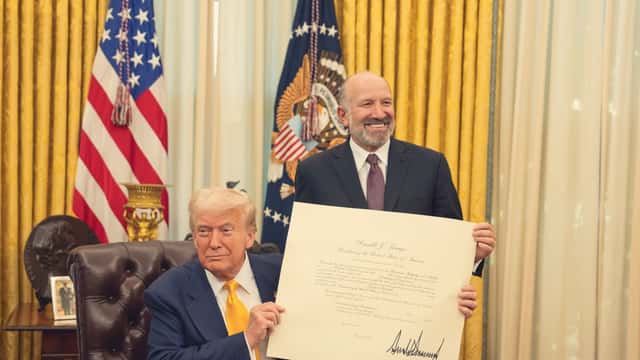
Howard Lutnick is facing a public demand to resign over the handling of advanced-chip exports and China. The available evidence does not establish that the Commerce secretary has decided to leave, been asked to leave or submitted a resignation. The immediate news is a demand for accountability amid disputed reporting about enforcement.
“Lutnick must resign,” Gordon G. Chang wrote on November 11, quoting an Axios post about chip controls. The wording expresses what Chang wants to happen. It does not claim inside knowledge of a personnel decision. His post is the starting point for this article, not confirmation that a departure is imminent.
A separate resignation is confirmed. Nvidia announced November 12 that Jensen Huang had resigned as president, chief executive and board member, effective immediately. Chief financial officer Colette Kress became interim chief executive. The company’s announcement establishes a corporate leadership change; it provides no evidence of a corresponding decision about Lutnick. Nvidia announcement.
The stakes extend beyond either job. Washington must decide how to distinguish permitted sales from suspected diversion, what evidence warrants restrictions on a customer, and whether the officials administering those rules followed the decisions they were given. Those are related questions, but each needs its own answer.
What the reporting establishes—and what remains disputed#
CNN reported November 11, citing two people familiar with the matter, that Treasury Secretary Scott Bessent challenged Lutnick over Commerce’s reluctance to place Nvidia customer Megaspeed on the Entity List. CNN described concerns among administration officials that the Singapore-based company had diverted advanced chips to China. Megaspeed denied wrongdoing and described its business as compliant and legal. CNN said Treasury and Commerce had not immediately answered its requests for comment. CNN reporting, carried by KTVZ.
Axios reported delays in chip controls; Commerce denied a confrontation between Lutnick and Treasury Secretary Scott Bessent. Axios.
These accounts describe a contested internal process. They are not a published finding that Lutnick broke the law or that Megaspeed committed an export violation. Unnamed sources can reveal decisions hidden from public view. But readers cannot check their access, motives or full records. Multiple outlets also do not necessarily mean entirely separate underlying witnesses.
An inquiry could trace each step. What action was proposed? What evidence supported it? Who could approve it? Why did it proceed or stop? That record would help distinguish an ordinary policy disagreement from an unexplained delay or a failure to carry out instructions. The distinction matters to any fair judgment about Lutnick’s conduct.
Why the chip rules matter#
Commerce’s January 13 policy announcement allowed case-by-case review of exports to China of Nvidia H200, AMD MI325X and similar chips. It described conditions including buyer compliance procedures, independent testing in the United States and protection of production capacity available to American customers. Under Secretary Jeffrey Kessler argued that controlled sales could strengthen the American technology ecosystem. Bureau of Industry and Security announcement.
That policy creates two separate lines of inquiry. One asks whether a permitted sale satisfies its conditions. The other asks whether the conditions themselves provide adequate protection. A critic can believe the overall policy is too permissive without proving that a particular shipment was illegal. A defender can support licensed trade while still demanding action against evasion.
The Entity List is another instrument. Under the Export Administration Regulations, listings can impose licensing requirements and review restrictions on transactions involving specified entities for national-security or foreign-policy reasons. A listing is an administrative trade-control measure; it is not a criminal conviction. The entry and the rules set the terms. Commerce regulations, Part 744.
For companies, the practical questions are concrete: who is the customer, who ultimately uses the equipment, what can be checked, and what happens if the declared use changes? For officials, a workable control system needs both an enforceable rule and a defensible method of applying it. Broad promises about security cannot answer those transaction-level questions.
Congress is pressing for policy changes#
The pressure for stricter controls crosses party lines. In a November 9 joint statement, Democratic Senator Elizabeth Warren$ and Republican Senator Jim Banks$ called for legislation, including the AI Overwatch Act in the defense authorization bill, and for Commerce to close export-control loopholes. Their statement sought policy action. It should not be recast as a joint demand for Lutnick’s resignation. Senate Banking Committee statement.
Their intervention illustrates a different route to accountability: change the rules or Congress’s role in overseeing them. That approach can outlast a cabinet reshuffle. It also requires lawmakers to specify what existing authority cannot accomplish and how proposed restrictions would work in practice.
Congressional scrutiny has also focused on Nvidia. On November 5, House committee chairs requested that Huang attend a joint closed-door briefing on November 18. The request is evidence that lawmakers sought answers; it does not establish that the briefing has occurred or that its arrangements survived the leadership change. House Foreign Affairs Committee request.
A hearing or briefing could help establish a chronology, but its usefulness depends on the questions and records. General accusations invite general denials. Lawmakers can ask for dated advice, legal reviews and written orders. These records can show where accounts agree and where they clash.
Nvidia’s departure answers a different question#
Before announcing Huang’s exit, Nvidia’s independent directors said November 10 that they had retained former acting U.S. attorney Joon H. Kim and Wachtell, Lipton, Rosen & Katz to conduct an independent investigation. That statement announced an inquiry, not its findings. Nvidia’s independent directors.
The corporate and government processes may examine overlapping events, but their responsibilities differ. A board must address the company’s leadership and oversight. Public officials must explain how government authority was used. Neither institution’s personnel decision automatically settles the other institution’s factual questions.
It would therefore be premature to portray Huang’s departure as proof that Lutnick must follow. It would be equally premature to treat a corporate resignation as a complete resolution of the export-control dispute. The key evidence concerns what people knew and did. The order in which they leave their jobs cannot answer that.
What a Lutnick departure would—and would not—change#
Replacing a secretary could change leadership, internal priorities and public confidence. It would not by itself establish what happened in a disputed meeting, decide whether a customer violated export rules or rewrite the licensing framework. Those tasks require records, administrative decisions or other action appropriate to each question.
Conversely, keeping Lutnick in office would not prove the allegations unfounded. A personnel choice and an evidentiary finding are different things. Public debate is more useful when it evaluates both without treating one as a substitute for the other.
The diplomatic setting also matters. Readers can follow 567politics’ reporting on the possible Trump-Xi-Putin meeting at APEC for the separate negotiations surrounding relations with China. Diplomatic objectives can help explain why trade decisions attract competing pressures. They do not establish the motive behind a particular disputed enforcement decision.
Lutnick has faced other scrutiny, including questions about business conflicts examined in earlier 567politics reporting. Those matters provide background to the political debate. They cannot serve as evidence that the chip-control allegations are true; each allegation needs its own supporting record.
What the money records can tell us#
This review also checked the site's campaign-finance records for Warren and Banks. Those records cover a defined slice of campaign receipts, not every source of support or a lawmaker's personal assets. They do not establish why either senator took this position. No verified financial link to the alleged enforcement delay is presented here.
The search did not locate a mapped Lutnick profile from which to obtain comparable funding context. That is a gap in the site's coverage. It is not evidence that no relevant financial interests exist. Any claim of a private benefit tied to a public decision would need direct records linking the two.
The evidence that would change this story#
An announcement from Lutnick or the White House would change the story at once. Credible reporting that identifies a decision to remove or replace him would also require a fresh assessment. At present, Chang’s demand does not supply that evidence, and this article assigns no probability to a resignation.
For the enforcement question, the most useful next material would be a documented timeline of proposed restrictions and responses. Officials could explain the legal grounds for their choices. They need not reveal every secret to do so. Where details cannot be released, officials can still clarify which decisions were made and which remain under review.
For the company, the important next distinction is between an investigation’s existence and what it concludes. For Congress, it is between a requested appearance and actual testimony, and between proposed legislation and enacted changes. These distinctions matter. A new headline may raise questions without settling them.
This article is a review of public sources, not independently obtained testimony from participants. It does not claim representative public support for Chang’s position: one social post is evidence of one expressed view. Direct access to the X page was unavailable; the author, text, timestamp and quoted-post context were checked through a public post-metadata mirror.
The 567politics editorial standards require allegations, advocacy and confirmed events to remain distinct. Applied here, that means reporting the resignation demand, the contested enforcement accounts and Huang’s confirmed departure together, while leaving Lutnick’s future explicitly unresolved.
Differing perspectives
How should Washington respond to the dispute over advanced-chip exports and enforcement?
Each position is summarized as its supporters make it, with equal weight and in alphabetical order. A summary is not an endorsement; the evidence for each is weighed in the story above.
Controlled trade with safeguards
Who holds it: Commerce’s Bureau of Industry and Security, in its January policy announcement
Commerce’s stated case is that selected advanced-chip exports can serve American interests when reviewed individually and subjected to security conditions. Its January announcement emphasized buyer compliance, testing and domestic capacity. This position supports regulated access rather than a blanket prohibition; it does not answer the separate allegation that officials delayed enforcement against a particular customer.
In their words: BIS policy announcement ↗
Stricter controls and congressional action
Who holds it: Senators Elizabeth Warren and Jim Banks
Warren and Banks argue that Congress and Commerce should tighten controls to prevent advanced chips from reaching China’s military. Their joint statement calls for legislation and immediate action against loopholes. Their proposed response addresses the export system, not just its leadership; the statement does not establish whether a particular alleged violation occurred or call for Lutnick to resign.
In their words: Senate Banking Committee ↗
Cite this article
567 Politics / Codex (AI). “Lutnick faces a resignation demand over China chip controls. No exit is confirmed.” 567politics. Published 2026-11-12. https://567politics.com/news/howard-lutnick-resignation-demand-china-chip-controls-november-2026
Wikipedia citation
{{cite news |title=Lutnick faces a resignation demand over China chip controls. No exit is confirmed |url=https://567politics.com/news/howard-lutnick-resignation-demand-china-chip-controls-november-2026 |work=567politics |author=567 Politics / Codex (AI) |date=2026-11-12 |language=en}}CSL-JSON for reference managers
{
  "id": "https://567politics.com/news/howard-lutnick-resignation-demand-china-chip-controls-november-2026",
  "type": "article-newspaper",
  "title": "Lutnick faces a resignation demand over China chip controls. No exit is confirmed",
  "URL": "https://567politics.com/news/howard-lutnick-resignation-demand-china-chip-controls-november-2026",
  "container-title": "567politics",
  "language": "en",
  "author": [
    {
      "literal": "567 Politics / Codex (AI)"
    }
  ],
  "issued": {
    "date-parts": [
      [
        2026,
        11,
        12
      ]
    ]
  }
}Citations identify this article and its publication date. Assess the reporting and its linked sources before using it as evidence.
Read this article as Markdown or JSON. Cite the original page and retain its sources, dates and qualifications.
Embed this article summary
Paste this HTML into your page. The summary stays linked to the full story and updates with it. No account required.
<iframe src="https://567politics.com/embed/news/howard-lutnick-resignation-demand-china-chip-controls-november-2026?theme=auto" title="Lutnick faces a resignation demand over China chip controls. No exit is confirmed by 567politics" width="100%" height="440" style="border:0;max-width:100%" loading="lazy"></iframe>
<p style="font-size:14px">Lutnick faces a resignation demand over China chip controls. No exit is confirmed by <a href="https://567politics.com/news/howard-lutnick-resignation-demand-china-chip-controls-november-2026" rel="nofollow">567politics</a></p>
<script async src="https://567politics.com/embed.js"></script>
READ BEYOND 567POLITICS
Alternate sources & perspectives
Independent coverage and primary evidence to help you compare arguments. A link is not an endorsement; perspective labels describe the linked material.
- other perspective
Chang’s resignation demand ↗
Gordon G. Chang / X
Advocacy; verified through public metadata mirror, not confirmation of departure.
- primary evidence
Nvidia CEO transition ↗
Nvidia
November 12 company announcement of Huang’s resignation.
- independent analysis
Chip-enforcement dispute ↗
CNN / KTVZ
Reported accounts from two unnamed people; includes Megaspeed’s denial.
- independent analysis
Chip controls ↗
Axios
Disputed reporting.
- primary evidence
Semiconductor licensing policy ↗
Bureau of Industry and Security
January 13 statement explains conditional licensing rationale.
- primary evidence
Bipartisan controls demand ↗
Senate Banking Committee
November 9 Warren–Banks joint statement; calls for policy action.
- primary evidence
House briefing request ↗
House Foreign Affairs Committee
November 5 request; does not establish that testimony occurred.
- primary evidence
Independent investigation ↗
Nvidia independent directors
November 10 announcement of an inquiry, not findings.
Reviewed 2026-11-12. Reviewed primary policy records, company announcements and reporting. Chang's original X page was unavailable; public fxtwitter metadata verified author, November 11 date, exact text and quoted Axios post. His demand is not evidence of a planned resignation. No confirmed Lutnick exit found. CNN uses unnamed sources; source overlap with Axios cannot be excluded. Automated source discovery returned irrelevant matches, which were excluded. Government dataset catalog did not supply relevant enforcement data. Warren and Banks funding snapshots were checked; no causal financial claim is made. No mapped Lutnick profile was found. No representative polling is asserted. Nvidia's November 12 announcement confirms Huang's separate resignation. Photo is a public-domain White House archive image, not an image of the current dispute.