Election Commission gives ASDD voters another path onto rolls in seven SIR regions
A November 6 letter lets electors marked absent, shifted, dead or duplicate refile enumeration forms without Form 6 where SIR is still open. Finished-SIR states stay on a harder path.
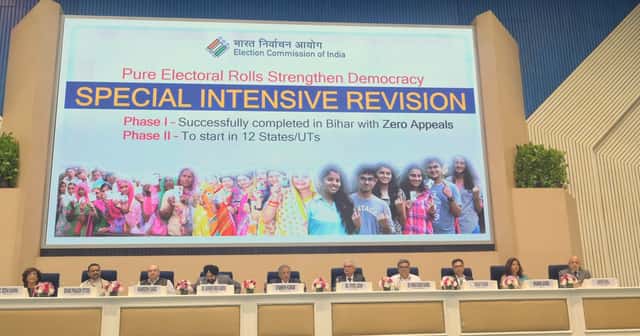
India's Election Commission has opened another path back onto the rolls for voters who were left off draft lists during the Special Intensive Revision (SIR). In a letter dated November 6, 2026, the Commission told the chief electoral officers of Delhi, Maharashtra, Haryana, Andhra Pradesh, Jharkhand, Telangana and Nagaland to facilitate electors marked Absent, Shifted, Dead or Duplicate (ASDD) whose enumeration forms never came back, the full instruction states.
Those voters may submit a fresh SIR Enumeration Form plus a short signed statement. They do not have to file Form 6, the form meant for first-time enrollment, in those seven regions while SIR is still open. Hindustan Times reported that the same route is not being offered in states where SIR has already finished and a Special Summary Revision (SSR) is under way instead.
The order answers part of a dispute that has filled opposition rallies and Supreme Court hearings for months. The opposition says mass deletions amount to disenfranchisement. The Commission says it is cleaning rolls and that wrongly omitted electors can return. Background on the political clash over Chief Election Commissioner Gyanesh Kumar is in our October report on the INDIA bloc's impeachment push. This article focuses on what the November 6 instruction actually does, where it stops, and how each side reads it.
What the November 6 letter requires#
Secretary Pawan Diwan's letter, No. 23/INST/2025-ERS, is addressed to the CEOs of the seven regions still in SIR. It says electors who were issued Enumeration Forms but were not included in the draft roll because they were marked ASDD "shall be provided one more opportunity" to reach the final roll.
The steps are concrete:
- Booth-wise ASDD lists must be displayed again at polling stations, panchayat bhawans, urban local body offices and related offices, and uploaded as readable PDFs on CEO websites, with the probable reason for non-inclusion.
- Partially filled Enumeration Forms for those electors must be regenerated in the ECINET system.
- District and electoral registration officers must try to reach voters through booth-level officers (BLOs), including by WhatsApp, email or SMS when contact details exist. Voters may also download forms with their old EPIC number.
- BLOs are told to work with booth-level agents of parties, visit houses, ask neighbors and resident welfare associations, and guide people on how to file.
- Voters who have not moved may file the Enumeration Form plus Annexure-B, explaining why they missed the earlier round. Online filing with e-sign is also to be enabled.
- Voters who shifted inside the same state need not file Form 8. They file the Enumeration Form plus Annexure-C with the new address and address proof at the new constituency. Homeless people without documents may rely on a BLO field verification report.
- Accepted forms are to be processed under Rule 21(1) of the Registration of Electors Rules, 1960, and parked for inclusion in the SIR final roll. The old EPIC number is to be reassigned.
- Anyone who already filed Form 6 during SIR need not file the enumeration form again; those applications follow a November 3 clarification.
- CEOs must publicize the measures widely, including through social media, newspapers, websites and loudspeaker announcements in clusters with homeless people.
- Find your nameCheck the redisplayed ASDD list at the polling station or CEO website
- Get the formReceive a regenerated Enumeration Form from a BLO, or download it with your old EPIC
- Add a statementAnnexure-B if you stayed put; Annexure-C with address proof if you moved inside the state
- SubmitFile with the ERO or AERO for your current ordinary residence, on paper or online with e-sign
- VerificationERO checks eligibility and residence under Rule 21(1); old EPIC is reassigned if accepted
Source: Election Commission of India letter No. 23/INST/2025-ERS
How this sits beside the October deadline extensions#
On October 29 the Commission had already stretched SIR calendars in six of those regions after the Supreme Court asked it to consider more time for claims and objections in Delhi, The Indian Express explained. Final rolls were moved to November 30 in Maharashtra, Haryana, Andhra Pradesh, Telangana and Nagaland, and to December 22 in Delhi. Claims and objections windows were reopened or extended state by state.
Source: The Indian Express
Show the numbers
| Region | Final roll (days from Nov 9, 2026) |
|---|---|
| Maharashtra | 21 |
| Haryana | 21 |
| Andhra Pradesh | 21 |
| Telangana | 21 |
| Nagaland | 21 |
| Delhi | 43 |
The chart uses day counts from November 9 only as a readable scale; the source dates are November 30 and December 22. The November 6 facilitation letter adds a process for ASDD electors inside that remaining window. It does not, by itself, change the final-roll dates.
Where the relief does not apply#
Hindustan Times reported that voters marked ASDD during SIR Phases 1 and 2 are not getting the same enumeration-form route. An Election Commission official told the paper the panel had no plan to launch that drive where SSR had already been announced. "The SSR has already been announced in those regions. We would not be launching this drive there," the official said.
SSR, ordered on October 15 for 17 states and Union Territories including Bihar, Uttar Pradesh, West Bengal, Tamil Nadu, Kerala and Gujarat, treats existing rolls as the base. Draft SSR rolls were due November 12, claims and objections through December 11, disposal by December 28, and final rolls on January 4, according to Hindustan Times. The SSR order names Forms 6, 6A, 7 and 8. It does not, on the paper's reading, create an ASDD-specific enumeration path or promise restoration of old EPIC numbers for people with no current entry.
That distinction matters. Form 6 is the first-time voter form. On October 28 a Supreme Court bench led by Chief Justice Surya Kant, hearing Delhi SIR pleas, asked why deleted voters were being pushed to Form 6 and why Form 8 could not be used, Hindustan Times reported. The court asked the Commission to consider late enumeration forms. The November 6 letter is a partial answer for regions where SIR is still live. It is not a nationwide template for every earlier deletion.
Former chief election commissioner O.P. Rawat told Hindustan Times that confusion in Phase 1 and 2 states should clear once SSR notifications spell out which form deleted electors must use. Until then, the text of the SSR order points applicants without a current entry toward Form 6.
Scale of the underlying dispute#
Opposition leaders and earlier reporting have put nationwide draft deletions in the range of about 130 million names across dozens of states and Union Territories. Draft deletions are not the same as final removals; some names return through claims. Delhi's draft roll left out about 4.76 million names after August 31 publication, according to secondary reporting on the Commission's follow-up checks. Karnataka's final roll after SIR listed 45,500,011 voters, down from 55,432,314 before the exercise, as cited in our October CEC story.
The Commission says the SIR's purpose is a clean roll: eligible voters in, ineligible names out. In affidavits and press statements summarized in earlier 567politics coverage, it has said the main SIR orders were unanimous decisions of the full three-member Commission and that software platforms run under security protocols. An Indian Express investigation reported that the other two commissioners lodged repeated written objections over process. The Commission has called those notes ordinary internal queries rather than decisions. The Supreme Court has not finally ruled on that conflict.
Profiles of Narendra Modi, Amit Shah and Rahul Gandhi sit on the political track of the same fight. This piece stays with the administrative text.
How the sides read the facilitation order#
For the Commission, the letter is evidence that omission from a draft is not the last word. BLOs must chase ASDD electors, lists must be public again, and old EPIC numbers can return. For opposition parties that have marched against "vote theft," the order is a late repair that still leaves millions in finished-SIR states on a harder Form 6 path, and that does not concede bias in the original deletions.
Neither reading is a court judgment. The practical test is how many ASDD electors file before the November 30 and December 22 deadlines, how many forms EROs accept, and whether SSR states later get an equivalent restoration rule. Those outcomes are not yet in the documents opened for this article.
Documents voters will see#
Annexure-A in the November 6 packet is the Enumeration Form itself, with pre-printed BLO contacts, old photo fields, and columns for the elector's details on the last SIR roll and for a relative listed there. It asks for date of birth, optional Aadhaar, mobile number and parents' or spouse's EPIC numbers when available. The applicant must declare that the person has not taken another country's citizenship and is not enrolled elsewhere, and must acknowledge that a false statement is punishable under Section 31 of the Representation of the People Act, 1950.
Annexure-B is a short statement for people who never shifted: why the earlier form was missed, and a request to enroll at the current address. Annexure-C is for intra-state movers: old address, new address, and a tick-list of residence proofs such as utility bills, Aadhaar, bank passbooks, passports, land records or registered leases. The letter says a BLO field verification report can stand in for homeless people who have none of those papers.
Those annexures matter because they define what "facilitation" means in practice. A voter who can produce the form and statement still faces ERO verification. A voter in a finished-SIR state still faces whatever SSR rules the Commission issues next. Publishing the forms does not, by itself, restore a name.
Delhi's draft omissions and the court prompt#
Delhi has been the sharpest test case for time pressure. After the draft roll published on August 31, about 4.76 million names were left out, according to secondary reporting summarized when the Commission ordered fresh doorstep checks. On October 28 the Supreme Court pressed the Commission on Form 6. The next day the Commission extended Delhi's claims window to November 25 and pushed final publication to December 22, The Indian Express reported. The November 6 letter then told Delhi's CEO, along with six state CEOs, to regenerate ASDD forms and chase electors again.
That sequence matters for readers who ask whether courts or politics forced the change. The public record shows a court suggestion, an administrative extension, and then a facilitation circular. It does not show a judicial order rewriting the Representation of the People Act. Opposition parties continue to seek broader remedies, including resignation of the chief election commissioner, in petitions and street campaigns covered in our October CEC report. The BJP continues to say the Commission is cleaning rolls and that defeated parties are blaming the referee. Profiles of Rahul Gandhi and Amit Shah track the partisan argument; the letter itself is an election-administration document.
Continuous enrollment versus intensive revision#
India's roll system has two overlapping modes. Continuous updation lets anyone apply year-round on Forms 6, 7 and 8. Special Intensive Revision is a time-bound, house-to-house drive with enumeration forms mapped to older rolls. Special Summary Revision is a lighter annual update of an existing roll. The November 6 relief works only while an SIR final roll is still pending, because that is where accepted enumeration forms are parked. Once a final SIR roll is published, the Commission has told CEOs in completed regions to run special drives with Form 6 for left-out and first-time electors, according to related ECI instructions listed on its site. Those drives are not the same as reopening enumeration with the old EPIC number guaranteed.
Voters therefore face different paperwork by geography. In the seven ongoing-SIR regions, ASDD electors can use Enumeration Forms plus Annexures B or C. In SSR regions, the current order text points people without a roll entry toward Form 6 unless a later circular says otherwise. In finished-SIR regions that are neither in the seven nor yet in SSR claims, continuous Form 6 remains the default path described in Commission letters about left-out electors.
Political actors will read those differences through their own lenses. Opposition organizers will say the uneven map proves the original revision was reckless. Commission officials will say each phase has a lawful close-out and that continuous enrollment never stopped. Both claims can be tested only against future enrollment statistics the Commission has not yet released for the November window.
Link to the wider November calendar#
The same week as the facilitation letter, Shah offered Gandhi a special Parliament session on SIR, and Gandhi demanded an open debate with Modi. Those speeches do not amend the November 6 instruction. They do raise the political cost of any remaining gap between draft omissions and final restorations. If large ASDD cohorts remain off the final rolls in Delhi on December 22, or in the five November 30 states, the floor debate Shah invited will have fresh numbers. If restorations are large, the government will cite them as proof the system self-corrects. Either way, the administrative clock and the political clock are now aligned on the same calendar.
Method and limits#
Primary text for the facilitation steps is the Election Commission's November 6 letter hosted on eci.gov.in. Calendar dates for final rolls come from the Express explainer of the October 29 extensions. The Phase 1/2 gap and the Supreme Court Form 6 exchange come from Hindustan Times' November 9 report. Nationwide deletion totals cited for context come from earlier verified reporting linked above; they are draft-stage figures unless a source says otherwise.
Campaign finance note: This article does not review party contribution filings.
Photo note#
Photo: Chief Election Commissioner Gyanesh Kumar at an Election Commission press conference, Vigyan Bhawan, New Delhi, October 27, 2025. Election Commission of India / Press Information Bureau, original file, Government Open Data License - India.

Differing perspectives
Is the Election Commission's ASDD facilitation enough to fix SIR omissions?
Each position is summarized as its supporters make it, with equal weight and in alphabetical order. A summary is not an endorsement; the evidence for each is weighed in the story above.
Extend deadlines so claims can still be filed
Who holds it: Election Commission letters to CEOs after the Supreme Court prompt
After the Supreme Court asked it to consider more time in Delhi, the Commission postponed final rolls to November 30 in five states and December 22 in Delhi, and reopened or extended claims windows. Officials present the extensions as giving left-out and newly eligible electors more time before the final SIR lists publish.
In their words: The Indian Express, Oct. 30, 2026 ↗
Give ASDD electors another enumeration chance
Who holds it: Election Commission of India
The Commission says electors marked Absent, Shifted, Dead or Duplicate whose forms never returned should get one more opportunity during ongoing SIR. Its November 6 letter orders redisplayed lists, regenerated forms, BLO outreach and reassignment of old EPIC numbers after Rule 21 verification, arguing draft omission is not final for eligible voters.
In their words: Election Commission letter No. 23/INST/2025-ERS, Nov. 6, 2026 ↗
Stop forcing deleted voters onto Form 6
Who holds it: Supreme Court bench and reporting on unfinished-SIR gaps
The court asked why deleted voters were being told to use Form 6, which is meant for first-time applicants. Hindustan Times notes the new enumeration route still does not cover Phase 1 and 2 states now in SSR, where deleted electors may still face Form 6 unless later guidelines say otherwise.
In their words: Hindustan Times, Nov. 9, 2026 ↗
Cite this article
567 Politics staff. “Election Commission gives ASDD voters another path onto rolls in seven SIR regions.” 567politics. Published 2026-11-09. https://567politics.com/news/india-eci-asdd-voters-enumeration-forms-sir-facilitation-november-2026
Wikipedia citation
{{cite news |title=Election Commission gives ASDD voters another path onto rolls in seven SIR regions |url=https://567politics.com/news/india-eci-asdd-voters-enumeration-forms-sir-facilitation-november-2026 |work=567politics |author=567 Politics staff |date=2026-11-09 |language=en}}CSL-JSON for reference managers
{
  "id": "https://567politics.com/news/india-eci-asdd-voters-enumeration-forms-sir-facilitation-november-2026",
  "type": "article-newspaper",
  "title": "Election Commission gives ASDD voters another path onto rolls in seven SIR regions",
  "URL": "https://567politics.com/news/india-eci-asdd-voters-enumeration-forms-sir-facilitation-november-2026",
  "container-title": "567politics",
  "language": "en",
  "author": [
    {
      "literal": "567 Politics staff"
    }
  ],
  "issued": {
    "date-parts": [
      [
        2026,
        11,
        9
      ]
    ]
  }
}Citations identify this article and its publication date. Assess the reporting and its linked sources before using it as evidence.
Read this article as Markdown or JSON. Cite the original page and retain its sources, dates and qualifications.
Embed this article summary
Paste this HTML into your page. The summary stays linked to the full story and updates with it. No account required.
<iframe src="https://567politics.com/embed/news/india-eci-asdd-voters-enumeration-forms-sir-facilitation-november-2026?theme=auto" title="Election Commission gives ASDD voters another path onto rolls in seven SIR regions by 567politics" width="100%" height="440" style="border:0;max-width:100%" loading="lazy"></iframe>
<p style="font-size:14px">Election Commission gives ASDD voters another path onto rolls in seven SIR regions by <a href="https://567politics.com/news/india-eci-asdd-voters-enumeration-forms-sir-facilitation-november-2026" rel="nofollow">567politics</a></p>
<script async src="https://567politics.com/embed.js"></script>
READ BEYOND 567POLITICS
Alternate sources & perspectives
Independent coverage and primary evidence to help you compare arguments. A link is not an endorsement; perspective labels describe the linked material.
- primary evidence
Ongoing SIR left out electors facilitation ↗
Election Commission of India
Full Nov. 6 instruction on ASDD lists, enumeration forms and EPIC reassignment.
- independent analysis
SIR extended in six states: What EC move means for voters ↗
The Indian Express
Explains Oct. 29 final-roll and claims-window extensions after the Supreme Court prompt.
- left argument
ASDD voters get way back to electoral rolls without Form 6, but not in all states ↗
Hindustan Times
Documents that finished-SIR/SSR states lack the same enumeration route; quotes court Form 6 concern.
- primary evidence
ECI instructions index including Form-6 clarification ↗
Election Commission of India
Commission public list of current SIR/SSR instructions and Form 6 clarifications.
- other perspective
CEC row India bloc SIR protest Delhi live updates ↗
The Hindu
Opposition framing of mass deletions that the facilitation order partially answers.
Reviewed 2026-11-09. Hand-checked Nov. 9, 2026. Primary text is the ECI Nov. 6 ASDD facilitation letter on eci.gov.in. Deadline extensions from Indian Express; Form 6/SSR gap from Hindustan Times. discover_politics_sources was not used.