Martin proposes an independent study of three futures for the island of Ireland
The Taoiseach's Futures Study Initiative would examine a unitary republic, an all-island state with devolution, and no change, without recommending any of them.
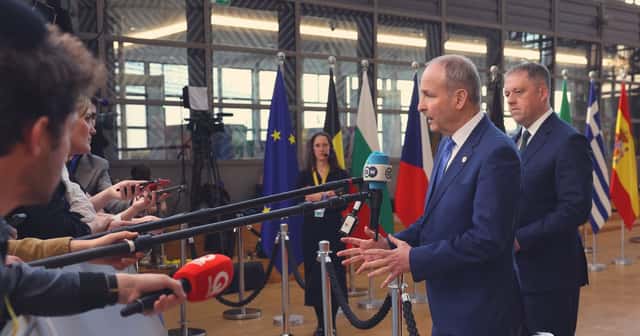
Taoiseach Micheál Martin has proposed an independent study of what Irish unification, or the absence of it, would mean in practice. His plan sets out three possible constitutional futures for the island, and the study would not recommend any of them. He presented the plan, which he calls the Futures Study Initiative, to a private meeting of the Fianna Fáil parliamentary party in Dublin on Tuesday, November 3, RTÉ reported. A policy paper circulated at the meeting was also seen by BBC News NI and by the Press Association, whose account was published by The Independent.
The timing matters. Fine Gael, Fianna Fáil's partner in government, is due to unveil its own "blueprint" for Irish unity at its ard fheis, or annual conference, in Cork this weekend, according to the BBC. Sinn Féin, the largest opposition party, has spent the year pressing the government to start formal planning for a unity referendum. Martin's paper sets out a third approach. It is neither a party plan for unity nor a refusal to discuss it, but a shared body of evidence that any side can use.
This article reflects reporting available as of about 7:15 p.m. Eastern Time on November 3. The proposal had not yet been published as a government document, and the main parties in Northern Ireland had not issued formal responses to it by that time.
What Martin proposed
According to the paper as reported by RTÉ and the BBC, the initiative would "seek to provide an objective, independent knowledge base" for the debate on future constitutional arrangements. It would be led by a chairperson and at least five other people, each linked to one of the six subject areas, with the work overseen by experts in those fields. A dedicated secretariat would sit in the Department of the Taoiseach and would mix civil servants with outside specialists.
Every political party and activist group would be invited to make submissions. The group would not be asked to recommend a single option. Instead, PA reported, it would sum up current knowledge, identify gaps and points of "significant contestation," and commission work to fill those gaps. It would then produce a report for the Irish government, which would be published.
Martin presented the inclusiveness of the process as its main selling point. "In this it would provide a good faith opportunity for those outside the nationalist tradition to participate," the paper says. "Critically, it would challenge all traditions to move from making general assertions about the future to engaging with hard evidence." It also warns: "It is essential to avoid the most consistent failure of the last century where initiatives ended up with one side talking with itself and reinforcing division."
RTÉ reported that Martin told his party a substantial part of Northern Ireland's population will continue to have a British identity, which must be respected. The paper also states that "nothing" in the initiative "interferes with or seeks to replace current commitments" on North-South and Ireland-UK cooperation under the Good Friday Agreement, according to the BBC.
The three scenarios
The study would examine three possible futures, worded in the paper as follows (as reported by RTÉ):
- A unitary republic. "A single unitary republic, governed by institutions primarily based in Dublin which would be fully in place within a maximum of five years of a unification referendum." This model would keep the Good Friday Agreement's minority and identity guarantees but not its devolved government in Belfast.
- An all-island state with devolution. A united state in which Northern Ireland keeps devolved government "in a manner similar to that which currently operates under Strand One of the Good Friday Agreement." Other parts of the Agreement's intergovernmental cooperation would continue.
- No constitutional change. "Long-term cooperation and shared development in accordance with the Good Friday Agreement without constitutional change."
Including the status quo as one of the three options is the clearest sign of the audience Martin is trying to reach. Unionist parties have dismissed unity plans from Dublin, as their responses to Fine Gael show below. This study would formally treat Northern Ireland staying in the United Kingdom as one of the outcomes to be costed and described. That is a different kind of invitation, though no unionist party had accepted it by Tuesday evening.
Six areas of study
The paper lists six areas: constitutional and legal change, the economy, health, education, security, and symbols and culture. RTÉ's summary gives some detail on what each would cover:
- Constitutional and legal change, including parliamentary and other powers, points where Northern Ireland practice conflicts with that of the Republic, and a continuing UK role on the rights of the minority.
- The economy, including "fiscal and economic convergence," taxation and social supports, replacing sterling and GB-based regulation, and keeping Northern Ireland's access to the British market while moving closer to EU rules.
- Health and education, examining both merging and keeping separate the two systems on the island.
- Security, covering whether police and security forces would be merged or kept apart, plus defense and international engagement.
- Symbols and culture, which the paper says would be examined "to ensure inclusiveness."
PA reported that the paper sets a common working assumption for all three scenarios: that "broad fiscal and economic convergence should underpin policy and be defined and costed in medium and long-term impacts." That is a notable commitment. The cost of unification, including the scale of the UK Treasury's spending in Northern Ireland, has been among the most disputed questions in the debate. A government-backed study that tries to put agreed figures on it would be new.
The other strands of the briefing
The study was one of three priorities Martin set out. PA reported that he also briefed TDs (members of the Dáil) on reform of Strand One of the Good Friday Agreement, which covers the power-sharing Assembly and Executive at Stormont. The paper says Fianna Fáil supports reform of the institutions and that there is "a clear need and public demand to see them operate more effectively." It says talks involving all Northern Ireland parties and both governments remain the most constructive way to discuss such changes.
Fianna Fáil will set up its own committee to take part in the work. RTÉ said Oireachtas members Brendan Smith, Erin McGreehan, Paul McAuliffe, Cormac Devlin, Alison Comyn and Pat the Cope Gallagher could serve on it. The BBC reported that the parliamentary party will hold a dedicated meeting on the issue in the coming weeks.
Stormont's institutions have been under steady strain. This week the DUP lost one of its MPs when Carla Lockhart quit the party over its handling of the Drumcree parading dispute. The split exposed tensions within unionism while the DUP shares power with Sinn Féin.
How it differs from Sinn Féin's bill
Martin's proposal follows a direct clash in the Dáil over unity planning. On July 8, the Dáil rejected Sinn Féin's Planning for Constitutional Change Bill by 79 votes to 69. The bill would have required the Taoiseach to publish a green paper on Irish unity within 18 months and to convene a citizens' assembly, the Irish Examiner reported as the debate opened. Sinn Féin, the Social Democrats, Labour, Aontú and several independents voted for it, according to the Dáil division record.
Sinn Féin president Mary Lou McDonald called the bill "historic" and said it would be the first law to direct a government to begin planning for a united Ireland. Waterford TD Conor D McGuinness told the Dáil that if the Taoiseach refused to plan for unity, "that refusal will become a black mark on his legacy."
Martin's response during that debate previewed Tuesday's paper. He said the bill would "do little" to achieve its goal. "Instead of waving flags in people's faces and talking about the inevitable march of history, we need people to be open about the scale of the obstacles to overcome," he said. He added that "a policy of one more push and hoping for an unpopular government in London will achieve nothing." Tánaiste Simon Harris said in the same debate that unity "has to be carefully prepared for, honestly debated, and above all, built on durable consent."
The two approaches differ in three ways. Sinn Féin's bill would have put the planning duty in law and set a deadline. Martin's initiative is a government process with no deadline yet announced. The bill's green paper would have been a government policy statement on unity, while the study would set out options without choosing one. And the bill's citizens' assembly would have been a deliberative body of citizens, while Martin is proposing an expert-led group taking submissions.
Where unionists stand
Unionist parties rejected Fine Gael's unity plans after Harris announced them earlier this year. In comments to the News Letter, DUP MLA Gareth Wilson said: "There is no majority for Irish unity and no evidence that one is emerging." He called the blueprint a "constitutional fantasy." TUV leader Jim Allister said it would "strengthen unionist resolve to neither be coerced or cajoled out of the United Kingdom," and the UUP's Jon Burrows called it a "constitutional pet project."
Those comments were aimed at Fine Gael, not at Tuesday's proposal. Whether unionists treat Martin's study, with its status-quo scenario, any differently is the main open question. The UK government's position also matters. Under Schedule 1 of the Northern Ireland Act 1998, only the Secretary of State for Northern Ireland can call a referendum on Irish unity, and must do so if it appears likely that a majority would vote for it. Prime Minister Andy Burnham has not commented publicly on the initiative. For background on how Northern Ireland fits into UK politics, see our United Kingdom issues guide.
What polling shows
Recent surveys in Northern Ireland do not show a majority for unity, though results vary with the question asked.
The most recent detailed survey is the Institute of Irish Studies/Sunday Times Northern Ireland survey by the University of Liverpool. Social Market Research carried it out online between May 8 and 22, 2026, among 1,534 Northern Ireland electors aged 18 and over. Results were weighted by gender, age, socio-economic group, local government district and religion. The published report gives a margin of error of plus or minus 2.5 percentage points at the 95% confidence level. It was sponsored by the Institute and The Sunday Times.
Asked whether they would vote for a united Ireland "tomorrow," 35.8% agreed and 49.7% disagreed, with 9.8% neither agreeing nor disagreeing and 4.7% not knowing. A second question, whether they would vote "yes tomorrow for NI to remain in the UK," found 61.4% yes, 28.3% no and 10.3% not knowing. The report's authors say the gap arises partly because the first question offers four answers and the second three, and that "neither finding meets the criteria of a Border Poll."
Source: Institute of Irish Studies, University of Liverpool / Sunday Times NI Survey, May 2026
Show the numbers
| Answer | Share (%) |
|---|---|
| Agree | 35.8 |
| Disagree | 49.7 |
| Neither agree nor disagree | 9.8 |
| Don't know | 4.7 |
The Northern Ireland Life and Times survey is run by Ulster University and Queen's University Belfast and has about 1,200 respondents. Its 2025 round found 36% for unity and 45% against, according to the News Letter. An Irish Times poll-of-polls tracker published on October 1 puts the three-year average at 48% for remaining in the UK, 35% for unity and 17% undecided. For how we report polls, see our methodology.
These figures help explain Martin's stated reasoning. The paper's emphasis on persuading people outside the nationalist tradition reflects the large group in the Liverpool survey who identify as neither unionist nor nationalist. The report says nearly half of that group would not vote for constitutional change tomorrow.
Funding and the wider Shared Island program
The study sits alongside the government's existing Shared Island initiative, which funds cross-border projects without taking a position on the constitutional question. PA reported that Martin also told his party the government must keep developing the Shared Island Initiative, set up in 2020 and backed by a Shared Island Fund of €2 billion. The study would differ from Shared Island because it would deal directly with the constitutional question rather than leaving it aside.
The paper did not say how much the study would cost, how long it would take, or who would chair it. Those details are still to come.
Fine Gael's blueprint and the open questions
The next test comes at the weekend, when Fine Gael presents its unity blueprint in Cork. The two coalition parties will then have separate public positions on the same question: one party plan for how unity could work, and one government-led study that refuses to choose between unity and the status quo. How the two fit together, and whether Sinn Féin sees Martin's proposal as a step toward its demands or a way to delay them, will shape the debate before the Dáil returns to the issue.
Also watch for:
- whether the DUP, UUP, TUV and Alliance agree to make submissions;
- who is named as chair, and whether the person is accepted as independent on both sides of the border;
- whether the UK government takes part, as the debate on Britain's own European future grows louder, with former prime minister Keir Starmer using a Dublin speech to argue for closer EU ties;
- the timetable for the report.
Key facts
| Item | Detail |
|---|---|
| Proposal | Futures Study Initiative on the island's constitutional future |
| Announced | Nov. 3, 2026, to the Fianna Fáil parliamentary party |
| Led by | An independent chair and at least five others |
| Secretariat | Department of the Taoiseach |
| Scenarios | Unitary republic; all-island state with NI devolution; no constitutional change |
| Areas | Constitutional/legal, economy, health, education, security, symbols and culture |
| Output | A published report; no single recommendation |
| Related vote | Sinn Féin unity-planning bill defeated 79–69 on July 8, 2026 |
Differing perspectives
How should Ireland prepare for a debate on the island's constitutional future?
Each position is summarized as its supporters make it, with equal weight and in alphabetical order. A summary is not an endorsement; the evidence for each is weighed in the story above.
Build an independent evidence base first
Who holds it: Taoiseach Micheál Martin and Fianna Fáil
Martin says any debate on the island's future must start from rigorous, independent evidence rather than slogans. An expert-led study examining three scenarios, including no constitutional change, would let unionists take part in good faith and push every tradition to engage with hard facts. He argues that past initiatives failed because one side ended up talking only to itself, deepening division instead of building consent.
In their words: RTÉ News, quoting the Taoiseach's policy paper ↗
Focus on the Union and existing arrangements
Who holds it: DUP, UUP and TUV
Unionist parties say there is no majority for Irish unity in Northern Ireland and no sign one is emerging. They see unity blueprints from Dublin as outbidding Sinn Féin on nationalism and say such pushes only strengthen unionist resolve to stay in the United Kingdom. They argue that Irish ministers should concentrate on problems in the Republic rather than a constitutional project with little public priority.
In their words: News Letter, quoting Gareth Wilson, Jim Allister and Jon Burrows ↗
Start formal planning for unity now
Who holds it: Sinn Féin, with support from Labour, the Social Democrats and Aontú
Sinn Féin says the government should be legally required to plan for unity, publishing a green paper within 18 months and convening a citizens' assembly. Mary Lou McDonald called her party's bill historic because it would be the first law directing a government to prepare. Her colleagues argue that refusing to plan leaves the country unready and denies younger generations a say in their future.
In their words: Irish Examiner, quoting Mary Lou McDonald and Conor D McGuinness ↗
READ BEYOND 567POLITICS
Alternate sources & perspectives
Independent coverage and primary evidence to help you compare arguments. A link is not an endorsement; perspective labels describe the linked material.
- independent analysis
Taoiseach outlines plans for Futures Study Initiative ↗
RTÉ News
Nov. 3 report with the three scenarios and six study areas as worded in the policy paper.
- independent analysis
Taoiseach to set up initiative on constitutional future of the island ↗
BBC News NI
Nov. 3 report on the paper's structure, secretariat and published report, and Fine Gael's weekend blueprint.
- independent analysis
Taoiseach expands on initiative to examine Irish unity options ↗
The Independent (Press Association)
PA account of the briefing, including Strand One reform and the Shared Island Initiative.
- other perspective
Failing to plan for united Ireland 'a black mark on Taoiseach's legacy' – Mary Lou McDonald ↗
Irish Examiner
July 7 Dáil debate on Sinn Féin's unity-planning bill, with McDonald, Martin and Harris in their own words. Irish nationalist case for planning.
- other perspective
Fine Gael push for Northern Ireland to leave the UK 'will likely only strengthen the resolve of unionists to resist' ↗
News Letter
DUP, TUV and UUP responses to Dublin's unity plans; unionist case against.
- primary evidence
Dáil division on the Planning for Constitutional Change Bill 2026, July 8 ↗
ContactYourTD.ie (Dáil division record)
The 79–69 vote by party.
- primary evidence
Institute of Irish Studies/Sunday Times NI Survey, May 2026 ↗
University of Liverpool
Full results and method for the 1,534-elector survey charted in the article.
- independent analysis
Irish unity tracker: the poll of polls ↗
The Irish Times
Three-year average of Northern Ireland unity polling.
- primary evidence
Northern Ireland Act 1998, Schedule 1 (polls for the purpose of section 1) ↗
legislation.gov.uk
The legal test for calling a referendum on Irish unity.
Reviewed 2026-11-03. Automated discovery returned only generic pages about Ireland, so these sources were picked by hand from pages opened while reporting. Martin's policy paper had not been published by the government as of about 7:15 p.m. ET on Nov. 3; it is cited through RTÉ, BBC News NI and the Press Association. Sinn Féin and unionist responses to this specific proposal had not appeared by then, so their positions are linked to their earlier statements on unity planning.