NYC’s public-space reform shifts the fight from waiting times to public input
The charter measure would make permit hearings optional and remove the Council’s sidewalk-cafe veto. Accessibility advocates want stronger participation safeguards.
New York City's fight over outdoor dining and other uses of public sidewalks is moving from a question of how long applicants should wait to a question of who will hear objections. One of the five charter changes put to voters on November 3 would remove a mandatory public hearing from the city's revocable-consent process and end the City Council's power to reject sidewalk-cafe approvals.
The measure is about the decision process, not an automatic permit for every restaurant. Its practical effect will depend on the rules agencies use, the way neighbors receive notice and whether officials still hold hearings when a proposal raises substantial concerns. An application moving faster is one possible result. A resident having less opportunity to challenge it is another.
This report examines the official legal changes and the documented arguments as of November 4. It does not treat an election-night report as a certified result or assume that any individual cafe has received approval. The official NYC Votes explanation of Proposal 1 is the starting point for understanding what the measure changes.
City & State reported on election night that all five proposals had passed. That report is useful evidence about the apparent political result, but it is not the Board of Elections' certified canvass. This article does not reproduce a live percentage or declare a certification date. Readers checking a particular result should use the Board of Elections and distinguish a news organization's call from the final official record.
Approval would answer the charter question, but not every administrative question underneath it. Officials still have to tell applicants which procedure applies to their petition and explain how neighbors can raise concerns. A restaurant looking for a clear date and a resident looking for an accessible way to object need those operational instructions. A campaign promise about speed cannot substitute for them.
Permission to use a shared sidewalk
A revocable consent lets a person or business put an approved structure or use in public space. The name describes an important limit: the city can withdraw that permission. The ballot question reaches beyond restaurant tables to installations such as accessibility ramps, benches and certain street equipment. Different applications can raise very different questions about access, maintenance and competing uses.
That breadth explains why a faster process can attract support from people with different goals. A ramp can help someone reach a building. A cafe can support a small restaurant. A bench can offer a place to rest. Those benefits are not interchangeable, and none eliminates the need to keep the route usable for other pedestrians.
The city's explanation says the existing process includes an agency application, a required hearing and paid newspaper notices. Community boards, borough presidents and council members receive notification. In the special case of sidewalk cafes, the Council can reject an agency-approved application. Proposal 1 would make hearings optional, remove the paid-notice requirement and end that cafe veto. Public officials would still receive notice and could comment.
What the administration is promising
The Commission on Government Efficiency argued that the current system makes relatively ordinary uses of public space too costly and slow. Its July announcement of the proposals presented a shorter outdoor-dining process as part of a wider effort to improve city administration. Those advertised time savings are the commission's expectations, not measured results of a system that has already operated under the new rules.
The strongest case for the change is that a required hearing can consume time even when nobody identifies a substantive problem. A small operator pays in money, attention and staff hours while waiting. Eliminating an automatic step can let an agency focus its effort on applications with actual disputes. That is an argument about how to allocate review, rather than an argument against every kind of review.
Support also crosses some usual political lines. In his November 2 explanation of his vote, Public Advocate Jumaane Williams supported the measure while emphasizing the need to retain community engagement. His position illustrates a distinction that implementation will have to preserve: accepting a shorter process does not require accepting weaker access protections.
Why disability advocates object
The Center for Independence of the Disabled, New York opposed the proposal in a submission reproduced by NYC Votes. Its concern was not simply that officials should take more time. The organization argued that written comments and formal notices do not offer everyone an equally usable way to participate, particularly people facing sensory, digital or financial barriers.
A hearing offers an exchange. A resident can explain that an apparently clear route is difficult to navigate at particular hours, and officials can ask questions. A notice followed by a written comment can preserve some of that information, but it does not automatically preserve the same conversation. That is the factual question behind the competing claims about meaningful input.
NYC Votes also identifies opposition from D9 Harlem Votes, a civic-engagement coalition concerned about the loss of public oversight. These are documented organizational positions, not a representative survey of residents. The number of submissions received by a voter guide cannot establish how most New Yorkers feel. The selection process identifies people and organizations motivated to submit a view.
A veto and a comment are different powers
Keeping a council member informed does not preserve the Council's ability to stop a permit. Notice, consultation and formal approval are distinct authorities. A clear account of the measure should not collapse them into a general claim that community input either survives entirely or disappears completely.
The change would shift responsibility toward the deciding agency. That can make accountability easier to locate: residents know which agency approved the use. It can also remove a second route for challenging that decision. Whether that trade improves government depends partly on how accessible the first route becomes.
The same question runs through the city's wider local politics coverage: which decisions need multiple layers of approval and which need a clear decision-maker who can be held responsible. The answer can differ for a modest ramp, a busy sidewalk cafe and a major land transaction. A uniform slogan about efficiency does not resolve those differences.
The transition is not immediate for every applicant
The official guide places the new approval procedure on a March 1, 2027 timetable and says applications already submitted would remain under the earlier process. That means an operator should not assume that a proposal described in November immediately changes the handling of a pending petition. Certification and the applicable transition rules matter.
Residents likewise should not assume that an existing permission becomes permanent. The underlying concept remains revocable consent. A change in the route to approval is different from a change in the city's ability to address a violation or withdraw permission under applicable law. Individual cases still require the agency's actual conditions and decisions.
This timing differs from other charter measures. The separate contracting proposal has its own effective dates and rulemaking questions. The distinction matters when businesses and nonprofits plan around promised administrative savings: a citywide vote is not a single switch that changes every procedure at the same moment.
What would show that the change works
A serious evaluation should examine both processing and participation. The agency can report how long complete applications take, how many are returned for missing information and how often it chooses to hold a hearing. Those figures would show whether the new discretion changes the work or simply moves delay into another stage.
Participation needs a separate record. Officials could explain how notices are delivered, whether accessible formats are available, how objections are answered and whether people who do not use digital systems can still respond. A smaller number of hearings is not, by itself, proof that residents lost influence. A larger number of permits is not, by itself, proof that everyone received fair consideration.
The content of the resulting approvals also matters. Agencies should be able to show how they protect pedestrian access and handle complaints after installation. If repeated objections concern the same type of design, officials can change standards rather than force every neighbor to raise the issue again. That is one way to make a process both more predictable and more responsive.
The agency record will matter
For an applicant, the useful record is a dated notice explaining whether a hearing will occur and how the city will decide the request. For a neighbor, it is the application itself, the access conditions and a clear route to raise a concern. Keeping those records together would make it easier to tell whether an objection was answered. Without them, both supporters and opponents would be left arguing from impressions rather than the history of a particular permit.
The wider political test
The measure sits beside proposals on building permits and street projects and city property. Each seeks to remove administrative steps, but the stakes and remaining safeguards differ. Comparing the actual decisions is more useful than treating all five questions as a vote for or against the mayor personally.
The political test after the election is whether officials describe those differences honestly. An administration can demonstrate that some routine procedures consume resources without adding much protection. Opponents can identify situations where the same procedure gives residents a practical voice. Both claims deserve evidence from actual cases rather than assumptions about motives.
For now, the documented choice is narrower than some of the campaign rhetoric. Proposal 1 would make hearings optional and remove the Council's cafe veto while leaving notification and agency decision-making in place. The next record to watch is not simply a count of permits. It is whether a faster application still produces a sidewalk that people can use and a decision that affected neighbors can understand.
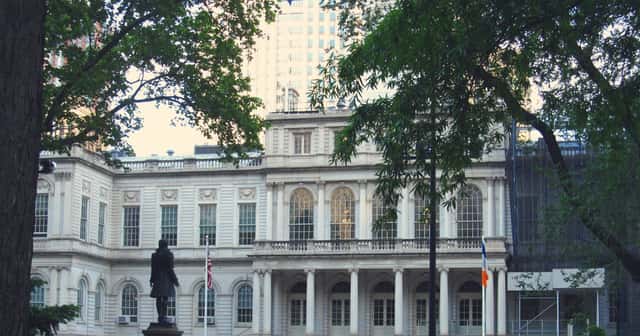
Representative archive photograph: New York City Hall, May 2012. Ken Lund / Wikimedia Commons, CC BY-SA 2.0. Cropped; adapted photograph remains under the same license. Not an image of the 2026 event.

Differing perspectives
How should New York balance faster public-space permits with accessible public review?
Each position is summarized as its supporters make it, with equal weight and in alphabetical order. A summary is not an endorsement; the evidence for each is weighed in the story above.
Retain mandatory hearings and local review
Who holds it: Center for Independence of the Disabled, New York, and D9 Harlem Votes
Opponents argue that written notice and comments do not provide an equally usable route for everyone to participate. They want public hearings and local oversight preserved because residents facing sensory, financial or digital barriers may otherwise lose a practical opportunity to question a decision that affects their sidewalks.
In their words: NYC Votes: published organizational statements ↗
Simplify the approval route
Who holds it: Commission on Government Efficiency
The commission argues that mandatory steps make routine uses of public space take too long and cost too much. It wants agencies to approve appropriate uses more promptly while retaining notification and opportunities to comment, so small businesses and people needing useful street infrastructure face fewer procedural barriers.
In their words: NYC Mayor’s Office / Commission on Government Efficiency ↗
READ BEYOND 567POLITICS
Alternate sources & perspectives
Independent coverage and primary evidence to help you compare arguments. A link is not an endorsement; perspective labels describe the linked material.
- primary evidence
Official ballot explanation and submitted positions ↗
NYC Votes
Original source for the specified policy and documented arguments; read with dates and the qualifications in the article.
- primary evidence
Official policy case and administrative objectives ↗
NYC Mayor’s Office
Original source for the specified policy and documented arguments; read with dates and the qualifications in the article.
- other perspective
Public Advocate’s November 2 explanation of his positions ↗
NYC Public Advocate
Original source for the specified policy and documented arguments; read with dates and the qualifications in the article.
- independent analysis
Election-night reporting on all five charter questions ↗
City & State New York
Original source for the specified policy and documented arguments; read with dates and the qualifications in the article.
Reviewed 2026-11-04. Reviewed the official ballot provisions and named organizations’ arguments, mayoral and other city-official statements, and independent election-night reporting. No independent election call or certified result is claimed. Ballot-guide submissions are selected advocacy statements, not a representative opinion poll. Administrative forecasts are distinguished from observed results. No campaign-funding amounts or causal claims are inferred. Related articles are part of this reviewed city batch.