NYC’s bundled charter measure joins street safety, land sales and office leases
Proposal 3 changes three approval systems at once. Supporters see faster action; critics question lost review and a ballot choice voters could not split.
New York City voters were asked to make three different decisions with one answer on November 3: how to move urgent street-safety work forward, how to dispose of certain city-owned property and how to obtain office space for public employees. Proposal 3 combines them in one charter amendment. That bundle is now the central issue in understanding what an apparent election victory would actually authorize.
City & State reported on election night that all five charter questions had passed. This report does not substitute that account for a certified canvass or make a fresh call from live returns. It examines the official text and explanation of Proposal 3 and the choices that agencies and elected officials would face in carrying it out.
The unifying argument is speed. The distinct concerns are safety, the value of public assets and oversight of city spending. A person may support a faster response to a dangerous street while wanting a longer public review before city land is sold. The ballot design does not let that person split those views into separate votes.
Three processes, three sets of consequences
The street component concerns the Department of Transportation's work and its consultation with other city bodies. The property component changes review for eligible sales, leases and development rights. The office component concerns space acquired or leased for the city workforce. None should be described as though it were simply another name for the others.
The distinction also matters for evaluating results. A transport project has safety and mobility outcomes. A land transaction has a price, a proposed use and long-term implications for a neighborhood. An office lease creates a public obligation and a workplace. A shorter approval period might help each, but a common processing-time target would not capture every relevant consequence.
For residents following our New York City desk, the useful question is which official will make a particular decision after the change and what the remaining public route for questioning it will be. A claim that the package either eliminates all oversight or preserves every existing check would obscure the actual transfer of authority.
The emergency street provision
The official explanation describes existing consultation and notification duties before major transportation projects. Proposal 3 would clarify that the transportation department can begin certain work before notifying elected officials and community boards when it identifies an immediate public-safety need based on safety data. It would also prevent technical errors or missed consultations from serving as a reason to stop a project.
That is not the same as authorizing every proposed street redesign without a public explanation. The safety finding matters. Officials should be able to identify the condition that required immediate work and the evidence they used. Otherwise, residents cannot distinguish a genuine need to move quickly from a routine project that an agency prefers not to debate.
The case for allowing urgent work is straightforward: a procedural error can leave a documented hazard in place even when the city knows how to address it. The countervailing concern is also concrete. People who use a street daily may know about access or operational problems that a design team has missed. Acting quickly should not mean that officials stop listening once construction begins.
Selling or leasing eligible public property
A separate part of the amendment would create a shorter review route for certain smaller city properties and development rights associated with city landmarks. According to the official guide, the expedited route would be limited to projects that do not require an environmental impact statement. That boundary is important. The proposal is not described as a general exemption for every major land transaction.
The shortened review would let community boards and borough presidents consider a proposal at the same time, with a final decision by the City Planning Commission rather than a final Council review. Concurrent review can reduce waiting time. Moving the final vote can also change the leverage available to a district's elected representative.
Those are legal and political changes, not proof that any particular sale will be wise or unwise. A public asset still has a value and a potential use. The documents that matter for a specific transaction include the site, the reason for disposition, the valuation and the proposed terms. Faster review cannot answer those substantive questions without that information.
The office-space change
The office component would remove specified hearings and approval votes from the process for obtaining space for city employees. The Department of Citywide Administrative Services commissioner would certify the acquisition and provide notification to relevant local officials before it is completed, with additional notice afterward.
A city office is different from a new housing development, but it can still affect a neighborhood. Employees need a place to work; the public may need to reach the services housed there. A lease can commit money over time. The absence of a Council vote makes the agency's explanation and the accessible record of the transaction more consequential.
The measure also addresses situations in which more than two years have passed after an earlier approval of a property transaction. Eliminating a repeated hearing can reduce duplication. It can also mean that a neighborhood's changed circumstances receive less formal attention. Agencies should explain what information they update before relying on an older approval.
A supporter who objects to the bundle
Public Advocate Jumaane Williams offered a useful example of a position that does not fit a simple supporter-versus-opponent slogan. In his November 2 statement, he supported Proposal 3 but said the three subjects should have been presented separately. He also raised concerns about reducing opportunities for community leaders to weigh in.
His reasoning does not establish that the concerns will be resolved automatically. It shows that agreement with the package's general aim can coexist with reservations about the way it redistributes authority. A fair account should preserve that distinction rather than counting his support as approval of every design choice.
The administration's charter-commission announcement argues that unnecessary process slows essential projects and prevents the city from using its assets effectively. Those forecasts should be tested against implementation. An estimated time saving is different from an observed reduction after the new rules take effect.
The public-review objection
The voter guide's published arguments identify the Municipal Art Society of New York among the opponents. MAS supports faster street-safety work but objects to combining the subjects and raises concerns about city land. The Long Island City Partnership separately warns that consultation helps adjust street designs around industrial businesses. These positions illustrate a practical problem: a resident may retain the ability to send a comment but lose a point in the process where an elected body can require an answer or refuse approval. Those are different forms of influence.
That concern is strongest when a decision has durable consequences, such as the disposition of public land. It need not carry the same weight for a short, urgent street intervention. The fact that the measure bundles the subjects makes it especially important to evaluate the safeguards for each on its own terms.
A vote total cannot resolve those operational disputes. It can authorize a charter change while leaving competing expectations about its use. The next phase will be a record of agency decisions, objections and responses. That record can establish whether a concern was borne out or whether a faster route retained protections in practice.
Timing and the limits of a general promise
The official guide says most of the changes would take effect on certification of voter approval. It identifies December 31, 2030 as the later date for making permanent the program allowing certain undevelopable lots to be sold to adjacent owners. A statement that every property change begins at once would therefore be too broad.
Nor does the package erase requirements outside the provisions it changes. Residents and applicants should consult the governing procedure for a particular project rather than infer a universal exemption from the name of the amendment. An official explanation should identify the legal basis for using the expedited route and the decision-maker responsible.
The same care is needed in comparing this measure with the separate building-permit proposal. One concerns how an application moves among agencies; another changes review of specific public decisions. The relationship is real, but the authorities are not identical.
Decisions should remain traceable
The city can make the new authority legible by identifying the provision it uses in every relevant decision. A record that simply cites the whole amendment will not tell a resident whether the action concerns an immediate street hazard, an eligible property transaction or an office lease. Naming the specific route also lets later reviewers compare similar cases. If agencies use the same authority differently, the public can then ask for an explanation grounded in the files rather than guess at the reason.
What an accountable rollout would show
Transportation officials can publish the evidence behind emergency findings and explain how they address access concerns raised after work starts. Property officials can identify which transactions qualify for shortened review and publish terms that allow residents to understand the public interest involved. Office decisions can disclose the space, purpose, duration and financial commitment in a clear record.
Those are different reporting tasks because the decisions are different. Publishing a single number for time saved across the package would not show whether the city obtained a fair value for land or kept a street accessible. Outcome measures have to match the underlying public purpose.
The package also sits alongside the public-space consent measure and contracting reform. Together they will test a political claim with broad appeal: that government can act more promptly without becoming harder to question. The evidence for that claim will be found in specific decisions, not in the shared efficiency label attached to them.
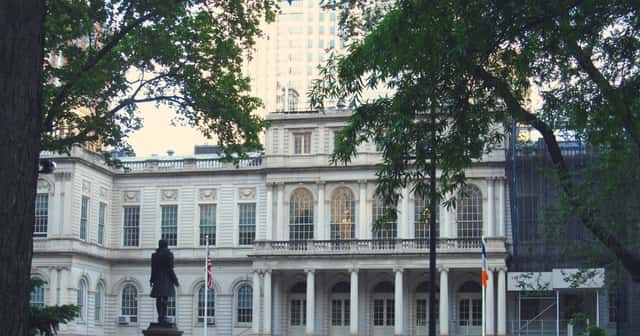
Representative archive photograph: New York City Hall, May 2012. Ken Lund / Wikimedia Commons, CC BY-SA 2.0. Cropped; adapted photograph remains under the same license. Not an image of the 2026 event.

Differing perspectives
Should street safety, city-property and office-leasing reforms be adopted in one charter package?
Each position is summarized as its supporters make it, with equal weight and in alphabetical order. A summary is not an endorsement; the evidence for each is weighed in the story above.
Separate the questions and retain stronger review
Who holds it: Municipal Art Society of New York
The organization argues that combining three different subjects prevents voters from expressing distinct preferences. It supports faster street-safety work but raises concerns about city land and public input, favoring an approach that lets communities evaluate the separate decisions and their long-term consequences.
In their words: NYC Votes: published organizational statements ↗
Use faster routes for eligible decisions
Who holds it: Commission on Government Efficiency
The commission argues that unnecessary procedural steps slow important street improvements and prevent the city from making effective use of its property. It wants targeted expedited authority so agencies can act sooner on safety needs and appropriate transactions instead of repeating lengthy reviews that may add little value.
In their words: NYC Mayor’s Office / Commission on Government Efficiency ↗
READ BEYOND 567POLITICS
Alternate sources & perspectives
Independent coverage and primary evidence to help you compare arguments. A link is not an endorsement; perspective labels describe the linked material.
- primary evidence
Official ballot explanation and submitted positions ↗
NYC Votes
Original source for the specified policy and documented arguments; read with dates and the qualifications in the article.
- primary evidence
Official policy case and administrative objectives ↗
NYC Mayor’s Office
Original source for the specified policy and documented arguments; read with dates and the qualifications in the article.
- other perspective
Public Advocate’s November 2 explanation of his positions ↗
NYC Public Advocate
Original source for the specified policy and documented arguments; read with dates and the qualifications in the article.
- independent analysis
Election-night reporting on all five charter questions ↗
City & State New York
Original source for the specified policy and documented arguments; read with dates and the qualifications in the article.
Reviewed 2026-11-04. Reviewed the official ballot provisions and named organizations’ arguments, mayoral and other city-official statements, and independent election-night reporting. No independent election call or certified result is claimed. Ballot-guide submissions are selected advocacy statements, not a representative opinion poll. Administrative forecasts are distinguished from observed results. No campaign-funding amounts or causal claims are inferred. Related articles are part of this reviewed city batch.