Sweden's Riksdag rejects Center leader Thand Ringqvist as prime minister 324-25; Kristersson gets a week
Every party but her own voted no to a centrist government. Two prime ministerial votes remain before Sweden would hold an extra election.
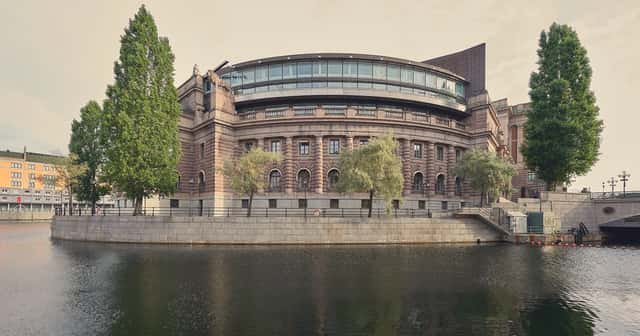
Sweden's parliament on November 3 rejected Center Party leader Elisabeth Thand Ringqvist as prime minister by 324 votes to 25. Only her own party's 25 members voted yes. Every other party, from the Left Party to the Sweden Democrats, voted no, according to SVT and Dagens Nyheter.
The result was expected. Thand Ringqvist herself said on her way into the chamber that she knew she would lose. It is still a formal milestone. It is the second failed prime ministerial vote since the September 13 election, after the Riksdag rejected Social Democratic leader Magdalena Andersson in mid-October. Under Sweden's constitution, the speaker can propose a prime minister four times. If all four votes fail, an extra election follows automatically. Two attempts remain.
Speaker Andreas Norlén had already announced the next step. Moderate Party leader Ulf Kristersson, the outgoing prime minister, now has a one-week assignment, from November 3 to November 10, to explore whether he can form a government that the Riksdag will tolerate.
This article sets out what the Riksdag voted on, how each party explained its vote, why the speaker chose to hold a vote he knew would fail, and what the next week could bring. Swedish quotations are translated by 567politics. For the background to the nomination, see our earlier report on the speaker's decision to schedule the vote.
What the Riksdag rejected
The proposal was not only a vote on a person. When the speaker nominates a candidate, he must also name the parties that would form the government. According to the Riksdag's announcement, Thand Ringqvist asked for the government to be listed as the Center Party (C), the Social Democrats (S), the Christian Democrats (KD), the Green Party (MP) and the Liberals (L). Those are the parties she had sounded out during her own exploratory assignment. As a result, Norlén said, the Riksdag would "formally take a position on the so-called center alternative."
Sweden uses negative parliamentarism. A nominee is approved unless an absolute majority of the 349 members, at least 175, votes against. Abstentions count in the nominee's favor. That rule made today's outcome hinge on whether any party outside the Center Party would abstain. None did. All 349 members took part, and the no side cleared the threshold by 149 votes.
Source: SVT, Dagens Nyheter
Show the numbers
| Party | No | Yes |
|---|---|---|
| Social Democrats (S) | 99 | 0 |
| Moderates (M) | 70 | 0 |
| Sweden Democrats (SD) | 62 | 0 |
| Left Party (V) | 30 | 0 |
| Center Party (C) | 0 | 25 |
| Christian Democrats (KD) | 22 | 0 |
| Green Party (MP) | 22 | 0 |
| Liberals (L) | 19 | 0 |
The chart shows why the vote was a formality. Three of the five parties named in the proposed government, KD, MP and L, voted against it. So did the Social Democrats, whose leader was supposed to lead the centrist government that Thand Ringqvist had explored.
How the parties explained their votes
Before a prime ministerial vote, each party may give an explanation of vote in the chamber. Dagens Nyheter's live coverage summarized the main statements.
Social Democrats. Group leader Lena Hallengren said her party would vote no. "Several of the parties in an imagined center government have closed the door on this alternative," she said. "In addition, the candidate we are voting on has not taken a position for it either." She said the party had had good and open talks with Thand Ringqvist.
Left Party. Samuel Gonzalez Westling said the Left Party would vote no because it was not part of the proposed government's base. "The center alternative is thereby rejected," he said. He added that his party was ready to negotiate so that the process could move on.
Sweden Democrats and the right-of-center parties. Matheus Enholm of the Sweden Democrats contrasted what he called the deep divisions among the red-green parties with the unity of the "blue-yellow team." The Moderates, Christian Democrats and Liberals also said they would vote no.
The candidate who did not seek the job
Thand Ringqvist's position was unusual. She had explored a centrist government led by Andersson, not by herself. When she received that assignment, she said her aim was "to contribute to a solution to the government question, not to become prime minister myself," SVT reported.
"I have accepted this vote even though I know I will fall in the chamber," she told Expressen before the vote. She told Dagens Nyheter that Andersson remained her party's candidate for prime minister "if she can make sure that we find a government that does not need to have the Left Party in it." On Kristersson's chances, she said: "I will talk constructively with Ulf, just as he talked constructively when I had it. But it is clear that the conditions for finding a government are very limited."
The Center Party's red lines remain in place. TV4 summarized them: the party will not accept the Left Party in government and will not support a government in which the Sweden Democrats have influence. Those two conditions are the core of the deadlock. The four center-left parties (S, V, MP and C) hold 176 seats, a bare majority. But the Center Party will not sit with the Left Party. Meanwhile, the four right-of-center parties hold 173 seats, two short of what they would need to block a red-green nominee on their own.
Why the speaker held a vote he expected to fail
Norlén explained his reasoning at a press conference on October 29. His approach this autumn, he said, has been to pair each exploratory assignment with a vote. He pointed to the 2018 government formation, which began with about two months of talks without votes and little movement. "Only when we started voting on prime ministerial candidates did movements begin to appear between the parties," he said. Stefan Löfven was approved at the third vote in January 2019.
The speaker said he had not been fond of that approach himself. But he said it had become an established view, and that a speaker must act on it. He said the votes serve two purposes: keeping up the pace and "gradually increasing the pressure on the parties" as an extra election approaches, and creating a clear end to each stage of the process. He noted that most parties seemed to expect the first two votes to fail before real movement could start. "On that basis one must assume there is an interest in the second vote taking place as soon as possible," he said.
The red-green parties criticized the decision. Andersson and Green Party spokesperson Amanda Lind both said Kristersson should have received the exploratory mandate directly, SVT reported. Andersson repeated that view before today's vote. "I have had the exploratory assignment once, and since then I have thought all along that it is time for Kristersson to have an exploratory assignment," she told Dagens Nyheter. "I think he should have got it without the vote we are having today."
Kristersson's week
Kristersson now has until November 10. The Christian Democrats welcomed the step. "It is entirely natural that Ulf Kristersson is now given the formal exploratory assignment," KD leader Ebba Busch said at a press conference, adding that the Moderate leader is her party's candidate for prime minister. She said her party had held talks with various parties since election day and would continue to do so "regardless of who has the exploratory assignment."
The Moderates themselves are cautious. Group leader Mattias Karlsson told Expressen that he saw no opening for the Center Party to join a right-of-center government. Kristersson would have to "examine whether there are any openings around the red lines that came during the election campaign," he said. "But I see no such openings." Asked who would be to blame for an extra election, he said: "Magdalena Andersson, it is her failure that means we are standing here today." Speaking to Dagens Nyheter, Karlsson also said that "all scenarios for reaching a solution here and getting a new government in place seem completely improbable today."
On the left, the message is that the Center Party must now choose. "It is up to the Center Party now to choose between a government that goes right or a government that goes left," Left Party leader Nooshi Dadgostar said on her way into the vote. She told TV4 she was "very disappointed" that the red-green parties had not started negotiating earlier. Lind, for the Greens, remained optimistic. "We believe we will get this together. There is a red-green majority in the Riksdag," she told Dagens Nyheter.
The path to an extra election
The speaker has also set out what happens if Kristersson fails. According to the Riksdag announcement, Norlén will then find out whether a government can be formed on the red-green side before calling a third vote. "It would undeniably be good if the government formation could be resolved before the third vote," he said, "so that we can if possible avoid the fourth vote and all the tension and drama it would bring."
Sweden has never held an extra election under the current constitution, which took effect in 1975. The closest precedent is the 2018 to 2019 formation, which lasted more than four months and ended at the third vote. As of today, 51 days have passed since the 2026 election.
For context on how Sweden's institutions compare with other democracies, see our Norway vs. Sweden and Sweden vs. United States comparisons. Our methodology explains how we report on government formation and polling.
The next decisions
Three dates matter. Kristersson's exploratory assignment ends on November 10, when he is expected to report to the speaker. Norlén will then decide whether to nominate Kristersson, return to the red-green side, or take another step. And if a third vote also fails, only one attempt would remain before Sweden goes back to the polls.
Differing perspectives
Was holding a prime ministerial vote on Elisabeth Thand Ringqvist a useful step toward a new Swedish government?
Each position is summarized as its supporters make it, with equal weight and in alphabetical order. A summary is not an endorsement; the evidence for each is weighed in the story above.
Accept it to move the process forward
Who holds it: Center Party leader Elisabeth Thand Ringqvist
Thand Ringqvist says she accepted the vote, knowing she would lose, so that her exploratory work would lead somewhere concrete. She argues that Sweden still needs a government that includes neither the Left Party nor Sweden Democrat influence, and says she will talk constructively with Kristersson while warning that the conditions for any government are very limited.
In their words: Expressen ↗
It clears the way for a right-of-center attempt
Who holds it: Christian Democrat leader Ebba Busch and the right-of-center parties
Busch argues that after the failed vote it is entirely natural for Ulf Kristersson to receive the formal exploratory assignment, giving the Moderate leader a week to test whether he can form a government. She backs Kristersson as prime minister, and her Christian Democrats joined the Moderates, Sweden Democrats and Liberals in voting against the centrist option.
In their words: SVT Nyheter ↗
It proves the center option is dead
Who holds it: Left Party leader Nooshi Dadgostar
Dadgostar argues that the vote makes clear that no centrist government exists and that the Center Party must now choose between a government leaning right with Sweden Democrat influence and a government leaning left. She says she is very disappointed that the red-green parties did not begin negotiating much earlier, when more problems could have been solved.
In their words: TV4 ↗
No, Kristersson should have been tested first
Who holds it: Social Democrats, including Magdalena Andersson and group leader Lena Hallengren
The Social Democrats argue that the vote was unnecessary because several parties in the proposed centrist government had already closed the door to it and the candidate herself had not sought the post. Andersson says Kristersson should have received the exploratory assignment without today's vote, and that the party is holding talks with several parties.
In their words: Dagens Nyheter ↗
Yes, votes create pressure and close each stage
Who holds it: Riksdag Speaker Andreas Norlén
Norlén argues that pairing each exploratory assignment with a vote keeps up the pace of government formation and gradually increases pressure on the parties as an extra election approaches. Citing 2018, when movement began only after votes started, he says a vote also gives each stage a clear end so that other alternatives can be explored next.
In their words: Sveriges riksdag ↗
READ BEYOND 567POLITICS
Alternate sources & perspectives
Independent coverage and primary evidence to help you compare arguments. A link is not an endorsement; perspective labels describe the linked material.
- primary evidence
Talmannen lägger fram Elisabeth Thand Ringqvist (C) som förslag till statsminister ↗
Sveriges riksdag
Speaker's nomination, full press-conference remarks and the schedule for Kristersson's assignment.
- independent analysis
Senaste nytt om valet 2026 ↗
SVT Nyheter
Public broadcaster's live coverage with the 324-25 result.
- independent analysis
DN Direkt – Riksdagen röstar om C-ledaren ↗
Dagens Nyheter
Live coverage of each party's explanation of vote and the result.
- other perspective
Riksdagen röstar om Elisabeth Thand Ringqvist ↗
Expressen
Interviews with Thand Ringqvist and Moderate group leader Mattias Karlsson.
- left argument
Riksdagen röstar om Elisabeth Thand Ringqvist (C) ↗
TV4
Left Party leader Nooshi Dadgostar's criticism of the red-green parties and the Center Party's red lines.
- right argument
C-ledaren går mot nederlag – Kristersson väntas få stafettpinnen ↗
SVT Nyheter
Christian Democrat leader Ebba Busch on Kristersson taking the exploratory assignment.
Reviewed 2026-11-03. Built by hand from sources opened on Nov 3 2026; the discovery tool has returned unrelated results this batch. Tally (324 no, 25 yes) confirmed by SVT and DN; Swedish quotations translated by 567politics.