Human Rights Watch (HRW) has accused Zambia's police and military of forcibly disappearing, arbitrarily detaining, beating and threatening opposition members, lawyers, journalists and critics around the country's August 13 general election. The report was released at 11 p.m. Eastern Time on Sunday, November 1, and reported by the Associated Press and Zambian media on Monday.
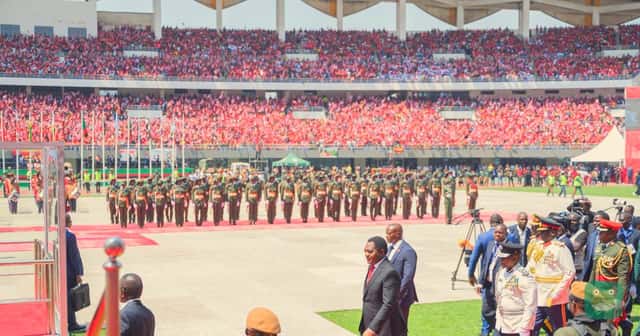
President Hakainde Hichilema won a second term in that election. The government has said the arrests that followed were a response to an armed plot against the state, and police say they recovered military-grade weapons. The opposition denies any such plot. Eighteen people, including the main opposition candidate, Brian Mundubile, face treason charges.
As of midday Monday, Eastern Time, 567 Politics had not found a published government response to the new report. This article sets out what HRW documented, what the government and police have said about the same events, what independent observers found, and which questions remain open.
What the report says
HRW said it documented, from court records and interviews with victims, relatives and lawyers:
- 14 cases in August that appear to be enforced disappearances, in which authorities refused to reveal where a detained person was being held
- 61 cases in which detainees or their lawyers or relatives allege beatings or other violent abuse during arrest or detention
- 71 arrests or prolonged detentions on charges HRW says "may be politically motivated," including 43 opposition election monitors and 17 musicians and comedians who performed at an opposition rally
- 18 people charged with treason, two of whom also face sedition charges
- seven people, including lawyers and a journalist, who said they fled their homes because they believed they were targeted for arrest
- two cases of alleged harassment of relatives of government critics living abroad
HRW also said the government "has not disclosed how many people were arrested during the crackdown or the charges against them."
"Zambia's government should break this dangerous cycle of repression," said Ashwanee Budoo-Scholtz, HRW's deputy Africa director. Budoo-Scholtz said the authorities should "immediately halt the ongoing post-election crackdown." HRW also asked them to allow detainees access to lawyers and medical care, release everyone arbitrarily detained and hold security forces accountable.
These are HRW's findings. Most of the individual abuse allegations come from detainees, their families and their lawyers, and in several cases from court petitions that have not yet been tested in court.
type: bar
title: What Human Rights Watch documented in Zambia around the August 2026 election
note: Counts are Human Rights Watch's own, drawn from court records and interviews with victims, relatives and lawyers. Cases can fall in more than one category. HRW says the government has not disclosed how many people were arrested.
source: [Human Rights Watch, Nov. 1, 2026](https://www.hrw.org/news/2026/11/01/zambia-widespread-repression-in-post-election-crackdown)
---
Category | Cases
Arrests or long detentions HRW calls possibly political | 71
Alleged beatings or abuse in custody | 61
People charged with treason | 18
Apparent enforced disappearances | 14
The August 14 raid
The central event in the report is a raid on August 14, the day after the election, at Mundubile's home in Lusaka's Kabulonga suburb. Former cabinet minister Mutotwe Kafwaya died during the operation.
The two sides give very different accounts.
The police account. Inspector General of Police Graphel Musamba said the raid was a "joint intelligence-led operation" by a task force that included the Drug Enforcement Commission, Lusaka Times reported on August 19. He said it followed intelligence gathered after 7.3 million kwacha was recovered in a separate operation, and that security agencies had been monitoring the activities since November 2023. According to Musamba, officers "were met with gunfire and resistance from unknown individuals," prompting them to return fire. One man was fatally wounded and was later identified by family members as Kafwaya.
Musamba said 11 people were arrested at the property. He said they included three former commandos and two retired police officers. He listed items recovered: five AK-47 rifles, 60 rounds of ammunition, a Zastava pistol, automatic Uzi weapons, a bulletproof vest, night-vision binoculars and other equipment. He said electronic devices and documents would undergo forensic examination.
The opposition and HRW account. Opposition members who were present allege that security forces killed Kafwaya. Mundubile has stated in a High Court petition, which HRW says it has seen, that he saw a soldier fatally shoot Kafwaya. HRW said Kafwaya's fate was not known until August 19, after his wife filed a habeas corpus petition.
HRW also pointed to contradictory official statements. On August 15, the telecoms regulator sent a text message to all registered phones warning: "Beware of false reports of shootings and abductions." The Ministry of Information and Media called reports of the raid "disinformation intended to alarm and mislead the public." Police first denied there had been a raid and later acknowledged the operation.
Neither account has been tested in court, and no independent investigation of the killing has been published. Amnesty International called on August 20 for an independent inquiry into Kafwaya's death. Amnesty said the government's allegation of an insurrection plot and the weapons seizure "must be thoroughly and transparently investigated." It added that the authorities remain bound by the constitution and human rights law "regardless of the allegations."
The treason charges and the closed courts
Mundubile and his running mate, Makebi Zulu, took refuge at a United Nations building in Lusaka after the raid. They were handed to police and charged with treason at the end of August, the BBC reported. The authorities accused their party, the NRPUP, part of the Tonse Alliance, of planning an armed insurgency, which the party denied.
HRW said the charge sheet against Mundubile and Zulu alleges that they went on Facebook Live on August 14 to say the opposition had won. The government alleges that this was meant to "raise discontent or disaffection among the people of Zambia." HRW argues that treason charges, which are not bailable, are being used "to stifle dissent and political opposition."
From August 24 to 28, the authorities closed and cordoned off court premises. HRW said police called the closures an "intelligence-led and preventive measure" without giving details. The BBC reported that this blocked an opposition challenge to the presidential result, because the courts were sealed on the final day a petition could be filed.
Defense lawyer Milner Katolo said police should have gathered sufficient evidence before laying the treason charge, Lusaka Times reported. Police spokesperson Godfrey Chilabi dismissed suggestions that Lusaka's central police station had been sealed off. "All persons in custody are given their full rights," he said, "which include interacting with their relatives as well as having access to their legal counsel."
The government's case
The government's position, as set out in its public statements, is that the arrests are criminal matters, not political ones.
In September, a United Nations special rapporteur called for the release of "all political detainees." The Ministry of Foreign Affairs replied, as quoted by HRW, that being an opposition member "does not place a person beyond the reach of the law, nor does it convert a criminal suspect into a political detainee." It called the rapporteur's statement "inaccurate, undiplomatic and falling short of the standards of objectivity, moderation and discretion expected of UN mandate holders." The ministry added that "Zambia's courts are open to test" detainees' legal protections.
The governing United Party for National Development (UPND) has made a similar argument. After Amnesty raised concerns, UPND media director Mark Simuwe said Zambia's justice system requires investigations to be completed before charges are determined, Lusaka Times reported. He argued that the question should be whether suspects face trumped-up charges, not the fact of arrests involving alleged military weapons.
The government has also rejected earlier HRW criticism. In March, before the election, Information Minister and chief government spokesperson Cornelius Mweetwa told The Mast that a previous HRW report was "desktop research and not connected to hard facts on the ground."
At his inauguration on September 1, Hichilema did not mention his opponent's detention, the BBC reported. He said the "pursuit of political power must never come at the expense of peace, security and stability in our country." He also said: "Democracy does not require us to agree on everything. It requires us to respect one another even when we disagree."
What independent bodies have said
Zambia's own institutions have raised concerns. HRW said the state Human Rights Commission reported on September 3 that it was following 84 election-related detainees. The commission described a "disturbing pattern of prolonged detention, delayed notification of charges, restricted access to family and legal representation." The Law Association of Zambia raised concerns about prolonged detention without court appearances on September 22.
On September 10, a court in Lusaka ordered the release of the 43 detained election monitors, ruling that their arrest was unjustified, according to HRW.
On the election itself, official results gave Hichilema 60% of the vote and Mundubile 38%, the BBC reported. Observers described polling day as largely peaceful. European Union observers said staff at many tallying centers did not record results on tally sheets as soon as they were announced, and they cited weak checks between digital entries and paper records. These observations concern the counting process. They do not by themselves show that the overall result was wrong, and the opposition's claim of a stolen election has not been tested in court.
Checking the arguments
"Not beyond the reach of the law." The Foreign Ministry's principle is correct as a general statement: opposition membership does not shield anyone from prosecution. But it does not answer HRW's specific allegations about disappearances, beatings and denial of lawyers. Those allegations concern how suspects are treated, not whether they can be charged.
"Desktop research." Mweetwa's March description was aimed at an earlier report, not the new one. The new report cites court petitions, charge sheets and interviews. Whether those sources are accurate is a fair question, but the "desktop research" label does not fit a report built on them. In the same March interview, Mweetwa asked where the researchers had been when UPND supporters were being shot dead by police and rival cadres, and he contrasted the current period with media and campaign restrictions under the previous Patriotic Front government. That question is a "whataboutism" (tu quoque) argument: past abuses by others do not answer whether current abuses occurred.
"To stifle dissent." HRW's view that treason charges are being used for political ends is an inference from the pattern of arrests. The government says the charges rest on evidence, including seized weapons. The courts have not yet heard the evidence, so neither claim has been established.
How this compares
Questions about how authorities treat opposition figures around elections appear elsewhere in 567 Politics coverage. In Malaysia, police are investigating remarks by opposition figure Rafizi Ramli during a state election campaign. In India, the opposition is pursuing the removal of the chief election commissioner. Zambia's neighbor South Africa holds local elections this week. Our editorial standards and methodology explain how we weigh rights-group reports against official statements.
What is not known
- How the government will respond to the November 1 report. No response had been published by midday Monday, Eastern Time.
- What the forensic examination of the seized weapons and devices found, and whether the treason cases will reach trial.
- Who fired the shots that killed Kafwaya. No independent investigation has been published.
- How many people were arrested in total. HRW says the government has not disclosed a figure.
- How Zambians view the crackdown or the election. This article cites no opinion poll on either.
Funding note: this story concerns detentions and charges rather than candidates' finances. 567 Politics did not review Zambian party or campaign funding records for this article and did not identify a public donation-disclosure database to check.