Brazil's first round: Flávio Bolsonaro edges Lula as the PL wins the most seats in Congress
Bolsonaro took 47.03% to Lula's 45.16% on Oct. 4, against every final poll. The PL won 121 Chamber seats and is set for 29 senators; 21 governors won outright.
Senator Flávio Bolsonaro of the Liberal Party (PL) finished first in Brazil's presidential election on October 4, 2026. He took 56,104,503 votes, or 47.03% of valid votes. President Luiz Inácio Lula da Silva of the Workers' Party (PT) took 53,879,538, or 45.16%, according to the Superior Electoral Court's (TSE) official results file. Neither reached the majority needed to win outright, so the two met in a runoff on October 25.
The order surprised pollsters. Every major final poll had Lula ahead. The same day, the PL won the most seats in the Chamber of Deputies, 121 of 513, and was set to hold the largest single-party bench in the Senate since 1988.
Lula went on to win the runoff, as covered in our report on the October 25 result. This article records what happened in the first round: the presidential vote, the polls, the new Congress and the 27 governor races.
The presidential vote
| Candidate | Party | Votes | Share |
|---|---|---|---|
| Flávio Bolsonaro | PL | 56,104,503 | 47.03% |
| Lula | PT | 53,879,538 | 45.16% |
| Augusto Cury | Avante | 3,448,569 | 2.89% |
| Renan Santos | Missão | 2,675,887 | 2.24% |
| Ronaldo Caiado | PSD | 2,605,148 | 2.18% |
| Romeu Zema | Novo | 326,488 | 0.27% |
| Six others | Various | 260,655 | 0.22% |
Source: TSE national results file, 100% of 499,248 sections counted. Shares are of valid votes, which exclude blank and null ballots.
Bolsonaro's lead was 2,224,965 votes, or 1.87 points. The other candidates finished far behind. Ronaldo Caiado, the former governor of Goiás, ran for the PSD with party president Gilberto Kassab as his running mate and won 2.18%. Former Minas Gerais governor Romeu Zema of Novo won 0.27%. The best of the rest was Augusto Cury, a psychiatrist and best-selling author, with 2.89%. Renan Santos, founder of the new Missão party, won 2.24%.
Turnout was low by Brazilian standards. Of 158,745,502 registered voters, 33,469,244 did not vote, an abstention rate of 21.08%. That was the highest first-round abstention in a general election since 1998, Agência Brasil reported. Blank ballots were 1.84% of votes cast and null ballots 2.93%.
How the polls missed
All five major polls released on the eve of the vote had Lula ahead on valid votes. All of them underestimated Bolsonaro, by 2 to 5 points.
| Pollster | Field dates | Lula | Flávio |
|---|---|---|---|
| AtlasIntel | Sept. 27-Oct. 2 | 47.0% | 44.1% |
| CNT/MDA | Sept. 30-Oct. 2 | 47.8% | 42.1% |
| Datafolha | Final week | 45% | 42% |
| PoderData | Sept. 30-Oct. 2 | 45% | 43% |
| Quaest | Oct. 2-3 | 46% | 45% |
| Result | Oct. 4 | 45.16% | 47.03% |
Sources: Poder360 for Datafolha and CNT/MDA, CNN Brasil for Quaest and AtlasIntel, and Gazeta do Povo for PoderData. Outlets gave different field dates for the final Datafolha survey of 4,006 voters.
The polls were closer on Lula than on Bolsonaro. Their estimates of Lula's share were within about 3 points of the result. Their estimates of Bolsonaro's were all too low. Quaest came closest, with Bolsonaro 2 points short.
Pollsters offered different explanations, Metrópoles reported. Quaest's Felipe Nunes said his survey had caught a late consolidation of right-leaning voters around Bolsonaro, a "useful vote" for the strongest candidate on that side. Political scientist Antônio Lavareda pointed to higher abstention among lower-income voters, a group that leans toward Lula. Both readings fit the numbers. Neither has been tested with published voter-level data, and the two are not mutually exclusive.
The runoff added a twist. Three weeks later, the final polls missed in the other direction: all of them had Bolsonaro ahead, and Lula won. Errors that change sign between rounds point away from a fixed bias toward one camp. They are consistent with difficulty predicting who will turn out, since abstention fell from 21.08% in the first round to 19.22% in the runoff. That remains an inference, not a finding.
Election night
Bolsonaro called the result "the end of the PT era," CNN Brasil reported. He mocked the polls that had shown him behind and said a government led by him could appoint at least four Supreme Court justices, SBT News reported.
Lula spoke in São Paulo. He called the vote a lesson in democracy and said the runoff would be the "prova dos nove," or the decisive test, Agência Brasil reported. He said he would appeal to the more than 28 million people who had not voted, Alma Preta reported. The TSE's final count of non-voters was higher, at 33.5 million.
The eliminated candidates split over the next days. Zema endorsed Bolsonaro on October 5, and former President Michel Temer of the MDB did too. Caiado followed on October 6, and Cury on October 8 after Bolsonaro signed eight written commitments. Renan Santos stayed neutral and called both finalists crooks. Several small left-wing parties gave Lula what they called "critical" support. Our runoff report covers these endorsements in more detail.
The new Chamber of Deputies
The PL won 121 seats, 24 more than in 2022, the Chamber's news agency reported. It is the largest party by a wide margin. The PT won 70 seats on its own and 88 counting its federation partners, the PCdoB and PV. Brazilian law lets parties form "federations" that must act as a single bloc for four years.
Source: Agência Câmara, Gazeta do Povo
Show the numbers
| Party | Seats |
|---|---|
| PL | 121 |
| PT | 70 |
| União Brasil | 46 |
| PSD | 43 |
| PP | 41 |
| Republicanos | 41 |
| MDB | 36 |
| Podemos | 27 |
| PSB | 15 |
| PSOL | 14 |
| PCdoB | 11 |
| PSDB | 11 |
| Novo | 10 |
| PV | 7 |
| PDT | 6 |
| Avante | 5 |
| PRD | 5 |
The PL's gain does not give it control. The center-right parties often called the "Centrão," including União Brasil, the PP, the PSD, Republicanos and the MDB, together hold more than 200 seats. They remain the swing bloc for any government, Gazeta do Povo noted. Novo rose from 3 seats to 10 and Podemos from 20 to 27. The PDT fell from 17 to 6 and the PSDB-Cidadania federation from 18 to 11.
Two PL candidates set records. Nikolas Ferreira of Minas Gerais won 3,119,318 votes, and Lucas Pavanato of São Paulo won 3,038,438. Both surpassed the previous record for a federal deputy, O Liberal reported. Erika Hilton of PSOL was third nationally, with 1,596,472 votes in São Paulo.
| Rank | Deputy | Party and state | Votes |
|---|---|---|---|
| 1 | Nikolas Ferreira | PL-MG | 3,119,318 |
| 2 | Lucas Pavanato | PL-SP | 3,038,438 |
| 3 | Erika Hilton | PSOL-SP | 1,596,472 |
| 4 | André Fernandes | PL-CE | 684,372 |
| 5 | Sâmia Bomfim | PSOL-SP | 583,107 |
Source: TSE deputy results files by state.
Big vote totals matter more in Brazil than elsewhere because of how seats are filled. Each state is one large district. Seats go to parties by their combined vote, so a candidate with millions of votes can carry party colleagues into office. That effect is at the center of a new push to change the system, covered in our report on the Chamber's mixed district voting proposal. Other notable winners included Kim Kataguiri, Missão's only deputy, and Tabata Amaral of the PSB.
The Senate
Two-thirds of the Senate, 54 of 81 seats, were on the ballot, two per state. The PL won 19 of them, more than any other party. The MDB won 7 and the PT 6. Forty of the 54 seats went to new senators, and only 14 of the 32 incumbents who ran again were re-elected, the Senate's news agency reported.
Combined with senators whose terms run to 2031, the result gives the PL 29 senators from February 2027, the Senate agency projected. That is more than a third of the chamber and the largest single-party bench since 1988, the agency noted.
| Party | Senators from 2027 |
|---|---|
| PL | 29 |
| PT | 10 |
| MDB | 8 |
| PP | 6 |
| União Brasil | 5 |
| Republicanos | 5 |
| PSD, PSB | 4 each |
| Others | 10 |
Source: Agência Senado projection, October 25, 2026. It is subject to party switches and to a pending ruling on one Paraná seat.
Several well-known figures won. Former first lady Michelle Bolsonaro and Bia Kicis took both seats in the Federal District for the PL. Carlos Bolsonaro, another of the former president's sons, won in Santa Catarina. In São Paulo, Guilherme Derrite of the PP won more than 13.2 million votes, the most of any Senate candidate.
Several prominent senators and ministers lost. In São Paulo, Simone Tebet of the PSB and Marina Silva of Rede finished third and fourth. Gleisi Hoffmann of the PT lost in Paraná. Renan Calheiros of the MDB lost in Alagoas to Arthur Lira, the former Chamber speaker, and Marina JHC. Esperidião Amin of the PP lost in Santa Catarina, and Manuela D'Ávila of PSOL lost in Rio Grande do Sul.
One seat is in dispute. Former prosecutor Deltan Dallagnol of Novo finished second in Paraná, which would elect him. A TSE justice rejected his registration on October 3. The TSE president suspended that ruling the next day, so his votes were counted pending appeal. If the rejection is upheld, Paraná will hold a supplementary election, the Senate agency reported.
The governors
Voters chose governors in all 26 states and the Federal District. Twenty-one races were decided on October 4. Six went to runoffs on October 25, in Acre, Amazonas, the Federal District, Espírito Santo, Rio Grande do Norte and Tocantins.
| State | Winner (party) | Share |
|---|---|---|
| São Paulo | Tarcísio de Freitas (Republicanos) | 62.65% |
| Minas Gerais | Cleitinho Azevedo (Republicanos) | 55.40% |
| Rio de Janeiro | Douglas Ruas (PL) | 50.88% |
| Bahia | Jerônimo Rodrigues (PT) | 55.80% |
| Paraná | Sergio Moro (PL) | 50.10% |
| Rio Grande do Sul | Luciano Zucco (PL) | 58.05% |
| Pernambuco | Raquel Lyra (PSD) | 53.27% |
| Ceará | Elmano de Freitas (PT) | 53.19% |
| Pará | Dr. Daniel (Podemos) | 51.36% |
| Santa Catarina | Jorginho Mello (PL) | 68.98% |
| Goiás | Daniel Vilela (MDB) | 59.17% |
| Maranhão | Eduardo Braide (PSD) | 54.02% |
| Paraíba | Lucas Ribeiro (PP) | 64.30% |
| Mato Grosso | Otaviano Pivetta (Republicanos) | 60.77% |
| Alagoas | JHC (PSDB) | 52.20% |
| Piauí | Rafael Fonteles (PT) | 70.90% |
| Mato Grosso do Sul | Eduardo Riedel (PP) | 67.07% |
| Sergipe | Fábio Mitidieri (PSD) | 59.27% |
| Rondônia | Marcos Rogério (PL) | 56.86% |
| Amapá | Dr. Furlan (PSD) | 62.75% |
| Roraima | Arthur Henrique (PL) | 69.13% |
Source: TSE state governor results files; shares are as displayed by the TSE. A BBC Brasil summary republished by O Povo lists the same winners.
The PL won six governorships in the first round, more than any other party. In São Paulo, Tarcísio de Freitas won a second term by beating former Finance Minister Fernando Haddad of the PT, 62.65% to 36.42%. In Paraná, former judge and senator Sergio Moro, now in the PL, cleared the 50% line by about 6,800 votes. In Ceará, the PT's Elmano de Freitas held off former minister Ciro Gomes, now in the PSDB. The PT won Bahia, Ceará and Piauí, all in the Northeast. Incumbents Raquel Lyra in Pernambuco and Eduardo Riedel in Mato Grosso do Sul were re-elected.
Rio de Janeiro was decided in court. On election night the PL's Douglas Ruas led Rio Mayor Eduardo Paes of the PSD but fell short of 50%. Anthony Garotinho of Republicanos had run while appealing a lower court's rejection of his candidacy under Brazil's "clean record" law. On October 8 the TSE voted 5 to 2 to annul his 274,411 votes, Agência Brasil reported. With those votes removed from the valid total, Ruas's share rose to 50.88%, and the state court declared him elected. Paes said on October 9 that he would not keep fighting.
Election-day problems
The TSE's public results page for the national race stalled for about an hour on election night, at about 65% of sections counted. State pages kept updating. The TSE said the pause came from a surge in data and affected only the display, not the count. It called claims of fraud false, Poder360 reported.
More than 1,500 voting machines, about 0.3% of the total, had been replaced by mid-afternoon without any need for paper ballots, Agência Brasil reported. TSE President Kassio Nunes Marques said the court had seen no concrete sign of foreign interference, the Chamber's news agency reported. Police detained 59 people for electoral crimes by mid-afternoon.
The last days of the campaign were turbulent too. TV Globo canceled its October 1 presidential debate after Lula declined to attend and a string of court rulings on its format, Poder360 reported. On October 2, the U.S. and Australian embassies suspended consular services nationwide, citing security, Agência Brasil reported. U.S. President Donald Trump said he was following the election closely but endorsed no one, O Povo reported.
What the first round showed
The first round sent two signals that pulled in different directions. The PL emerged as the largest party in both houses, and Bolsonaro led the presidential vote. At the same time, the center-right parties kept the votes any president needs to pass laws, and many of them later backed Bolsonaro in the runoff. Lula then won the second round by 4.4 million votes.
The result leaves Lula facing a Congress in which the PL is his largest opponent in both houses. Constitutional amendments need 308 deputies and 49 senators, so the PL alone cannot block one in the Chamber but holds more than a third of the Senate. In the Senate, 33 votes are enough to defeat an amendment, and the PL's 29 senators come close. Background on the system is on our Brazil election guide.
Campaign finance note: Brazilian candidates file campaign accounts with the TSE. This article did not review those filings.
Photo and reporting note
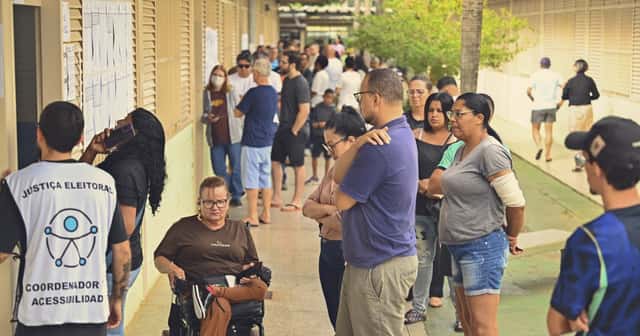
Photo: Voters wait in line at a school in Taguatinga Norte, Federal District, on the morning of October 4, 2026. Edilson Rodrigues/Agência Senado, original file, CC BY-SA 4.0. Cropped for publication; the adapted photo remains available under the same license. This AI-assisted report was prepared on November 2, 2026, from TSE results files and the sources linked above. Seat counts and margins not attributed to an outlet are 567politics calculations from TSE files.

Differing perspectives
After the first round, whom should voters for eliminated candidates back in the runoff, and on what terms?
Each position is summarized as its supporters make it, with equal weight and in alphabetical order. A summary is not an endorsement; the evidence for each is weighed in the story above.
Back Bolsonaro only on written commitments
Who holds it: Augusto Cury of Avante, third-place finisher
Cury said he could not support Lula because of his political project, not for personal reasons, and backed Bolsonaro only after he signed eight public commitments, including ending re-election, full-time schooling, telemedicine in the public health system and action on violence against women. Cury stressed that his support was not a blank check and said he would not join a government.
In their words: Poder360, Oct. 8, 2026 ↗
Back Bolsonaro to end PT rule
Who holds it: Romeu Zema of Novo, Ronaldo Caiado, former President Michel Temer and parties including Republicanos, Novo and Podemos
Zema said he could not sit on the fence and that the risk Brazil runs with four more years of PT government is very clear. He described the PT as the opponent the right had to defeat. Those who followed him argue that Bolsonaro, who led the first round, was the only candidate able to beat Lula, so a divided vote on the right would help the president win a fourth term.
In their words: CNN Brasil, Oct. 5, 2026 ↗
Back neither finalist
Who holds it: Renan Santos of Missão, fourth-place finisher
Santos said he would not endorse anyone and told his voters to do as they wished. He said he does not vote for crooks and applied that description to both Lula and Bolsonaro. He also said Bolsonaro had already won, so in his view his own endorsement would not change the result and his voters owed neither finalist their support.
In their words: Agência Brasil, Oct. 5, 2026 ↗
Give Lula a critical vote without backing his government
Who holds it: Small left-wing parties including the PSTU and PCB and their candidates
These parties called for a vote for Lula in the runoff while saying they would give no political support to a new Lula government. They argue that keeping Bolsonaro's camp out of power comes first, but that their programmatic differences with the PT remain, and that a critical vote lets them oppose both the right and the government's own policies.
In their words: O Liberal/Estadão, Oct. 7, 2026 ↗
Re-elect Lula and win back those who stayed home
Who holds it: President Lula, the Workers' Party and its coalition partners
Lula said the first round was a lesson in democracy and that the runoff would be the decisive test, which he called the "prova dos nove." He described the other side as uncertainty with a dark past. He said a new two-candidate campaign began the next day and that he would work to reach the millions of Brazilians who had not voted on October 4.
In their words: Agência Brasil, Oct. 4, 2026 ↗
READ BEYOND 567POLITICS
Alternate sources & perspectives
Independent coverage and primary evidence to help you compare arguments. A link is not an endorsement; perspective labels describe the linked material.
- primary evidence
TSE official national first-round results file (election 6257, president) ↗
Tribunal Superior Eleitoral
Final first-round totals for all 12 presidential candidates, turnout, abstention, blank and null votes.
- primary evidence
PL sai na frente na eleição da Câmara dos Deputados com 121 eleitos ↗
Agência Câmara
The Chamber's own count of seats by party and federation, with changes from 2022.
- primary evidence
Fim da eleição define composição do Senado em 2027 com 13 partidos ↗
Agência Senado
Projected party totals in the Senate from February 2027, including the PL's 29 seats and the caveats.
- primary evidence
Em 2027, Senado terá 40 senadores novos e 14 reeleitos ↗
Agência Senado
Renewal figures for the 54 Senate seats and the list of re-elected incumbents.
- independent analysis
TSE anula votos de Garotinho e Ruas vence governo do Rio no 1º turno ↗
Agência Brasil
The Oct. 8 TSE ruling that annulled Garotinho's votes and decided Rio de Janeiro's governor race.
- independent analysis
Erros das pesquisas para presidente, governo e Senado ↗
Metrópoles
Post-election review of polling misses, with pollsters' own explanations.
- independent analysis
PL amplia bancada na Câmara e mira mais poder, mas Centrão continua decisivo ↗
Gazeta do Povo
Analysis of the new Chamber's balance and comparisons with 2022 bench sizes.
- right argument
Flávio diz estar feliz com resultado do 1º turno: 'é o fim da era do PT' ↗
CNN Brasil
Flávio Bolsonaro's election-night reading of the result as a vote for change.
- left argument
Nunca fomos perdoados pelas cotas, diz Lula sobre 2º turno ↗
Alma Preta
Lula's election-night case for the runoff, including his appeal to non-voters.
- primary evidence
TSE nega fraude e diz que pausa na divulgação não alterou votos ↗
Poder360
The TSE's explanation of the election-night pause in the national results display.
- independent analysis
Quem são os governadores eleitos em 2026 e quais estados terão 2º turno ↗
BBC News Brasil (via O Povo)
State-by-state list of governors elected and runoffs, with notes on contested registrations.
Reviewed 2026-11-02. Reviewed November 2, 2026. Vote totals and seat counts come from the TSE's official results files; the TSE's own news releases blocked automated access. The final Datafolha poll's field dates differ across outlets, and no final-week national Ipec poll was found. Senate seat totals for 2027 are an Agência Senado projection subject to party switches and a pending ruling on Deltan Dallagnol's registration. Election-night statements by the smallest parties could not be verified. Automated source discovery returned no relevant results, so sources were found by manual search and opened individually.