Lula wins Brazil's runoff 51.8% to 48.2% after trailing in the first round and in every final poll
Lula gained 10.4 million votes between rounds. A late court order extending voting, which Flávio Bolsonaro protested, added about 34,000 votes to a 4.4 million margin.
President Luiz Inácio Lula da Silva won Brazil's presidential runoff on October 25, 2026, and will serve a fourth term. He took 64,256,232 votes, or 51.79% of valid votes. Senator Flávio Bolsonaro of the Liberal Party (PL) took 59,826,041, or 48.21%. The margin was 4,430,191 votes, according to the Superior Electoral Court's (TSE) official national results file, which shows all 499,248 polling sections counted.
The result reversed two earlier signals. Bolsonaro had finished first in the October 4 first round, with 47.03% to Lula's 45.16%. Every major final poll also had Bolsonaro ahead. Lula is the first candidate since Brazil's return to democracy to win the presidency after finishing second in the first round, Reuters reported.
The night was not tidy. A Supreme Court justice extended voting by two hours late in the afternoon, after reports that city buses had stayed in their garages. Bolsonaro then said he would not recognize the result. His party accepted it the next day. This article covers the campaign between the two rounds, the count, the court order and the reactions. Our separate reports cover what Bolsonaro did after the runoff, his first week in Florida, how markets reacted to Lula's win and the political violence reported around the vote.
The national result
| Measure | Figure | Share |
|---|---|---|
| Lula (PT) | 64,256,232 | 51.79% of valid votes |
| Flávio Bolsonaro (PL) | 59,826,041 | 48.21% of valid votes |
| Blank votes | 1,430,496 | 1.12% of votes cast |
| Null votes | 2,723,305 | 2.12% of votes cast |
| Abstention | 30,509,005 | 19.22% of the electorate |
Source: TSE national results file, generated October 25, 2026, at 23:27 Brasília time.
Brazil had 158,745,502 registered voters. Of them, 128,236,074 voted, a turnout of 80.78%. Voting is compulsory for literate citizens aged 18 to 70, but abstention is common and the fine is small. The 19.22% abstention rate was the lowest in a presidential race since 2006, Estadão reported. Lula's total was the largest ever received by a presidential candidate in Brazil, Agência Brasil reported. The previous record was his own 60.3 million votes in 2022.
Turnout varied by state. Ceará had the lowest abstention, 13.89%, as its electoral court reported in figures covered in our report on state turnout data. Acre had the highest, about 26%.
Where the votes came from
The country split along familiar regional lines. Lula won the Northeast with about 69% of valid votes. Bolsonaro won the South, the Center-West and the Southeast. The North was nearly a tie. Lula won it by 1,079 votes out of more than 10 million.
Source: TSE results files
Show the numbers
| Region | Lula | Flávio Bolsonaro |
|---|---|---|
| Northeast | 69.37% | 30.63% |
| North | 50.01% | 49.99% |
| Southeast | 47.24% | 52.76% |
| Center-West | 39.99% | 60.01% |
| South | 37.42% | 62.58% |
Brazil has 27 federal units, the 26 states plus the Federal District. Lula carried 13 of them, and Bolsonaro carried 14, including the Federal District. Lula's best state was Piauí, at 75.88%. Bolsonaro's was Roraima, at 72.46%. In the three largest states, Bolsonaro won São Paulo with 53.85% and Rio de Janeiro with 53.10%. Lula won Minas Gerais with 50.43%.
Minas Gerais was the only state that changed hands between the two rounds. Lula gained about 10.4 million votes from the first round, and his total rose in every state, Agência Brasil reported. Bolsonaro gained about 3.7 million and lost votes in six states in the North and Northeast. Higher turnout accounts for part of Lula's gain. Abstention fell from 21.08% in the first round to 19.22%. The first-round votes of eliminated candidates account for the rest, though official totals cannot show how any individual voter moved.
How the polls missed
Every major poll published on the eve of the runoff had Bolsonaro ahead on valid votes. The leads were small, between 0.2 and 4 points. In the event, Lula won by 3.6 points.
| Pollster | Field dates | Flávio | Lula |
|---|---|---|---|
| AtlasIntel | Oct. 18-23 | 50.8% | 49.2% |
| CNT/MDA | Oct. 21-23 | 50.7% | 49.3% |
| Datafolha | Oct. 23-24 | 51% | 49% |
| Futura | Oct. 23-24 | 50.1% | 49.9% |
| Quaest | Oct. 23-24 | 51% | 49% |
| Nexus/BTG | Oct. 23-24 | 50.5% | 49.5% |
| Gerp | Oct. 21-24 | 52% | 48% |
| Result | Oct. 25 | 48.21% | 51.79% |
Source: Gazeta do Povo's roundup of registered polls, October 24, 2026. Valid-vote shares exclude blank, null and undecided responses. Samples ranged from 2,000 to 4,990 interviews, with stated margins of error of 1 to 2.2 points.
Each poll underestimated Lula by roughly 2 to 4 points. That is beyond the stated margin of error for most of them. A margin of error covers only random sampling error, though. It does not cover errors that affect every poll in the same direction, such as a wrong guess about who will turn out. Reuters reported that pollsters attributed the miss to higher turnout than they had expected. That explanation fits the drop in abstention, but no pollster has yet published an analysis that tests it. Datafolha's final survey reached 4,050 voters in 124 municipalities, Congresso em Foco reported. In total-vote terms it had Bolsonaro at 48% and Lula at 47%, with 5% blank, null or undecided.
The campaign between the rounds
Endorsements. Most of the eliminated center-right and right-wing candidates backed Bolsonaro. Minas Gerais's former governor Romeu Zema of Novo endorsed him on October 5. "I can't sit on the fence," Zema said, CNN Brasil reported. Ronaldo Caiado of the PSD, the former governor of Goiás, followed on October 6 at an event attended by São Paulo Governor Tarcísio de Freitas, Poder360 reported. Psychiatrist and author Augusto Cury of Avante, who finished third with 2.89%, backed Bolsonaro on October 8 after he signed eight commitments. "It is not a blank check," Cury said, SBT News reported.
Not everyone picked a side. Caiado's party, the PSD, stayed officially neutral and let its state branches choose, party president Gilberto Kassab said. Renan Santos of the new Missão party, who finished fourth, also stayed out, Agência Brasil reported. Several small left-wing parties gave Lula "critical" support. All quotations from Portuguese in this article are 567politics translations unless marked otherwise.
Debates. The two finalists met twice. At Band on October 18, Lula raised Bolsonaro's ties to banker Daniel Vorcaro, and Bolsonaro raised an influence-peddling probe involving Lula's son and fraud at the INSS pension agency, Agência Brasil reported. Bolsonaro said he now backed ending the six-day work week, which he had opposed. At TV Globo on October 23, the exchanges turned personal. After Bolsonaro said Lula "gives with one hand and takes with nine fingers," a reference to the finger Lula lost in a factory accident, Lula said he would not allow "a militiaman" to call him that. Bolsonaro apologized on air, Agência Brasil reported. Bolsonaro also said he had been wrong to vote against an extension of maternity leave.
Issues. The biggest legislative event of the runoff was Congress's enactment of a constitutional amendment ending the six-day work week on October 16, covered in our report on Amendment 141. Lula promised free weekend public transit through another amendment and a tax-free basic food basket from January. Bolsonaro promised a new fiscal rule tied to the debt, an adjustment his economic adviser put at about 1.5% of GDP, fewer ministries and tax cuts, Agência Brasil reported. On security, Bolsonaro proposed treating criminal factions as narco-terrorist groups and lowering the age of criminal responsibility to 16. Lula proposed a Ministry of Public Security.
Court rulings. The TSE ruled on many complaints about campaign ads during the runoff. TSE President Kassio Nunes Marques suspended a Workers' Party (PT) ad on Bolsonaro's ties to the Vorcaro case on October 10. Another justice barred PT ads saying Bolsonaro was against ending the six-day week. A Kassio order taking down a pro-Lula WhatsApp channel was reversed the same day by another TSE judge, and Lula said the campaign would not accept "undue interference" by the electoral courts, Agência Brasil reported. On October 21, Kassio ordered 20 posts attacking Lula removed over a suspected deepfake.
Election day and the two-hour extension
Problems with city buses dominated the afternoon. Brazil's Supreme Federal Court (STF) has ruled that cities must run free public transit on election days. In Salvador, consumer-protection officials counted at least 544 buses held in five garages, and the state electoral court's president ordered police to detain the city's mobility secretary, Agência Brasil reported. The mayor cited "operational problems." The Ministry of Justice later reported transit failures in at least eight states.
Both campaigns asked for more time. Lula's coalition first went to the TSE early in the afternoon about Bahia, then widened its request to nine more states. Bolsonaro's campaign asked the TSE to extend voting in 17 municipalities in São Paulo, Paraná and Santa Catarina, citing rain, flooding and power cuts, Midiamax reported. The TSE did not rule before the polls closed at 5 p.m.
Lula's coalition then went to the STF. In a decision posted by the court, Justice Cristiano Zanin extended voting by two hours, to 7 p.m., in every section in Brazil. The order reached the TSE after 5 p.m., when most machines had already closed. Zanin then clarified that it applied only where voting machines had not yet been closed, and that votes in closed machines would be counted. The TSE paused the release of results at 5:06 p.m. and resumed at 7 p.m.
Kassio criticized the order that night. "The decision issued after the voting closing time created difficulties in the electoral process," he said, noting that no rule authorized any extension, Agência Brasil reported. He nonetheless called both candidates and confirmed the result.
How many votes did the extension add? On October 27 the TSE said 34,393 votes were recorded after 5 p.m., Gazeta do Povo reported. Of those, 32,399 came in the first hour. Some 24,268 sections were still open at 5:10 p.m. Earlier media tallies put the figure at about 35,000. Even if every late vote had gone to Lula, it would equal less than 1% of his 4.43-million-vote margin. That figure answers whether late votes decided the result. It does not answer whether voters who gave up after waiting for a bus, or found machines closed, could have changed it. No official count of those voters exists.
Reactions
Lula spoke at a São Paulo hotel late that night. "This election was a defeat for denialism," he said. "No one is obliged to like the president-elect, but he was elected to govern for everyone," he added, Agência Brasil reported. He also said his campaign had to overcome "interference from abroad through digital platforms." He gave no specific evidence in the speech. His campaign had earlier accused Meta of cutting the reach of its posts, and Meta said the claim was "simply false," Agência Brasil reported.
Bolsonaro spoke outside his campaign office in Brasília and took no questions. "It is impossible to recognize the result of the elections in the context in which these things happened," he said, Agência Brasil reported. He said he would ask for the election to be annulled and would not accept "that this rule changed in the middle of the game." He called Zanin, who was Lula's lawyer before joining the court, "Lula's former lawyer."
His own party moved the other way within a day. "We recognize the presidential election results. But we believe the issues raised need to be properly clarified," PL president Valdemar Costa Neto said on October 26, Al Jazeera reported. The MDB, Republicanos, União Brasil, the PSD and the PSDB also recognized Lula's victory, Movimento Econômico reported.
Abroad, French President Emmanuel Macron, European Commission President Ursula von der Leyen, Mexico's Claudia Sheinbaum and Canada's Mark Carney were among the leaders who congratulated Lula, Agência Brasil reported. So did right-leaning leaders in Chile, Paraguay and Ecuador, Correio da Manhã reported. Argentina's government under Javier Milei did not. U.S. President Donald Trump told reporters on October 26 that "it looked like another rigged election, frankly," without offering evidence. Vice President Geraldo Alckmin called the remark "totally mistaken," Agência Brasil reported.
Weighing the claims
Claims from both camps go beyond the public evidence, and they can be tested by the same standard.
Bolsonaro's case is that a judge changed the rules while voting was under way, and that the change helped some regions and not others. The first part is accurate as a description. No rule provided for an extension, and the TSE president said so. The second part rests on a counterfactual that cannot be measured: how many people would have voted if every machine had stayed open. His own campaign had asked for longer voting hours in 17 municipalities that afternoon, which shows both sides saw a need for more time. The recorded late votes are about 1/129th of the margin.
Trump's "rigged" remark is an assertion, not an argument. He cited no evidence, and the TSE, the PL and the major parties that backed Bolsonaro all recognized the count.
Lula's claim of "interference from abroad through digital platforms" has not been established either. On October 15 the TSE ordered Meta to treat both campaigns equally, and Meta said it had complied, the Associated Press reported. No public finding has established that a platform deliberately favored either side. The claim may yet be supported. As of election night, it was a charge without public proof, like the others.
Governor runoffs
Six of Brazil's 27 federal units held governor runoffs on the same day. Two incumbent governors, Mailza Assis in Acre and Celina Leão in the Federal District, won. A third, Ricardo Ferraço in Espírito Santo, lost.
| State | Winner | Runner-up |
|---|---|---|
| Acre | Mailza Assis (PP), 66.21% | Alan Rick (Republicanos) |
| Amazonas | Omar Aziz (PSD), 61.42% | Maria do Carmo (PL) |
| Federal District | Celina Leão (PP), 57.18% | Leandro Grass (PT) |
| Espírito Santo | Lorenzo Pazolini (Republicanos), 52.17% | Ricardo Ferraço (MDB) |
| Rio Grande do Norte | Cadu de Lula (PT), 50.77% | Allyson (União) |
| Tocantins | Vicentinho Júnior (PSDB), 64.52% | Professora Dorinha (União) |
Source: TSE governor runoff results files for each state, October 25, 2026.
In Rio Grande do Norte and Tocantins, the first-round leader lost. Allyson had led in Rio Grande do Norte with 36.94% in the first round. Senator Dorinha had led in Tocantins with 45.52%. In Amazonas, Senator Omar Aziz, who as rapporteur steered the six-day-week amendment through the Senate, won with a coalition that included the PT.
What comes next
The TSE must certify the winners, a step called "diplomação," by December 18. As of November 1 it had not set a date, Congresso em Foco reported. Lula's fourth term begins on January 5, 2027, the first inauguration under a 2021 constitutional amendment that moved the date from January 1. A new Congress takes office on February 1.
Legal challenges remain open. About two dozen abuse-of-power cases filed during the campaign against both tickets are still pending at the TSE, CNN Brasil found, and none had been judged by early November. Bolsonaro has said he will pursue them instead of annulment. Background on the system and the parties is on our Brazil election guide.
Campaign finance note: Brazilian candidates file campaign accounts with the TSE. This article did not review those filings.
Photo and reporting note
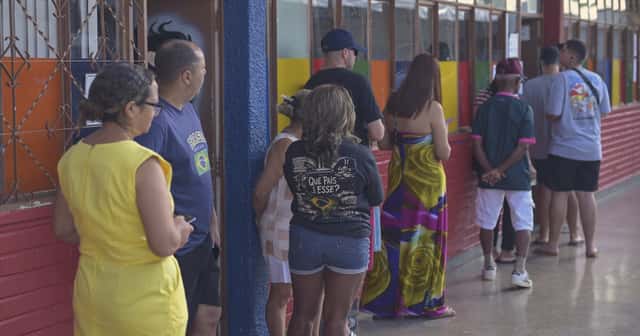
Photo: Voters wait to vote in Gama, Federal District, on the morning of October 25, 2026. Pedro França/Agência Senado, original file, CC BY-SA 4.0. Cropped for publication; the adapted photo remains available under the same license. This AI-assisted report was prepared on November 2, 2026, from TSE results files and the sources linked above. Regional totals and between-round changes are 567politics calculations from TSE state files.

Differing perspectives
Was the Supreme Court's two-hour extension of voting on October 25 justified, and does it affect the runoff result?
Each position is summarized as its supporters make it, with equal weight and in alphabetical order. A summary is not an endorsement; the evidence for each is weighed in the story above.
Changing the rules mid-vote invalidates the result
Who holds it: Senator Flávio Bolsonaro on election night; he later turned to abuse-of-power petitions instead
Bolsonaro said it was impossible to recognize the result given how events unfolded, and that he would not accept a rule changed in the middle of the game. He said a Supreme Court justice who was once Lula's lawyer issued the order, and that machines reopened in some places and not others, so he would never know how many votes he lost. He said his lawyers would seek to annul the election.
In their words: Agência Brasil, Oct. 25, 2026 ↗
Extend voting where transit failures kept voters away
Who holds it: Lula's coalition, Brasil Pronto Pra Mais, which filed the request, and Justice Cristiano Zanin, who granted it
Supporters of the order argue that the Supreme Court has already made free public transit on election day mandatory, and that cities which kept buses in garages blocked people from voting. Zanin wrote that the facts reported were serious enough to extend voting to 7 p.m., with the electoral court carrying it out. His clarification limited it to sections still open and kept all votes already cast, which they say protected access without disturbing the count.
In their words: Supreme Federal Court (STF), Oct. 25, 2026 ↗
No rule allowed it, but the count stands
Who holds it: Superior Electoral Court President Kassio Nunes Marques
Kassio said the decision, issued after the official close of voting, created difficulties for the electoral process, and that no rule authorized any extension. He said he had received the request for more time at about 3:30 p.m. In his view, extending voting hours requires planning that a late order cannot provide. He nonetheless treated the count as valid, called both candidates that night and confirmed the totals.
In their words: Agência Brasil, Oct. 25, 2026 ↗
READ BEYOND 567POLITICS
Alternate sources & perspectives
Independent coverage and primary evidence to help you compare arguments. A link is not an endorsement; perspective labels describe the linked material.
- primary evidence
TSE official national runoff results file (election 6258, president) ↗
Tribunal Superior Eleitoral
Final national totals with 100% of sections counted: votes, valid-vote shares, blank and null votes, turnout and abstention.
- primary evidence
STF prorroga votação até as 19h em locais onde urnas permaneceram abertas após as 17h ↗
Supremo Tribunal Federal
The court's own account of Justice Zanin's extension order and its clarification limiting it to sections still open.
- other perspective
Nunes Marques diz que decisão de Zanin dificultou processo eleitoral ↗
Agência Brasil
The electoral court president's criticism of the late order, while confirming the count.
- independent analysis
TSE informa o registro de 34,3 mil votos após as 17h no segundo turno ↗
Gazeta do Povo
Reports the TSE's Oct. 27 count of 34,393 votes recorded after 5 p.m., by hour, and the number of sections still open.
- right argument
Flávio não reconhece vitória de Lula e tentará anulação do pleito ↗
Agência Brasil
Flávio Bolsonaro's election-night statement arguing that the mid-vote rule change made the result impossible to recognize.
- left argument
Lula agradece votos e diz que teve de vencer intromissão vinda de fora ↗
Agência Brasil
Lula's victory speech, including his claim of foreign interference through digital platforms and his pledge to govern for everyone.
- independent analysis
Bolsonaro's party accepts result after Trump suggests vote was rigged ↗
Al Jazeera
The PL's Oct. 26 recognition of the result, Trump's remarks and independent estimates of votes cast after 5 p.m.
- primary evidence
O que dizem as pesquisas para presidente na véspera do segundo turno ↗
Gazeta do Povo
Field dates, samples, margins of error and TSE registration numbers for the seven final runoff polls.
- independent analysis
Brazil heads to polls in runoff between leftist Lula and Bolsonaro Jr ↗
Reuters (via Internazionale)
Wire report on the result, pollsters' turnout explanation and the campaign's main pledges.
- independent analysis
Lula cresce em número de votos em todos os estados; Flávio recuou em 6 ↗
Agência Brasil
State-by-state change in each candidate's vote between the two rounds.
- right argument
Caiado anuncia apoio a Flávio Bolsonaro no 2º turno ↗
Poder360
The Goiânia endorsement event, with Caiado's case for backing Bolsonaro and the presence of Tarcísio de Freitas.
- other perspective
Líderes estrangeiros reconhecem vitória e parabenizam Lula ↗
Agência Brasil
International reactions to the result from European, North American and Latin American leaders.
Reviewed 2026-11-02. Reviewed November 2, 2026. Vote totals come directly from the TSE's official results files; the TSE's news pages blocked automated access, so its Oct. 27 count of late votes is cited through Gazeta do Povo. Final-poll figures are from a roundup of registered polls; no Ipec, Paraná Pesquisas or PoderData national runoff poll was found. No pollster's own post-election accuracy analysis was available. Election-night quotations are from Agência Brasil and Al Jazeera; a formal annulment filing by Flávio Bolsonaro and a formal U.S. State Department statement could not be verified. Automated source discovery returned no relevant results, so sources were found by manual search and opened individually.