Brazil's Big Tech vote likely slips a week as its sponsor narrows targets and adds a no-censorship clause
Aliel Machado says the Chamber vote on PL 4,675 will probably wait while he courts Centrão parties; Lula wants it passed before a more right-leaning Congress arrives.
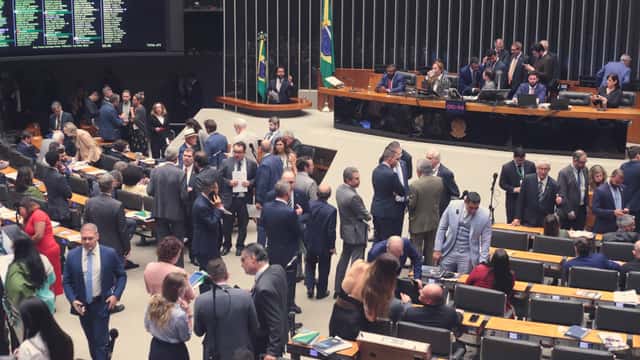
Brazil's bill to give its antitrust regulator advance powers over the largest technology platforms will probably miss its scheduled Chamber of Deputies vote on Tuesday, November 17. The rapporteur, Deputy Aliel Machado (PV-PR), said he would release a revised text narrowing which companies can be targeted and adding an explicit clause barring the regulator from content moderation, then keep negotiating with Centrão parties into next week, Folha de S.Paulo reported.
The bill, PL 4,675/2025, is one of the last major items on Luiz Inácio Lula da Silva's year-end agenda. The government wants it through both chambers by December, before a more right-leaning Congress takes office in February. Opponents on the right call it a censorship tool. The platforms say it would punish companies for their size. Machado says it is "a project about economic freedom." Quotations from Portuguese-language sources below are 567 Politics translations.
What changed on Tuesday#
Machado told CNN Brasil the vote could move to next Tuesday because Chamber President Hugo Motta (Republicanos-PB) travels to Buenos Aires on Wednesday. "But not in the sense that there isn't support to vote, because President Hugo is supporting approval of the project," he said. The Liberal Party (PL) still resists the bill, and deputies in the PSD, Republicanos and PP remain divided, according to CNN Brasil. Machado scheduled meetings with the PP, PSD, Republicanos and MDB benches on Tuesday afternoon, R7 reported. Motta's meeting of party leaders, which sets the week's floor agenda, was called for 3 p.m. Brasília time (1 p.m. ET), according to Poder360.
He described two main changes to Folha. First, a company could be designated for advance oversight only if it meets at least four of six qualitative criteria at once. These include operating in multi-sided markets, holding power tied to network effects, occupying a strategic position on which other businesses depend, and acting as a gatekeeper to a digital ecosystem. Under the July text, the regulator would weigh those traits in a "joint and reasoned analysis" with no minimum count. The revenue thresholds stay: R$50 billion a year worldwide or R$5 billion in Brazil.
- Size testgroup revenue above R$50 billion worldwide or R$5 billion in Brazil
- Conduct testmeets at least four of six criteria, such as network effects or gatekeeper status
- DesignationCade's new superintendence names it an agent of systemic relevance
- ObligationsCade sets duties case by case for the services and risks it identifies
- Reviewobligations can be revised as market conditions change
Source: Folha de S.Paulo, Ministry of Finance
Second, he said he would add an article stating that the regulator will have no power over content moderation. He called the change technically unnecessary. "The project already did not deal with this, but we are going to put in an article to make it even clearer," he told Folha.
The core of the bill is not on the table. "The central idea of the project, which is the creation of the superintendence, will not be altered," Machado told CNN Brasil earlier on Tuesday. Approval needs a simple majority in a single round, with at least 257 of 513 deputies present.
What the bill would do#
The executive branch sent the bill to Congress on September 18, 2025, according to the Chamber's legislative record. It amends Brazil's 2011 competition law and creates a Digital Markets Superintendence inside Cade, the Administrative Council for Economic Defense, the country's antitrust authority.
Today Cade acts mainly after the fact, opening cases once harm is alleged. The bill would let the new superintendence designate "economic agents of systemic relevance" and impose tailored obligations in advance, a model that borrows from the European Union's Digital Markets Act and the United Kingdom's digital markets law.
G1 summarized the obligations Cade could impose under Machado's text:
- letting users move their data to rival services;
- allowing users to run products and apps from different suppliers;
- giving business users access to performance data on their own products and offers;
- banning self-preferencing, in which a platform ranks its own products above competitors';
- banning tying, the forced bundling of one service with another.
Designated companies would also have to keep an office in Brazil, under a daily fine of R$20,000 that can rise up to 50-fold, according to G1. The president would nominate the superintendent, subject to Senate approval. G1 listed Alphabet, Meta, ByteDance, Amazon, Apple and Microsoft as companies that could fall under the thresholds. The Finance Ministry stresses that meeting a threshold would not trigger automatic designation, and that designation alone would not impose obligations; those would be set case by case.
- Sept. 18, 2025The executive branch submits the bill
- Oct. 7, 2025Aliel Machado named rapporteur
- Oct. 22, 2025PL deputy Caroline de Toni asks for a special committee
- Mar. 18, 2026The Chamber approves urgency for the bill
- July 8, 2026Machado files his preliminary floor report
- Nov. 17, 2026Vote expected, then likely pushed a week
The government's economic case#
The Finance Ministry released a technical note on Monday estimating the bill's benefits. Its Secretariat for Economic Reforms estimated that the 20 platform segments it studied, from e-commerce and payments to cloud computing and artificial intelligence, had roughly R$410 billion in revenue in 2025, about 3.2% of GDP.
It then applied illustrative price cuts of 10% and 33% to revenue in the segments it judged most prone to competition problems. The range comes from app-store commission cuts seen after enforcement abroad.
Source: Ministry of Finance, Secretariat for Economic Reforms, technical note, November 2026
Show the numbers
| Scenario | Annual gain |
|---|---|
| 10% price cut | R$15.3bn |
| 33% price cut | R$50.6bn |
The ministry's announcement put that at 0.1% to 0.4% of GDP, or R$70 to R$240 per person a year. The note is explicit about its limits. It says the price-cut range is illustrative and implies nothing about specific platforms. It also says it relies on the assumption that the markets studied have significant market power, a premise drawn from earlier ministry reports "but not demonstrated here independently." Before the note was released, Igor Luna of the Brazilian Chamber of the Digital Economy told Folha that no study had estimated how much companies' costs would rise or how much of that might be passed on to consumers; the ministry's note measures price effects and does not estimate compliance costs.
The objections#
The bill's critics fall into three overlapping groups.
- PL deputies call the bill censorship; Machado is adding a clause saying it does not cover content
- Platforms say duties punish size, not proven harm; supporters say ex-ante rules exist because antitrust cases take years
- Some Centrão deputies want proof of predatory conduct; Machado proposes requiring four of six criteria for designation
Source: Folha de S.Paulo, Folha de S.Paulo
The PL and the Bolsonarista right. Deputies including Nikolas Ferreira (PL-MG) and Mário Frias (PL-SP) have campaigned online against the bill as censorship, Folha reported. "We know Lula's intentions: to regulate social networks and, under that pretext, silence the voices that diverge from the ideology of the left," Frias posted. Ferreira and others asked Machado to leave the vote until next year, according to Folha. CNN Brasil identifies the Liberal Party as the bench most resistant to the text.
Neither the government's original text nor Machado's report sets rules for content, G1 found, and Machado's new clause is meant to answer this objection directly. "Some people think regulating big techs is censoring WhatsApp, and there is none of that," he told Folha last week. The government says the obligations are limited to competition practices such as ranking, bundling, fees and data access.
The platforms. The industry argues the bill would punish size rather than proven harm. The Latin American Internet Association (Alai) told Folha that "lawful, pro-competitive practices common in several sectors, such as private labels in retail, integrated product experiences and loyalty programs, would become infractions when adopted by a designated company, regardless of the benefits they may generate for consumers." Luna, legal adviser to camara-e.net, said the text gives Cade "broad powers to intervene in the digital economy and punish companies for their size, without any proven infraction or benefit to the consumer." Companies also argue the bill could affect how content is distributed, because Cade could demand changes to technology and terms of use.
Part of the Centrão. Deputy Any Ortiz (PP-RS), who is rapporteur on a rival digital competition bill, said "it is necessary to prove that these companies really engage in predatory action in the market; the mere fact that they are big should not allow Cade to make demands." She warned the bill "will compromise the capacity for innovation." Machado's four-of-six rule is aimed at this group.
Supporters answer that ex-ante rules exist precisely because antitrust cases take years. Nicolo Zingales, a law professor at FGV Rio, told Folha that relying on Cade's existing interim measures is like patching potholes instead of maintaining the road. Backers include Febraban, the banking federation, Abrasel, the bar and restaurant association, payments group Abipag and parts of retail, according to Folha. Opponents include the platforms, the commerce confederation CNC and Fecomercio.
Why the calendar matters#
- Nov. 17, 2026Leaders meet; Machado expects the vote to slip
- Nov. 18, 2026Motta travels to Buenos Aires
- Nov. 24, 2026Earliest likely Chamber vote, per Machado
- December 2026Government target for passage in both chambers
- Feb. 1, 2027New Congress takes office
Source: CNN Brasil, Folha de S.Paulo
The government's urgency is political. Machado told Folha that from 2027 the Senate will have a broad Bolsonarista majority able to block the bill. Lula begins his fourth term with the smallest core base in Congress since Fernando Collor, and the bill sits alongside a betting ban, Desenrola 3.0 and the 2027 budget on a crowded year-end list.
Lula has tied the issue to the election. In his post-election national address, he said "the so-called big techs tried to interfere in the Brazilian electoral process, giving millions of views to content with disinformation and fake news," CNN Brasil reported. Days ago the Superior Electoral Court fined Meta R$7.5 million for only partly complying with runoff orders, though the rapporteur found insufficient evidence that Meta intentionally favored either candidate. Platform companies dispute Lula's characterization.
Motta's support is central. His own party, Republicanos, was one of the benches Machado met on Tuesday.
The Washington angle#
The bill is also watched in the United States. The Office of the U.S. Trade Representative listed PL 4,675 in the Brazil chapter of its annual trade-barriers report in April, and 20 Republican members of Congress wrote to USTR in July citing it, CNN Brasil reported. On July 15, USTR imposed a 25% tariff on certain Brazilian goods after a Section 301 investigation that, in USTR's words, covered measures "related to digital trade and electronic payment services," among others. USTR's announcement did not name the bill. CNN Brasil said the topic has come up in tariff talks more than once but was not a formal U.S. demand in the latest rounds.
The next steps for the bill#
Machado's revised report was due before Tuesday's leaders' meeting. If leaders agree, the bill could reach the floor as soon as Tuesday, November 24. If the Chamber passes it, it then goes to the Senate. No representative poll on this specific bill was found, so it is not possible to say what Brazilians think of it. Campaign-finance records for the deputies quoted here sit in Brazil's electoral court disclosure system and were not reviewed for this story; nothing here concerns campaign money.
Differing perspectives
Should Brazil give Cade power to set advance competition rules for the largest digital platforms?
Each position is summarized as its supporters make it, with equal weight and in alphabetical order. A summary is not an endorsement; the evidence for each is weighed in the story above.
Pass the bill this year
Who holds it: The Lula government and Finance Ministry, rapporteur Aliel Machado (PV-PR), and backers such as Febraban and Abrasel
Supporters argue that a few platforms control search, app stores, payments and delivery, and that antitrust cases taking years cannot keep up. Giving a Cade superintendence power to set tailored duties in advance, such as bans on self-preferencing and tying and rights to move data, would cut fees for small businesses and prices for consumers. The Finance Ministry estimates gains of R$15.3 billion to R$50.6 billion a year and stresses that designation would be case by case and would not cover content.
In their words: Ministry of Finance of Brazil ↗
Reject it as a risk to free expression
Who holds it: Liberal Party (PL) deputies including Mário Frias and Nikolas Ferreira, and allied conservative activists
Opponents on the right argue that the bill is a first step toward the government regulating social networks. Deputy Mário Frias says Lula's intention is to regulate the networks and, under that pretext, silence voices that diverge from the ideology of the left. PL deputies have campaigned against the text as censorship, as they did against the fake news bill, PL 2,630, and some have asked the rapporteur to leave the vote until next year, when a new Congress takes office.
In their words: Folha de S.Paulo ↗
Require proven abuse before imposing duties
Who holds it: The Latin American Internet Association (Alai), platform companies, camara-e.net and some Centrão deputies such as Any Ortiz (PP-RS)
This camp argues that the bill would punish companies for their size rather than for proven harm. Alai says common practices such as private labels, integrated products and loyalty programs would become infractions for designated firms regardless of consumer benefits. Critics say Cade can already use interim measures, that the text overlaps other regulators and gives broad powers the law does not define, and that this would harm innovation. They favor narrower criteria or case-by-case enforcement.
In their words: Folha de S.Paulo ↗
Cite this article
567 Politics staff. “Brazil's Big Tech vote likely slips a week as its sponsor narrows targets and adds a no-censorship clause.” 567politics. Published 2026-11-17. https://567politics.com/news/brazil-pl-4675-big-tech-digital-markets-cade-vote-delay-aliel-machado-november-2026
Wikipedia citation
{{cite news |title=Brazil's Big Tech vote likely slips a week as its sponsor narrows targets and adds a no-censorship clause |url=https://567politics.com/news/brazil-pl-4675-big-tech-digital-markets-cade-vote-delay-aliel-machado-november-2026 |work=567politics |author=567 Politics staff |date=2026-11-17 |language=en}}CSL-JSON for reference managers
{
  "id": "https://567politics.com/news/brazil-pl-4675-big-tech-digital-markets-cade-vote-delay-aliel-machado-november-2026",
  "type": "article-newspaper",
  "title": "Brazil's Big Tech vote likely slips a week as its sponsor narrows targets and adds a no-censorship clause",
  "URL": "https://567politics.com/news/brazil-pl-4675-big-tech-digital-markets-cade-vote-delay-aliel-machado-november-2026",
  "container-title": "567politics",
  "language": "en",
  "author": [
    {
      "literal": "567 Politics staff"
    }
  ],
  "issued": {
    "date-parts": [
      [
        2026,
        11,
        17
      ]
    ]
  }
}Citations identify this article and its publication date. Assess the reporting and its linked sources before using it as evidence.
Read this article as Markdown or JSON. Cite the original page and retain its sources, dates and qualifications.
Embed this article summary
Paste this HTML into your page. The summary stays linked to the full story and updates with it. No account required.
<iframe src="https://567politics.com/embed/news/brazil-pl-4675-big-tech-digital-markets-cade-vote-delay-aliel-machado-november-2026?theme=auto" title="Brazil's Big Tech vote likely slips a week as its sponsor narrows targets and adds a no-censorship clause by 567politics" width="100%" height="440" style="border:0;max-width:100%" loading="lazy"></iframe>
<p style="font-size:14px">Brazil's Big Tech vote likely slips a week as its sponsor narrows targets and adds a no-censorship clause by <a href="https://567politics.com/news/brazil-pl-4675-big-tech-digital-markets-cade-vote-delay-aliel-machado-november-2026" rel="nofollow">567politics</a></p>
<script async src="https://567politics.com/embed.js"></script>
READ BEYOND 567POLITICS
Alternate sources & perspectives
Independent coverage and primary evidence to help you compare arguments. A link is not an endorsement; perspective labels describe the linked material.
- primary evidence
PL 4675/2025: ficha de tramitação ↗
Câmara dos Deputados
Official legislative record: submission on Sept. 18, 2025, rapporteur appointment, urgency approval and Machado's July 2026 report.
- primary evidence
Potencial de impacto do PL 4.675 (technical note) ↗
Ministério da Fazenda, Secretaria de Reformas Econômicas
The ministry's estimate of R$15.3 billion to R$50.6 billion a year in gains under 10% and 33% illustrative price cuts, with its stated limits and assumptions.
- left argument
Maior concorrência em plataformas digitais pode gerar mais de R$15 bilhões por ano em benefícios ↗
Ministério da Fazenda
The government's case for the bill in its own words, including the per-person and share-of-GDP figures.
- other perspective
Relator vai alterar projeto que regula mercados digitais para restringir empresas fiscalizadas pelo Cade ↗
Folha de S.Paulo
Nov. 17 interview with rapporteur Aliel Machado on the four-of-six criteria and no-censorship clause, with Alai, camara-e.net and Any Ortiz objections.
- right argument
Governo lança ofensiva para aprovar na Câmara regulação de big techs ↗
Folha de S.Paulo
Nov. 14 report on the government push and PL deputies' censorship campaign, quoting Mário Frias.
- independent analysis
Votação do PL das big techs pode ficar para semana que vem, diz relator ↗
CNN Brasil
Nov. 17 report that Machado expects the vote to slip a week.
- independent analysis
PL das big techs pode ser votado hoje apesar da resistência do Centrão ↗
CNN Brasil
Bench-by-bench resistance to the text, identifying the PL as most resistant.
- other perspective
Casa Branca acompanha projeto de regulação das big techs no Brasil ↗
CNN Brasil
Reports that USTR listed PL 4,675 in its April trade-barriers report and that 20 Republican members of Congress wrote to USTR about it in July.
- independent analysis
Big techs: Câmara deve votar projeto que regulamenta mercados digitais; entenda ↗
G1
Explainer finding that neither the original text nor Machado's report sets rules for content.
- independent analysis
PL das big techs: relator se reúne com Centrão e admite alterações ↗
R7
Nov. 17 report on the rapporteur's meetings with Centrão parties.
- independent analysis
Leia quais ações estão na pauta do Congresso nesta 3ª feira ↗
Poder360
Tuesday's congressional agenda listing the bill.
- primary evidence
USTR Section 301 action on Brazil's unreasonable acts, policies and practices ↗
Office of the U.S. Trade Representative
July 15, 2026 release imposing a 25% tariff on certain Brazilian goods after the Section 301 investigation.
Reviewed 2026-11-17. Hand-picked from pages opened on Nov. 17, 2026; discover_politics_sources returned only unrelated pages (sports links). The Finance Ministry note was read in full. No Cade statement on Machado's revision was found, and the revised report text had not been filed when reviewed, so its contents come from the rapporteur's interviews.