Canada–EU summit leaves closer association to negotiation, with parliamentary scrutiny still at issue
The October 30 statement sets a 2027 negotiating horizon; it does not make Canada an EU member.
Canada and the European Union ended their October 29–30 Montréal summit with a plan for closer ties. They aim to define that relationship by their 2027 summit. It would fall short of full membership. The October 30 joint statement does not establish an “associate member” status for Canada. It records talks that have concluded on several deals. That does not mean every deal has taken effect.
The statement resolves the question of the summit’s final wording. It does not settle the debate over Parliament’s role. The provinces’ role and the terms of future deals also remain at issue. This updated account separates the published outcome from the debate that preceded it.
What Ottawa sought from the summit#
The Prime Minister's Office announced the summit on October 25. Its release pointed to the strategic, security and defense partnerships launched at the last summit. That meeting took place in Brussels on June 23, 2025. It argues the two economies are complementary. In its words, the EU brings "market power, research depth, and manufacturing strength," while Canada brings energy, critical minerals, space, artificial intelligence and quantum capabilities, and a strong banking system.
The release lists steps taken since then. In February 2026, Canada became the first non-European country to join the EU's Security Action for Europe (SAFE) defense procurement initiative. In May, Carney became the first non-European leader to take part in a European Political Community summit, held in Armenia. In June, Ottawa announced the first order secured through SAFE. Montréal-based Marconi Technologies will build tactical radios for Poland's Cyber Command. In September, Carney addressed the European Parliament in Strasbourg.
The government also supplied trade figures, expressed in Canadian dollars. It says the EU is Canada's second-largest trading partner for goods and services, with about $178 billion in two-way trade in 2025. It puts EU direct investment in Canada at $219 billion and Canadian direct investment in the EU at $315 billion for the same year. These are the government's own estimates, published to support its case for the summit. The investment figures measure stocks of investment. The trade total measures activity during a year. Adding them together would not give a valid measure of annual benefit.
Before the summit, Carney described it as the start of formal negotiations rather than a finished agreement. The Canadian Press’s October 27 report also quoted ambassador Jonathan Wilkinson saying unrestricted free movement of workers was not under discussion. That account describes the pre-summit position, not the final terms of a future agreement. See our Mark Carney profile for background.
The label and the final statement#
The debate over an undefined “associate member” label continued even as negotiators used more cautious language in the final text. The distinction matters. A political goal does not create a legal membership category. Nor does it define the duties that a future deal would carry.
The Canadian Press’s October 30 summit report says Carney and European leaders continued to discuss associate membership publicly. The same report records Conservative objections about trade barriers and CETA ratification, and the Bloc Québécois’s demand for a parliamentary vote and Quebec involvement. These are continuing disputes about the terms and approval of closer cooperation, not evidence that Canada entered the EU at the meeting.
The published statement is more precise than a general membership headline. It records substantive talks concluded on a digital trade deal. Talks on investment and competition deals have also concluded. The two sides have agreed on a framework for their border agencies. It separately describes future work on research, energy, financial services, security and mobility. Readers should distinguish an agreed negotiating objective from a signed instrument, ratification and actual implementation.
The case for a deeper partnership#
Supporters present the alliance as insurance against an unreliable trading environment. The government’s release promises consumer savings, export opportunities and more scope for young people to study and work across the Atlantic. Carney argues that a stronger partnership could help both sides resist pressure in a more divided world. These are the government’s stated objectives rather than an independent estimate of the agreement’s effects.
Diversification is the core economic argument: access to another large market could give businesses more options when a principal trading relationship becomes less predictable. That argument is plausible without proving that every proposed measure will deliver a net benefit. Different standards can carry costs. Access rules also matter, as does the time needed to build new trade links.
The case for caution#
Conservative leader Pierre Poilievre supported trade and NATO cooperation while warning against imposed EU taxes, laws and migration policies, according to El País’s September account. Those warnings address possible future obligations. They do not establish that such obligations were adopted in Montréal.
The concern about parliamentary scrutiny is not limited to the right. In a September 18 statement, NDP foreign affairs critic Heather McPherson supported stronger European ties while calling for public debate, parliamentary scrutiny and respect for sovereignty. She emphasized labor standards, public services, human rights, environmental protection and broadly shared economic benefits.
That position differs from rejecting cooperation outright. It asks which groups benefit and which safeguards accompany new access. A trade agreement may increase overall opportunity while distributing gains unevenly between sectors, workers and regions. A promise of growth is not enough to assess a deal. The rules must be clear. So must the costs of adapting to them and who pays those costs.
The provincial question#
Quebec’s role was a visible pre-summit dispute. Global News reported that Premier Paul St-Pierre Plamondon planned a boycott over his requested speaking role. The broader policy question survives that disagreement: how will provinces participate when proposed arrangements affect areas they administer?
The October 30 Canadian Press account says Culture Minister Marc Miller identified film-industry labor mobility as an example requiring provincial involvement, given provincial tax credits. It also records the Bloc Québécois’s insistence that the agreement be negotiated with Quebec. A seat at a summit dinner is one issue. A role in setting rules is another. Neither settles the other.
Professional recognition illustrates why implementation matters. An announcement of easier mobility is not itself a credential assessment, a permit or permission to practice a regulated profession. Workers and employers need the rules for each job and place. The final statement calls for further work on qualifications and mobility, so a reader should not infer an immediate entitlement from the announcement.
Weighing the arguments#
The final statement narrows one dispute but does not eliminate the need for scrutiny. It explicitly describes association short of full membership. Claims that the summit itself imposed unrestricted immigration or EU taxes go beyond that text. Conversely, saying that Canada is not joining the EU does not answer every question about regulatory commitments that may be negotiated later.
Supporters face a parallel test. Lower consumer costs and new export opportunities are expected benefits, not measured outcomes of the new alliance. The government’s existing trade figures describe the scale of the relationship before the negotiations; they do not measure how much additional activity the new arrangements will cause.
It is also necessary to separate a commitment from its delivery date. A plan to explore connecting payment systems is different from an operational service with stated fees and settlement times. A plan to join an education program is not an open call for applicants. It does not yet provide a funded place or a right to study abroad.
The relevant comparison is with the arrangements already available under CETA and other partnerships. Announcements should be assessed for what they add, which barriers they remove and whether implementation follows. Counting the number of subjects in a communiqué cannot answer those questions by itself.
What remains to be settled#
- The scope and legal form of the closer association to be defined by the 2027 summit.
- The occupations, eligibility rules and procedures covered by future mobility arrangements.
- The texts and timing of parliamentary consideration.
- How provincial participation and implementation will be organized.
- Which commitments require further negotiation, approval or operational work before people can use them.
These questions can be tracked separately. A completed digital agreement does not establish the completion of a mobility negotiation; progress in one area should not be used as a substitute for evidence in another. Follow-up reports should name the deal and who will carry it out. They should give its start date and explain what will change for users.
The Canadian Press noted that the summit coincides with the 10th anniversary of CETA's signing. Ottawa's recent outreach to Indigenous partners on project financing is covered in our report on the First Nations wealth fund talks, and the country's electoral context is in our Canada election guide.
What this account establishes#
The summit produced a published framework and a timetable for further work. It did not settle every obligation, implementation rule or domestic approval question. Opposition demands for scrutiny remain distinct from claims about what a future agreement might contain. This report treats government promises as proposals to test, and party objections as positions to examine against the eventual text.
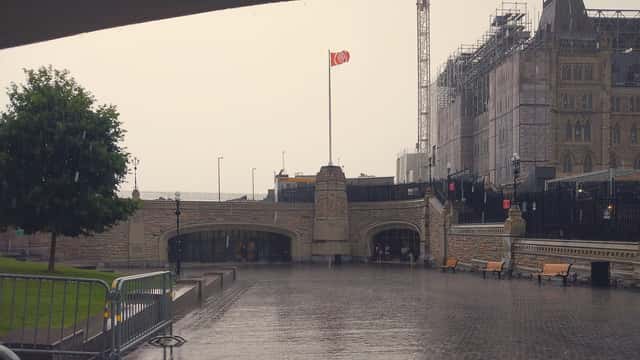
Sources and the final statement were checked on November 12, 2026. The accompanying photograph shows Parliament’s Visitor Welcome Centre in Ottawa in June 2025, not the Montréal summit. Our sourcing approach is described in our methodology.
Differing perspectives
How should Canada approach a closer association with the European Union?
Each position is summarized as its supporters make it, with equal weight and in alphabetical order. A summary is not an endorsement; the evidence for each is weighed in the story above.
Deepen cooperation through negotiated sector agreements
Who holds it: Canadian government and European Union leaders
The leaders present closer cooperation as a way to strengthen trade, security, research and strategic industries. Their joint statement sets a negotiating horizon short of EU membership. This position treats the relationship as a set of practical commitments to develop, rather than a decision to bring Canada into the Union.
In their words: Canada–EU joint statement, October 30 ↗
Require parliamentary scrutiny before new commitments
Who holds it: NDP foreign affairs critic Heather McPherson
The NDP supports stronger European ties while calling for public debate, parliamentary scrutiny and respect for Canadian sovereignty. McPherson emphasizes labor standards, public services, environmental protection and broadly shared benefits. This position asks how cooperation is approved and who gains from it, rather than opposing a closer relationship outright.
In their words: NDP statement on the EU proposal ↗
Support trade while preserving Canadian control over rules
Who holds it: Conservative Party representatives
Conservatives support free trade and NATO cooperation while opposing the imposition of EU taxes, laws or open-border policies on Canada. They call for parliamentary consultation and a clearer account of the proposed obligations. Those concerns are objections to potential future commitments, not evidence that the summit already imposed such measures.
In their words: El País, September 22 ↗
Cite this article
567politics News Desk. “Canada–EU summit leaves closer association to negotiation, with parliamentary scrutiny still at issue.” 567politics. Published 2026-11-12. https://567politics.com/news/canada-eu-summit-montreal-associate-member-quebec-october-2026
Wikipedia citation
{{cite news |title=Canada–EU summit leaves closer association to negotiation, with parliamentary scrutiny still at issue |url=https://567politics.com/news/canada-eu-summit-montreal-associate-member-quebec-october-2026 |work=567politics |author=567politics News Desk |date=2026-11-12 |language=en}}CSL-JSON for reference managers
{
  "id": "https://567politics.com/news/canada-eu-summit-montreal-associate-member-quebec-october-2026",
  "type": "article-newspaper",
  "title": "Canada–EU summit leaves closer association to negotiation, with parliamentary scrutiny still at issue",
  "URL": "https://567politics.com/news/canada-eu-summit-montreal-associate-member-quebec-october-2026",
  "container-title": "567politics",
  "language": "en",
  "author": [
    {
      "literal": "567politics News Desk"
    }
  ],
  "issued": {
    "date-parts": [
      [
        2026,
        11,
        12
      ]
    ]
  }
}Citations identify this article and its publication date. Assess the reporting and its linked sources before using it as evidence.
Read this article as Markdown or JSON. Cite the original page and retain its sources, dates and qualifications.
Embed this article summary
Paste this HTML into your page. The summary stays linked to the full story and updates with it. No account required.
<iframe src="https://567politics.com/embed/news/canada-eu-summit-montreal-associate-member-quebec-october-2026?theme=auto" title="Canada–EU summit leaves closer association to negotiation, with parliamentary scrutiny still at issue by 567politics" width="100%" height="440" style="border:0;max-width:100%" loading="lazy"></iframe>
<p style="font-size:14px">Canada–EU summit leaves closer association to negotiation, with parliamentary scrutiny still at issue by <a href="https://567politics.com/news/canada-eu-summit-montreal-associate-member-quebec-october-2026" rel="nofollow">567politics</a></p>
<script async src="https://567politics.com/embed.js"></script>