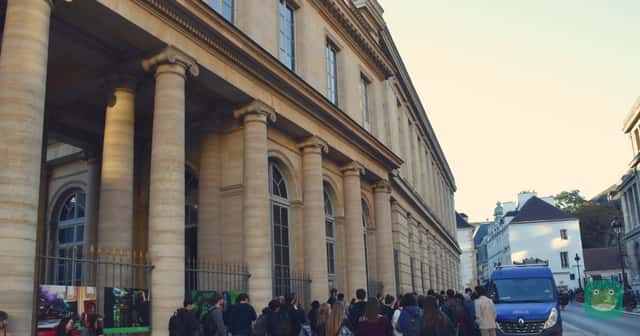
Blockades returned at high schools across France on Monday, Nov. 2, as classes resumed after the two-week All Saints' holiday, and the country's main trade unions have called a nationwide strike for Thursday, Nov. 5. The education ministry and the student unions give very different counts of the blockaded schools. Prime Minister Sébastien Lecornu's office said he is ready to receive student representatives again "next week," and the government and student groups disagree about whether its concessions of recent days go far enough.
This article reports what the sources say about Monday's blockades, what the government has offered, what the student unions and the trade unions are asking for, and what a poll taken before the holiday ended shows about public opinion. Quotes from French-language sources are 567politics translations.
Monday's blockades: two different counts
The education ministry said 41 high schools were blocked at 9:30 a.m. on Monday, about 1% of the roughly 3,700 high schools in France, and that no disruption had been recorded in three-quarters of the country's departments, Europe 1 reported. Student unions put the number at 150, according to The Guardian. The two figures were not reconciled in the reports reviewed here, and neither source says when or how the student count was made.
Education Minister Édouard Geffray told France Inter that the blockades were "a priori assez résiduel" ("a priori fairly residual"), with a few schools disturbed in the Paris region, the Nord department and Toulouse. He said that "the absolute priority" was for pupils to be able to attend class. "I have pupils sitting the baccalauréat at the end of the year who, for several hundred thousand of them, have had no classes for four or five weeks (...) and for whom, as a result, the school year is now at risk," he said, in the Europe 1 transcript. The Guardian reported that he also called the blockades "illegal."
Reports from several cities, from Europe 1 with AFP and The Guardian, describe a varied picture:
- Lyon. The Rhône prefecture told AFP the situation was "relatively calm," with 15 establishments counting gatherings at the entrance and one that chose remote teaching. At the Lycée Ampère, riot police calmly removed bins, street furniture and a scooter that a few dozen students had piled up. Police made one arrest in the suburbs for the use of a "mortier" (mortar).
- Marseille. Garbage containers were stacked in front of the gates of the Lycée Montgrand in the city center. According to student activists, about seven of roughly 75 schools in Marseille were blocked on Monday morning.
- Toulouse. Students at the Lycée Berthelot rebuilt their barricades, and about a hundred young people blocked the Lycée des Arènes.
- Lille. Europe 1 reported that students are divided over continuing. A 16-year-old said the government's response was "largely insufficient" and refused to return to class, while others hoped the movement would stop.
- Montpellier. The Guardian reported that Socialist senator Hussein Bourgi accused the government of "misconduct" and "provocation" after a video showed a 53-year-old school nurse being forced to the ground and handcuffed near a school barricade. The local prefect defended the arrest, saying the woman had insulted officers and resisted police.
Students quoted by AFP in the Europe 1 live report also differed. A blockade organizer in Lyon said the government's recent answers were "a bit like breadcrumbs." A 16-year-old in Marseille said the answers were "clearly not enough." A 17-year-old in Toulouse said that "two government announcements that will be out of date in a few months" would not stop the movement. Other students said they were worried: a student in Lyon said it "could be good to get back into the rhythm a bit," citing tests and chapters to redo, and a 14-year-old in Toulouse said "I support the movement and its demands, but it's tough, we haven't had classes for a month."
What the government has offered
At the start of the week of Oct. 26, the government announced what BFMTV called an "évolution forte" ("strong change") of Parcoursup, the national platform for admission to higher education, before its "replacement in 2028." The poll firm Elabe, in a questionnaire used on Oct. 27-28, listed the measures announced that Monday as follows:
- a reform of Parcoursup this year, then a replacement system from next year;
- 15,000 additional places in higher education;
- reduced-rate loans of 4 billion euros for regions and departments to renovate middle and high schools, and 1 billion for universities;
- a limit of 28 pupils per class in the second year of high school in the 50% least advantaged schools in fall 2027, and in all schools in fall 2028;
- cancellation of planned job cuts in middle and high schools, and 500 extra posts;
- the recruitment of 920 contract teachers to improve substitute cover;
- indexation of student grants to inflation from fall 2027.
On Wednesday, Oct. 28, Lecornu opened a debate without a vote at the National Assembly that he had himself requested. According to BFMTV, he said the debate "must allow us to identify a path through Parliament," and that the government was "looking for proposals and precise commitments. Not slogans or promises without a serious basis." He added that behind the criticism of Parcoursup, "some want a more assertive selection for access to university, others want on the contrary to abolish it entirely."
Lecornu said that Geffray and Higher Education Minister Philippe Baptiste would receive student representatives and regional councils on Thursday, Nov. 5, "on the question of buildings," a field that falls within the regions' remit. He also said he would receive student representatives again "in less than 15 days" to review the commitments made, and would establish "measure by measure" what falls under regulation, what requires funding voted in the 2027 budget and what would need a change in the law.
On Monday, Matignon repeated that a slot is planned "at the level of the prime minister next week to receive the high school students again," Europe 1 reported.
The Élysée's position
President Emmanuel Macron's entourage told BFMTV and AFP on Sunday, Nov. 1, that "the time for a return to class has come," while adding that "this kind of movement never ends in an absolutely clean way." The entourage also said that "the main demands of the high school students have found an answer in the measures brought by the government." These are statements attributed to Macron's entourage, not direct statements by the president. BFMTV added that, in an interview on Wednesday on the HugoDécrypte YouTube channel, Macron called for classes to resume "calmly" after the holiday.
The entourage said the Oct. 24 and Oct. 31 mobilizations were calmer than Oct. 17 because "anticipation this time, thanks to the intelligence services, thanks to the interior minister, was up to the task." BFMTV noted that the president had acknowledged a lack of anticipation by the security services about the Oct. 17 violence. The entourage added that, since those two days fell during school holidays, "there seem to have been a few fewer young people than in the earlier stages."
What the student unions say
A coalition of the Union syndicale lycéenne (USL), Unef, Fage and Union étudiante is demanding, among other things, 10 billion euros of investment in education and higher education and the repeal of Parcoursup, Europe 1 reported. Unef posted on X on Monday (567politics translation): "The government doesn't want to listen to us? On Nov. 3, black day at universities: go to your general assembly and block your faculty. On Nov. 5, let's go out in the streets en masse!"
The Guardian reported that student unions ignored Macron's call to end the blockades, which it said had been running since September. Nathanaël Combary of the school students' union Renouveau Lycéen, whom the Guardian identified as a member of Macron's Renaissance party, said schoolchildren must keep going in their "battle of strength" with the government. He told BFMTV that it was "a bit scandalous, democratically speaking, that we have to reach this type of situation to be heard, but it's the only solution we have," the Guardian reported. Combary said measures offered the week before, including limits on some class sizes and a review of the university applications platform, were inadequate.
Nicolas Bonnet of the headteachers' union SNPDEN-UNSA said, according to the Guardian: "It's time for us to return to our job: teaching and supporting pupils." He said he understood why high school students felt the government had not done enough to fix school problems, urged more dialog between the government and pupils, and warned that coursework, final-year exams and university applications were at risk.
- Nov. 2Blockades resume at high schools after the holiday
- Nov. 3Unef's call to block university faculties; SNCF unions meet management; Assembly vote on the budget's revenue section
- Nov. 4, 7 p.m.SNCF strike notice begins
- Nov. 5Nationwide interunion strike and demonstrations; ministers meet students and regions on school buildings
- Nov. 6, 8 a.m.SNCF strike notice ends
- Week of Nov. 9Lecornu's office plans a new meeting with student representatives
Source: Europe 1, BFM Business, BFMTV, CGT
The Nov. 5 strike
The CFDT, CGT, FO, Unsa and FSU have called for strikes and demonstrations on Thursday, Nov. 5, in both the public and private sectors, according to the CGT's website. The CGT's call, published on Oct. 26, says that with the 2027 state and social security budgets "the government once again wants to make employees, retirees and the sick pay, rather than large companies and the ultra-rich." It lists demands that include increases in the minimum wage (Smic), the civil service pay index, pensions and social minimums, equal pay between women and men, more public service jobs and the defense of industrial jobs. It says public aid to companies exceeds 200 billion euros a year, and that payments to shareholders reached more than 60 billion euros in the first six months for the CAC 40 companies. These figures are the CGT's, and this article has not checked them against another source.
Four unions at the rail company SNCF (CGT Cheminots, Sud Rail, Unsa Ferroviaire and CFDT) have filed a strike notice running from Nov. 4 at 7 p.m. to Nov. 6 at 8 a.m., BFM Business reported. Unsa Ferroviaire asks for a 2.6% raise for all employees and Sud Rail for 400 euros more a month, citing a forecast of 2.3% inflation over the year, including 3.4% in October. The unions say the group "has the means," pointing to 1.2 billion euros in profit in the first half. BFM Business noted that these profits are absorbed by a payment to SNCF Réseau for network maintenance. The unions were to meet management on Tuesday, and BFM Business said disruption could be similar to that of June 10, a day it described as widely followed. It added that Nov. 6 is the date of the inaugural trip of the TGV M train.
Europe 1 reported that some Yellow Vest groups are already calling to extend the strike from Friday, and that the finance ministry, known as Bercy, has warned that more efforts will be needed without sufficient growth. Europe 1 wrote that future savings could add to the anger the prime minister is trying to calm.
Radio France reported on Sunday that the government is considering a boost to the minimum wage of about 20 euros net a month, that discussions with employers and unions are ending, and that the prime minister's decision is expected "at the earliest at the end of the week." The broadcaster did not name a source for this report. It also quoted an executive source who described the situation after the Oct. 31 protests as "broadly under control" and said the day "bore no resemblance to Oct. 17." The Interior Ministry reported 779 arrests on Oct. 31, down from 1,435 on Oct. 24 and 2,628 on Oct. 17. Our report on the Mélenchon–Philippe exchange gives these figures in a chart.
What a poll shows
Elabe surveyed 1,002 adults in mainland France for BFMTV on Oct. 27-28, before the holiday ended and before Monday's blockades. It asked about the government's announcements to students on Monday, Oct. 26. Its margins of error are about 2 to 3 points, depending on the result.
Source: Elabe for BFMTV
Show the numbers
| Answer | Share |
|---|---|
| Good and meet the demands | 36% |
| Go in the right direction but insufficient | 52% |
| Not good | 12% |
Elabe found that opinion on whether the student mobilization should continue was close to even: 54% wanted it to stop and 46% wanted it to continue, with 29% saying it should continue as it is and 17% that it should become tougher. The results were nearly unchanged from Oct. 7, when 55% wanted it to stop. The result differs by age. Among 18-24-year-olds, 63% wanted it to continue, as did 59% of 25-34-year-olds, while 58% of 35-49-year-olds, 55% of 50-64-year-olds and 65% of those over 65 wanted it to stop. Among 18-24-year-olds, 70% called the proposals insufficient, against 51% of those over 65.
Elabe also asked about the Nov. 5 mobilization: 59% said they support it (32%) or feel sympathy for it (27%), 28% are opposed or hostile and 13% are indifferent.
Source: Elabe for BFMTV
Show the numbers
| Group | Support or sympathy |
|---|---|
| All respondents | 59% |
| NFP voters | 84% |
| RN voters | 48% |
| Ensemble voters | 43% |
| LR voters | 25% |
| 18-24 year-olds | 67% |
| 25-34 year-olds | 69% |
On the cost-of-living demands, Elabe found large majorities for some measures and a minority for others. A cut in fuel prices drew 89% support, followed by a rise in the Smic and a reform conditioning company aid on commitments on jobs, wages and the environment, each at 75%, and a rise in pensions at 72%. A tax rise for the wealthiest households drew 62%, a rise in the civil service pay index 59%, and a rise in social benefits 36%, with 63% against that last measure. On the budget side, 57% wanted the government to make some gestures without meeting every demand, 28% wanted it to meet most demands even at the cost of extra spending, and 14% wanted no new spending.
Source: Elabe for BFMTV
Show the numbers
| Demand | Should be put in place |
|---|---|
| Lower fuel prices | 89% |
| Higher minimum wage (Smic) | 75% |
| Conditions on company aid | 75% |
| Higher pensions | 72% |
| Higher taxes on wealthier households | 62% |
| Higher civil service pay index | 59% |
| Higher social benefits | 36% |
What the sources do not show
- How many schools are blocked. The ministry's count (41 at 9:30 a.m.) and the student unions' count (150) cannot both be checked from the reports reviewed here, and neither was updated later in the day in these sources.
- Turnout. There is no turnout figure yet for Tuesday's university blockades or Thursday's strike, and none of the sources gives a forecast for the strike beyond the SNCF notice.
- The wage decision. The reported Smic boost of about 20 euros net a month comes from an unnamed source cited by Radio France, and no official statement was found.
- The poll's timing. Elabe's survey was taken before the holiday ended and before the Nov. 2 blockades, so it does not measure reactions to them.
The context for these protests is covered in our report on the youth protests over living costs, on the budget vote in the National Assembly, on the France issue page and in the profile of Sébastien Lecornu. Our approach to sourcing is described in our methodology and editorial standards.
Differing perspectives
What should come next in the autumn protest movement over schools and living costs?
Each position is summarized as its supporters make it, with equal weight and in alphabetical order. A summary is not an endorsement; the evidence for each is weighed in the story above.
Keep the blockades and mobilization going
Who holds it: Student unions Unef, USL, Fage and Union étudiante, and student blockade organizers
The student coalition argues that the government's answers fall short of its demands for 10 billion euros of investment in education and higher education and the repeal of Parcoursup. Unef asks "The government doesn't want to listen to us?" and calls on students to block their faculties on Nov. 3 and to march on Nov. 5. A blockade organizer in Lyon described the recent answers as "a bit like breadcrumbs."
In their words: Europe 1 with AFP (live coverage) ↗
Return to class first
Who holds it: Education Minister Édouard Geffray and the headteachers' union SNPDEN-UNSA
Geffray and the headteachers' union argue that pupils should be back in class before anything else. Geffray says hundreds of thousands of final-year pupils have had no lessons for four or five weeks, that the school year is "at risk," and that the blockades are illegal. SNPDEN-UNSA's Nicolas Bonnet says it is "time for us to return to our job," while accepting that students feel the government has not done enough and urging more dialog.
In their words: The Guardian ↗
Settle it measure by measure in Parliament
Who holds it: Prime Minister Sébastien Lecornu and the government
Lecornu argues that the government has announced measures and now needs "proposals and precise commitments" from parliamentary groups, not "slogans." He says the Parcoursup question needs political clarification, because some want more selective admission and others want none. He proposes to sort out, measure by measure, what can be done by regulation, what needs credits voted in the 2027 budget and what needs a change in the law, and to meet students again within 15 days.
In their words: BFMTV (report on Lecornu's Assembly speech) ↗
Share wealth and raise pay and public funding
Who holds it: The CGT, which with the CFDT, FO, Unsa and FSU called the Nov. 5 strike
The CGT argues that the 2027 budgets make employees, retirees and the sick pay while large companies and the very wealthy are spared. It says the problem comes from billions of euros of revenue given up, not from social spending, and points to more than 200 billion euros a year in public aid to companies and over 60 billion euros paid to CAC 40 shareholders in six months. It calls for higher wages, pensions and social minimums, and more funding for public services.
In their words: CGT ↗