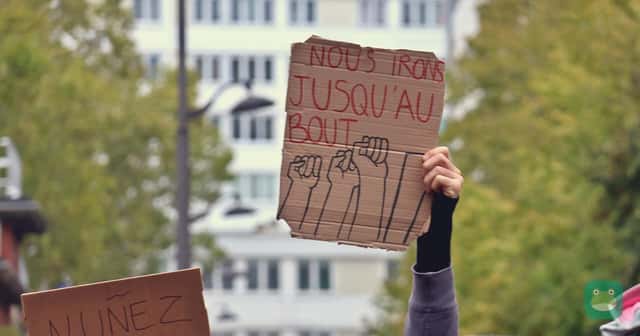
Young people marched in France, Germany, Portugal and other European countries over the Halloween weekend. They were angry about the cost of living, run-down schools, housing and, in Germany, the prospect of compulsory military service. Most marches were peaceful. Several ended in clashes with police, and the violence in Frankfurt and Paris has already become its own political fight.
This report covers what happened on Saturday, October 31, and early Sunday, November 1. It sets out what organizers want, how governments and parties on the left and right have responded, and what comes next. Crowd sizes are disputed in every country. We give the police or government figure and the organizers' figure side by side. Quotations from German- and French-language sources are 567politics translations unless an English source is linked.
France: a third Saturday, with smaller crowds
France saw its third straight weekend of marches. The interior ministry counted about 320,000 people nationwide, including 70,000 in Paris, according to Euronews. That compares with government counts of 410,000 on October 24 and 550,000 on October 17. A coalition of student and youth groups said nearly half a million people took part, including 200,000 in Paris, Al Jazeera and AFP reported.
type: column
title: France interior ministry counts of marchers nationwide, Oct. 17 to 31, 2026
note: Interior Ministry counts of participants across France on three Saturdays. Organizers counted 800,000 on each of Oct. 17 and Oct. 24, and said nearly half a million took part on Oct. 31; those figures are not charted because they use a different method.
source: [Euronews, Oct. 31, 2026](https://www.euronews.com/2026/10/31/frances-third-weekend-of-social-protests-sees-lower-turnout-and-early-clashes-in-major-cit)
---
Saturday | Interior Ministry count
Oct. 17 | 550000
Oct. 24 | 410000
Oct. 31 | 320000
The movement began last month with high school students. They complained about neglected buildings, teacher shortages and the Parcoursup university admissions system, which they see as unfair to poorer students. Unions joined later, as did some former "gilets jaunes" (yellow vest) protesters. Their demands widened to wages, fuel prices and public services.
Interior Minister Laurent Nuñez said about 150 planned marches had passed off peacefully, the Guardian reported. He also said police met an "extraordinary" level of violence from some rioters as rallies ended. He called a Molotov cocktail attack on a riot officer in Paris an "attempted murder." In Paris, dozens of masked people pried up paving stones near the end point of the march and threw them at police. Police answered with tear gas and baton charges. Officers also used tear gas in Lyon and water cannon in Toulouse.
Arrest totals rose through the night. The ministry gave 565 arrests at 9 p.m. Its final count was 779 people arrested across France, according to franceinfo. Paris prosecutors opened an "attempted homicide" inquiry over the Molotov attack on gendarmes and said no suspect had yet been arrested for it.
The government kept the main Paris march on the city's eastern edge after a court fight. It also imposed a 9 p.m. curfew on unaccompanied minors around the Champs-Élysées. Prime Minister Sébastien Lecornu [Funding: local campaign funding not researched; FEC does not cover this country] met student unions several times during the week and is looking at cost-of-living measures, Al Jazeera reported.
Those measures were announced on Monday, October 26. They include a Parcoursup overhaul, 15,000 more university places and cheap loans to rebuild schools. They also include a cap of 28 pupils per class in the first year of high school, 500 extra school posts and inflation-linked student grants from 2027. The list is set out in an Elabe poll for BFMTV that tested public views of the package.
What French voters think
That Elabe poll is the most detailed opinion data we found. Elabe surveyed 1,002 residents of metropolitan France aged 18 and over. The sample used quotas for sex, age, occupation, region and town size. Interviews were online on October 27 and 28, 2026, for the broadcaster BFMTV. Elabe gives a margin of error of about plus or minus 3.1 points for results near 50 percent, at 95 percent confidence.
Asked about the government's school and student package, 36 percent said the proposals were good and met the demands. Another 52 percent said they went in the right direction but were not enough, and 12 percent said they were not good. Asked about the protests themselves, 54 percent wanted the student movement to stop. Another 29 percent wanted it to continue at the same level, and 17 percent wanted it to grow harder. Yet 59 percent said they supported, or felt sympathy for, a union strike planned for November 5.
The poll shows a sharp split by age and party. Among 18- to 24-year-olds, 63 percent wanted the movement to go on. Among people 65 and older, 65 percent wanted it to stop. Sixty-nine percent of voters for the left-wing New Popular Front wanted it to continue. Eighty-one percent of voters for the centrist Ensemble bloc and the conservative Les Républicains wanted it to end, as did 66 percent of National Rally voters.
On money, 57 percent wanted the government to make a few gestures without meeting every demand, citing budget limits. Twenty-eight percent wanted most demands met even at extra cost, and 14 percent wanted no new spending. Lower fuel prices drew 89 percent support. A higher minimum wage drew 75 percent. Higher social benefits were opposed by 63 percent.
The French party fight
France's parties have argued about the violence since the first big day of protest on October 17. That day, National Rally presidential candidate Marine Le Pen wrote that "legitimate social demands" had been "taken hostage by the far left," Europe 1 and AFP reported. She blamed the lawmakers of France Unbowed for, in her words, legitimizing violence. Party president Jordan Bardella attacked "the professionals of chaos." [Funding: local campaign funding not researched; FEC does not cover this country] [Funding: local campaign funding not researched; FEC does not cover this country]
On the left, France Unbowed founder Jean-Luc Mélenchon accused news channels of flooding screens with violent images. He said "tens of thousands of people" were marching calmly. Greens leader Marine Tondelier asked the government to "review" its policing doctrine. She argued that it puts "protesters and police" at risk. These remarks came on October 17. We did not find fresh statements from these leaders on the October 31 marches in sources we could open. [Funding: local campaign funding not researched; FEC does not cover this country]
The debate now includes a "casseurs-payeurs" (rioters pay) bill that reached the Senate on October 27. Franceinfo reports that it would make people in a rioting crowd liable for damage, even if they broke nothing, and could reach their social benefits. The bill aims to make it easier to recover the cost of damage. Unions call it an attack on the right to protest.
Germany: "Gen Z Regelt" brings the protests across the Rhine
In Germany, a new initiative called "Gen Z Regelt" ("Gen Z has got this") held marches in dozens of cities. The initiative says about 120,000 people took part, tagesschau reported. That was below the 182,000 organizers had expected, NBC News reported.
City counts varied. In Berlin, police estimated about 5,000 people and the initiative said 10,000. Frankfurt saw up to 8,000 and Munich about 5,000. Cologne's march ended early. In Hamburg, police said organizers stopped early because officers were "repeatedly pelted with stones, fireworks and other objects," according to Al Jazeera.
The group listed six demands. It wants more money for schools, addiction help and psychotherapy. It also asks for an affordable life, fair sharing of burdens, protection of basic rights against surveillance and climate action. And it says no to compulsory military service. A spokesperson, Lina Friedrich, told NBC News that young people want to "fight for peace and freedom, rather than for war and coercion." On Instagram, the initiative "expressly distanced" itself from any form of violence, franceinfo reported.
The conscription question
The military service point refers to a law the Bundestag passed in December 2025. As DW explained at the time, service stays voluntary for now. But all 18-year-old men must fill out a questionnaire. From mid-2027, men born in 2008 or later must also attend a fitness exam. If too few people volunteer, the Bundestag can vote to bring in "needs-based" conscription for part of an age group.
Defense Minister Boris Pistorius [Funding: local campaign funding not researched; FEC does not cover this country] of the SPD has said he hopes service will stay voluntary. DW reported that many in the CDU and CSU would rather return to the full national service Germany suspended in 2011. Critics see the compulsory exam as a first step toward a draft. The law is meant to grow the army from just under 182,000 soldiers to 260,000, a NATO commitment made in view of what DW called the perceived threat from Russia. More background on these debates is on our Germany issues page.
Frankfurt: two kinds of violence
Frankfurt saw the worst violence. Police wrote on social media that rioters looted shops, smashed windows and threw Molotov cocktails at emergency services, NBC News reported. The police later gave a fuller count, tagesschau's Hesse service reported. Police made 54 arrests of people aged 13 to 29, most of them German citizens. One hundred officers were hurt, one seriously. Five shops were looted, and police filed 87 criminal complaints.
Police drew a line between two groups. One group turned violent during the demonstration. A different group rioted later in the night. Police described that second group as mostly young men with a migration background and no clear political motive.
That description has split politicians. Hesse Interior Minister Roman Poseck (CDU) called the night an "appalling excess of violence." He estimated 1,000 to 1,500 troublemakers and said there must be "no false taboos" in naming who was involved. He called for a tougher response. Frankfurt Mayor Mike Josef (SPD) replied: "I could not care less what passport someone holds."
The German party fight
Reactions in Berlin followed party lines, but not neatly.
On the right, Federal Interior Minister Alexander Dobrindt (CSU) blamed "violent left-wing groups and troublemakers from the migrant milieu," tagesschau reported. CDU General Secretary Hoppermann asked whether the protests had a real goal at all. Bavarian Premier Markus Söder (CSU) thanked both police and peaceful protesters. Poseck told NBC News that "France must not be held up as a model." [Funding: local campaign funding not researched; FEC does not cover this country] [Funding: local campaign funding not researched; FEC does not cover this country]
Not every conservative took a hard line. Federal Education Minister Karin Prien (CDU) called the young people's concerns "justified and highly relevant," tagesschau reported.
On the center-left, SPD politician Dirk Wiese said Germany must renew its "promise of social mobility." He called for a national education summit. Greens leader Franziska Brantner said: "Violence harms the legitimate cause."
Researcher Nina Kolleck told tagesschau that fear of violence likely kept some people at home.
The German protests also raised questions about the organizers. Tagesschau noted that organizer Akram Selo's website lists a Swiss address in its legal notice.
Portugal: housing camps cleared at dawn
In Portugal, the protest was about housing. Police moved in at about 4:30 a.m. on Sunday to clear tent camps in Lisbon's Rossio square and Porto's Praça Dom João I, DW reported. Police said they arrested six people in Lisbon and seven in Porto. They said 13 officers were injured and eight went to hospital. The protest group Acampada Lisboa said more than 30 protesters were hurt and 10 were taken to hospital.
The camps formed after more than 1,000 people marched against a rental bill. Critics say it would make evictions easier and end rent caps on new leases. Prime Minister Luís Montenegro has refused to withdraw it, though he says he is open to changes. Opponents point to house prices that have more than doubled since 2017.
Italy, Spain and beyond
Italy has seen its own wave of protest. Our earlier report covered Italy's general strike over living costs and defense spending. NBC News reported that Prime Minister Giorgia Meloni [Funding: local campaign funding not researched; FEC does not cover this country]'s government is sending 500 troops to Milan until the end of the year. Rome also saw protests on Friday. Italian police were on alert after recent clashes in Milan, Turin and Bologna, Al Jazeera reported.
In Spain, Catalan police went on their highest alert in Barcelona, according to Al Jazeera. An anonymous TikTok network called Blocus had urged new gatherings there. Rioting on October 24 had led to about 130 arrests, mostly of minors. The Hague in the Netherlands stayed quiet, Euronews reported. In Albania, protesters in Tirana again demanded that Prime Minister Edi Rama resign. Some masked youths threw paving stones and firebombs at police, the Guardian reported.
Is this one movement?
The protests share a generation, social media tactics and some slogans. They also differ a great deal. French students started with school conditions, and unions widened the demands to wages and fuel. German organizers put conscription and mental health care near the top. Portuguese campers focused on rents.
Andrew Barclay, a politics lecturer at the University of Sheffield, told NBC News that the national causes differ. He said the protests are unlikely to bring down governments, unlike in Serbia.
Both sides of the debate can find support in the record so far. Mélenchon and Tondelier in France, and Brantner and Josef in Germany, have stressed the peaceful majority and the legitimacy of the demands. Their side can point to the Elabe finding that only 36 percent of French adults think the government's school package fully meets students' demands. It can also point to the government's concessions, which came after weeks of marches.
Nuñez, Dobrindt, Poseck and Le Pen have stressed looting, injured officers and Molotov attacks. Their side can point to hundreds of arrests in France and 100 injured officers in Frankfurt. It can also cite the same Elabe poll, in which 54 percent of French adults want the student movement to stop. And most French voters in that poll want only some concessions, within budget limits.
What comes next
France faces a national strike called by unions for Thursday, November 5. Student groups have also called new school and university blockades for Tuesday and Thursday, the Guardian reported.
In Germany, Gen Z Regelt plans school and university actions from November 2 to 6. It has also called an international youth strike for November 20, tagesschau reported. The federal school students' conference, which kept its distance from the October 31 marches, says it will join on November 20.
In Portugal, Montenegro says he is open to changes to the rental bill but will not drop it. The size of the next protests, and whether they stay peaceful, will shape how much ground governments give.
For more on French politics, see our France issues page. Our methodology page explains how we choose and review sources.