Six French unions call a Nov. 17 public-sector strike over a pay freeze now entering its fourth year
The unions want the frozen index point raised and indexed to inflation. FO and the CFDT did not sign. The government prefers targeted help, and the state auditor floated a promotions freeze.
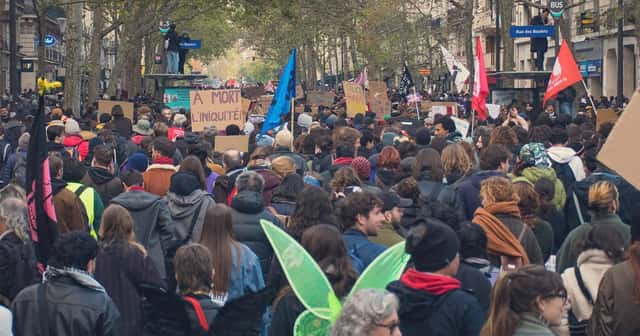
Six French public-sector unions have called a strike for Tuesday, November 17, to demand that the government lift a freeze on the "index point," the value that sets the base pay of most of the country's 5.8 million public employees. The call came on Monday, the same morning Prime Minister Sébastien Lecornu met private-sector unions and employers at Matignon and announced a 1.6% rise in the minimum wage for December 1.
The timing sharpens a problem for the government. The index point has not changed since July 2023, and the 2027 budget keeps it frozen. A higher minimum wage pushes more public employees below it. Hours after the strike call, the Cour des comptes, France's public auditor, suggested going further and suspending civil servants' promotions for a year to save €3.9 billion. Public-sector unions are due to meet Lecornu on Friday, November 13.
What the unions are demanding#
The CGT, UNSA, FSU, Solidaires, CFE-CGC and FA-FP signed the call, which the FSU published on its website and the CGT's public-services federation reposted. "It is not acceptable for the index point to stay frozen for a fourth year," the statement says. "The 5.8 million public employees must be recognized." It says a rise cannot be avoided given inflation, which it puts at 3.4% in October.
The unions list four demands:
- an "immediate and significant" increase in the index point and its indexation to inflation, with first steps to raise pay on career scales;
- a quick start to a rebuild of the pay scales, including equal pay between women and men;
- 2027 budget and Social Security laws that fund quality public services and social protection;
- abolition of the unpaid first day of sick leave, the "jour de carence," and full pay for staff on ordinary sick leave.
Two large unions did not sign. Force Ouvrière, the second-largest union in the public sector, and the CFDT, the third, are not among the signatories, franceinfo and RTL reported. Both still want a pay rise. Christian Grolier, who leads FO's public-sector federation, told Acteurs Publics that "the absolute priority is the immediate increase in the index point and its indexation to inflation." Laure Revel of CFDT Fonctions publiques told the same outlet that measures must show up "substantially on the payslip." She also asked for an annual mandatory pay negotiation in the public sector.
Why the index point matters#
A civil servant's base salary equals the index point value multiplied by the number of index points attached to their grade and step. The point is worth about €4.92 gross a month, according to a simulation by Economie Matin. On that basis, a 1% rise would lift a base salary of €2,500 gross by €25 a month. Bonuses and allowances follow their own rules.
The point has moved little. LCP, the National Assembly's channel, reported that since 2017 it rose only in 2022 (3.5%) and 2023 (1.5%), a little over 5% in total. Over the same period, LCP said, cumulative inflation measured by the national statistics office Insee will reach 24.17% by the end of 2026. Governments have used other tools in the meantime. Five extra index points were granted to all public employees in January 2024, worth about €24.61 gross a month, Economie Matin said.
- Index point frozen
- Valls government announces a thaw
- Index point rises 3.5%
- Index point rises 1.5%, its last change
- Five extra index points for all public employees
- Minister David Amiel offers to raise the minimum index on January 1
- Six unions call a strike; the Cour des comptes floats a promotions freeze
- Public-sector unions due at Matignon
- Public-sector strike and protests
Source: LCP, Acteurs Publics, Economie Matin, FSU
The cost is the government's main argument. A 1% rise in the point costs €2.4 billion, or about €1.5 billion after income tax, according to estimates cited by Acteurs Publics.
The government's targeted approach#
The government has so far preferred targeted steps. On October 2, Public Action and Accounts Minister David Amiel offered to raise the minimum index on January 1, LCP reported. He said the change would lift about 400,000 public employees above the minimum wage. The law requires a top-up payment, called the "indemnité différentielle," for every public employee whose base pay is below the minimum wage. In 2026 that covered 862,000 people, according to LCP.
"For these employees, the aim is to replace a catch-up allowance with index pay," Amiel said, as LCP reported. He noted that index pay, unlike the top-up, counts toward civil servants' pensions. He also promised "lasting injections of index points in the first steps, to start giving value back to advancement and seniority." The CGT's Damien Martinez called the offer "small measures" and "window dressing," according to AFP as quoted by LCP.
Monday's minimum-wage decision undercuts that plan. The minimum wage will rise to about €1,502 net a month on December 1, franceinfo reported. Acteurs Publics wrote that the rise "purely and simply wipes out" the minimum-index increase decided in October. It said ministerial offices are studying options, including a further rise in the minimum index or keeping the top-up, which would then go to more than a million public employees. Those details come from the outlet's own reporting and unnamed observers; the government has not published its plan.
At a summer pay meeting on July 8, 2026, the government did not plan any general measure on the point for 2027, Economie Matin reported. It favored career and experience measures tied to passage of the budget.
A separate meeting on Friday#
Public-sector unions were not part of Monday's conference at Matignon, which brought together private-sector unions and the main employer groups. They will instead be received by the Prime Minister on Friday, November 13, Acteurs Publics reported. Grolier called their exclusion from Monday's talks "abnormal," given that weeks of strike calls and protests had spanned the whole workforce.
Union leaders welcomed the Friday meeting but set conditions. "The Prime Minister's decision to receive the public-sector unions is a good thing," said Luc Farré, general secretary of UNSA Fonction publique, according to Acteurs Publics. "He must move on unfreezing the index point; he cannot leave public employees below the minimum wage." Caroline Chevé, general secretary of the FSU, was more skeptical. "It's better, but it's too late," she told the outlet. She said she feared "only crumbs" would be left for the public sector, which "would not be acceptable."
The auditor's promotions freeze#
The Cour des comptes report released Monday lists 18 measures it says could save €32 billion to €38 billion in 2027. One of them would suspend all step advances and promotions in the civil service for a year. The court says the public wage bill was €370 billion in 2025, 22% of public spending, and has grown 2.4% a year since 2012, faster than inflation. It puts the saving at €3.9 billion in 2027.
Carine Camby, who chairs the court's first chamber, conceded that the measure "is difficult for public servants" but said it would have "a massive effect" on the wage bill, TF1 Info reported. Public Sénat quoted her as saying the index freeze "did not prevent very strong increases" in the wage bill. The court calls the promotions freeze an emergency measure for cases of "imperative necessity." The full list is in 567politics' report on the auditor's 18 measures.
How big the last strike was#
The November 17 call follows a broad protest day on November 5. On that day more than 10% of state civil servants were on strike, along with 6.10% in local government and 4.97% in public hospitals, according to figures reported by franceinfo and RTL. Those are official participation rates for one day. They do not measure support for the demands.
Solidaires, one of the signatories, has framed the date as part of a wider wave. In its own statement, it said up to 1.6 million people marched on November 5 "at the call of the unions." It argued that the 1.6% minimum-wage rise is only about 0.4 points more than the automatic January increase. It calls on workers to discuss "renewing" the strike after November 17. Solidaires also backs a student and education protest on November 10 and a protest against the cost of living on November 14.
CGT leader Sophie Binet called on "all employees, retirees and young people" to make November 17 a new day of strikes and protests. "As long as wages do not rise, as long as we have no answer to our demands, the mobilization will continue," she said after the Matignon conference, according to franceinfo. The high-school protests that began in October are covered in our earlier report.
Competing arguments#
The dispute turns on two goals that pull against each other: restoring public employees' purchasing power and cutting a deficit the government expects to reach 5.4% of GDP in 2026, according to the Cour des comptes.
Unions argue that a fourth year of freeze is unfair while prices keep rising. They say targeted fixes at the bottom of the scale flatten pay across careers, so that experienced staff earn little more than new hires. FO and the CFDT share the goal of a general rise but did not join the strike call.
The government argues that a general rise is expensive and that money should go first to the lowest-paid. Its 2027 budget keeps the point frozen. Amiel's approach would lift the minimum index and add points early in careers.
The auditor goes further than the government in the other direction. It argues that pay restraint is needed to stabilize public spending and that a one-year promotions freeze would be the fastest lever, while admitting the cost to staff.
567politics did not find a statement from the National Rally, La France Insoumise, the Socialists or the Republicans on the November 17 call by Monday evening. Readers can compare the parties' economic positions on the France political spectrum, which shows dated editorial estimates.
Friday talks and the strike date#
Unions meet the Prime Minister on Friday. Acteurs Publics reported that a six-month extension of a mileage allowance and ministry-level measures are among the options under study. The pay demands will also be tested in the Senate, which resumed debate on the 2027 Social Security budget this week, as 567politics reported. The strike on November 17 will show whether the non-signatory unions' members join in.
Differing perspectives
Should France raise the frozen index point for public employees in 2027, target pay help more narrowly, or restrain public pay further?
Each position is summarized as its supporters make it, with equal weight and in alphabetical order. A summary is not an endorsement; the evidence for each is weighed in the story above.
Also pause promotions for one year
Who holds it: The Cour des comptes, France's public auditor
The court says the public wage bill reached €370 billion in 2025, 22% of public spending, and has grown 2.4% a year since 2012, faster than inflation, despite the index freeze. It argues that suspending step advances and promotions for one year would save €3.9 billion in 2027 and have a large effect on the wage bill. It presents this as an emergency option, acknowledging the measure penalizes staff.
In their words: Cour des comptes ↗
Keep the freeze, help the lowest paid
Who holds it: The Lecornu government, through Public Action and Accounts Minister David Amiel
The government keeps the index point frozen in its 2027 budget and says help should go first to the lowest-paid. Amiel offered to raise the minimum index on January 1, lifting about 400,000 public employees above the minimum wage, and to add lasting index points at the first career steps. He says this replaces a catch-up allowance with real index pay that, unlike the allowance, counts toward pensions.
In their words: LCP - Assemblée nationale ↗
Unfreeze and index the point now
Who holds it: The CGT, UNSA, FSU, Solidaires, CFE-CGC and FA-FP, which called the November 17 strike
The six unions say a fourth year of freeze is not acceptable while inflation reached 3.4% in October, and that 5.8 million public employees must be recognized. They want an immediate and significant rise in the index point, automatic indexation to prices and first steps to raise pay along career scales. They also want a rebuild of the pay scales, equal pay for women and men, and full pay from the first day of sick leave.
In their words: Fédération syndicale unitaire (FSU) ↗
Win a rise through talks with Matignon
Who holds it: Force Ouvrière's and the CFDT's public-sector federations, which did not sign the strike call
FO's Christian Grolier says the absolute priority is an immediate rise in the index point and its indexation to inflation, and that the unions expect concrete answers at Friday's meeting with the Prime Minister. The CFDT's Laure Revel wants measures that show up substantially on the payslip, quick work on pay scales and a mandatory annual pay negotiation for the public sector, so the same situation does not recur.
In their words: Acteurs Publics ↗
Cite this article
567 Politics staff. “Six French unions call a Nov. 17 public-sector strike over a pay freeze now entering its fourth year.” 567politics. Published 2026-11-09. https://567politics.com/news/france-public-sector-strike-november-17-point-d-indice-freeze-unions-november-2026
Wikipedia citation
{{cite news |title=Six French unions call a Nov. 17 public-sector strike over a pay freeze now entering its fourth year |url=https://567politics.com/news/france-public-sector-strike-november-17-point-d-indice-freeze-unions-november-2026 |work=567politics |author=567 Politics staff |date=2026-11-09 |language=en}}CSL-JSON for reference managers
{
  "id": "https://567politics.com/news/france-public-sector-strike-november-17-point-d-indice-freeze-unions-november-2026",
  "type": "article-newspaper",
  "title": "Six French unions call a Nov. 17 public-sector strike over a pay freeze now entering its fourth year",
  "URL": "https://567politics.com/news/france-public-sector-strike-november-17-point-d-indice-freeze-unions-november-2026",
  "container-title": "567politics",
  "language": "en",
  "author": [
    {
      "literal": "567 Politics staff"
    }
  ],
  "issued": {
    "date-parts": [
      [
        2026,
        11,
        9
      ]
    ]
  }
}Citations identify this article and its publication date. Assess the reporting and its linked sources before using it as evidence.
Read this article as Markdown or JSON. Cite the original page and retain its sources, dates and qualifications.
Embed this article summary
Paste this HTML into your page. The summary stays linked to the full story and updates with it. No account required.
<iframe src="https://567politics.com/embed/news/france-public-sector-strike-november-17-point-d-indice-freeze-unions-november-2026?theme=auto" title="Six French unions call a Nov. 17 public-sector strike over a pay freeze now entering its fourth year by 567politics" width="100%" height="440" style="border:0;max-width:100%" loading="lazy"></iframe>
<p style="font-size:14px">Six French unions call a Nov. 17 public-sector strike over a pay freeze now entering its fourth year by <a href="https://567politics.com/news/france-public-sector-strike-november-17-point-d-indice-freeze-unions-november-2026" rel="nofollow">567politics</a></p>
<script async src="https://567politics.com/embed.js"></script>
READ BEYOND 567POLITICS
Alternate sources & perspectives
Independent coverage and primary evidence to help you compare arguments. A link is not an endorsement; perspective labels describe the linked material.
- primary evidence
Communiqué de l'Intersyndicale Fonction publique: appel à la grève le mardi 17 novembre ↗
FSU
The six unions' strike call and full list of demands, dated November 9, 2026.
- left argument
L'intersyndicale fonction publique appelle à la mobilisation et à la grève le mardi 17 novembre ↗
Fédération CGT des services publics
The CGT public-services federation's posting of the same call.
- left argument
Le 17 novembre en grève et dans la rue! ↗
Union syndicale Solidaires
Argues the minimum-wage rise is too small and calls for a renewable strike, linking the public-sector date to student and cost-of-living protests.
- independent analysis
Hausse du point d'indice des fonctionnaires: le gouvernement sous pression maximale ↗
Acteurs Publics
Specialist public-service outlet with FO, UNSA, FSU and CFDT reactions, the €2.4 billion cost of a 1% rise and options under study.
- other perspective
Salaire des fonctionnaires: le ministre David Amiel propose de relever l'indice minimum au 1er janvier ↗
LCP - Assemblée nationale
The government's targeted offer and its rationale, plus index-point history since 2017.
- primary evidence
Contribution au rétablissement des finances publiques ↗
Cour des comptes
The auditor's case for a one-year promotions freeze (measure 2) and wage-bill data.
- independent analysis
Une intersyndicale appelle à la grève le 17 novembre dans la Fonction publique ↗
RTL
Notes that FO and the CFDT did not sign and gives the November 5 strike participation rates.
- independent analysis
Ce que le dégel du point d'indice changerait sur la paie des fonctionnaires ↗
Economie Matin
Explains how the index point sets pay, with a simulation of a 1% rise.
Reviewed 2026-11-09. discover_politics_sources returned only unrelated pages (Public.com and dictionaries), so sources were found and opened directly. No statement on the strike call from the government after Monday's announcement, or from the National Rally, LFI, PS or LR, was found by Monday evening; no right-of-center argument specific to the strike was located, so none is listed. Public-sector employer groups were not found commenting.