Germany and Singapore have agreed on a work plan to deepen their strategic partnership, according to a German government account of Chancellor Friedrich Merz's October 27 press conference with Prime Minister Lawrence Wong.
The announcement places economic and security cooperation on the same diplomatic agenda. Its value will depend on the measures that follow: a statement of intent can identify priorities, but it does not by itself establish a completed project or a measurable economic return.
At a glance
| Item | Official account |
|---|---|
| Merz–Wong press conference | October 27 |
| EU–ASEAN anniversary referenced | 50th anniversary in 2027 |
What the official account says
The German government's summary lists security and defense, trade and investment, digital technology, artificial intelligence and research, and green energy among the work plan's areas. It also identifies the fiftieth anniversary of EU–ASEAN relations in 2027 as an opportunity for further cooperation.
The chancellor's itinerary places talks with Wong and a Singapore Lecture speech on October 27. It lists a planned meeting with President Tharman Shanmugaratnam as well. The itinerary describes a wider trip continuing to Japan and South Korea.
Those records support the date, participants and stated priorities. This brief does not treat every planned meeting as a confirmed completed event, and it does not infer terms of any agreement that have not been published.
Analysis: cooperation has benefits and constraints
A partnership covering several fields could make it easier to connect investment with research, skills or energy projects. It could also give both governments a regular channel for addressing concerns before they become trade disputes. Whether those gains occur requires evidence beyond a meeting announcement.
Broad agendas carry a coordination risk. A long list of priorities can make a partnership appear more substantial than its delivery capacity. Clear responsibilities, deadlines and public reporting would help readers judge which commitments become practical work.
Security and commercial goals can also pull in different directions. Businesses may seek access to technology or customers, while governments may impose safeguards on sensitive activities. A credible assessment should examine the actual rules for a specific transaction rather than assuming either unrestricted trade or a blanket restriction.
This is an analytical tradeoff, not an allegation that either government has breached a commitment. The same scrutiny should apply to claimed benefits and claimed risks. Neither can be measured from diplomatic language alone.
What would count as follow-through
Look for publication of the work plan, named implementing bodies and details of individual projects. For investment claims, distinguish a proposal from a signed commitment and from money actually spent. For research, check the participants, funding and conditions for sharing results.
Any later claim about jobs, exports or energy savings should specify a period and comparison. The announcement reviewed here does not establish a new employment total or a change in Germany's election prospects. This report provides no such estimate.
Our Germany guide and German policy watchlist give wider political context. This AI-assisted report was prepared on October 27, 2026, from dated German government material. The source describes the government's own position; it is not an independent assessment of the partnership's eventual costs or results.
Photo and reporting note
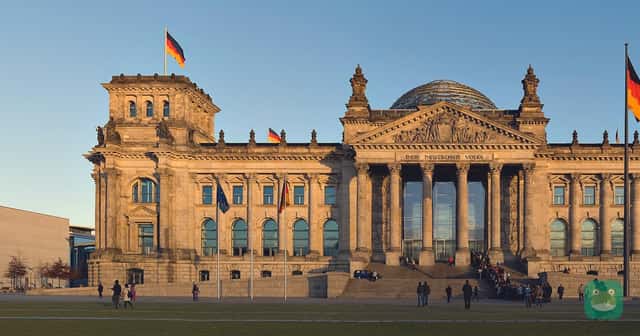
File image for institutional context, not a photograph of the event reported here. Photo: Jürgen Matern , original file, CC BY-SA 3.0. Cropped for publication. The adapted photo remains available under the same license.
