Haitian gang leader asks UN for talks as Salvadoran troops push into Cul-de-Sac
The UN says receiving Wilson Joseph's letter implies no endorsement, and that most of El Salvador's 2,000 new troops are outside the UN-backed force.
The leader of one of Haiti's most powerful gangs has written to United Nations Secretary-General António Guterres asking for a UN delegation to open talks, as more than 2,000 Salvadoran soldiers move into the areas his group controls east of Port-au-Prince. The UN confirmed on Monday, Nov. 2, that it had received the letter. It also said, in unusually careful language, that receiving it meant nothing more than that.
The letter is signed by Wilson Joseph, known as "Lanmò Sanjou," who leads the 400 Mawozo gang in the Croix-des-Bouquets area. He has been on the UN Security Council's sanctions list since December 2023, and the U.S. government offers a reward of up to $1 million for information leading to his capture. The letter arrived as Salvadoran troops began their first large operation in the Cul-de-Sac plain, the farmland and roadway corridor northeast of the capital where 400 Mawozo and the Chèn Mechan gang operate.
The exchange puts three parties with different aims on the same ground: a Salvadoran government that says its only goal is to bring home four missing aviation technicians, a Haitian government that wants to retake territory before elections it has just postponed to 2027, and a UN-authorized multinational force whose rules most of the new Salvadoran soldiers are not operating under.
What the UN said about the letter
According to UN News, Joseph asked Guterres to send a delegation to open talks and act as a mediator. In the letter, as described by the UN, he said he feared the Salvadoran intervention would increase reprisals against civilians, and he claimed the four missing Salvadorans were dead. Haitian authorities consider the four missing. The Salvadoran government has said it believes they are alive. Joseph offered no evidence for his claim, and 567 Politics has not been able to verify it.
Secretary-General's spokesperson Stéphane Dujarric told reporters: "The receipt of such a letter does not constitute an endorsement of its contents, nor an acknowledgment of its author, nor a position taken by the United Nations." A Spanish-language account of the same briefing reported that Dujarric added that transparency and accountability were essential and that the UN remained focused on supporting a coordinated international response to restore security. The letter, according to that account, was signed "Gwoup Rebel 400."
Dujarric also drew a line between the Salvadoran deployment and the UN-authorized mission. The Gang Suppression Force, which the Security Council authorized at up to 5,500 personnel, remains well below that strength. He said the "vast majority" of the roughly 2,000 additional Salvadoran troops "are not deployed under the Gang Suppression Force," and that all security operations in Haiti must comply with international law, including international human rights law and international humanitarian law. UPI reported that the UN described those operations as falling outside the mandate and reporting framework of the UN Support Office in Haiti.
That distinction matters because the Gang Suppression Force operates under a Security Council mandate and reports through the UN framework, while troops deployed outside it do not report through that channel. The UN statement did not say the Salvadoran operation was unlawful. It said all operations had to follow the law, and that this one sits mostly outside the UN's own oversight.
How the Salvadoran deployment began
The chain of events started on Sunday, Oct. 18, when four Salvadoran aviation technicians attached to El Salvador's contingent in the Gang Suppression Force were ambushed in Croix-des-Bouquets. No gang has claimed responsibility. Bukele said in an Oct. 21 message posted on X, delivered in Haitian Creole, that the four were not combatants but technicians whose main work was medical evacuation, and that they were seized while returning from buying food. He said El Salvador had launched a military rescue operation that day.
In the same message he addressed gang leaders directly. As Al Jazeera translated it: "Do not take our word for empty threats… We have already finished with the gangs in El Salvador, and we can finish with you too." He said the decision was in the gangs' hands and that returning the four unharmed would restore things to how they were before the kidnapping.
On Oct. 24, human remains were handed over at the airport in Port-au-Prince by what Bukele described as a non-governmental organization. He said on X that the remains were not those of his men: they belonged to a child, to a man considerably taller than any of the technicians, and to a person wearing part of another country's army uniform. The BBC reported the same account.
On Oct. 28, El Salvador's foreign ministry announced what the BBC described as a "robust deployment" of more than 2,000 soldiers to assist "security efforts against gangs in Haiti." Bukele spoke by phone with Haitian Prime Minister Alix Didier Fils-Aimé, and the prime minister's office posted a statement that night on strengthening security cooperation with El Salvador.
The next day, Bukele posted a second Creole-language message to the Haitian public. In 567 Politics' translation, he said: "This is not an operation against the Haitian people, nor an invasion of Haiti. We are not a great power." He said all El Salvador wanted was for its four technicians to come home, and that it would also "give the gangs a lesson." He said El Salvador was paying almost alone, covering 90 percent of the cost from its own funds with some logistical help from other countries, and that the troops would go home when the mission ended. That cost figure is his own; 567 Politics has not found an independent breakdown.
- Four Salvadoran aviation technicians are ambushed in Croix-des-Bouquets
- Bukele announces a rescue operation and warns gang leaders in a Creole message
- Remains handed over at the airport; Bukele says they are not his men
- El Salvador announces more than 2,000 troops; Haiti's electoral council moves the first round to July 2027
- Bukele tells Haitians the deployment is not an invasion
- Salvadoran troops start a Cul-de-Sac operation; the UN confirms it received Joseph's letter
Source: UN News, Al Jazeera, UPI
The Cul-de-Sac operation
Salvadoran troops began what EFE, in a report carried by CNN en Español, called their first large operation on Monday, moving in about ten armored vehicles into the Cul-de-Sac plain with the stated aim of dismantling Chèn Mechan and 400 Mawozo. The soldiers had started arriving in the capital on Oct. 22. Video circulating on social media showed the vehicles crossing areas that looked abandoned while gang members put up barricades. That video has not been independently verified.
Haitian media reported at least ten gang members killed in clashes in the Santo and Croix-des-Missions sectors, according to the same EFE report. 567 Politics has not confirmed that figure, and neither the Salvadoran nor the Haitian government had published a casualty count by Tuesday afternoon.
The Haitian National Police announced its own operation in the same plain, with support from the Gang Suppression Force, in Carrefour Shada, at the Croix-des-Missions bridge and in Santo 17. The police said in a statement quoted by EFE that the operation was meant "to eliminate toll points, put an end to kidnapping attempts and to the mistreatment the population suffers at the hands of terrorist bandits in the Cul-de-Sac plain."
Some Haitian outlets reported that the Viv Ansanm gang coalition forced residents of La Plaine, under threat, into the streets to protest the operations, which the coalition called an "invasion." Those reports came from local media cited by EFE and could not be independently checked.
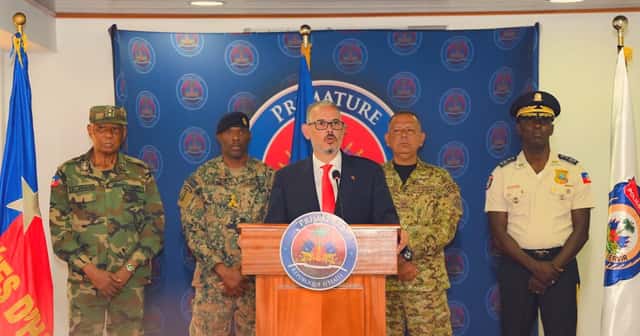
On Tuesday, the Office of the Prime Minister posted a press release on X headed "National security: the state goes on the offensive against the gangs," with photographs of a briefing attended by military and police officers. The full text of the release was posted on Facebook and was not available to 567 Politics at publication time.
Elections pushed back again
The deployment was announced the same day Haiti's Provisional Electoral Council moved the first round of national elections from Dec. 13, 2026, to July 18, 2027, according to Al Jazeera. A second round and local elections are now scheduled for Oct. 4, 2027. Al Jazeera, citing the Miami Herald, reported that fewer than 900,000 people had registered to vote out of about 6.5 million holders of national identity cards.
Haiti has not held an election since 2016. President Jovenel Moïse was assassinated in 2021, and the country has been governed since then by a series of transitional arrangements. The new calendar was announced the same day as the Salvadoran deployment, and the vote will now take place, if it is held on schedule, after months of operations like the one in Cul-de-Sac.
Other countries in the hemisphere are working through their own delayed or contested electoral paths, including Venezuela, where opposition leader María Corina Machado has returned and is pressing for a 2027 vote. Haiti's case is different because the main obstacle is physical control of territory: the AP has reported that gangs control about 70 percent of the capital.
The humanitarian picture
The UN says more than 5,700 people were killed or injured in Haiti between January and mid-September 2026. About 1.5 million people are displaced, and about 6.4 million need humanitarian aid. Al Jazeera, citing the Integrated Food Security Phase Classification, reported that 5.94 million people face acute hunger, including 1.8 million at emergency levels, with the total projected to reach 6.35 million by mid-2027. RTVE, citing UN figures, reported more than 230 kidnappings so far this year and more than 1,000 women and girls raped.
Those numbers sit behind both arguments now being made. Bukele has framed the deployment as a way to end the suffering gangs cause Haitians. Joseph's letter, as the UN described it, warned that the fighting would expose civilians to more reprisals, and the UN has stressed that any operation must protect civilians under international law.
Who 400 Mawozo is
400 Mawozo is based in Croix-des-Bouquets, on the eastern edge of the capital. In October 2021, it kidnapped 17 U.S. and Canadian missionaries, including five children, and held most of them for about two months. The FBI has offered a reward of up to $1 million for information on Joseph. The UN Security Council listed him for sanctions in December 2023, citing killings, kidnappings, sexual violence and the recruitment of children, according to UPI.
The Cul-de-Sac area is also home to Chèn Mechan and to Kraze Barye, led by Vitel'Homme Innocent, according to the AP's reporting carried by Al Jazeera. Both Joseph and Innocent are under UN and U.S. sanctions.
How the international mission fits
The Security Council expanded the powers of the international force in Haiti in October 2025, according to the BBC, and the Gang Suppression Force now has an authorized strength of 5,500. Contributors include Chad, Jamaica, Guatemala and El Salvador. Reports of its current size differ: the AP put it at more than 2,000 personnel before the new Salvadoran deployment, while RTVE reported about 1,500. RTVE reported that the Council recently extended the mandate by six months, with China, Russia and Pakistan abstaining over concerns about funding, staffing and effectiveness.
Questions about what happens when a UN-authorized force is under strength are not limited to Haiti. In Lebanon, the end of the UNIFIL mission has raised questions about what follows when a UN force leaves without a successor. In Western Sahara, U.S. and Russian vetoes of rival drafts left the MINURSO mission without a mandate after Oct. 31. And in Iraq, factions are disputing a reported deal behind a June 2027 deadline for militias to give up their weapons, another case of a government trying to set terms with armed groups it does not fully control.
In Haiti, the immediate question is whether any party will engage with Joseph's request. The UN has said only that it received the letter. 567 Politics did not find a formal response from the Salvadoran or Haitian governments by Tuesday afternoon, though Bukele reshared several news reports about the letter on X.
What to watch
The Salvadoran government has not said how long its troops will remain. Bukele has tied their return to the end of the mission, which he defined as the recovery of the four technicians. If the technicians are found, the length of the deployment could become a question for both governments. If they are not, the pressure on 400 Mawozo is likely to continue.
At the UN, the open question is how a national deployment of this size, operating largely outside the Gang Suppression Force's reporting framework, will be accounted for as operations move through populated areas. Dujarric's statement set out the standard the UN says applies to all of them: international human rights law and international humanitarian law.
For Haitian voters, the July 2027 date depends on what happens in places like the Cul-de-Sac plain. Voter registration remains low, and parts of the capital and surrounding areas remain outside government control. This article follows 567 Politics' editorial standards on unverified claims: casualty counts and claims about the fate of the four technicians are attributed to their sources and will be updated as they are confirmed.
Differing perspectives
How should foreign troops operate against Haiti's gangs while a gang leader seeks UN-mediated talks?
Each position is summarized as its supporters make it, with equal weight and in alphabetical order. A summary is not an endorsement; the evidence for each is weighed in the story above.
A Haitian state offensive with foreign support
Who holds it: Office of Prime Minister Alix Didier Fils-Aimé and the Haitian National Police
Haiti's government presents the operations as the state going on the offensive against gangs, with Haitian police leading operations in the Cul-de-Sac plain alongside the Gang Suppression Force and partner countries. The police say the goal is to remove gang toll points, stop kidnappings and end abuse of residents, and that they will keep operating until security returns to threatened areas and residents' lives and property are protected.
In their words: Office of the Prime Minister of Haiti on X ↗
Keep up pressure until the hostages return
Who holds it: President Nayib Bukele and the government of El Salvador
El Salvador says its deployment is not an operation against Haitians or an invasion, and that its single aim is to bring four aviation technicians home alive. Bukele has warned gang leaders that El Salvador already defeated its own gangs and can defeat them too, and presents sustained military pressure as the way to free the four and end the suffering gangs inflict on ordinary Haitians. He says El Salvador is paying most of the cost itself and will leave when the mission is done.
In their words: Nayib Bukele on X ↗
Operate within international law and UN oversight
Who holds it: UN Secretary-General António Guterres's office
The UN says receiving the gang leader's letter does not endorse it or recognize its author. It stresses that most of the new Salvadoran troops are outside the Gang Suppression Force and its reporting framework, and that every security operation in Haiti must comply with international human rights law and international humanitarian law. It calls transparency and accountability essential and backs a coordinated international effort to restore security and stability.
In their words: UN News ↗
READ BEYOND 567POLITICS
Alternate sources & perspectives
Independent coverage and primary evidence to help you compare arguments. A link is not an endorsement; perspective labels describe the linked material.
- primary evidence
Haiti gang leader seeks UN talks as El Salvador sends 2,000 troops to hunt for missing soldiers ↗
UN News
The UN's own account of the letter from Wilson Joseph, the spokesperson's statement that receiving it implies no endorsement, and the note that most Salvadoran troops are outside the Gang Suppression Force.
- primary evidence
Bukele's Creole-language message to the Haitian people, Oct. 29, 2026 ↗
Nayib Bukele on X
El Salvador's president says the deployment is not an invasion, that its aim is the return of four technicians, and that El Salvador covers 90 percent of the cost.
- primary evidence
Bukele's message to Haitian gang leaders, Oct. 21, 2026 ↗
Nayib Bukele on X
The original Creole statement announcing a rescue operation and warning gang leaders to return the four technicians.
- primary evidence
Bukele on remains handed over at the airport, Oct. 24, 2026 ↗
Nayib Bukele on X
Bukele's statement that remains handed over by an NGO did not belong to the missing technicians.
- primary evidence
Press release: National security, the state goes on the offensive against gangs ↗
Office of the Prime Minister of Haiti
The Haitian government's Nov. 3 announcement and briefing photographs.
- independent analysis
U.N. receives Haiti gang's request for talks amid Salvadoran offensive ↗
UPI
Wire report on the letter, Joseph's sanctions history and the Cul-de-Sac operation.
- independent analysis
El Salvador pledges more than 2,000 soldiers as Haiti delays elections ↗
Al Jazeera
Covers the new electoral calendar, voter registration figures and hunger data alongside the deployment.
- independent analysis
El Salvador's Bukele threatens Haitian gangs over abducted soldiers ↗
Al Jazeera (AP)
AP reporting on the ambush, the gangs operating in the area and the size of the Gang Suppression Force.
- independent analysis
BBC News report on El Salvador's deployment to Haiti ↗
BBC News
BBC account of the deployment announcement and the dispute over remains handed over by Haitian authorities.
- independent analysis
Soldados salvadoreños lanzan su primera gran operación contra las bandas en Haití ↗
CNN en Español (EFE)
Spanish-language EFE report on the Cul-de-Sac operation and the Haitian National Police statement.
- other perspective
El Salvador lanza una operación militar contra las bandas en Haití ↗
RTVE
Spanish public broadcaster's overview, including excerpts of Joseph's letter, UN casualty figures and the Security Council mandate vote.
Reviewed 2026-11-03. discover_politics_sources returned no relevant results for this story, so these sources were hand-picked from pages 567 Politics opened and checked on Nov. 3, 2026. Primary evidence comes from the UN and from the governments of El Salvador and Haiti in their own words; reporting from wire services and international broadcasters covers the operation and the election delay. No source here takes a clear left or right argument; the UN, Salvadoran and Haitian government positions are summarized in the perspectives section.