A food-safety chief wants Indians to drop 'it'll do.' A High Court said be realistic
The Economist's Nov. 8 India column uses Maharashtra FDA Commissioner Tukaram Mundhe to argue that a culture of "good enough," not a lack of laws, is the deeper problem. Official sample data, court orders and restaurant groups complicate that story.
The Economist used a Maharashtra food-safety commissioner this week to make a larger claim about India: the country already has laws and capable officials, but a habit of settling for "good enough" keeps institutions weak. The magazine's Nov. 8 "Ashoka" column, by Leo Mirani, circulated on X on Nov. 10 with the line, "'Good enough' is not good enough." The column's test case is Tukaram Mundhe, the Indian Administrative Service officer who took charge of Maharashtra's Food and Drug Administration on May 25, 2026, and has since become a public face of kitchen raids, license suspensions and a slogan against "chalta hai" — Hindi for "it'll do."
The column is analysis, not a government finding. Its main factual claims can be checked. A Bombay High Court bench did tell the FDA in July to take "a realistic stand" after inspectors suspended a hotel over two insects. Mundhe has said, in his own interviews, that Indian food-safety laws are Indian laws and that a casual attitude "will not work because this is playing with the lives of people." National testing data given to Parliament show that nearly one in five food samples analyzed in 2025-26 did not meet the standard against which it was tested. Those figures, however, come from the fiscal year that ended on March 31, 2026, almost two months before Mundhe took the Maharashtra post. They describe a national backdrop, not the results of his campaign.
This article sets the magazine's argument beside the court record, the official sample data, Mundhe's own words, and the pushback from restaurants and judges already documented in 567 Politics' reporting on Maharashtra's Diwali food-hygiene drive.
What The Economist argued#
Mirani's column, summarized here from The Economist's X post, from The Print's account of the piece and from a widely circulated reprint, opens with a pointed question: how many cockroaches are acceptable in a commercial kitchen. It contrasts a reader's likely answer — zero — with the Bombay High Court's July remark that the "solitary finding" of two bugs was not enough to keep a kitchen shut, and with the acting chief justice's caution that "We are in India, we have to take a realistic stand."
Mundhe's reply, as the column quotes him, is that the rules "are Indian, not foreign," written by Indian experts for Indian conditions, and that "we have a very low estimate about ourselves." The magazine places that view in a familiar bureaucratic pattern: a strict officer appears, the press turns him into "something between a saint and an action hero," the public briefly sees the state working, and then the officer is transferred and "everything goes back to normal." Mundhe, the column says, wants a rebuilt FDA with more officers, labs and automated checks, including a way to trace milk "from cow to glass," so the institution does not depend on one energetic person.
The magazine also says Mundhe built a modern complaints site with an artificial-intelligence assistant that helps officers match violations to rules, draft notices and escalate ignored complaints, and that the FDA is receiving more than six times as many complaints as a year earlier. Those portal and volume figures were not independently confirmed from an official statistical release opened for this article; they are The Economist's account of what the FDA says. Mundhe's closing line in the column is that when the public itself says "chalta hai," the system will work that way too.
The original essay sits behind The Economist's paywall. This summary attributes the magazine's analysis and does not reproduce its prose.
The High Court did tell the FDA to be "realistic"#
The court episode is real, and the details matter. On July 29, 2026, a Bombay High Court bench of Acting Chief Justice Ravindra Ghuge and Justice Gautam Ankhad quashed the FDA's July 3 suspension of the food license of Park Inn by Radisson in Navi Mumbai. Inspectors had cited "serious lapses in hygiene, sanitation, food storage and food handling practices." The hotel had a 95% compliance score, but two small insects had been found in the kitchen.
The bench said that "solitary finding regarding the presence of two insects," set against an overall "satisfactory" compliance report, did not justify keeping the license suspended. "We are in India. We have to take a realistic stand," the court said, according to The Hindu. Government Pleader Neha Bhide argued that there could be "no compromise on food safety and hygiene" and that "one insect or 10 insects" should not matter. The judges still restored the license and asked whether the FDA was applying the same scrutiny to government and semi-government canteens, including those at Mantralaya, the state secretariat, and at the High Court itself. Bhide told the court there was no "pick and choose" approach and that civic and club kitchens had also been inspected and shut.
The ruling is not a finding that insects in a kitchen are acceptable as a matter of food science. It is a proportionality decision: the court treated an isolated finding, against a high compliance score, as too thin a basis for the "extreme step" of suspension. Mundhe has given the other side of that argument in public. In an NDTV interview he said, "'Chalta hai' attitude will not work because this is playing with the lives of people. Safety and health of people are of prime importance." He added that his job is to ensure "every person who is eating food gets safe food that is as per the standards."
Later court friction has cut both ways. The BBC reported that in August the same High Court ordered the department to pay 500,000 rupees in compensation to a sweets shop whose license stayed suspended even after a reinspection found it 98% compliant. The judges called the regulator's intentions "laudable" but said it had "gone overboard." The BBC also reported that Mundhe's team inspected canteens in the court complex after that criticism and flagged violations. The Indian Express later reported that those inspections produced stop-business notices for two of the court's canteens and an improvement notice for a third. Those later inspections do not erase the July holding on Park Inn. They show a running argument over how strictly a written standard should be applied in messy kitchens.
Official sample data show a real gap — and a narrower one than a slogan implies#
The national testing record supports the claim that non-compliance is common. It does not support treating every failed test as a dangerous kitchen, and it cannot be read as a report card on Mundhe.
In a written reply to Lok Sabha unstarred question 1636, answered July 29, 2026, the government said that in 2025-26, state and union territory food-safety authorities analyzed 223,808 samples. Of those, 40,023 were non-conforming: 9,086 unsafe, 26,754 substandard and 4,225 with labeling defects, misbranding, misleading claims or other deficiencies. Civil cases decided with penalties numbered 31,878 and raised 109.11 crore rupees. Criminal convictions numbered 1,918 and raised 5.71 crore rupees. A parallel Health Ministry reply to unstarred question 985, answered July 24, 2026, repeats the 223,808 and 40,023 totals and flags the 2025-26 figures as provisional, subject to further lab tests and court proceedings.
Non-conforming is a wide bucket. Unsafe samples were about 4.1% of those tested. Substandard samples, which may be off specification without being scored as unsafe, were about 12.0%. Labeling and related defects were about 1.9%. Combined, 17.9% of samples failed the test against which they were measured. That is "nearly one in five," as the BBC put it, but it is not "nearly one in five samples was poisonous."
| Category, FY 2025-26 | Samples | Share of all tests |
|---|---|---|
| Unsafe | 9,086 | 4.1% |
| Substandard | 26,754 | 12.0% |
| Labeling or other defects | 4,225 | 1.9% |
| All non-conforming | 40,023 | 17.9% |
The three-year annexure to question 985 also shows that the non-conforming share was not rising into Mundhe's tenure. It was 19.8% in 2023-24 (33,808 of 170,513 samples) and 20.2% in 2024-25 (34,388 of 170,535), then 17.9% in the provisional 2025-26 year, when testing volume jumped. The decline in share happened while the absolute number of failed samples rose, because many more samples were tested. Correlation between more tests and a slightly lower failure rate is not proof that food got safer, or that it did not.
Source: Lok Sabha unstarred question 985, Annexure-I, July 24, 2026
Show the numbers
| Fiscal year | Non-conforming share |
|---|---|
| 2023-24 | 19.8% |
| 2024-25 | 20.2% |
| 2025-26 | 17.9% |
The same annexure lists 704 licenses suspended and 4,764 canceled nationwide in 2025-26, compared with 769 suspended and 1,679 canceled in 2024-25. Those are national totals from a year that ended before Mundhe became Maharashtra's commissioner. They cannot be used to score his raids.
Sampling itself is not a random portrait of every kitchen in India. Authorities choose what to test. A state that inspects more aggressively can look worse on paper than a state that tests less. The government replies also do not, in the pages opened here, break the 2025-26 non-conforming counts into a Maharashtra-only series that would show whether Mundhe's state moved differently from the rest of the country after May.
Mundhe's campaign is broader than one column#
Mundhe is the state's food and drug commissioner, according to the Maharashtra FDA's official directory. In a Sept. 7 interview with The Indian Express, a week after he completed 100 days in the post, he called food safety "a huge public health crisis," pointed to a shift in India's disease burden toward non-communicable illness, and said food and medicines are major contributors. He said Maharashtra imports more than 1.5 crore eggs a day and that stated milk production does not match the state's milking-animal population, a discrepancy he posed as an open question about supply, not as a completed finding of fraud. He also said about 14,000 lab samples were pending when he arrived, that labs had been working ordinary day hours rather than a 24-hour roster, and that the department processed more than 35,000 samples in three months, with results on more than 32,000. Those operational figures come from Mundhe; no separate published lab audit was opened to confirm the backlog counts.
By the end of July, he told the BBC, the department had carried out more than 3,100 inspections, suspended around 300 licenses and issued more than 1,000 improvement notices, and a new complaints portal had drawn more than 16,000 complaints in its first three months. By late August he told The Indian Express the tally was 12,083 inspections, 5,269 improvement notices and 603 license suspensions since May 25. The later, higher figures are the ones to use for the end of August. They still measure activity, not fewer hospital cases.
The BBC also recorded the limits of that visibility. Pawan Agarwal, a former chief of the Food Safety and Standards Authority of India, said hygiene "has always been a problem here" and that "what Mundhe has done differently is make it visible." He also said the awareness is "desirable — but not sustainable" unless systems outlast one officer. Mundhe has made a similar point himself. In the Indian Express interview he said the real question is "what work culture institutions carry and whether society rewards excellence or pays for mediocrity," and that "people will come and go." He has declined to confirm a circulating count of his own transfers. "I have stopped counting my transfers," he told the BBC. The Economist's description of him as a man whose "incorruptibility ensures he does not keep any posting for long" is the magazine's character judgment, not a proven cause of those transfers.
Restaurant groups have not argued for dirty kitchens. They have argued about method. In a July 30 joint statement, the Hotel and Restaurant Association (Western India), the National Restaurant Association of India and the Indian Hotel and Restaurant Association said they support food safety but want improvement notices under Section 32 of the Food Safety and Standards Act before suspensions, and they asked the FDA not to publish names, photographs and videos until the legal process ends, The Indian Express reported. Niranjan Laxman Shetty, legal chairman of the Indian Hotel and Restaurant Association, told the BBC that "high-handed approaches" and "instant suspensions over minor procedural or rectifiable issues" "create panic rather than reform." Mundhe has said suspensions are for extreme cases and that each order records the public-health reason required by the Act.
Maharashtra politics has followed the same split. BJP Mayor Ritu Tawde ordered BMC follow-up cancellations and praised the FDA's methods. Shiv Sena (UBT), the faction led by Uddhav Thackeray, has not spoken with one voice: MP Sanjay Raut alleged in a reported letter that officers were using the panic to extract money, an unverified allegation Mundhe asked him to take to the Anti-Corruption Bureau with names and proof. Those fights, and the November Diwali seizure numbers, are set out in the earlier 567 Politics story and are not repeated at length here.
- Tukaram Mundhe takes charge as Maharashtra FDA commissioner
- Health Ministry gives Parliament provisional FY 2025-26 sample figures
- Bombay High Court quashes Park Inn suspension and says take a realistic stand
- High Court orders 500,000-rupee compensation in a sweets-shop suspension case, BBC reports
- Mundhe tells The Indian Express food safety is a public-health crisis; BBC profiles the campaign
- Pre-Diwali FDA rounds suspend scores of licenses statewide
- The Economist publishes "Why Indians should have higher standards"
- The magazine posts the column on X
Source: The Hindu, Lok Sabha, The Economist via X
"Chalta hai" is an old political line. The NITI report is about data, not kitchens#
The Economist ties Mundhe's slogan to a wider claim that Prime Minister Narendra Modi and others see "chalta hai" as an attitude that holds India back. That attribution has a primary source, but it is nine years old and was not about food inspections. In his Independence Day speech from the Red Fort on Aug. 15, 2017, Modi said: "We have to leave this 'Chalta Hai' attitude. We have to think of 'Badal Sakta Hai'- this attitude will help us as a nation." The Prime Minister's Office listed the same lines among the speech highlights. The 2017 address was a general call for national change, issued long before Mundhe's FDA posting. It does not amount to a current government endorsement of every Maharashtra suspension.
The magazine also cites a NITI Aayog report from last year on poor official data. The document is India's Data Imperative: The Pivot Towards Quality, released June 24, 2025. In a section titled "The Cost of Low Expectation," it says that once systems learn to live with error, "a database that's 80% accurate becomes 'good enough.'" Then comes the passage The Economist trimmed toward "chalta hai": "This mindset shapes everything: how platforms are designed, how staff are trained, and how performance is judged. Slowly, quietly, quality becomes optional." NITI Aayog CEO B.V.R. Subrahmanyam used the Hindi phrase directly at the release, telling reporters a "'chalta hai' attitude, where we are OK with things which are 80 per cent OK," will not work in an era of artificial intelligence.
That report is about government data quality, not restaurant kitchens. Its examples include blocked pensions, rejected hospital claims and welfare leakage. The analogy is fair only if it is labeled as an analogy. A related 567 Politics story on Delhi's Diwali smog fight and missing pollution readings shows how fights over official numbers can sit next to fights over enforcement. It does not prove that a food inspector and a statistics officer are doing the same job.
What the column gets right, and what remains unproved#
The Economist is on firm ground in three places. First, Mundhe is a genuine public figure whose enforcement drive is unusually visible for a state regulator, a point also made by the BBC, The Hindu and The Indian Express. Second, the High Court really did warn the FDA against treating a small insect finding as automatic grounds to shut a largely compliant hotel. Third, official sample data show that a large minority of tested food in India fails some part of the standard, even if most of those failures are recorded as substandard or labeling problems rather than as unsafe food.
The column is on weaker ground where it turns a style of administration into a national character diagnosis. "Chalta hai" is a real phrase in Indian political speech, but there is no representative poll in the sources opened here that measures whether most Indians now demand higher standards, or whether they still shrug. Social praise for Mundhe, including a large Instagram following reported by the BBC in September, is selected online reaction, not a survey of public opinion. The magazine's account of a rebuilt FDA, an AI complaints co-pilot and a six-fold rise in complaints should be treated as reported claims until the state publishes a detailed official note. And no official health series opened for this article shows that hospitalizations from contaminated food have already fallen in Maharashtra since May.
There is also a live tradeoff the column underplays and that courts, hotels and a former national regulator have put on the record. Strict enforcement can make hidden dirt visible. It can also close a business over a fixable lapse, put names in circulation before an appeal is heard, and fade when the officer moves on. Mundhe says the answer is public ownership and stronger institutions. Restaurant associations say the answer is due process first. The High Court has said the answer, in at least one kitchen, is proportion. Those positions can all be true in different cases. They cannot all be collapsed into a single moral about Indians and their standards.
Method and limits#
The Economist's Nov. 8, 2026, column "Why Indians should have higher standards" was read through the magazine's Nov. 10 X post, The Print's Nov. 9 summary of the "Ashoka" column and a third-party reprint. The paywalled economist.com page could not be opened in full. Direct quotations of Mundhe, Modi, the High Court, NITI Aayog and Pawan Agarwal were taken from primary or first-hand interviews and official texts cited above, not copied from The Economist. Food-sample counts come from Lok Sabha replies 1636 and 985, retrieved Nov. 10, 2026. FY 2025-26 is April 1, 2025, to March 31, 2026. British spellings in Indian and British sources are converted to U.S. spelling in this text, except inside direct quotations and official titles.
Photo note#
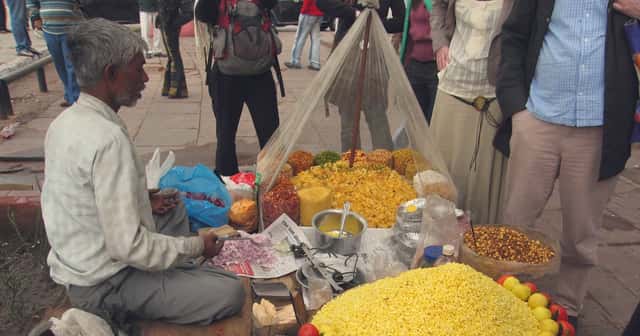
Photo: A bhelpuri street stall in India, the kind of informal food business covered by national hygiene rules as well as hotel kitchens. foam / Wikimedia Commons, originally posted to Flickr, original file, CC BY-SA 2.0.

Differing perspectives
How strictly should India enforce its existing food-safety standards?
Each position is summarized as its supporters make it, with equal weight and in alphabetical order. A summary is not an endorsement; the evidence for each is weighed in the story above.
Apply the written standards as they are
Who holds it: Maharashtra FDA Commissioner Tukaram Mundhe
Mundhe argues that a "chalta hai" attitude has no place in food and medicine because it plays with people's lives. He says his role as state food-safety and drug commissioner is to ensure that every person eating food gets a product that meets the standard, and that every person getting medicine receives standard medication, neither spurious nor substandard. He says the laws are already on the books, that regulators must perform their role, and that license holders are supposed to comply with existing regulations rather than treat them as optional.
In their words: NDTV interview with Tukaram Mundhe ↗
Build systems that outlast one officer
Who holds it: Pawan Agarwal, former chief of the Food Safety and Standards Authority of India
Agarwal says poor kitchen hygiene has long been a problem in India, and that what Mundhe has done differently is make the failures visible. He argues that putting inspections and complaints in public view is valuable because conventional food-safety cases can take years to move through regulators and courts. But he also says the nationwide awareness Mundhe has created among businesses and consumers, while desirable, is not sustainable unless the state builds systems that continue after one energetic officer moves on.
In their words: BBC News interview with Pawan Agarwal ↗
Do not suspend over isolated minor findings
Who holds it: Bombay High Court bench of Acting Chief Justice Ravindra Ghuge and Justice Gautam Ankhad
The Bombay High Court bench says a single finding of two insects, set against an overall satisfactory hygiene and operations report and a 95 percent compliance score, did not justify keeping a hotel's food license suspended. The judges say officials have to take a realistic stand in Indian conditions and treat full suspension as an extreme step when a kitchen is otherwise substantially compliant. They also ask whether the same scrutiny is applied to government and semi-government canteens, not only private hotels.
In their words: The Hindu, reporting the July 29, 2026, Bombay High Court ruling ↗
Give improvement notices before public naming
Who holds it: Hotel and Restaurant Association (Western India), National Restaurant Association of India, and Indian Hotel and Restaurant Association
The hotel and restaurant associations say they support food safety but want a balanced process that also protects natural justice. They argue operators should ordinarily receive an improvement notice under Section 32 of the Food Safety and Standards Act and a chance to fix lapses before a license is suspended or ended. They also say publishing names, photographs and videos before the legal process is finished damages livelihoods and consumer confidence for findings that are still under review, and that instant suspensions over minor or fixable issues create panic rather than reform.
In their words: The Indian Express, reporting the July 30 joint hospitality statement ↗
Cite this article
567 Politics staff. “A food-safety chief wants Indians to drop 'it'll do.' A High Court said be realistic.” 567politics. Published 2026-11-11. https://567politics.com/news/india-economist-mundhe-chalta-hai-food-safety-standards-november-2026
Wikipedia citation
{{cite news |title=A food-safety chief wants Indians to drop 'it'll do.' A High Court said be realistic |url=https://567politics.com/news/india-economist-mundhe-chalta-hai-food-safety-standards-november-2026 |work=567politics |author=567 Politics staff |date=2026-11-11 |language=en}}CSL-JSON for reference managers
{
  "id": "https://567politics.com/news/india-economist-mundhe-chalta-hai-food-safety-standards-november-2026",
  "type": "article-newspaper",
  "title": "A food-safety chief wants Indians to drop 'it'll do.' A High Court said be realistic",
  "URL": "https://567politics.com/news/india-economist-mundhe-chalta-hai-food-safety-standards-november-2026",
  "container-title": "567politics",
  "language": "en",
  "author": [
    {
      "literal": "567 Politics staff"
    }
  ],
  "issued": {
    "date-parts": [
      [
        2026,
        11,
        11
      ]
    ]
  }
}Citations identify this article and its publication date. Assess the reporting and its linked sources before using it as evidence.
Read this article as Markdown or JSON. Cite the original page and retain its sources, dates and qualifications.
Embed this article summary
Paste this HTML into your page. The summary stays linked to the full story and updates with it. No account required.
<iframe src="https://567politics.com/embed/news/india-economist-mundhe-chalta-hai-food-safety-standards-november-2026?theme=auto" title="A food-safety chief wants Indians to drop 'it'll do.' A High Court said be realistic by 567politics" width="100%" height="440" style="border:0;max-width:100%" loading="lazy"></iframe>
<p style="font-size:14px">A food-safety chief wants Indians to drop 'it'll do.' A High Court said be realistic by <a href="https://567politics.com/news/india-economist-mundhe-chalta-hai-food-safety-standards-november-2026" rel="nofollow">567politics</a></p>
<script async src="https://567politics.com/embed.js"></script>
READ BEYOND 567POLITICS
Alternate sources & perspectives
Independent coverage and primary evidence to help you compare arguments. A link is not an endorsement; perspective labels describe the linked material.
- primary evidence
Lok Sabha reply on underweight and adulterated packaged commodities, with FY 2025-26 food-sample totals ↗
Lok Sabha / Ministry of Consumer Affairs
Official written reply of July 29, 2026, giving the 223,808 samples, 40,023 non-conforming split into unsafe, substandard and labeling defects, and civil and criminal penalty totals.
- primary evidence
Lok Sabha reply on food-safety enforcement, with a three-year annexure ↗
Lok Sabha / Ministry of Health and Family Welfare
Official written reply of July 24, 2026, repeating the 2025-26 totals, marking them provisional, and listing inspections, samples, non-conforming shares, and license suspensions and cancellations for 2023-24 through 2025-26.
- primary evidence
Bombay High Court quashes Park Inn license suspension and says take a realistic stand ↗
The Hindu
News report of the July 29, 2026, ruling that restored a hotel license after a two-insect finding, quoted the acting chief justice, and recorded the government's no-compromise argument.
- primary evidence
Chalta hai attitude will not be tolerated: Tukaram Mundhe to NDTV ↗
NDTV
Mundhe's own interview stating that a casual attitude will not work in food and medicine safety because it plays with people's lives, and that licensees must comply with existing rules.
- primary evidence
Indian Express interview with Mundhe on food safety as a public-health crisis ↗
The Indian Express
Mundhe's 100-day interview on lab backlogs, school-diet rules, milk and egg supply questions, and his argument that institutions, not individuals, have to carry the work culture.
- primary evidence
India's Data Imperative: The Pivot Towards Quality ↗
NITI Aayog
June 2025 government think-tank report whose 'Cost of Low Expectation' section says a good-enough mindset slowly makes quality optional; The Economist cited this passage in support of its cultural argument.
- primary evidence
Preliminary text of Prime Minister Modi's 2017 Independence Day speech ↗
narendramodi.in
Official speech text in which Modi said Indians have to leave a chalta hai attitude and think badal sakta hai; the line is nine years older than Mundhe's FDA posting and was not about food inspections.
- independent analysis
Tukaram Mundhe: Maharashtra food safety officer who is a social media star ↗
BBC News
September 2026 profile that checks Mundhe's inspection figures, quotes former FSSAI chief Pawan Agarwal on visibility versus sustainability, and reports later High Court compensation and hospitality criticism.
- independent analysis
The Print Global Pulse summary of The Economist's Ashoka column ↗
The Print
Nov. 9, 2026, account of Leo Mirani's column, used to attribute The Economist's analysis after the paywalled original could not be opened in full.
- other perspective
Hospitality bodies ask the FDA for improvement notices and a hold on public naming ↗
The Indian Express
Report of the July 30 joint statement by three restaurant associations supporting food safety but opposing instant suspensions and pre-process publication of names and photos.
- other perspective
NITI Aayog CEO says a chalta hai attitude toward data quality will not work ↗
The Indian Express
Report of B.V.R. Subrahmanyam's remarks at the June 24, 2025, NITI report release, using the chalta hai phrase about official data rather than restaurant kitchens.
- independent analysis
The Economist X post promoting 'Why Indians should have higher standards' ↗
The Economist
The Nov. 10, 2026, post Patrick asked the desk to cover, with the dek 'Good enough is not good enough' and a link to the Nov. 8 Asia column.
Reviewed 2026-11-10. The Economist's Nov. 8 paywalled column could not be opened in full (the economist.com page returned HTTP 403). The column was read through the magazine's Nov. 10 X post, The Print's Nov. 9 summary, and a third-party reprint, then checked against primary interviews, the High Court report, Lok Sabha replies and the NITI Aayog PDF. discover_politics_sources was not used because it returns unusable results. No official Maharashtra FDA statistical release was found for the magazine's six-fold complaints claim or the proposed FDA restructuring. The July 29 High Court order was read through The Hindu rather than an official judgment PDF. No representative poll on public demand for higher food-safety standards was located.