Delhi's worst Diwali air since 2021 sets off a fight over Punjab's fires and missing pollution data
The BJP alleges a plot behind Punjab's Diwali fire surge. AAP and Congress question Delhi's AQI data. Official records back parts of each claim.
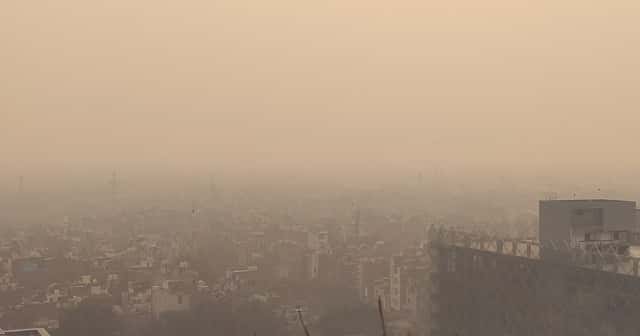
Delhi woke up under thick smog on Monday, the day after Diwali, and its politicians spent the day arguing about who caused it and whether the official numbers can be trusted. The Bharatiya Janata Party, which governs the capital, blamed a sudden surge of farm fires in Punjab, which is run by the Aam Aadmi Party. AAP said the BJP government was hiding the true level of pollution. Congress asked why many monitoring stations went blank during the worst hours of the night.
The official record shows a bad festival night. The Central Pollution Control Board's daily bulletin put Delhi's average air quality index at 376 on Diwali, November 8. That is "Very Poor" and the highest Diwali-day reading since 2021. The next day's bulletin put the average at 344, but only 47 of the city's 59 stations contributed to it. Here is what each side says, what the public data show, and where the gaps are.
What the BJP alleges about Punjab#
Delhi Labour Minister Kapil Mishra, a BJP leader, held a press conference at his official residence on Monday. He said satellite data showed farm fires in Punjab jumped on Diwali evening. According to The Indian Express, he said Punjab had recorded between 100 and 125 fires a day from November 5 to 7. He said that number rose to about 1,200 on the evening of November 8.
"How did the number suddenly rise to 1,200 locations on Diwali? How did the figures increase by more than 10 times?" Mishra asked. He called it "a conspiracy against farmers, a conspiracy against Diwali, a conspiracy against Delhi and a conspiracy against Punjab."
Mishra did not blame Punjab's farmers. He said his office had received calls from farmers who said strangers were setting their fields alight while families were at home for the festival. He asked Punjab Chief Minister Bhagwant Mann to register police complaints, known as FIRs, in the affected areas. He also asked that phone records of AAP legislators and of party workers who had traveled from Delhi to Punjab be examined. He said that if an honest inquiry were held, former Delhi chief minister Arvind Kejriwal "could end up in jail in this matter." He offered no evidence for that claim in the reported remarks.
BJP Member of Parliament Praveen Khandelwal made a similar charge. "This is a well-thought-out conspiracy," he said, according to The Times of India. He said the Punjab government let stubble burn "so that Delhi remains polluted on Diwali and they can blame us for it." He also blamed earlier Congress and AAP governments in Delhi for years of inaction.
No official body has found that the Diwali fires were set deliberately or by anyone linked to a party. The calls Mishra described have not been made public. The conspiracy charge remains an allegation.
What the fire count shows#
The jump in fires is real. Official Punjab data cited by the Press Trust of India recorded 1,152 new farm fires on November 8. That was the state's sharpest one-day rise this season. It took the season's total from 3,307 on November 7 to 4,459.
The Indian Express compared those totals with last year. Up to November 7, Punjab was 2.3 percent below the same point in 2025, with 3,307 fires against 3,384. After Diwali, the state was 23.1 percent above last year, with 4,459 fires against 3,622.
A spike does not by itself show who lit the fires or why. Diwali falls at the end of the paddy harvest, when farmers race to clear fields before sowing wheat. A holiday can also change when fires are set and when satellites catch them. The numbers fit Mishra's account, but they also fit an ordinary late-harvest surge. The data alone cannot tell the two apart.
There is also a question of how much Punjab smoke reached Delhi on Diwali night. Sunil Dahiya, founder of the think tank Envirocatalysts, told The Indian Express that "firecrackers drove most of the spike." He said winds were calm and the layer of air that mixes pollution was only 55 to 80 meters deep. Sulfur dioxide, a gas typical of firecracker smoke, "nearly quadrupled," he said, and most of the rise came after the 10 p.m. deadline for bursting crackers.
How Punjab's government answered#
AAP leaders in Punjab rejected the charge. Punjab Finance Minister Harpal Singh Cheema said, "Kapil Mishra is lying." He said the BJP was taking revenge on Punjab's farmers for the long protest that forced the central government to repeal three farm laws in 2021. He asked why the 300-kilometer stretch of Haryana between Punjab and Delhi, and the Uttar Pradesh districts that surround the capital, were never blamed. Haryana is governed by the BJP. Cheema also said Punjab's fire counts are far lower than a few years ago.
Baltej Pannu, AAP's media in-charge in Punjab, said BJP leaders began blaming the state "even before paddy harvesting began." He said, "Punjab has almost brought stubble-burning incidents under control, yet the BJP continues to target the state."
Neither Cheema nor Pannu addressed, in the reported remarks, why fires rose so sharply on the festival night itself.
The fight over Delhi's own numbers#
The second front of the row is about data. AAP's Delhi president Saurabh Bharadwaj accused the BJP government of fraud. "The government which shuts down air quality monitoring stations on the night of Diwali, the government that does data fraud, how will you trust such a government?" he said in a video, The Hindu reported.
Bharadwaj repeated earlier charges. He said the government had placed 20 new stations in remote green areas, which would pull the city average down. He also said water was being sprayed directly over stations in polluted spots. AAP wrote to the Commission for Air Quality Management and the pollution control board about these claims last week. No regulator has made a finding on them.
Congress leader Pawan Khera asked a narrower question. "There were no PM2.5 readings recorded at 25 of Delhi's 39 monitoring stations between 2 and 3 a.m. on the night of November 8 to 9. WHY?" he asked, according to The Times of India. He asked whether the readings were withheld, whether machines were switched off, or whether pollution had gone past what the machines can measure.
Mishra said on Monday that the government would look into the missing data within an hour and tell reporters. The Hindu reported his promise. An explanation from the Delhi government had not been located by the time of publication.
The data row is not new. After similar charges following Diwali in 2025, Chief Minister Rekha Gupta said, "The data cannot be tampered with or hidden," Hindustan Times reported. Her environment minister, Manjinder Singh Sirsa, called the stations "tamper-proof and fully automatic." He said they are run by three agencies and publish on several platforms at once.
What the missing readings mean#
Independent analysts offered a different account of the gaps from either party's. Several of them point to the limits of the instruments rather than to deliberate tampering.
The Indian Express examined all 59 stations. It found that 45 had at least one missing hourly reading for at least one pollutant on Diwali night. Only 14 reported complete data. At Lodhi Road, 96 of 192 expected hourly data points were blank.
Officials told the paper that the outages came from a mix of software and hardware strain. On the central board's portal, hourly particle readings went blank when concentrations passed 1,000 micrograms per cubic meter. That is the top of the instruments' range. Yet the Delhi Pollution Control Committee's own dashboards logged values far above that at the same hours. They showed 4,697 micrograms at Punjabi Bagh and 4,985 at Jahangirpuri.
Manoj Kumar, lead pollution analyst at the Centre for Research on Energy and Clean Air, said those blanks should not be treated like ordinary missing data. Dropping them "could result in an underestimation of pollution levels," he said. He suggested using 1,000 micrograms as a floor for those hours instead. He also flagged "unusually low" fine-particle readings at four stations for checking.
Dahiya said the board's official city average of fine particles peaked at 592 micrograms at 1 a.m. That is almost 10 times India's 24-hour standard. Following only the stations that kept reporting, he estimated the true peak was near 800.
These accounts suggest the official average likely understated the worst hours. They do not establish that anyone switched stations off on purpose. They also do not answer AAP's separate claims about station siting and water spraying.
How this Diwali compares#
The central board publishes a daily bulletin at 4 p.m. It gives each city's average air quality index for the previous 24 hours. The chart below uses those bulletins for Diwali and the day after in each of the last six years.
Source: Central Pollution Control Board daily AQI bulletins
Show the numbers
| Year | Diwali day | Day after |
|---|---|---|
| 2021 | 382 | 462 |
| 2022 | 312 | 302 |
| 2023 | 218 | 358 |
| 2024 | 328 | 339 |
| 2025 | 345 | 351 |
| 2026 | 376 | 344 |
By this measure, Diwali day in 2026 was worse than every year since 2021. The day after looks better than 2023 and 2025. But that day-after average left out 12 stations, and the gaps fell during the hours of peak smoke. That is the point Khera and the analysts raised.
The figures also do not settle Mishra's claim that pollution around Diwali rose much less this year than in 2023 and 2024. He said it fell by 1.33 percent on his before-and-after comparison. He did not say which days or readings he used, and that figure could not be checked against the bulletins.
The parties behind the row#
The dispute pits the three main parties in the capital against one another. The BJP won Delhi's assembly in February 2025 after more than two decades out of power there. AAP lost Delhi in that election but still governs Punjab, where Mann faces voters in early 2027. Congress is in opposition in both places. The 567politics India political spectrum places the three parties on its economic and social axes.
Pollution has become a standing quarrel between Delhi and Punjab each winter. Whichever party runs Delhi tends to point to farm fires across the border. Whichever runs Punjab tends to point to traffic, industry, dust and firecrackers inside the capital.
The national stage is crowded too. Parliament has been sitting for a record stretch without being prorogued. The BJP and Congress are also fighting over the revision of the voter rolls. Air quality may now join those issues on the agenda.
Open questions#
Several things would help settle the row. Punjab could publish the location and time of each November 8 fire, which would show whether they cluster in a way that suggests coordination. Delhi's government could explain, station by station, why readings went blank and how the daily average treats those hours. The air quality commission could respond to AAP's letter on station siting and water spraying.
Until then, each side has some data on its side and none has proof of its strongest claim. The fire spike is real, but the conspiracy is unproven. The missing readings are real, but deliberate tampering is unproven. What the official record does show is that Delhi's Diwali-day air was the worst since 2021, even before counting the hours the monitors could not see.
Differing perspectives
What explains Delhi's Diwali smog, and can the official air quality readings be trusted?
Each position is summarized as its supporters make it, with equal weight and in alphabetical order. A summary is not an endorsement; the evidence for each is weighed in the story above.
Delhi is hiding its true pollution levels
Who holds it: AAP Delhi president Saurabh Bharadwaj and the Aam Aadmi Party
AAP argues the BJP government shut monitoring stations on Diwali night and has long tried to make the numbers look better. It says 20 new stations were placed in green, less polluted areas and that water is sprayed directly on monitors in dirty spots. AAP has written to the air quality commission and pollution board and says residents no longer trust the official readings.
In their words: The Hindu, reporting Saurabh Bharadwaj's statements ↗
Firecrackers and data gaps need answers
Who holds it: Congress leader Pawan Khera, CREA analyst Manoj Kumar and Envirocatalysts founder Sunil Dahiya
Khera says the government owes residents an explanation for why 25 stations reported no fine-particle readings at the worst hour. Independent analysts say many monitors went blank as levels hit their 1,000-microgram ceiling, so the official average likely understates the peak. Dahiya says firecrackers, calm winds and a shallow mixing layer drove most of the spike, and that year-round cuts across the whole region matter more than blame.
In their words: The Indian Express, reporting CREA and Envirocatalysts analysis ↗
Punjab farmers are being scapegoated
Who holds it: Punjab Finance Minister Harpal Singh Cheema, AAP Punjab media in-charge Baltej Pannu and the Punjab government
Punjab's AAP government says Mishra's account is false and that BJP leaders blame Punjab every year, even before the paddy harvest starts. Cheema says Delhi is surrounded by Haryana and Uttar Pradesh, whose fires and emissions draw little attention. They say Punjab has given farmers machinery to manage crop residue, sharply cut fires over recent years, and is being punished for farmers' role in defeating the 2020 farm laws.
In their words: Press Trust of India via ThePrint ↗
Punjab fires were a deliberate plot
Who holds it: Delhi Labour Minister Kapil Mishra, BJP MP Praveen Khandelwal and the BJP-led Delhi government
BJP leaders argue that satellite data show Punjab's farm fires jumped about tenfold on Diwali evening, from roughly 125 a day to about 1,200. Mishra says farmers called to report strangers setting fields alight while families celebrated at home. They argue the timing points to a planned effort to foul Delhi's air and blame its new government, and want FIRs, a full inquiry and checks of AAP leaders' phone records.
In their words: The Indian Express, reporting Kapil Mishra's press conference ↗
Cite this article
567 Politics staff. “Delhi's worst Diwali air since 2021 sets off a fight over Punjab's fires and missing pollution data.” 567politics. Published 2026-11-09. https://567politics.com/news/india-delhi-diwali-smog-bjp-aap-punjab-stubble-fires-missing-aqi-data-november-2026
Wikipedia citation
{{cite news |title=Delhi's worst Diwali air since 2021 sets off a fight over Punjab's fires and missing pollution data |url=https://567politics.com/news/india-delhi-diwali-smog-bjp-aap-punjab-stubble-fires-missing-aqi-data-november-2026 |work=567politics |author=567 Politics staff |date=2026-11-09 |language=en}}CSL-JSON for reference managers
{
  "id": "https://567politics.com/news/india-delhi-diwali-smog-bjp-aap-punjab-stubble-fires-missing-aqi-data-november-2026",
  "type": "article-newspaper",
  "title": "Delhi's worst Diwali air since 2021 sets off a fight over Punjab's fires and missing pollution data",
  "URL": "https://567politics.com/news/india-delhi-diwali-smog-bjp-aap-punjab-stubble-fires-missing-aqi-data-november-2026",
  "container-title": "567politics",
  "language": "en",
  "author": [
    {
      "literal": "567 Politics staff"
    }
  ],
  "issued": {
    "date-parts": [
      [
        2026,
        11,
        9
      ]
    ]
  }
}Citations identify this article and its publication date. Assess the reporting and its linked sources before using it as evidence.
Read this article as Markdown or JSON. Cite the original page and retain its sources, dates and qualifications.
Embed this article summary
Paste this HTML into your page. The summary stays linked to the full story and updates with it. No account required.
<iframe src="https://567politics.com/embed/news/india-delhi-diwali-smog-bjp-aap-punjab-stubble-fires-missing-aqi-data-november-2026?theme=auto" title="Delhi's worst Diwali air since 2021 sets off a fight over Punjab's fires and missing pollution data by 567politics" width="100%" height="440" style="border:0;max-width:100%" loading="lazy"></iframe>
<p style="font-size:14px">Delhi's worst Diwali air since 2021 sets off a fight over Punjab's fires and missing pollution data by <a href="https://567politics.com/news/india-delhi-diwali-smog-bjp-aap-punjab-stubble-fires-missing-aqi-data-november-2026" rel="nofollow">567politics</a></p>
<script async src="https://567politics.com/embed.js"></script>
READ BEYOND 567POLITICS
Alternate sources & perspectives
Independent coverage and primary evidence to help you compare arguments. A link is not an endorsement; perspective labels describe the linked material.
- primary evidence
Daily AQI bulletin, November 8, 2026 (Diwali) ↗
Central Pollution Control Board
Official 4 p.m. bulletin giving Delhi's 24-hour average AQI of 376, Very Poor, from 59 stations.
- primary evidence
Daily AQI bulletin, November 9, 2026 ↗
Central Pollution Control Board
Day-after-Diwali bulletin: Delhi average AQI 344 based on 47 of 59 stations.
- primary evidence
Daily AQI bulletin, October 20, 2025 (Diwali) ↗
Central Pollution Control Board
Prior-year comparison: Delhi average AQI 345 on Diwali 2025.
- right argument
'Farmers didn't burn stubble': Delhi minister's 'conspiracy' charge as AQI soars ↗
The Indian Express
Kapil Mishra's case that Punjab's Diwali fire spike was deliberate, with AAP's reply and official fire counts.
- left argument
Delhi pollution sparks row: BJP alleges 'conspiracy'; AAP and Congress question AQI data ↗
The Times of India
Congress leader Pawan Khera's questions about missing PM2.5 readings, alongside BJP and AAP statements.
- other perspective
Delhi AQI row: AAP alleges data fraud, BJP fires back over Punjab stubble 'conspiracy' ↗
The Hindu
AAP Delhi president Saurabh Bharadwaj's allegation that the BJP government manipulated air quality data.
- other perspective
Punjab minister Cheema slams BJP over stubble burning issue ↗
Press Trust of India via ThePrint
Punjab's AAP government rejects Mishra's account and says Haryana and Uttar Pradesh are ignored.
- right argument
'Delhi's AQI data is tamper proof': Govt hits out at Oppn ↗
Hindustan Times
November 2025 defense of the monitoring network by Chief Minister Rekha Gupta and minister Manjinder Singh Sirsa.
- independent analysis
As Delhi's air turned toxic on Diwali, 45 monitoring stations had missing readings ↗
The Indian Express
Station-by-station count of missing data, with CREA and Envirocatalysts analysts on instrument limits and underestimation.
Reviewed 2026-11-09. The discovery tool returned only unrelated results (self-hosting forums, Nevada private schools, a credit-card portal), so these sources were chosen and opened by hand. Perspective labels describe the argument each link carries, not the outlet's lean: BJP government statements are labeled right, Congress criticism left, and AAP statements other perspective. No official finding on the alleged fire conspiracy or data manipulation was located.