Illegal entry, commercial licenses, six deaths: How two Indian truckers got behind the wheel
Authorities say both drivers entered illegally. Work permits, a wrong license category and a disputed upgrade explain how they obtained commercial credentials.
Two Indian truck drivers obtained state-issued commercial licenses before crashes that killed six people. Authorities said both had entered the United States illegally. The key question is how they got licensed. Federal work permits opened a route. Washington admits it issued the wrong type of license. Federal officials say California later mishandled an upgrade in the other case.
The two cases have different legal outcomes. Jashanpreet Singh pleaded guilty to grossly negligent manslaughter in California. Harjinder Singh pleaded not guilty in Florida, and this review did not establish a final verdict. The licensing record also requires separating a documented state error from contested federal findings.
How illegal entry could still lead to a commercial license#
Before the rules changed in 2025, a valid federal work permit could meet the document requirement for a non-domiciled commercial driver's license, or CDL. That route helps explain why an illegal-entry history did not automatically prevent licensing. Other qualifications still applied. Federal rule's explanation of the earlier requirements.
A work permit, immigration status and a commercial driving credential answer different questions. Federal authorities described these drivers as being in the country illegally; California pointed to federal work authorization in defending its licensing decisions. The dispute cannot be resolved merely by treating those documents as interchangeable.
Harjinder Singh: Washington admits a licensing error. Washington's licensing department told Overdrive that staff incorrectly issued him a standard CDL instead of a non-domiciled credential. It blamed inadequate staff training and experience. The department said the two categories required the same driving tests, but the non-domiciled credential had a different expiration limit. It maintained that the affected drivers qualified for a CDL, while acknowledging that the category was wrong. Washington's explanation, reported by Overdrive.
Jashanpreet Singh: the disputed California upgrade. Federal officials say California issued him a restricted non-domiciled CDL on June 27, 2025, then removed its age-related restriction on October 15. They say that change required a new eligibility check under the tightened rules, which would have disqualified him as an asylum seeker. The fatal Ontario crash followed six days later. California defended his original licensing on the basis of federal work authorization. Federal licensing timeline; California's response.
The records raise clear questions. Did the state issue the right license? Did it enforce the limits? Did it review the driver's eligibility when it changed the license? The crashes prompted cancellations and tighter rules across several states, but the evidence does not establish that Indian drivers as a group have a higher crash rate.
Florida: three deaths after an alleged illegal U-turn#
On August 12, 2025, a tractor-trailer and minivan collided on Florida's Turnpike in St. Lucie County. Florida Highway Patrol investigators said Harjinder Singh attempted a U-turn at an unauthorized location, putting the trailer across the minivan's path. All three people in the minivan died.
Florida authorities obtained a warrant for three counts of vehicular homicide. Their release said Singh crossed the Mexican border illegally in 2018 and later obtained a California CDL. Troopers also issued an immigration detainer under their delegated federal authority. Those statements describe the state's investigation and immigration allegations; they are not a criminal verdict. Florida's original crash and arrest account.
Singh, a native of India, pleaded not guilty in September 2025, according to the Associated Press. He had previously received a Washington commercial license before obtaining one in California. AP's plea report. Local reporting documented another continuance in July 2026. This review did not verify a subsequent final disposition. WPBF's July update.
The unresolved prosecution should not obscure the loss of life. It does, however, require care about describing the defendant's guilt. Investigators' account of the maneuver and the defense's not-guilty plea belong in the same report.
California: a guilty plea, prison sentence and corrected drug allegation#
The second case now has a conviction. On July 14, 2026, Jashanpreet Singh pleaded guilty to three counts of vehicular manslaughter with gross negligence and received four years and eight months in state prison. The case arose from the October 21, 2025, collision on Interstate 10 in Ontario, California, which killed three people.
There is also an important correction to the early coverage. Prosecutors initially alleged intoxication. Their October 31 update said toxicology testing found none of the tested substances in his blood. Their July sentencing update said no detectable intoxicant was present and cited his lack of a criminal history, age and sentencing rules in explaining the lower term. The office described the outcome as inadequate relative to the families' loss. San Bernardino County prosecution updates.
Homeland Security identified Singh as an Indian national who entered through the southern border illegally in 2022. California's position was that federal work authorization allowed him to obtain a commercial license. Those competing accounts concern different questions: immigration history, permission to work and eligibility for a particular driving credential. ABC News's account of the agency statements.
What states have actually done#
The table separates implemented changes and announced administrative action from measures that failed. It is a selected comparison, not a complete inventory of all 50 states.
| State | Verified response | Important limit |
|---|---|---|
| Florida | Adopted English-only license exams; sought to sue California and Washington; considered new trucking penalties | The lawsuit was not accepted, and SB 86 died |
| California | Announced cancellation of about 13,000 non-domiciled CDLs effective March 6, 2026 | DMV disputed federal claims about the recipients' status |
| Texas | Resumed issuance for H-2A agricultural workers from June 1, 2026 | Its current notice still lists H-2B and E-2 issuance as pending approval |
| Ohio | Announced October 23 that it would end its non-domiciled CDL program | Remaining downgrades take effect after individual notice; hearings are available |
| Indiana | Lists H-2A, H-2B and E-2 documentation as eligible under its current rules | It also requires medical, identity and driving qualifications |
Sources: the state records linked in the following sections, checked November 12, 2026.
Florida changed testing, but two other efforts failed#
Florida announced that all driver-license knowledge and skills exams would be in English only beginning February 6, 2026. The change covers license classes beyond commercial trucks. The state framed it as a measure to improve communication and understanding of traffic rules. FLHSMV announcement.
The statewide policy also drew practical concerns from local licensing officials. Hillsborough County's tax collector warned that the change would create difficulties for parts of the community while confirming that the office would implement it. That concern is about access to testing, rather than a claim that drivers should be exempt from understanding road signs. County implementation notice.
Florida also sought to bring an interstate lawsuit challenging California's and Washington's licensing practices. On May 26, 2026, the Supreme Court denied permission to file the complaint. Two justices dissented. The refusal did not produce a merits judgment resolving every disputed licensing claim. Supreme Court order.
And SB 86, a proposal addressing commercial vehicles operated by unauthorized immigrants, passed the Florida Senate but died in House messages on March 13. The bill proposed impoundment, out-of-service orders and a $50,000 carrier penalty. Those provisions did not become law through SB 86. Proposed bill text. A proposed effective date printed on a bill page does not mean the measure took effect. Official bill history.
California canceled licenses while disputing the federal account#
California DMV announced approximately 13,000 non-domiciled CDL cancellations effective March 6, 2026, under federal requirements. It said affected drivers had received notice and that not all non-domiciled license holders were covered.
The agency also disputed the portrayal of recipients as people licensed without lawful presence. It said all had federal work authorization and were legally present when their licenses were issued. The DMV notice said a court ruling allowed new applications, but federal restrictions prevented the agency from processing them at that time. California DMV notice.
That is a dated account of what California did and said. It does not establish that every canceled credential involved fraud, that every affected person had a dangerous driving record, or that every dispute over the original issuance had been resolved.
Texas reopened a narrow route; Ohio closed its program#
Texas initially halted non-domiciled issuance in September 2025. Its updated guidance says it received federal approval to resume issuance for H-2A temporary agricultural workers from June 1, 2026. The same page lists H-2B workers and E-2 investors as awaiting approval for resumed issuance.
Texas says drivers may use an existing valid credential until it expires, but an employment-authorization document alone does not qualify them for renewal under the revised rules. Thus, an issuance pause, a renewal denial and an immediate cancellation are different actions. Texas Department of Public Safety guidance.
Ohio took a broader step on October 23. Its motor-vehicle agency said it would end the non-domiciled program after reviewing roughly 5,000 credentials. About 2,000 had already been downgraded to standard licenses. The remaining licenses would also be downgraded, effective 30 days after each notice, with a right to request a hearing. Ohio BMV announcement.
Source: Ohio BMV, October 23, 2026
Show the numbers
| Status on announcement | Credentials |
|---|---|
| Already downgraded | 2,000 |
| Remaining for announced downgrade | 3,000 |
Indiana's current licensing page, by contrast, lists a route for applicants with the specified H-2A, H-2B or E-2 documents. Applicants must also meet medical, identification and driving-test requirements. This is narrower eligibility, not a ban on every foreign-born truck driver. Indiana BMV requirements.
The federal rule is broader than illegal immigration#
The federal final rule took effect March 16, 2026. For the foreign-domiciled applicants at issue, it limits eligibility to H-2A, H-2B and E-2 status. It requires immigration verification and limits credential duration. U.S. citizens and lawful permanent residents domiciled in a state remain eligible for standard CDLs if they satisfy the other requirements. FMCSA's current explanations.
That means the restrictions can affect people authorized to work, including people with asylum-related documents or other protected categories. Non-domiciled is a licensing category; it is not a synonym for illegal immigrant, Indian national or unsafe driver. Similarly, a standard passenger-car license does not authorize someone to operate a heavy commercial truck.
Public Citizen and unions challenged the final rule. Their case page says the court denied a requested stay of that rule, while their earlier challenge had secured a pause of the 2025 interim rule. Reporting the earlier pause as though it automatically suspended the later rule would confuse two legal events. The reviewed case materials do not establish a final merits resolution. Challengers' case record.
The safety dispute needs more than a list of crashes#
The federal government's strongest argument concerns licensing controls. The Transportation Department says states need reliable checks of applicants' driving histories and immigration documents. It cited at least 17 fatal crashes and 30 deaths in 2025 involving non-domiciled drivers who would be ineligible under the revised rule. Those are the department's identified cases, covering nationalities beyond India. Federal safety rationale.
The rule itself acknowledges a data limit: federal crash systems do not contain enough detail to directly extract the relevant non-domiciled category. The agency investigated identified cases instead. A case count can expose failures, but without a comparable denominator—such as miles driven—it cannot establish which group has a higher crash rate. Final rule and data discussion.
The challengers' strongest argument is that immigration category is an imperfect measure of driving skill. Their brief argues that removing experienced, work-authorized drivers could force employers to use less experienced replacements or stretch remaining workers' hours. That is a contested prediction, not proof that the restrictions will increase crashes. Petitioners' August 2026 brief.
Both arguments leave a concrete test for policymakers: do the changes improve verified qualifications and reduce fatal crashes? License cancellations measure administrative action. They do not, by themselves, measure lives saved. Equally, work authorization does not establish that a particular driver is competent or that a license was correctly issued.
Our reporting on India-origin irregular migration and fraud cases makes the same distinction between individual wrongdoing and population-wide claims. The separate H-1B fraud investigation concerns employer and visa misconduct, not commercial driving eligibility.
This review found no representative poll specifically measuring public views of Indian truck drivers and these crashes. Viral reactions cannot supply that missing evidence. See our examination of attitudes toward India and online portrayals of Indians and the broader U.S. immigration policy guide for those distinct debates.
The families' losses demand accurate accounting of who failed and what changed. The verified response includes criminal punishment and tighter licensing, alongside measures that stalled or failed. Whether those policies prevent the next fatal crash remains a question for evidence, not a conclusion established by the drivers' nationality.
Reporting note: Prepared with AI assistance from original public records and independently published reporting, checked November 12, 2026. No interviews were conducted. Immigration descriptions are attributed to the agencies making them. The Florida prosecution's final outcome was not established in this review. The state comparison is selective, and administrative notices may change.
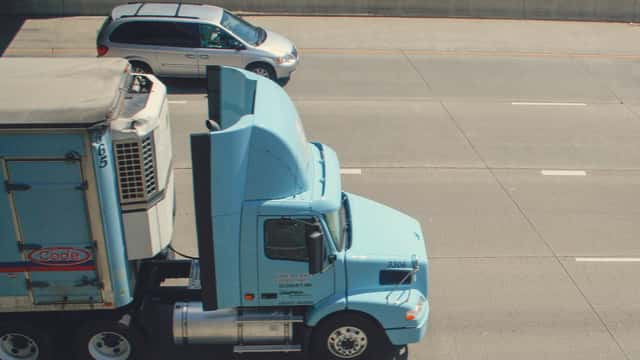
Illustrative photo: A truck on Interstate 94 in Saint Paul, Minnesota, April 27, 2006; neither this truck nor its driver is linked to the cases described. Tony Webster, CC BY 2.0, via Wikimedia Commons. Cropped for publication.

Differing perspectives
Will tighter immigration-based commercial-license rules make roads safer?
Each position is summarized as its supporters make it, with equal weight and in alphabetical order. A summary is not an endorsement; the evidence for each is weighed in the story above.
Assess actual driving fitness
Who holds it: Public Citizen and union petitioners
The challengers argue that broad status-based restrictions exclude experienced drivers who are authorized to work without showing that the changes improve safety. They warn that replacing those workers or increasing remaining drivers' workloads could introduce risks, and ask courts to scrutinize the rule's evidentiary basis.
In their words: Petitioners' final opening brief ↗
Distinguish work authorization from licensing disputes
Who holds it: California Department of Motor Vehicles
California says recipients of its non-domiciled licenses had federal work authorization and lawful presence when issued, and disputes blanket descriptions of them as illegally licensed immigrants. Its cancellation notice also acknowledges federal restrictions and identifies the immediate consequences for affected drivers seeking new credentials.
In their words: California DMV ↗
Tighten licensing and verification
Who holds it: U.S. Department of Transportation and FMCSA
Federal transportation officials argue that states need reliable immigration checks and access to driver histories before licensing commercial operators. They cite fatal crashes and licensing failures as reasons to restrict eligibility to categories subject to additional vetting and to enforce national standards across states.
In their words: U.S. Department of Transportation ↗
Cite this article
567 Politics. “Illegal entry, commercial licenses, six deaths: How two Indian truckers got behind the wheel.” 567politics. Published 2026-11-12. https://567politics.com/news/indian-truck-drivers-fatal-crashes-state-cdl-crackdown-november-2026
Wikipedia citation
{{cite news |title=Illegal entry, commercial licenses, six deaths: How two Indian truckers got behind the wheel |url=https://567politics.com/news/indian-truck-drivers-fatal-crashes-state-cdl-crackdown-november-2026 |work=567politics |author=567 Politics |date=2026-11-12 |language=en}}CSL-JSON for reference managers
{
  "id": "https://567politics.com/news/indian-truck-drivers-fatal-crashes-state-cdl-crackdown-november-2026",
  "type": "article-newspaper",
  "title": "Illegal entry, commercial licenses, six deaths: How two Indian truckers got behind the wheel",
  "URL": "https://567politics.com/news/indian-truck-drivers-fatal-crashes-state-cdl-crackdown-november-2026",
  "container-title": "567politics",
  "language": "en",
  "author": [
    {
      "literal": "567 Politics"
    }
  ],
  "issued": {
    "date-parts": [
      [
        2026,
        11,
        12
      ]
    ]
  }
}Citations identify this article and its publication date. Assess the reporting and its linked sources before using it as evidence.
Read this article as Markdown or JSON. Cite the original page and retain its sources, dates and qualifications.
Embed this article summary
Paste this HTML into your page. The summary stays linked to the full story and updates with it. No account required.
<iframe src="https://567politics.com/embed/news/indian-truck-drivers-fatal-crashes-state-cdl-crackdown-november-2026?theme=auto" title="Illegal entry, commercial licenses, six deaths: How two Indian truckers got behind the wheel by 567politics" width="100%" height="440" style="border:0;max-width:100%" loading="lazy"></iframe>
<p style="font-size:14px">Illegal entry, commercial licenses, six deaths: How two Indian truckers got behind the wheel by <a href="https://567politics.com/news/indian-truck-drivers-fatal-crashes-state-cdl-crackdown-november-2026" rel="nofollow">567politics</a></p>
<script async src="https://567politics.com/embed.js"></script>
READ BEYOND 567POLITICS
Alternate sources & perspectives
Independent coverage and primary evidence to help you compare arguments. A link is not an endorsement; perspective labels describe the linked material.
- primary evidence
Ontario crash: guilty plea, sentencing and corrected toxicology findings ↗
San Bernardino County District Attorney
July 2026 update establishes conviction and sentence; October update corrects the initial drug allegation.
- primary evidence
Florida Turnpike crash and arrest ↗
Florida Highway Safety and Motor Vehicles
Original police account; allegations are distinguished from a verdict.
- independent analysis
Florida defendant's not-guilty plea ↗
Associated Press
September 2025 court reporting; not a claim of a final disposition.
- independent analysis
Competing agency accounts of California driver's immigration and licensing ↗
ABC News
October 2025 reporting includes DHS claims and California's work-authorization response; initial DUI allegations were later corrected.
- primary evidence
Florida's unsuccessful trucking bill ↗
Florida Senate
Official history shows SB 86 died in House messages rather than becoming law.
- other perspective
California cancellation notice ↗
California DMV
March 2026 notice announces cancellations and disputes federal descriptions of recipients.
- primary evidence
Texas resumes a limited category of issuance ↗
Texas Department of Public Safety
Current notice permits H-2A issuance from June 2026 and lists other categories as pending.
- primary evidence
Ohio ends non-domiciled CDL program ↗
Ohio Bureau of Motor Vehicles
October 23, 2026 notice gives approximate downgrade totals, notice period and hearing rights.
- primary evidence
Federal rule and limitations of crash data ↗
Federal Motor Carrier Safety Administration / Federal Register
Final rule sets out eligibility changes, government rationale and limits of the identified crash sample.
- other perspective
Drivers and unions challenge the rule's safety basis ↗
Public Citizen and petitioners
Original legal argument against the rule; disputed predictions are not treated as established outcomes.
- primary evidence
Supreme Court declines Florida's interstate complaint ↗
Supreme Court of the United States
May 26, 2026 order rejects leave to file; this is distinct from a merits judgment.
- independent analysis
Washington admits it issued the wrong CDL category ↗
Overdrive
Direct responses from Washington's licensing department explain the standard-versus-non-domiciled error and staff-training response.
Reviewed 2026-11-12. Reviewed state agency notices, prosecution updates, bill history, federal rule text and litigants' briefs, alongside AP and ABC reporting. General source discovery returned irrelevant matches; targeted searches located the records used. Florida's original release was retrieved directly after browser blocking. No final Florida criminal disposition or final merits judgment in the federal rule challenge was verified. No representative poll specific to Indian truckers was established. No interviews conducted. State comparison is selective; crash cases do not establish group risk rates. Updated the opening to explain the prior work-authorization pathway, Washington's admitted category error and the disputed California upgrade.