LGB-only advocacy has gained institutional influence. Polls do not establish support for a split
Court records, group statements and selected filings show activity and resources, while surveys measure policy views rather than organizational support.
Organizations seeking separate lesbian, gay and bisexual advocacy have gained a place in legal and political disputes. That does not establish that most LGB people support an group split. A British court cited lesbian groups in a major equality-law ruling, while Log Cabin Republicans changed its advocacy focus in August 2026. The available polls measure views on policies, not support for those groups.
Influence in public bodies, revenue and public support answer different questions. A small group can intervene effectively in a court case. A larger group can change its mission without showing that everyone it seeks to represent agrees. And a person can favor one sex-based policy while supporting transgender protections in other areas.
This November 12 review compares the groups’ stated positions, selected public financial records, a court judgment and survey results. It does not establish an audited membership total or a trend in support for separating LGB and transgender advocacy. The evidence supports a narrower account of influence and disagreement.
What separate advocacy means to its supporters#
LGB Alliance says sexual orientation should be understood in relation to sex and that lesbian, gay and bisexual people need groups dedicated to their needs. Its account of its purpose emphasizes same-sex attraction and criticizes approaches that give gender identity priority over sex. The group presents those concerns as a defense of LGB equality.
Three practical disputes recur in its case: access to lesbian-only spaces, youth gender medicine and freedom to express beliefs about sex. These are policy positions advanced by the group. Its account does not establish the medical outcomes of treatment or show that all lesbian and gay people share its priorities. The questions require separate evidence.
Log Cabin Republicans frames its change through conservative politics. In an August 20 statement, president Ross Hemminger said its board had narrowed national advocacy to sexual orientation and conservative values. He argued that the transgender movement’s focus on minors, schools and sports had moved beyond the approach the group supported when it expanded its mission in 2015.
Hemminger also said membership remained open to all conservatives. A change in national advocacy therefore should not be reported as a blanket expulsion of transgender members. His claim that separation will protect public support for gay rights is a strategic argument, not a result established by the announcement.
Nor do all groups commonly placed in this camp reject transgender participation. Gays Against Groomers’ FAQ describes a coalition that includes transgender people. It opposes what it characterizes as the sexualization and medicalization of children. The group’s name and its claims should not be treated as proof of misconduct by the people or groups it criticizes.
A court victory has a defined scope#
The UK Supreme Court’s April 16, 2025 judgment in For Women Scotland v The Scottish Ministers is a concrete example of legal influence. LGB Alliance, the Lesbian Project and Scottish Lesbians submitted a joint intervention. The court’s reasoning addressed their concerns about lesbian-only associations. Official judgment.
The court held that sex in the Equality Act 2010 refers to biological sex rather than sex acquired through a gender recognition certificate. It also explained that transgender people retain protection against discrimination. The judgment interpreted a statute; it did not decide every wider dispute about identity or endorse the whole program of any intervening group.
That boundary matters when supporters cite the ruling as vindication and opponents describe its consequences. An group can contribute to a successful legal argument without proving every factual or political claim it makes. Equally, disagreement with an group does not erase the court’s actual holding.
Charity status is another distinct question. The Charity Commission’s April 2021 decision registered LGB Alliance while recording concerns about some of its public language. Mermaids challenged that registration and lost on standing in July 2023. In its response, Mermaids maintained that the group’s activity harmed transgender people and questioned whether it served a charitable purpose.
The outcome left the registration in place. It should not be described as a judicial endorsement of every statement the charity had made. Nor does Mermaids’ objection itself establish a legal finding that the group acted unlawfully.
Related disputes have their own records. Our reporting on the UK conversion-practices bill examines a separate legislative debate. The Sandie Peggie tribunal report addresses another employment dispute. Neither should be treated as interchangeable with the Supreme Court’s statutory ruling.
Revenue measures resources, not a constituency#
Selected public records show groups of very different sizes. The figures below concern revenue in specified reporting periods. They do not count members, measure popular support or establish how much money was spent on a particular campaign.
| Organization | Reported revenue | Reporting period | Source |
|---|---|---|---|
| LGB Alliance, UK | £383,480 | Year ending November 2025 | NGO Explorer’s charity-data record |
| Log Cabin Republicans | $1,520,349 | Year ending December 2024 | IRS-derived record via ProPublica |
| Gays Against Groomers | $158,285 | Year ending June 2025 | IRS-derived record via ProPublica |
The British register could not be reopened during this review, so its figure is attributed to NGO Explorer’s published record. The U.S. figures$ are from ProPublica’s presentation of IRS filings. They are not a new audit of the groups’ accounts or every possible amendment. Pounds and dollars are left separate, and the reporting periods differ.
Gays Against Groomers’ listed revenue was $194,851 for the year ending June 2023. Its later figure is lower, which cautions against treating increased visibility as proof of steady financial growth. Log Cabin Republicans’ larger budget also makes a blanket description of every group as having revenue below $1 million inaccurate.
These records cannot establish who supports the groups in the population. Revenue can reflect a few large gifts, many small gifts or other income. Without donor-level evidence, it cannot prove a common source of backing. Nor does a shared address, policy position or appearance at an event establish a financial connection.
What surveys establish—and what they do not#
Pew surveyed 1,618 gay and lesbian adults on January 8–19, 2025. This group did not include transgender adults. The subgroup’s reported margin of error was 3.5 percentage points. Pew asked the same policy questions of a national adult sample in February. Its surveys were conducted primarily online, with some live telephone interviews. January questionnaire and methods.
| Policy (share in favor) | Gay and lesbian adults | All US adults |
|---|---|---|
| Protect trans people from discrimination | 88% | 56% |
| Trans athletes on teams matching birth sex | 31% | 66% |
| Ban transition care for minors | 26% | 56% |
| Bathrooms matching birth sex | 12% | 49% |
Pew's published analysis gives 49% for the bathroom measure; adding separately rounded topline categories gives 48%. The general-public sports and bathroom questions used a half-sample of 2,565 adults, and 284 respondents' answers were carried over from January.
The national survey ran February 10–17 and included 5,097 adults, with a full-sample margin of error of 1.6 percentage points. These are separate surveys and samples, not a direct test of group membership. National questionnaire.
The broad finding is that support for nondiscrimination protections can coexist with disagreement on sports and youth treatment. Opposition to a particular policy does not by itself mean support for separating advocacy groups. Conversely, support for transgender protections does not mean agreement with every group operating under an LGBTQ label.
LGB Alliance’s own May 2023 survey asked its supporters about the LGBTQ+ umbrella. It reported that 94% of respondents were uncomfortable with that description. The report explicitly warns that its results cannot be generalized to the wider LGB population. That is evidence about the respondents’ views, not a national mandate for separation. Survey report.
The two kinds of survey should not be compared as if they asked the same question of the same population. Pew asked about laws and policies. LGB Alliance asked its supporters about language and identity. Neither supplies the missing national measure of support for the groups themselves.
The case for keeping a coalition#
Stonewall’s response is that different priorities need not require a break. Chief executive Simon Blake argues that lesbian, gay, bisexual and transgender people can disagree about policy while working together against discrimination. His account of coalition-building acknowledges differences rather than requiring unanimity, and presents shared advocacy as a way to protect rights.
That argument has a practical tradeoff. A broad coalition can combine resources and political support, but it must decide how to handle conflicts among members. Separate groups can focus on narrower concerns, but they must show how their strategy protects the rights of people outside that focus. Neither group model automatically resolves the underlying policy disagreements.
Resistance to separation also comes from some religious conservatives who oppose both movements’ premises. In a June essay, Glenn Stanton argued that changes to the legal understanding of marriage helped produce the sex-and-gender arguments that some gay advocates now reject. That is a different objection from Stonewall’s case for a united equality movement.
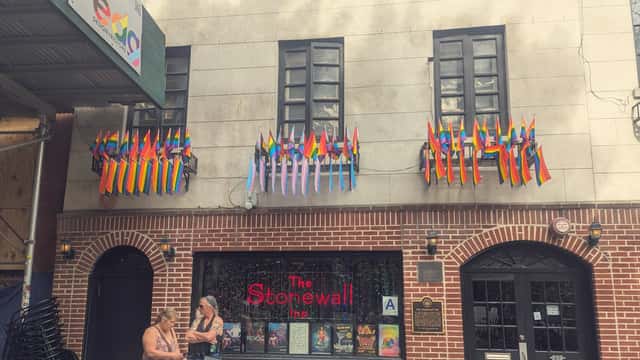
Government wording supplies another example of institutional change without measuring public agreement. The Stonewall National Monument homepage, checked November 12, describes lesbian, bisexual and gay history without naming transgender people in its introduction. That observation establishes what the page says. It does not establish which advocacy group caused the wording.
The remaining evidentiary gap is specific: this review did not identify an independent national survey directly measuring support for LGB-only groups. Court participation, policy announcements and revenue records establish activity and resources. They cannot substitute for that missing measure. Our methodology and editorial standards distinguish those forms of evidence.
Photo: National Park Service. No claim to original U.S. Government works. The agency’s reuse policy applies to the credited lead photograph.
Differing perspectives
Should lesbian, gay and bisexual advocacy be organized separately from transgender advocacy?
Each position is summarized as its supporters make it, with equal weight and in alphabetical order. A summary is not an endorsement; the evidence for each is weighed in the story above.
Build independent LGB organizations
Who holds it: LGB Alliance
LGB Alliance argues that sexual orientation rests on sex and that lesbian, gay and bisexual people need dedicated representation. It says broader organizations give gender identity priority in ways that can conflict with same-sex rights, including access to lesbian-only spaces.
In their words: LGB Alliance ↗
Challenge LGB Alliance’s charitable purpose
Who holds it: Mermaids
Mermaids argues that LGB Alliance’s activity is focused on hostility to transgender people rather than advancing LGB equality. It maintains that concern despite losing its appeal for lack of standing and calls for scrutiny of whether the organization serves a charitable purpose.
In their words: Mermaids ↗
Keep a broad equality coalition
Who holds it: Stonewall chief executive Simon Blake
Blake argues that lesbian, gay, bisexual and transgender people can retain different priorities and disagree on policy while working together for rights. He sees solidarity, shared campaigning and the ability to disagree within the movement as strengths.
In their words: Stonewall ↗
Refocus conservative gay advocacy
Who holds it: Log Cabin Republicans president Ross Hemminger
Hemminger argues that an emphasis on sexual orientation and conservative values can protect gay rights and rebuild public support. He objects to transgender advocacy involving minors, schools and sports, while saying membership remains open to all conservatives.
In their words: Ross Hemminger in Townhall ↗
Reject the premises of both movements
Who holds it: Glenn Stanton, writing in The Federalist
Stanton argues that changes to the meaning of marriage weakened legal distinctions based on sex and helped produce later gender-identity claims. He rejects the idea that advocates can separate the two developments merely because they disagree with the newer movement.
In their words: Glenn Stanton in The Federalist ↗
Cite this article
567politics News Desk. “LGB-only advocacy has gained institutional influence. Polls do not establish support for a split.” 567politics. Published 2026-11-12. https://567politics.com/news/lgb-without-the-t-lgb-alliance-log-cabin-gays-against-groomers-filings-polls-november-2026
Wikipedia citation
{{cite news |title=LGB-only advocacy has gained institutional influence. Polls do not establish support for a split |url=https://567politics.com/news/lgb-without-the-t-lgb-alliance-log-cabin-gays-against-groomers-filings-polls-november-2026 |work=567politics |author=567politics News Desk |date=2026-11-12 |language=en}}CSL-JSON for reference managers
{
  "id": "https://567politics.com/news/lgb-without-the-t-lgb-alliance-log-cabin-gays-against-groomers-filings-polls-november-2026",
  "type": "article-newspaper",
  "title": "LGB-only advocacy has gained institutional influence. Polls do not establish support for a split",
  "URL": "https://567politics.com/news/lgb-without-the-t-lgb-alliance-log-cabin-gays-against-groomers-filings-polls-november-2026",
  "container-title": "567politics",
  "language": "en",
  "author": [
    {
      "literal": "567politics News Desk"
    }
  ],
  "issued": {
    "date-parts": [
      [
        2026,
        11,
        12
      ]
    ]
  }
}Citations identify this article and its publication date. Assess the reporting and its linked sources before using it as evidence.
Read this article as Markdown or JSON. Cite the original page and retain its sources, dates and qualifications.
Embed this article summary
Paste this HTML into your page. The summary stays linked to the full story and updates with it. No account required.
<iframe src="https://567politics.com/embed/news/lgb-without-the-t-lgb-alliance-log-cabin-gays-against-groomers-filings-polls-november-2026?theme=auto" title="LGB-only advocacy has gained institutional influence. Polls do not establish support for a split by 567politics" width="100%" height="440" style="border:0;max-width:100%" loading="lazy"></iframe>
<p style="font-size:14px">LGB-only advocacy has gained institutional influence. Polls do not establish support for a split by <a href="https://567politics.com/news/lgb-without-the-t-lgb-alliance-log-cabin-gays-against-groomers-filings-polls-november-2026" rel="nofollow">567politics</a></p>
<script async src="https://567politics.com/embed.js"></script>
READ BEYOND 567POLITICS
Alternate sources & perspectives
Independent coverage and primary evidence to help you compare arguments. A link is not an endorsement; perspective labels describe the linked material.
- primary evidence
For Women Scotland Ltd v The Scottish Ministers [2025] UKSC 16 ↗
UK Supreme Court (National Archives Find Case Law)
April 16, 2025 judgment holding that 'sex' in the Equality Act 2010 means biological sex; paragraphs 34 and 207 summarize and rely on the joint intervention by Scottish Lesbians, the Lesbian Project and LGB Alliance.
- primary evidence
Mermaids v The Charity Commission for England and Wales and LGB Alliance [2023] UKFTT 563 (GRC) ↗
First-tier Tribunal (National Archives Find Case Law)
July 6, 2023 decision dismissing Mermaids' appeal on standing; the two judges split on whether LGB Alliance is a charity and found concerns about some of its social media output well-founded.
- primary evidence
LGB Alliance: financial history, charity 1194148 ↗
Charity Commission for England and Wales
Official income and spending by year, used to test the claim of growth: £118,228 in 2021, £551,025 in 2024 and £383,480 in 2025.
- primary evidence
LGBTQ Americans: Acceptance, Identity and Community ↗
Pew Research Center
Survey of 3,959 LGBTQ adults (January 8-19, 2025) on identity and community, including how much gay, lesbian and bisexual adults say they have in common with transgender people; the same survey's policy questions are compared with the general public in the story.
- primary evidence
Executive Order 14168: Defending Women From Gender Ideology Extremism and Restoring Biological Truth to the Federal Government ↗
The White House
January 20, 2025 order cited by agencies when they dropped transgender references from web pages and the Stonewall monument; the order itself does not use the term LGB.
- independent analysis
US Park Service erases the word 'transgender' from website commemorating Stonewall riot ↗
Associated Press (via WEAU)
Wire report on the February 13, 2025 change of the monument website from LGBTQ+ to LGB wording, with responses from Gov. Kathy Hochul and the Stonewall Inn.
- independent analysis
Log Cabin Republicans, a leading group for gay conservatives, abandons transgender advocacy ↗
CNN (via KEYT)
August 21, 2026 report on the group's change of mission, with responses from the Human Rights Campaign and a former Log Cabin board member, and background on its ties to the Trump administration.
- right argument
Log Cabin Republicans Renews Its National Advocacy Focus ↗
Townhall (Ross Hemminger, Log Cabin Republicans)
The group's president explains why its board voted to become an LGB advocacy organization, citing transgender advocacy on minors, school curricula and sports.
- right argument
No Andrew Sullivan, You Can't Separate LGB From TQ Just Because It's Backfiring ↗
The Federalist (Glenn T. Stanton)
A religious conservative argues that the LGB and transgender causes cannot be separated because same-sex marriage itself removed sex from the legal meaning of marriage.
- left argument
Going where angels fear to tread ↗
Stonewall (Simon Blake)
September 2026 essay by Stonewall's chief executive arguing that lesbian, gay, bisexual and trans people should stand together and avoid creating dividing lines, while learning to disagree well.
- left argument
Statement on the ruling in Mermaids v Charity Commission and LGB Alliance ↗
Mermaids
The trans youth charity's case that LGB Alliance should not hold charity status, and its reading of the 2023 tribunal decision.
- other perspective
About LGB Alliance ↗
LGB Alliance
The British charity's own account of why it was formed, its view that biological sex underpins sexual orientation, and its statement that it is nonpartisan and funded mainly by small donations.
Reviewed 2026-11-03. discover_politics_sources was run for the United Kingdom and the United States on November 3, 2026, and returned only unrelated results (adult-content sites, model-train retailers, Long Beach Airport and generic encyclopedia pages), so this list was built from pages 567politics opened and read directly. It pairs primary records (court judgments, charity filings, an executive order and Pew survey data) with the groups' own statements, their critics' statements and two wire reports. Some originals were paywalled or blocked: The Sunday Times (2019 letter to Stonewall), The New York Times (Andrew Sullivan's June 2025 essay), The Guardian, Axios, LGBTQ Nation and The Daily Signal. AP, CNN and PA reports were read through syndicated copies (WEAU, KEYT, Express & Star). The Cass Review was read from an Internet Archive copy because the live site requires a CAPTCHA. No independent poll has asked LGB people about LGB-only groups, and none of the groups publishes audited membership figures. Funding research: the 567politics funding registry has no topic covering LGBT or gender policy, and Donald Trump's profile has no verified FEC snapshot, so no campaign-finance context was added.