Paraguay's Senate weighs suspending school sex education books as UN panel urges their withdrawal
A UN women's rights panel says Paraguay's removal of the word "gender" from school materials risks deepening discrimination. The government defends its program.
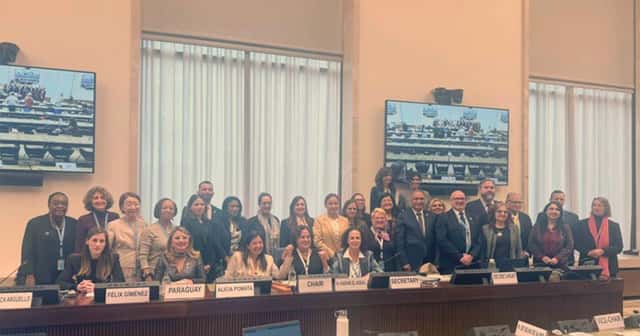
Paraguay's Senate is set to take up a proposal on Wednesday, Nov. 4, that asks the Ministry of Education and Science to suspend the sex education materials it has been piloting in schools. Two days earlier, the UN committee that monitors women's rights published its findings on Paraguay. It urged the government to withdraw the same materials. It also urged a rethink of a 2025 rule that removed the word "gender" from all school content.
The two moves put Paraguay's long-running dispute over "gender" in schools in front of both its Congress and an international treaty body in the same week. The government of President Santiago Peña has defended its approach. Parent groups that backed the 2025 rule are campaigning against the Senate proposal. Senators and deputies from several parties, along with women's rights advocates, want the policy changed.
What the UN committee said
The Committee on the Elimination of Discrimination against Women is a body of 23 independent experts. It monitors the 189 states that have ratified the CEDAW treaty. It reviewed Paraguay on Oct. 13 in Geneva. It published its concluding observations on Nov. 2, according to the regional office of the UN human rights office in Santiago.
The committee said it was concerned that replacing the terms "gender equality" and "gender perspective" with "equality between men and women" in official policy could undermine efforts to address entrenched discrimination against women. It also looked at the ministry's materials for emotional and sexual education, known by the Spanish acronym EASE. It said they reinforce gender stereotypes and do not adequately address consent, bodily autonomy, or sexual and reproductive health and rights.
It recommended that Paraguay revise the resolutions in question and withdraw the EASE materials, so that sex education in schools is comprehensive, age-appropriate, scientifically accurate and gender-sensitive. The committee also raised concerns about criadazgo, the practice of children, mostly girls, being sent to live and work in other households, and recommended a national study of it.
Paraguay was reviewed in the same session as Kenya and several other countries. The session record on the UN treaty body database lists the concluding observations under the symbol CEDAW/C/PRY/CO/8. Civil society groups filed written submissions ahead of the review. The list includes one from La Manif Pour Tous, a French group founded to oppose same-sex marriage legislation, which filed on both Paraguay and Kenya.
The committee's findings are recommendations. They are not binding court rulings, but Paraguay, as a state party, is expected to report back on how it has responded.
What Paraguay told the committee
At the October review, the Paraguayan delegation was led by Minister of Women Alicia Pomata. The UN Office at Geneva's summary of the session records its answers. The delegation said the resolution in question had replaced "gender equality" and "gender perspective" with language on equality between men and women, and that Paraguay's Constitution recognizes the equality of men and women.
The delegation pointed to several measures of progress. It said women's participation in the labor force rose from 56.1 percent in 2015 to 61.3 percent in 2025, and that the Ministry of Women's budget would rise by 11 percent in 2026. It said women hold 24 percent of seats in Congress, with 19 deputies and 11 of 45 senators. A 1996 electoral law sets a 20 percent quota for women on party lists.
Source: UN Office at Geneva
Show the numbers
| Year | Participation rate |
|---|---|
| 2015 | 56.1% |
| 2025 | 61.3% |
Committee members pressed the delegation on other figures. More than 32,000 girls aged 10 to 19 gave birth between 2022 and 2024, according to the Geneva summary. Committee expert Ana Peláez Narváez said groups opposed to what they call gender ideology were gaining ground in Paraguay, including in the government's own positions. Experts also criticized passages in the materials based on the "12 Sciences" method, including one they said suggested a girl's clothing had "provoked" men.
Pomata said the government would incorporate the committee's recommendations into SIMORE Plus, Paraguay's system for tracking human rights recommendations, and would keep up permanent follow-up with civil society.
The resolutions behind the dispute
The current fight centers on two education ministry resolutions. The first, Resolution 29.664 of 2017, was signed when Enrique Riera was education minister. It prohibits the distribution and use of printed and digital materials on "gender theory and/or ideology" in schools run by the ministry. FENAPEP's statement describes the 2025 resolution as extending that ban.
The second, Resolution 1803 of 2025, was issued on Nov. 7, 2025, under current Education Minister Luis Ramírez. ABC Color reported at the time that it ordered "the word gender suppressed in all educational materials, whatever the format." It replaced five terms, including "gender equality," "gender approach" and "gender perspective," with "equality between men and women." The resolution cited the Constitution's article on the family. It also cited Article 12 of the American Convention on Human Rights. That article protects parents' right to give their children a religious and moral education in line with their beliefs.
The National Federation of Parents of Paraguay, known as FENAPEP, welcomed the 2025 resolution. "With great emotion we celebrate" the measure, it said, thanking Ramírez and his chief of staff, Aníbal Zapattini, "for watching over and protecting the children of our republic."
The EASE program itself is separate from those resolutions. It uses 15 books produced by Editorial Verus and based on the "12 Sciences" approach developed by Ecuadorian educator María Judith Turriaga. It is still in a pilot stage and was approved through four further ministry resolutions between 2024 and 2026.
The Senate proposal
The draft Senate declaration, filed as file number 2604173, was led by Sen. Esperanza Martínez, with Senators Yolanda Paredes, Ignacio Iramain, Ever Villalba, Rafael Filizzola and Eduardo Nakayama, according to a report by RCC, a Paraguayan outlet whose report was critical of the proposal. It urges the ministry to temporarily suspend Resolutions 1580/2024, 1782/2024, 1880/2025 and 228/2026, which approved the EASE materials. The measure is on the Senate's order of business for Wednesday and has been referred to the Committee on Petitions, Powers and Rules.
A Senate declaration of this kind is a statement of the chamber's position. It does not on its own repeal or suspend a ministry resolution, and the ministry is not legally required to follow it. Its weight is political. A vote in favor would put the Senate on record against a program the president has backed. A defeat would strengthen the ministry's hand.
Parent and family groups, including FENAPEP, the Federation of Parents' Associations (FEDAPAR) and Padres en Acción, have urged senators to reject it, RCC reported. Turriaga, the author of the method, said a widely shared exercise from the ninth book had been taken out of context and asked that all 15 books be evaluated together. According to RCC, Ramírez has said he presented the books to Peña, who approved them.
The Chamber of Deputies has already weighed in, though accounts of what it said differ. ABC Color reported on Oct. 20 that deputies approved, without opposition from the ruling bloc, a nonbinding declaration by Deputy Johanna Ortega of País Solidario urging the ministry to repeal Resolutions 29.664 and 1803. RCC's report says that in October the chamber unanimously approved a declaration urging the ministry to keep its bans in place. 567 Politics has not been able to reconcile the two accounts and is reporting both.
The minister's response
The pressure on the ministry increased in October, after protests in Asunción over the femicide of Deisy Paola Giménez. Some have called for a gender perspective in schools to help prevent violence against women. Asked about those calls, Ramírez told reporters, according to ABC Color: "I really haven't received any kind of complaint along the lines you mention."
He said prevention would come through emotional management and mental health, with psychologists placed in schools next year, and defended the program. "EASE is really a very good process," he said. "Everything can be improved, but we have an extraordinary base." Radio Ñandutí reported the same remarks.
Critics of the program include the group Families for Education (Feipar). They say the materials lack scientific rigor and reproduce stereotypes, ABC Color reported. They also say families were left out and that the books weaken the detection of abuse.
A wider argument over language
Paraguay's dispute is one of several around the world over how governments use the word "gender" in law and schooling. In the United States, the Education Department has finalized an accreditation rule on intellectual diversity and DEI requirements. In Ghana, Speaker Alban Bagbin has vowed to name anyone who obstructs the anti-LGBTQ+ bill as Parliament resumes. In Nigeria, the Senate leader has revived a plan for seats reserved for women, a different answer to the representation gap the CEDAW committee raised with Paraguay. And in Germany, the justice minister has proposed making verbal sexual harassment a crime.
In Paraguay, the terms of the debate are set by the Constitution. Supporters of the 2017 and 2025 resolutions point to its language on the family and on parents' rights. Opponents point to the country's ratification of CEDAW and to the committee's view that dropping the word "gender" weakens the tools for addressing discrimination.
The Senate vote and the ministry decision
Wednesday's debate will show how much support the Senate has for suspending the program. Even if the Senate approves it, the decision on whether to suspend the materials or revise the resolutions rests with the education ministry and, ultimately, with Peña's government.
Pomata's commitment to enter the recommendations into SIMORE Plus means they will be tracked publicly, but it does not commit the government to adopting them. 567 Politics follows its editorial standards in reporting the competing accounts of the Chamber of Deputies' October vote and will update this story when the record is clear.
Differing perspectives
Should Paraguay withdraw its EASE sex education materials and restore gender terminology in schools?
Each position is summarized as its supporters make it, with equal weight and in alphabetical order. A summary is not an endorsement; the evidence for each is weighed in the story above.
Keep the ban on gender theory materials in schools
Who holds it: The National Federation of Parents of Paraguay (FENAPEP)
The parents' federation celebrated the 2025 resolution extending the 2017 measure that prohibits printed and digital materials on gender theory or ideology in schools under the education ministry. It thanked Minister Luis Ramírez, chief of staff Aníbal Zapattini and the ministry's legal team for watching over and protecting the children of the republic through the resolution, presenting the ban as a safeguard for children in public schools.
In their words: FENAPEP ↗
Keep the program and improve it over time
Who holds it: Education Minister Luis Ramírez and the Ministry of Education and Science
The minister says EASE is a very good process that gives the country an extraordinary base, even if everything can be improved. He says he has not received complaints asking to restore a gender perspective, and that preventing violence will come through emotional management and mental health, including psychologists placed in schools next year, rather than through changing the program's terminology.
In their words: ABC Color ↗
Withdraw the materials and restore a gender perspective
Who holds it: The UN Committee on the Elimination of Discrimination against Women
The committee says replacing "gender equality" and "gender perspective" with "equality between men and women" risks undermining efforts to tackle entrenched discrimination. It says the EASE materials reinforce gender stereotypes and do not adequately cover consent, bodily autonomy, or sexual and reproductive health and rights. It recommends revising the resolutions and withdrawing the materials so school sex education is comprehensive, age-appropriate, scientifically accurate and gender-sensitive.
In their words: UN Human Rights regional office (ACNUDH) ↗
READ BEYOND 567POLITICS
Alternate sources & perspectives
Independent coverage and primary evidence to help you compare arguments. A link is not an endorsement; perspective labels describe the linked material.
- primary evidence
Comité de derechos de las mujeres de la ONU publicó hallazgos sobre Paraguay ↗
ACNUDH (UN Human Rights, South America)
The CEDAW committee's Nov. 2 findings and recommendations on Paraguay.
- primary evidence
Experts of the CEDAW Committee commend Paraguay ... deletion of 'gender' from educational materials ↗
UN Office at Geneva
Official summary of the Oct. 13 review, with the delegation's figures.
- primary evidence
CEDAW session record including the Paraguay review ↗
OHCHR treaty body database
Session record listing state reports, submissions and concluding observations.
- right argument
La Resolución 1803/2025 Ramírez/Zapattini que amplía la Resolución 29.664/2017 Riera ↗
FENAPEP
Parents' federation statement celebrating the 2025 resolution.
- right argument
Alerta a las familias: seis senadores buscan suspender los materiales de educación afectiva y sexual del MEC ↗
RCC
Report on the Senate draft declaration, critical of it; includes Turriaga's response.
- left argument
Diputados insta al MEC a derogar resolución que sataniza materiales con el cuco del género ↗
ABC Color
Report on Deputy Johanna Ortega's declaration urging repeal of the resolutions.
- other perspective
Feminicidios: MEC defiende su plan de educación sexual ↗
ABC Color
Education Minister Luis Ramírez defends EASE after femicide protests.
- independent analysis
Pese a protestas por feminicidios, el MEC rechaza incluir el enfoque de género en las escuelas ↗
Radio Ñandutí
Second account of the minister's Oct. 14 remarks.
- primary evidence
MEC suprime la palabra género de todos los materiales educativos ↗
ABC Color
Report on the text of Resolution 1803/2025.
- other perspective
Ministra Carolina Llanes participó en diálogo constructivo con el Comité CEDAW ↗
Poder Judicial del Paraguay
Paraguayan judiciary's account of its part in the review.
- independent analysis
Ministra de la Mujer justifica frondosa delegación a Ginebra ↗
ABC Color
Coverage of the delegation's makeup ahead of the review.
Reviewed 2026-11-03. Discovery returned no relevant results; sources hand-picked. Accounts of the Chamber of Deputies' October declaration differ between ABC Color and RCC.