Philippine House panel advances LGBTQ anti-discrimination bill as church groups seek a rethink
A House committee approved consolidating 11 SOGIESC equality bills after one hearing; faith groups want more hearings, and some want the bill rejected.
A bill to ban discrimination against lesbian, gay, bisexual, transgender and intersex Filipinos has cleared a House committee in the Philippines for the first time in the current Congress. Supporters call the step historic for a measure first filed in 2000. A coalition of evangelical and conservative groups says the committee moved too fast and is asking it to reverse course.
The House Committee on Women and Gender Equality approved "in principle" on Nov. 11 the consolidation of 11 related bills on sexual orientation, gender identity and expression, and sex characteristics, known by the acronym SOGIESC, according to Outrage Magazine and The Philippine Star. Advocates expect the combined text to go to the full House for second reading, the stage of floor debate and amendment.
The decision came after one hearing, a point both camps agree on and read in opposite ways. To supporters, it shows a committee willing to end two decades of delay. To opponents, it shows a committee that closed debate before many objectors could speak.
What the committee did#
The panel is chaired by Rep. Ann Matibag of Laguna's 1st District. Anna Cubacub, national convenor of the advocacy coalition PANTAY, credited the chair's "decisiveness." She told The Philippine Star that earlier versions usually went back to a technical working group after a first hearing "because of opposition from evangelical and other opposition groups."
Advocates call the vote historic, Cubacub said, because they did not expect the committee to adopt the bills in principle for consolidation so early.
Accounts differ on the next procedural step. Cubacub told The Philippine Star the measure would be presented for second reading. Fridae, citing a Nov. 15 report in the tabloid Abante, said bill sponsor Rep. Perci Cendaña described the panel as voting to form a working group. Both can be true if staff first draft a single substitute bill. The reports reviewed for this story did not cite a committee report or a date for floor debate.
- Committeeapproved 11 bills in principle for consolidation on Nov. 11
- Working groupdrafts a single consolidated text, per Cendaña as cited by Fridae
- Second readingplenary debate and amendments on the House floor
- Third readingfinal House vote
- Senatemust also pass a version; the 2017 House bill never got one
Source: The Philippine Star, Fridae, Daily Tribune
What the bills would do#
The bills differ in detail, and the consolidated text is not yet public. Cendaña, of the Akbayan Citizens' Action Party, authored House Bill 765, one of the 11. He summarized it as a measure that "prohibits discriminatory practices, stigmatization and harassment in schools, workplaces, healthcare settings, and other public and private establishments on the basis of sexual orientation, gender identity and expression, and sex characteristics," Outrage Magazine reported.
Another filed proposal, House Bill 6873, lists refusing someone a job or a place at school, dismissing a worker and expelling a student among the acts it would prohibit when they are based on actual or perceived SOGIESC, according to Fridae.
The penalties are a central point of dispute. The version the House passed in 2017, House Bill 4982, carried fines of 100,000 to 500,000 pesos or one to six years in prison, at a court's discretion, GMA News reported at the time. Opponents of the current bills say they also carry prison terms and fines. The exact penalties in the consolidated draft are not yet known.
Opponents have also singled out a provision on speech. According to BRABO News, Section 5(m) of House Bills 765 and 216 would penalize public speech and media made to shame, vilify or promote discrimination based on SOGIESC, with an exemption for religious speech within formal religious services or ceremonies. 567politics could not obtain the filed bill texts to confirm that wording, so this description relies on that report.
Twenty-six years in Congress#
The measure has a long record of near misses. The House committee also approved versions in the 12th and 17th Congresses, Outrage Magazine noted. On Sept. 20, 2017, the full House passed House Bill 4982 on third reading by a vote of 198-0, with the Senate version still pending, GMA News reported. The bill never became law.
- First version of the anti-discrimination bill is filed
- House passes HB 4982 on third reading, 198-0; Senate version stalls
- House women's committee approves 11 bills in principle for consolidation
- Faith-based groups ask the committee to reconsider and hold more hearings
Source: GMA News, The Philippine Star, The Insider News
Cendaña has said the bill needs the president's backing to pass. After President Ferdinand Marcos Jr.'s State of the Nation Address in July left it out, he told reporters that "this fight for a SOGIE bill will require political will from the executive because there are really many people who are opposing this," the Daily Tribune reported. He pointed to the 2012 reproductive health law, which passed after then-President Benigno Aquino III made it a priority. No statement from Malacañang on the committee vote was found. Whether the Senate will take up a companion bill this Congress is also unclear; 567politics did not find a current Senate committee schedule for one.
Party labels offer limited guidance on the vote count. 567politics describes the Philippines as a multiparty presidential system with fluid, often personality-centered alliances; its Philippines party spectrum shows where the main parties sit, as dated editorial estimates.
The case for passage now#
Supporters argue the bill would extend to LGBTQ Filipinos the protections others already have, not create new rights. "People are people, we say. And so the ideal is for everyone to be treated equally," Aaron Moises C. Bonete, co-executive director of the Bahaghari Center for SOGIE Research, Education and Advocacy, told Outrage Magazine.
Bonete cited cases he said his group knows of: a same-sex couple separated before being served at an evacuation center, transgender students forced to cut their hair or barred from graduation, and LGBTQ disaster victims treated unequally in relocation housing. "These are not experienced by non-LGBTQIA+ Filipinos," he said.
Cendaña argued that society has moved since the first bill was filed. He said more than 80 local governments now have anti-discrimination ordinances and that private companies and insurers have adopted inclusive practices. A national law is still needed, he said, because local ordinances reach only so far. "Ito po ang puso ng SOGIESC Equality Bill: edukasyon, trabaho, kalusugan, social welfare," he said, naming education, work, health and social welfare as the heart of the bill. "And yet when we go back to these halls trying to make it a national policy, we somehow turn it into a moral issue."
The 80-ordinance figure is Cendaña's. 567politics did not find an official national count of local anti-discrimination ordinances to check it against.
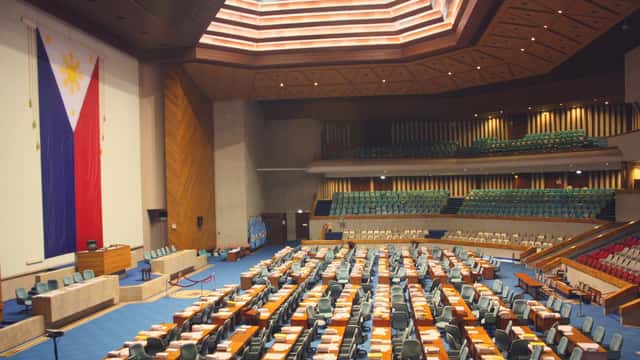
The House session hall in the Batasang Pambansa complex, Quezon City, shown empty in 2008. The consolidated bill would be debated here. Photo: Gerald Tejada, CC BY-SA 2.0, via Wikimedia Commons.

The case for slowing down, or stopping#
At least 11 faith-based and conservative groups criticized the committee's speed, The Insider News reported on Nov. 13. They include the Philippine Council for Evangelical Churches (PCEC), the Philippines for Jesus Movement (PJM), Jesus Is Lord Church Worldwide, the National Coalition for Family and Constitution, Gender Redeemed Philippines and Alliance for the Family Foundation.
"These bills touch on freedom of religion, freedom of conscience, the education of our children, and the life of our families and churches," said Bishop Noel Pantoja, PCEC's executive director. "To close the deliberations while more of the affected sectors have not yet been heard is not the kind of consultation our people expect. We are asking only for a fair chance to be heard."
PJM's president, Bishop Alconga, said the bill "raises serious questions concerning religious liberty, freedom of conscience, freedom of expression, parental rights, and the autonomy of religious and faith-based institutions." He argued that a penal measure carrying imprisonment and fines needs a series of hearings. The groups said past deliberations should not substitute for new ones, because the 20th Congress has new leaders, members and issues. They asked the committee to reconsider its approval and hold more hearings.
A separate account from BRABO News describes a dispute at the Nov. 11 hearing itself. Gender Redeemed Philippines, which opposes the bill, presented testimony from people describing transition and detransition. When the group invited a minor to speak, Cendaña raised a point of order, objecting that a child should not be exposed to the discussion, the outlet reported. The coalition called the objection biased and said the hearing favored the bill's supporters. It wants the full House to reject the bill outright. 567politics did not find Cendaña's own account of the exchange.
The two opposing positions are not identical. PCEC frames its request as procedural: more hearings, a fair hearing for objectors. Gender Redeemed Philippines and allied groups want the bill defeated.
What Filipinos say in surveys#
The best long-run measure of opinion is Pew Research Center's global question on whether "homosexuality should be accepted by society." In the Philippines, 73% said it should in 2019, up from 64% in 2002, according to Pew's topline. In 2019, 24% said it should not. Pew conducted the Philippine survey face to face as part of a 34-country study fielded from May to October 2019.
Source: Pew Research Center, Spring 2019 Global Attitudes topline
Show the numbers
| Year | Should be accepted | Should not be accepted |
|---|---|---|
| 2002 | 64% | 33% |
| 2013 | 73% | 26% |
| 2019 | 73% | 24% |
That question measures social acceptance, not support for this bill, its penalties or its speech provision. The data are also seven years old. 567politics found no recent representative poll on the SOGIESC Equality Bill itself, so how Filipinos view the current draft is unknown. The Philippine sample size and margin of error were not retrieved for this story.
Elsewhere, and what comes next#
The Philippine debate is one of several legislative fights over LGBTQ law this month. In Ghana, Parliament rescinded its earlier passage of the anti-LGBTQ+ bill on Nov. 10 so lawmakers can correct drafting errors before voting again. In Kenya, a parliamentary committee urged enforcement of laws on same-sex relations. In the Caribbean, the Privy Council struck down Trinidad and Tobago's ban on gay sex.
In Manila, the next markers are concrete. The committee must issue a report with a consolidated text. The groups seeking reconsideration want more hearings before that happens. If the bill reaches the floor, the speech provision and the penalties are the likeliest targets for amendment, given that opponents have focused on both. Any House-passed bill would then need a Senate version and the president's signature to become law.
Differing perspectives
Should the Philippine House pass the consolidated SOGIESC Equality Bill in the current Congress?
Each position is summarized as its supporters make it, with equal weight and in alphabetical order. A summary is not an endorsement; the evidence for each is weighed in the story above.
Pass the bill this Congress
Who holds it: Akbayan Rep. Perci Cendaña and other authors; the Bahaghari Center and other LGBTQ advocacy groups
Supporters argue that LGBTQ Filipinos face discrimination in schools, jobs, health care and disaster relief that other citizens do not, and that the bill only extends existing protections to them. They point to more than 80 local anti-discrimination ordinances and to inclusive practices at companies and insurers as signs that society has changed. A national law, they say, is needed because local rules reach only so far.
In their words: Outrage Magazine (quoting Rep. Cendaña and Aaron Bonete) ↗
Reconsider and hold more hearings
Who holds it: Philippine Council for Evangelical Churches, Philippines for Jesus Movement and other faith-based groups
These groups argue that a penal bill with prison terms and fines touches religious liberty, conscience, free expression, parental rights and the autonomy of churches and faith-based schools. They say the committee approved it after one hearing, before many affected sectors could present their concerns about specific prohibited acts. With new leaders and members in the 20th Congress, they argue, earlier deliberations cannot substitute for fresh hearings.
In their words: The Insider News (quoting PCEC and PJM leaders) ↗
Reject the bill on the floor
Who holds it: Gender Redeemed Philippines and allied groups opposing the SOGIESC bills
This coalition argues that the bills' speech provisions would penalize people for expressing traditional moral or biblical views in public, because the religious exemption covers only formal services and ceremonies. It says the committee hearing favored supporters and sidelined dissenting witnesses, including people who described detransitioning. It calls on the full House to reject the measure entirely as a threat to free speech and religious liberty.
In their words: BRABO News (reporting Gender Redeemed Philippines' position) ↗
Cite this article
567 Politics staff. “Philippine House panel advances LGBTQ anti-discrimination bill as church groups seek a rethink.” 567politics. Published 2026-11-16. https://567politics.com/news/philippines-sogiesc-equality-bill-house-committee-consolidation-cendana-november-2026
Wikipedia citation
{{cite news |title=Philippine House panel advances LGBTQ anti-discrimination bill as church groups seek a rethink |url=https://567politics.com/news/philippines-sogiesc-equality-bill-house-committee-consolidation-cendana-november-2026 |work=567politics |author=567 Politics staff |date=2026-11-16 |language=en}}CSL-JSON for reference managers
{
  "id": "https://567politics.com/news/philippines-sogiesc-equality-bill-house-committee-consolidation-cendana-november-2026",
  "type": "article-newspaper",
  "title": "Philippine House panel advances LGBTQ anti-discrimination bill as church groups seek a rethink",
  "URL": "https://567politics.com/news/philippines-sogiesc-equality-bill-house-committee-consolidation-cendana-november-2026",
  "container-title": "567politics",
  "language": "en",
  "author": [
    {
      "literal": "567 Politics staff"
    }
  ],
  "issued": {
    "date-parts": [
      [
        2026,
        11,
        16
      ]
    ]
  }
}Citations identify this article and its publication date. Assess the reporting and its linked sources before using it as evidence.
Read this article as Markdown or JSON. Cite the original page and retain its sources, dates and qualifications.
Embed this article summary
Paste this HTML into your page. The summary stays linked to the full story and updates with it. No account required.
<iframe src="https://567politics.com/embed/news/philippines-sogiesc-equality-bill-house-committee-consolidation-cendana-november-2026?theme=auto" title="Philippine House panel advances LGBTQ anti-discrimination bill as church groups seek a rethink by 567politics" width="100%" height="440" style="border:0;max-width:100%" loading="lazy"></iframe>
<p style="font-size:14px">Philippine House panel advances LGBTQ anti-discrimination bill as church groups seek a rethink by <a href="https://567politics.com/news/philippines-sogiesc-equality-bill-house-committee-consolidation-cendana-november-2026" rel="nofollow">567politics</a></p>
<script async src="https://567politics.com/embed.js"></script>
READ BEYOND 567POLITICS
Alternate sources & perspectives
Independent coverage and primary evidence to help you compare arguments. A link is not an endorsement; perspective labels describe the linked material.
- independent analysis
SOGIE Equality Bill advances to House plenary ↗
The Philippine Star
Reports the committee's Nov. 11 approval in principle and quotes PANTAY's Anna Cubacub on its significance and next steps.
- left argument
SOGIE Equality Bill approved for consolidation at committee level, to move to plenary level in House of Representatives ↗
Outrage Magazine
LGBTQ outlet's account of the hearing, with Rep. Perci Cendaña and the Bahaghari Center making the case for passage.
- right argument
Religious groups urge review of fast-tracked SOIESC bills ↗
The Insider News
PCEC and PJM leaders ask the committee to reconsider and hold more hearings, citing religious liberty and parental rights.
- right argument
Representative Perci Cendaña's SOGIE bill opposed by gay Christians ↗
BRABO News
Gender Redeemed Philippines' objections to the bills' speech provision and its account of a dispute at the hearing.
- independent analysis
SOGIE bill busisiin nang maigi ↗
Daily Tribune
Filipino-language report on church groups' call for closer scrutiny after the committee approved the bill in one session.
- independent analysis
Philippine House panel takes step on LGBTQ+ anti-discrimination bills ↗
Fridae (Gay News Asia)
Regional LGBTQ news site summarizing the committee vote, the planned working group and the acts listed in House Bill 6873.
- left argument
Akbayan lawmaker laments SOGIE bill omission in Marcos' SONA ↗
Daily Tribune
Cendaña argues the bill needs executive backing to overcome opposition in Congress.
- independent analysis
House OKs SOGIE Equality Bill on final reading ↗
GMA News
Contemporaneous 2017 report of the House's 198-0 third-reading vote on House Bill 4982 and its penalties.
- primary evidence
Spring 2019 Global Attitudes Survey topline: views of homosexuality ↗
Pew Research Center
Philippine results for 2002, 2013 and 2019 on whether homosexuality should be accepted by society.
- primary evidence
The Global Divide on Homosexuality Persists ↗
Pew Research Center
Pew report on the 34-country 2019 survey, with survey dates, face-to-face mode and the regional context for the Philippine results.
Reviewed 2026-11-16. The source-discovery tool returned only generic SOGIESC glossaries and international-organization pages, so this list was chosen by hand from pages opened while reporting. The filed House bill texts and the committee's own record of the Nov. 11 hearing could not be obtained, so descriptions of specific provisions rely on news reports. No statement from Malacañang or the committee chair on the vote was found at review time. No recent representative Philippine poll on the bill itself was found; Pew's 2019 survey measures general acceptance of homosexuality, not support for this legislation.