U.S. Strikes Iran's Qeshm Island After Missile Fired at Aircraft, Officials Say; Vance Cites 'Progress'
Unnamed U.S. officials call it limited self-defense, not a return to major combat. Iranian state media reported explosions; CENTCOM has not commented publicly.
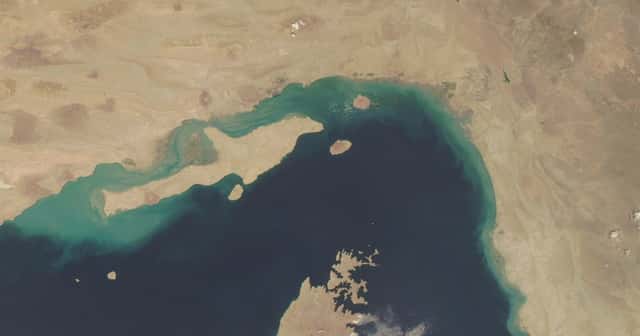
The United States carried out limited strikes on Iran's Qeshm Island on Monday evening, Nov. 2, according to U.S. officials quoted by NBC News, CBS News, Reuters and the Associated Press. The officials described the action as self-defense after Iran's Islamic Revolutionary Guard Corps (IRGC) fired a surface-to-air missile at a U.S. aircraft over the Strait of Hormuz, and said it was not a resumption of major combat operations. Iranian state media reported explosions on the island. The strikes came hours after President Donald Trump told reporters he was not considering new strikes on Iran after Tuesday's U.S. midterm elections. They also came hours after Vice President JD Vance said he and the president felt "pretty good" about the prospects of a negotiated settlement.$
This report covers what U.S. officials told reporters and what is not yet confirmed. It also covers earlier reporting on similar strikes, what Iranian officials said on Monday, and what Israel's prime minister is reported to have asked of Trump. As of Monday night, none of the outlets 567 Politics opened quoted a public statement from U.S. Central Command (CENTCOM), the military command responsible for the region, and the account of the strike rests on unnamed officials and on Iranian state media.
What U.S. officials said
NBC News reporters Courtney Kube, Monica Alba and Gordon Lubold wrote, citing two U.S. officials, that the U.S. military carried out limited strikes on Qeshm Island on Monday. The officials said the attacks were "not a resumption of major combat operations in Iran" and described them as self-defense "in response to Iran's ongoing efforts to target maritime shipping and U.S. assets."
One official told NBC that the IRGC "has routinely targeted and shot at U.S. manned and unmanned aircraft over the Strait of Hormuz and in the area over the past few weeks." The same official said the United States is "occasionally striking Iranian missile launchers in self-defense when the Revolutionary Guard shoots at U.S. aircraft." Iran "tried to target a U.S. aircraft again," the official said. That led "to the U.S. strike on Qeshm to take out the launcher." The official called the action "part of ongoing operations." A third official told NBC: "This was a defensive measure for Iranians using surface-to-air missiles against U.S. assets." One of the officials added that the United States continues to intercept drones and missiles aimed at shipping "every day."
Axios reporter Barak Ravid reported the same account. He posted shortly before 9 p.m. ET, citing a U.S. official. The IRGC fired a missile from Qeshm at a U.S. aircraft over the strait, he wrote. A U.S. fighter jet then destroyed the surface-to-air launcher in self-defense, he wrote.
The BBC, relaying reporting from CBS News, its U.S. partner, wrote that U.S. officials described the strikes as limited and as a response to the IRGC firing on a U.S. aircraft. The BBC said it had contacted CENTCOM for comment. The Guardian reported that CENTCOM "did not immediately respond to a request for comment" from Reuters. The Guardian attributed the first report of the strikes to the Wall Street Journal and said Reuters and the Associated Press reported that the targets were surface-to-air missiles used against U.S. assets.
What Iranian outlets reported
NBC reported that Iranian state media said five explosions were heard on Qeshm Island on Monday. The BBC wrote that the state news agency IRNA reported "several explosions" on the island. The Guardian added that local outlets described the cause of the blasts as unclear. In the reports 567 Politics opened, no Iranian government official had publicly addressed the specific U.S. claim that a missile was fired at an aircraft, and no Iranian account of casualties or damage was available.
Qeshm is the largest island in the Persian Gulf and lies at the mouth of the Strait of Hormuz. The Guardian wrote that the United States has targeted the island "on multiple occasions throughout the war" and that it "has been used in the past to launch attacks on shipping in the waterway." The Guardian added that, although U.S. attacks had ceased in recent weeks, Iran "has continued to enforce its closure of the strait by targeting oil tankers, shipping containers and other vessels." Those are the Guardian's characterizations; Iranian officials have a different account of why the strait is closed, which is described below.
An undisclosed pattern, according to the Wall Street Journal
The reports differ on how unusual the Qeshm action is. NBC wrote that the administration "was last known to have carried out some attacks in early September." The Guardian, summarizing the Wall Street Journal, wrote that the paper "described the attacks as part of a series of strikes carried out against the country in recent weeks that have not been made public." The Guardian summarized the Journal's sourcing. Recent strikes "have been carried out on a smaller scale and purposefully kept secret by the Trump administration," it wrote. The aim, it wrote, was "not to signal any intent of resuming the military campaign against Iran." The Guardian said that, if confirmed, the Qeshm attack "would mark the first publicly known strike by the U.S. on Iran in weeks."
567 Politics could not open the Wall Street Journal's original report. The claim that earlier unpublicized strikes took place therefore rests on the Guardian's summary of it and is not independently confirmed here. The NBC official's comment that strikes on launchers occur "occasionally" is consistent with that account but does not establish its scale or frequency.
What Trump and Vance said on Monday
The strike followed a day of public statements pointing in different directions.
Trump gave a speech at the Washington Reflecting Pool, billed as his closing argument before the midterms. Reporters then asked whether he was considering striking Iran after the election. He answered "no," according to Reuters as published by the Jerusalem Post. NBC reported that he said: "I don't know if you even call it a war, because we haven't been doing any fighting for months." NBC added that the war has cost U.S. taxpayers at least $47 billion, and that Trump noted a sharp drop in oil prices that day. Reuters, via the Jerusalem Post, quoted Trump as saying: "We're not going to allow Iran ever to have a nuclear weapon, and they understand that."
In a phone interview with Axios on Monday, Trump said he was "in no rush" to decide whether to resume fighting. "One way or the other, we will do something, but there is no rush. We crippled them financially. They have no money, no gasoline and their people are getting very tired of it," he said. Axios also quoted him: "We are talking to them. It's going fine. The problem with them is ... they try and tap, tap, tap [us along]. There's less urgency [on the Iranian side] than you think there would be, but they want to make a deal more than they ever wanted." Hours later he posted on Truth Social that oil prices were "DROPPING LIKE A ROCK, down almost $10 a Barrel, A RECORD, because people feel that there will not be a War with Iran." He added: "Iran wants a settlement, as soon as possible. It could happen!" The BBC reported a Fox News interview on the eve of the election. In it, Trump said the United States "might need to go after Pickaxe," a site linked to Iran's nuclear program. He added that it was "not a big deal" and could be done in "one hour." 567 Politics reported on a related claim about that site in its article on Tucker Carlson's post about a possible nuclear strike.
Vance told reporters on Monday: "The president and I both feel pretty good about the prospects for potentially coming to a negotiated settlement. We're going to keep on working at it." In the version Ravid posted, he added: "We made some progress and we will see if we can make some more," and said Trump "retains all kinetic and non kinetic options." Vance also said: "We haven't set deadlines (for resuming strikes). We want to make sure the Iranians don't rebuild or try to rebuild their nuclear program. We do think there is a pathway there, but it requires a firm and verifiable commitment that they don't rebuild their nuclear program."
Vance had sent a letter the previous week to Iran's Supreme National Security Council secretary. NBC wrote that the White House had offered few details and that Trump told reporters the letter was focused on helping Iran with "medical supplies and various things." Axios described it as a proposal to resume negotiations. For earlier coverage of that letter and the mediation effort, see 567 Politics' report on Iran weighing the Vance letter as Qatar mediates.
What Iranian officials said on Monday
Iran's foreign minister told IRNA on Monday, as relayed by the BBC, that "very intensive" talks aimed at ending the war were under way with the United States through mediators. He said Tehran was prepared for both diplomatic and military scenarios "more than ever before," and that it was up to Washington to choose between a "wise path" of negotiation and "the mistake of military aggression." Axios reported more of his remarks. The foreign minister said Qatar and Pakistan "are playing very active roles as mediators." He said Iran has presented its conditions and proposal. He also warned: "If they intend to engage in deception and military operations, they will face a response more painful and severe than in the past."
The foreign ministry spokesperson held his weekly news conference in Tehran, the Tehran Times reported. He said Iran had noticed "contradictory messages" from Washington. He cited threats from Trump and Secretary of State Marco Rubio. He contrasted them with the more conciliatory Vance letter. He said such contradictions could reflect confusion about who makes decisions in the U.S. government. He also said the Strait of Hormuz could not reopen unless the United States ends its naval blockade and meets Iran's demands, and that Tehran regards those demands as necessary steps rather than preconditions for diplomacy.
On Oct. 31, according to a statement relayed by Ravid, Iran's supreme leader told the country's top military commanders that a renewed U.S. or Israeli attack "must be met with an immediate and effective response, without geographical limitations." That directive predates the Qeshm strike and is not a response to it.
Israel's push for renewed strikes
Axios reported on Nov. 1 that Trump and Israel's prime minister spoke by phone on Saturday. It cited one Israeli and one U.S. source. They said the prime minister is pressing Trump to strike Iran right after the midterms. Trump, for now, wants to let negotiations play out. The Israeli source called the call "tough"; the U.S. source called it "direct." The White House and the prime minister's office declined to comment on the call, Axios said. Trump said on Sunday that it had been a "very good" call and confirmed that they discussed Iran, according to the Jerusalem Post. NBC wrote that the Israeli prime minister had pushed for renewed strikes even before Israel's election last week.
The Jerusalem Post, quoting Reuters, said the Wall Street Journal had reported that the call came days after Trump consulted senior U.S. military commanders about options for restarting major combat operations. On Saturday, Rubio said Trump would "prefer to solve it diplomatically" and has "incredible confidence" in military action if it is needed, the Jerusalem Post reported. For the domestic Israeli politics behind the prime minister's position, see 567 Politics' report on his call for a broad national government.
Where the military balance stands
NBC reported that thousands of U.S. troops remain in the waters off Iran. They maintain a naval blockade meant to keep tankers carrying Iranian oil from reaching the global market. A third aircraft carrier and thousands more troops are on the way to the Middle East, NBC wrote. On Oct. 31, CENTCOM said on X that, as of that date, U.S. forces had redirected 144 commercial vessels to ensure compliance with the blockade.
What is established and what is not
| Question | Status | Basis |
|---|---|---|
| U.S. forces struck Qeshm on Monday | Reported by several outlets, not confirmed on the record | Unnamed U.S. officials |
| A missile was fired at a U.S. aircraft | U.S. officials' claim; no independent confirmation | NBC, Axios, CBS |
| Explosions occurred on the island | Reported | Iranian state media, IRNA |
| Strikes were "limited" and not a return to major combat | U.S. officials' characterization | NBC, BBC, Guardian |
| Earlier unpublicized strikes occurred | Reported by the Wall Street Journal; unopened here | Guardian's summary |
| Casualties or damage | Not reported in sources opened | None |
The sources opened do not say whether the targeted launcher was destroyed, whether anyone was killed, or whether Iran will respond. They also do not settle a difference in how the action is described: U.S. officials call it routine self-defense, while Iran's officials say Washington is sending contradictory signals. Both descriptions come from the parties to the conflict.
Funding and financial-interest context
567 Politics checked its Federal Election Commission-based records for the U.S. politicians named in this story. The platform has no verified FEC snapshot for Trump or Rubio. For Vance it has only a 2022 Senate-cycle snapshot (candidate S2OH00436), which predates his time as vice president and says nothing about the events reported here. This article therefore makes no claims about their campaign funding, and nothing in those records bears on whether the officials' account of the Qeshm strike is accurate.
Differing perspectives
How should the United States combine military action, economic pressure and talks with Iran after the midterm elections?
Each position is summarized as its supporters make it, with equal weight and in alphabetical order. A summary is not an endorsement; the evidence for each is weighed in the story above.
End the blockade, then negotiate
Who holds it: Iran's foreign ministry
The ministry spokesperson says the Strait of Hormuz cannot reopen unless the United States ends its naval blockade and meets Iran's demands, which he calls steps to restore security rather than preconditions. He says Iran's seven-stage proposal can be implemented in two days, that messages through Qatar continue, and that 'the ball is in America's court.' He cites contradictory U.S. messages as a reason for caution.
In their words: Tehran Times ↗
Keep economic pressure without new combat
Who holds it: The Treasury secretary, the CIA director and the secretary of state, per Axios sources
A U.S. official says the Treasury secretary is telling Trump the pressure campaign is working and could push Iran's supreme leader toward a deal. Axios reports the CIA director argues that prolonged economic pain will bring concessions or instability inside Iran. Trump said in the interview: 'We crippled them financially. They have no money, no gasoline and their people are getting very tired of it.'
In their words: Axios ↗
Limited defensive action while talks continue
Who holds it: Vice President JD Vance and the U.S. officials quoted by NBC News
Officials describe strikes on missile launchers as self-defense after the IRGC fires at U.S. aircraft, and say they are not a return to major combat. Vance says he and the president 'feel pretty good about the prospect of reaching a settlement' and that 'we made some progress.' He says Trump keeps 'all kinetic and non kinetic options,' set no deadlines, and wants a 'firm and verifiable commitment' that Iran will not rebuild its nuclear program.
In their words: Axios reporter Barak Ravid on X, quoting Vance ↗
Resume major combat operations
Who holds it: Israel's prime minister and the U.S. defense secretary, as described by Axios sources
Axios reports that both argue Iran cannot be trusted to make a deal, let alone abide by one, and that Trump should finish the job militarily. Separate Axios reporting says Israel's prime minister is pressing Trump to strike immediately after the midterms. Supporters of this view point to Trump's own statements that the United States can hit remaining nuclear sites quickly and that Iran has backed out of agreements before.
In their words: Axios ↗
READ BEYOND 567POLITICS
Alternate sources & perspectives
Independent coverage and primary evidence to help you compare arguments. A link is not an endorsement; perspective labels describe the linked material.
- independent analysis
U.S. military carries out limited strikes on Iran's Qeshm Island, U.S. officials say ↗
NBC News
Main account of the strike from three U.S. officials, plus Iranian state media's report of five explosions. Read in full.
- independent analysis
US launches strikes on Iranian island ahead of election ↗
BBC News
Relays CBS reporting and Iran's foreign minister's comments to IRNA. Read in full.
- independent analysis
US reportedly strikes Iran's Qeshm Island as Vance voices optimism about a deal ↗
The Guardian
Summarizes the Wall Street Journal report on earlier undisclosed strikes. The original Journal report was not opened.
- primary evidence
Trump to Axios: "No rush" to decide on bombing Iran again ↗
Axios
Trump's phone interview, Vance's remarks, and Axios's account of three camps advising the president. Read in full.
- other perspective
Iran rejects uranium transfer abroad, says Hormuz reopening depends on US ending blockade ↗
Tehran Times
Iran's foreign ministry spokesperson on the blockade, the Vance letter and 'contradictory messages' from Washington. Read in full; the outlet is Iranian and reports the ministry's position.
- primary evidence
Barak Ravid on X: IRGC missile from Qeshm, U.S. jet destroyed launcher ↗
X (Axios reporter Barak Ravid)
Journalist's post citing one U.S. official; not an on-the-record statement.
Reviewed 2026-11-02. Reviewed Nov. 2, 2026 (ET). The strike account rests on unnamed U.S. officials and Iranian state media; no outlet opened quoted an on-the-record CENTCOM statement. The Wall Street Journal's original report was not accessible and is cited only through the Guardian's summary. The AP and CBS originals were not opened; their reporting is relayed by the BBC and the Guardian. No Iranian government statement addressing the claimed missile launch was found. Quotations are checked against the pages and posts listed here.