Belgium's De Wever offers government's resignation after coalition fails to agree budget
King Philippe holds the offer and will consult coalition leaders, as parties split over spending cuts versus new taxes to close a roughly €10 billion gap.
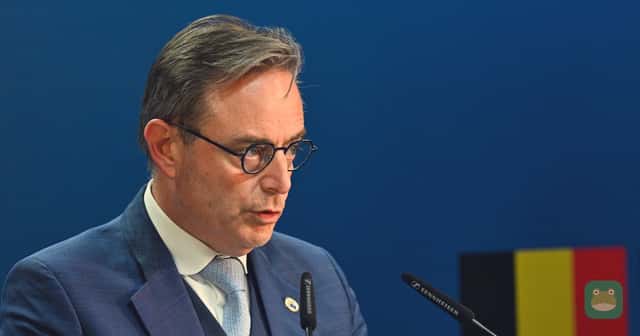
Belgian Prime Minister Bart De Wever offered his government's resignation to King Philippe on Monday, November 2, after his five-party coalition failed to agree on a budget in overnight talks. The king did not accept it. He put off his decision and said he would consult the leaders of the coalition parties, according to the royal palace statement reported by L'Avenir. De Wever is due back at the palace on Friday, November 6.
The crisis is about how to close a gap of roughly €10 billion in the public finances. The coalition partners split over how much of that should come from spending cuts and how much from new taxes. The outcome matters beyond Belgium. The country runs one of the largest budget deficits in the European Union, and the EU has placed it under a formal procedure to bring that deficit down.
Quotations from Dutch- and French-language sources are 567politics translations unless an English version is linked.
What happened overnight
The government's inner cabinet, known in Belgium as the "kern," met from Sunday evening. De Morgen reported that the meeting began around 9 p.m. local time and that by about 1:30 a.m. it was clear no breakthrough was possible. L'Avenir reported that the talks ended around 1 a.m. without a deal. The planned agreement covered the 2027 budget and a multiyear effort of about €10 billion by 2029.
De Wever went to the palace on Monday morning. Euronews reported that he spent about an hour and a half with the king and left without speaking to reporters. The palace said the king regretted that no agreement had been reached on a budget that was "credible and equal to current challenges," according to RTBF. The king would hold his decision in suspense and consult the chairs of the coalition parties from Tuesday, the palace said.
Politico Europe reported that Tuesday had been an unofficial deadline, because the budget needs to pass parliament before the end of the year. RTBF described November 6 as the last practical limit to present the 2027 budget.
De Wever's coalition is known as "Arizona," after the colors of its parties. It brings together the Flemish nationalist N-VA, the French-speaking liberal MR, the centrist Les Engagés, the Flemish social democrats Vooruit and the Flemish Christian democrats CD&V. It took office in early 2025 after 234 days of negotiations, Euronews noted.
The numbers behind the fight
Eurostat's October 2026 report on government deficits and debt gives the official figures. Belgium's deficit was 5.2% of gross domestic product in 2025, up from 4.4% in 2024 and 4.1% in 2023, according to the Eurostat release of October 21. That was the third-largest deficit in the EU last year, behind Romania and Poland and just ahead of France. Government debt stood at about €693 billion at the end of 2025, or 108.1% of GDP. Belgian public spending equaled 54.4% of GDP, against revenue of 49.2%.
EU rules set a reference value of 3% of GDP for deficits. On July 26, 2024, the Council of the EU decided that an excessive deficit existed in Belgium, according to the European Commission's recommendation on correcting it. That procedure requires Belgium to bring its deficit below the 3% limit by a set deadline.
Reuters reported that the European Commission forecast in May that Belgium's debt would reach 110.5% of GDP this year and its deficit would stay at 5.2%. Reuters also reported that Belgium's 10-year bond yield was 4.36% on Monday morning, compared with 3.48% four months ago. Germany's comparable yield stood at 3.30% and France's at 4.92%. De Wever has warned of an "interest snowball," in which rising interest costs feed a growing debt.
De Morgen reported that Belgium's National Bank and its debt agency warned in early October that such a snowball could start as early as 2028 or 2029. The paper also reported that coalition partners rejected De Wever's proposed "debt brake" in mid-October. That plan would have frozen about €4 billion in federal spending.
The government has been here before. VRT reported that the coalition only reached its previous multiyear deal, worth €9.2 billion in savings, on November 24, 2025. Euronews reported that De Wever asked the king for more time in November 2025 and was given 50 days.
Source: Eurostat, Oct. 21, 2026
Show the numbers
| Year | Belgium deficit |
|---|---|
| 2022 | 3.5% |
| 2023 | 4.1% |
| 2024 | 4.4% |
| 2025 | 5.2% |
What was on the table
De Morgen gave the most detailed account of the final offer. According to the paper, De Wever's table included about €4 billion in savings and reforms and €1.5 billion in new revenue. It also listed €1 billion in technical corrections and €2 billion from what the paper called catch-up operations. Some partners wanted to cut the total to €8 billion. De Wever refused. These figures come from De Morgen's reporting and have not been published by the government.
The sharpest split was over taxes. Euronews reported that the centrist and social democratic partners wanted €1 billion to €1.5 billion from taxes on higher incomes. De Morgen reported that MR demanded that no more than one-ninth of the savings effort come from new revenue. Les Engagés proposed a much higher tax on capital gains and a stock-exchange tax, which MR called "unacceptable," according to De Morgen. Politico reported that MR also pushed back on a reform of value-added tax.
De Morgen also reported that, late in the talks, De Wever proposed cutting ministers' pay. When that drew no support, he said he would offer his resignation.
The argument from the left
Vooruit, CD&V and Les Engagés wanted what VRT political journalist Bart Verhulst called a contribution from "the strongest shoulders." Verhulst described the dispute on VRT as "a classic left-right divide," with those three parties on one side and N-VA and MR on the other.
Vooruit said in a statement quoted by De Morgen: "We want an agreement. A fair agreement with a clear and concrete contribution from large fortunes." CD&V said that "our country has no time to lose" and that a government crisis "will solve no problem," La Libre reported. The party urged that "reason win out over shows of electoral strength."
Opposition parties on the left went further. Paul Magnette, leader of the French-speaking Socialist Party (PS), said the country was entering "a great fog." He accused the government of protecting large fortunes "at all costs," according to La Libre. Ecolo's Gilles Vanden Burre said the instability came "from ideology." He called for taxing the broadest shoulders and said the planned defense budget could be revised downward.
In Flanders, Groen's Matti Vandemaele said De Wever "likes to present himself as the man of the big deals, but in practice he is mainly the prime minister of standstill," Euronews reported. He called a second year of stopgap budgets "a complete humiliation." Raoul Hedebouw of the Workers' Party (PVDA-PTB) wrote on X about energy costs and purchasing power, HLN reported. He said defense spending was never questioned and that De Wever was himself responsible for the logic of austerity.
The argument from the right
MR and N-VA argued that Belgium's problem is spending, not a lack of revenue. Reuters reported that the two parties pushed for cuts, including in health care.
MR's David Clarinval said after the talks that "the volume of taxes on the table remains far too high," according to L'Avenir. He said it "goes well beyond what was planned in the government agreement." Politico reported that Clarinval did not rule out a return to talks. In a post on X reported by HLN, Clarinval said that refusing real reforms to cut spending condemns the country to a growing deficit that taxes cannot fill. He said the only solution was to restart growth by supporting competitiveness, job creation and workers. Euronews reported that Clarinval blamed Vooruit for the collapse.
Opposition parties on the right attacked the government from the other side. Vlaams Belang leader Tom Van Grieken said "this solves nothing," according to HLN, and said the government must stop playing for time. His party colleague Barbara Pas said every budget round becomes a search for new taxes, calling the coalition "yet another tax government." La Libre reported that Vlaams Belang said the coalition had "promised historic reforms" and delivered "a historic budget crisis."
Frédéric De Gucht of the Flemish liberal party Anders, which sits in opposition, said: "Two months of negotiating, and the only thing that comes out of it is a resignation letter." He added: "That is not what governing is."
Foreign Minister Maxime Prévot of Les Engagés said there were "too many sticking points" and that resolving them "would take an eternity," Euronews reported.
What can happen next
The king has several options, and none of them is automatic. If he accepts the resignation, Reuters reported, he could ask other parties to try to form a coalition, or he could call new elections. VRT's Verhulst noted that a new majority could in principle be formed without an election. De Morgen reported that if the government falls, elections would follow within 40 days. Reuters and VRT both described elections as one option rather than the only one.
Carl Devos, a political scientist at Ghent University, told VRT that the king's acceptance would mean "game over." He added: "Nobody believes that new elections would offer a solution."
If no budget passes by January 1, Belgium would run on "provisional twelfths." That system lets the government spend one-twelfth of the previous year's budget each month, as VRT explained. Devos said that outcome was now likely. Even with a deal soon, he said, it would be hard to pass a full budget through parliament in time. Politico reported that De Wever had ruled out a temporary budget, while Groen argued that stopgap financing would be a humiliation.
The coalition parties still say they want a deal. CD&V and Vooruit both said publicly that they wanted an agreement, and MR did not rule out more talks. The king's consultations this week will test whether those statements can produce a budget by Friday.
How this fits a wider European pattern
Belgium is not the only EU country struggling to pass a budget that cuts its deficit. France is also fighting over its 2027 budget in a divided National Assembly. We covered that in our story on France's third-quarter contraction and the budget fight. Our France country guide tracks that debate in more depth.
Defense spending is a shared pressure point. Ecolo argued on Monday that Belgium's defense budget could be revised down. Defense spending was also a theme in Italy, as covered in our report on Italy's general strike over living costs and defense spending. Reuters noted that protests over living costs have led to clashes in France, Spain, Italy and Belgium. Our story on youth protests across Europe describes that wave.
Interest rates also shape the debate. Belgian borrowing costs have risen sharply since the summer, according to the Reuters figures. The European Central Bank's choices on rates feed directly into what highly indebted governments pay, a theme in our report on ECB President Christine Lagarde and the bank's policy path.
About this report
Belgian politicians do not have profiles on 567 Politics, and our political funding tool covers only U.S. federal candidates. We have not reviewed Belgian party-finance filings for this article, so it makes no claims about who funds the parties involved. Several of the detailed budget figures above come from reporting by De Morgen and other outlets and have not been released by the Belgian government; we attribute them to those outlets. Our editorial standards explain how we handle claims we cannot verify independently.
Differing perspectives
How should Belgium's government close its roughly €10 billion budget gap?
Each position is summarized as its supporters make it, with equal weight and in alphabetical order. A summary is not an endorsement; the evidence for each is weighed in the story above.
Ask more of the largest fortunes
Who holds it: Vooruit, a member of the governing coalition
Vooruit said, in a statement quoted by De Morgen and translated here from Dutch: "We want an agreement." It called for "a fair agreement with a clear and concrete contribution from large fortunes." It said the proposal on the table at that point did not meet that test, adding that this was what people expect.
In their words: De Morgen, Nov. 2, 2026 ↗
Limit new taxes
Who holds it: MR, a member of the governing coalition (Deputy Prime Minister David Clarinval)
After the overnight talks failed, Clarinval said, in remarks translated here from French, that "the volume of taxes on the table remains far too high." He said the level "goes well beyond what was planned in the government agreement." L'Avenir reported the remarks as MR's reaction to the blocked budget negotiations.
In their words: L'Avenir (Belga), Nov. 2, 2026 ↗
READ BEYOND 567POLITICS
Alternate sources & perspectives
Independent coverage and primary evidence to help you compare arguments. A link is not an endorsement; perspective labels describe the linked material.
- primary evidence
Euro area and EU government deficit and debt, second notification 2026 ↗
Eurostat
Official 2022-2025 deficit and debt figures; Belgium's 2025 deficit 5.2% of GDP and debt 108.1%.
- primary evidence
Recommendation with a view to bringing an end to the situation of an excessive deficit in Belgium ↗
European Commission
Records the Council's July 26, 2024 decision that an excessive deficit existed in Belgium and the 3% reference value.
- independent analysis
Belgian government in crisis over failed budget talks ↗
Politico Europe
Timeline, Tuesday deadline, Vooruit-MR tensions and De Wever's rejection of a temporary budget.
- independent analysis
Belgian government crisis looms as budget talks collapse ↗
Reuters (via Internazionale)
Commission forecasts, bond yields and the king's options if he accepts the resignation.
- independent analysis
Belgium's PM Bart De Wever to offer resignation to King after overnight budget talks fail ↗
Euronews
Palace visit, coalition background and reactions from Prevot, Clarinval and Groen.
- independent analysis
Prime Minister De Wever offers resignation to King Filip ↗
VRT NWS
Public broadcaster's account, with Bart Verhulst's analysis of the left-right split.
- independent analysis
Geen begrotingsakkoord: politieke crisis, een overzicht ↗
VRT NWS
Explainer on provisional twelfths and the king's options, with political scientist Carl Devos.
- independent analysis
Crise dans le gouvernement Arizona: le kern se quitte sans accord ↗
RTBF
French-language public broadcaster's report with the palace statement and the Friday meeting.
- independent analysis
Regering in diepe crisis: premier De Wever biedt ontslag aan bij koning ↗
De Morgen
Detailed reconstruction of the final budget table, MR's revenue limit and Vooruit's statement.
- right argument
Oppositie fileert De Wever na mislukte begrotingsnacht ↗
HLN
Vlaams Belang's Van Grieken and Pas and MR's Clarinval argue the problem is taxes and spending, not revenue; also carries left-opposition reactions.
- left argument
Les reactions fusent apres l'echec sur le budget ↗
La Libre Belgique
PS leader Magnette and Ecolo's Vanden Burre call for taxing large fortunes and revisiting defense spending; also CD&V and Anders reactions.
- other perspective
Ce n'est pas ca diriger: crise budgetaire historique, l'opposition crie au fiasco ↗
L'Avenir
Full palace communique and statements from MR, CD&V and opposition parties across the spectrum.
Reviewed 2026-11-02. Reviewed November 2, 2026. Automated discovery returned only unrelated pages (BART transit, Bart Simpson), so sources were selected by hand from reporting the article cites. Primary evidence is Eurostat's October 2026 deficit and debt release and the European Commission's excessive-deficit recommendation for Belgium. Left and right arguments are reported statements by Belgian party figures in Belgian news coverage rather than op-eds; De Morgen's budget figures are the paper's reporting and were not released by the government. AP coverage timed out and was not used.