China's party confirms 33 expulsions as plenum turnout falls to 74% and a discipline resolution appears
The fifth plenum drew 279 of 376 members. The resolution published Sunday targets passive officials and family assets; analysts split on what the campaign is for.
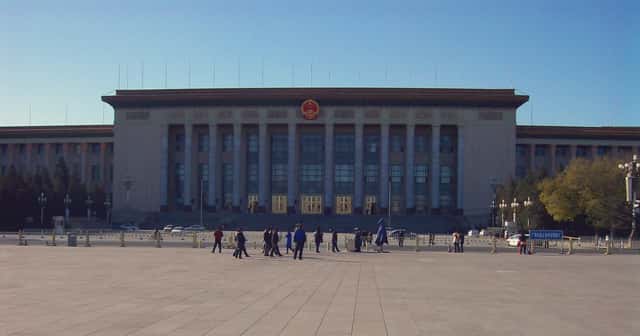
China's Communist Party ended a four-day meeting of its Central Committee on October 29 with a record 33 expulsions confirmed, the lowest attendance at a plenum since the end of the Mao era, and a long resolution on how the party polices itself. Only 279 of the 376 full and alternate members chosen in 2022 attended, according to a summary of proceedings from the Xinhua news agency that was reported by Reuters.
The resolution, on "persevering with full and rigorous Party self-governance," was adopted at the fifth plenum of the 20th Central Committee. Xinhua published its full English text on Sunday, November 1. The South China Morning Post described it as a 17,000-word document. This report covers what the plenum announced, what the resolution says, why the attendance figures matter, and how analysts read the campaign. Where we quote the resolution, we use Xinhua's official English translation. Quotations from other Chinese-language reporting are 567politics translations unless an English-language outlet is cited.
What the plenum announced
The communique, issued by Xinhua on Thursday, did four things that can be checked against reporting by several outlets.
First, the plenum confirmed earlier Politburo decisions to expel 33 people from the party. Lianhe Zaobao, a Singapore newspaper, reported that 24 were full Central Committee members and nine were alternates. The BBC reported that 16 of the 33 came from the military. The names include former Politburo members Ma Xingrui, a former party chief of Xinjiang, and Zhang Youxia, a former vice chairman of the Central Military Commission. Reuters also listed former senior diplomat Liu Jianchao and former industry minister Jin Zhuanglong. The BBC noted that the communique cites only "serious disciplinary and legal violations," wording it called routine, so the specific accusations have not been made public.
Second, the plenum elected Zhang Shengmin, vice chairman of the Central Military Commission, to the Politburo. Zaobao said it was the party's first mid-term addition to that body in 32 years, since Huang Ju was elected in September 1994. The Politburo now has 22 members. It was formed with 24 after the 2022 congress and, according to the BBC, fell as low as 21 after the removals of Ma Xingrui, Zhang Youxia and former general He Weidong.
Third, the plenum set the 21st Party Congress for the second half of 2027 in Beijing. The Straits Times reported that President Xi Jinping is widely expected to seek a fourth term as party leader there. The Guardian wrote that he is already the longest-serving ruler of Communist China since Mao Zedong.
Fourth, it promoted 10 alternate members, including Lu Dongliang and Liu Jie, to full membership, according to Zaobao. It also reported that alternate member Li Yunze was stripped of his party posts.
The empty seats
The plenum took place at a hotel in Beijing, the BBC said, behind closed doors. The numbers it produced are one public measure of how much the membership has changed since 2022. Zaobao compared each plenum's turnout with the 376 members originally elected, made up of 205 full and 171 alternate members.
| Plenum | Date | Attended | Share of 376 |
|---|---|---|---|
| Third | July 2024 | 364 | 96.8% |
| Fourth | October 2025 | 315 | 83.8% |
| Fifth | October 2026 | 279 | 74.2% |
Source: Lianhe Zaobao, BBC
Show the numbers
| Plenum | Members attending |
|---|---|
| Third, July 2024 | 364 |
| Fourth, October 2025 | 315 |
| Fifth, October 2026 | 279 |
The Straits Times said 162 full and 117 alternate members attended the fifth plenum. The BBC said it was the first time in Xi's 14 years as leader that attendance fell below 300. The Guardian said more than a quarter of the original cohort was absent, many because of expulsions, while other absences were unexplained. Hung Yao-nan of Tamkang University in Taiwan told Zaobao that 279 is still well above half of the membership, so the plenum's formal operation is not in question.
The more important effect, Hung said, is on the positions the missing members held. In his account, ministries, provinces and military units have many acting or newly appointed leaders, which makes decisions depend more on instructions from above. He said the Central Committee's deliberative role has weakened further and that it mainly ratifies personnel changes. This is one analyst's reading, given to a newspaper whose English edition says the article was machine-translated.
The military has been hit hardest. The BBC, the Guardian and the Straits Times all reported that the seven-member Central Military Commission now has only two members, Xi as chairman and Zhang Shengmin as vice chairman. Neil Thomas, Lobsang Tsering and Shengyu Wang of the Asia Society Policy Institute described the loss of senior officers as "in a category of its own," according to the BBC. They said the losses raise serious questions about organizational leadership and combat readiness.
The BBC also reported that the 33 expulsions bring the number removed during Xi's third term to a record 51. It gave the figures for his first and second terms as 35 and five. The Straits Times quoted Chen Gang of the National University of Singapore's East Asian Institute as estimating that about a fifth of the Central Committee's full members have been expelled, which he called unprecedented in the reform era. We could not reproduce that cumulative estimate from the published pages, so it remains his figure.
What the resolution says
The resolution runs to about 17,000 words, and we cover only the passages that bear on discipline, oversight and the conduct of officials.
Loyalty and the party's own account. The text says the party has found "two answers to the question of how to escape the historical cycle of rise and fall: the people's oversight over government and the Party's self-reform." It credits the Central Committee with Xi at its core for showing "tremendous political courage and a strong sense of responsibility" after 2012. It calls for removing officials "who lack loyalty to the Party, feign compliance, or abuse power for personal gain." It also lists behaviors to oppose, including "disregard of rules in thinking, opportunism in politics, factionalism in organization, departmentalism in work, and unprincipled nice-guyism in accountability," and says the party will "accurately identify and resolutely remove double dealers from the ranks of our Party." The SCMP reported that the "nice-guy" language targets conflict-averse officials who overlook wrongdoing to protect their own careers.
Limits on local leaders. The text pledges to "put into full practice the system whereby the head is the last to express opinions" in leadership teams. It says secretaries of party committees "must practice democracy, paying heed to differing opinions and treating minority views with a proper attitude," and "must resist dictatorial and paternalistic styles of work." Leaders may not "replace collective decisions of the leadership team with their own opinions" or arbitrarily change them. The SCMP read this as a proposal for stronger oversight of principal leaders below the central level. It said the text bars them from demanding personal allegiance from their teams, which it described as a demand reserved for the top leaders. That reading is the newspaper's. The resolution does not say that only top leaders may make such demands.
Corruption and family assets. The resolution says the party will "take out tigers," "swat flies" and "hunt down foxes," punishing "corrupt officials of all types." It names newer forms of corruption: assets held "under the name of bribe givers or a third party," agents concealing corruption "in ostensibly legal forms," and corruption "via the internet, virtual currency, cross-border capital, and blockchain." Officials' reporting of personal information will be refined. According to the text, "those with family property and spending far exceeding their normal incomes will be examined." The "commercial and entrepreneurial activities of leading officials' spouses, children, and their children's spouses" will face tighter management, and it promises "dedicated efforts" to address nepotism. It also takes aim at "resignation or early retirement aimed at escaping punishment."
Incentives for officials. The text says officials should be treated strictly and also with care, with "equal emphasis on providing incentives and imposing constraints." It promises mechanisms "for encouraging and protecting responsible and enterprising officials," and says candid talks with officials will cover "their thoughts, work progress, physical and mental health, and family conditions." These passages bear on the criticism below that discipline can make officials cautious.
Membership. The resolution says new members should be admitted so that "only those who are qualified join the Party while people with impure motives are not admitted." It adds that appraisals of party spirit should consider "family education, and family values."
What the party says it has achieved
The BBC quoted the communique as saying the party "squarely confronted the grim reality that party leadership had at times weakened or hollowed out." The resolution's own text, in Xinhua's translation, describes the situation after 2012 as "weak, hollow, and watered-down Party leadership, lax, superficial, and ineffective self-supervision and self-governance," along with "a number of egregious problems within the Party." It says "stringent measures" followed. English renderings of the two documents differ in wording, so we quote each as its outlet published it.
At a press briefing on Friday, Zhang Fuhai of the party's disciplinary commission said more than two million people have been disciplined since 2012 over "pointless formalities, bureaucratism, hedonism and extravagance," the BBC reported. He said the party would strengthen efforts so that officials "dare not, cannot, and do not want to be corrupt." The BBC also reported that the disciplinary commission said 680,000 people across the party apparatus were disciplined in the first nine months of 2026. We could not check those totals independently.
The Straits Times noted that the party sees tighter discipline as central to its legitimacy and to economic development. Chen said the number of expulsions the plenum approved suggests Xi has secured the party's endorsement for the campaign, and that it helps lay the groundwork for a fourth term.
How analysts read the campaign
Observers disagree on what the drive is for and what it costs.
Chong Ja Ian, a scholar with Carnegie China, told the BBC the campaign has become "an effort to consolidate and maintain authority," and that it "will continue and expand depending on how secure Xi feels rather than any real issue with corruption." He added that Xi "has few qualms about removing people he promoted."
Others stress the governance problem the party says it faces. Anthony Saich of the Harvard Kennedy School said Xi, even with control of the political center, remains frustrated with local officials who "feign compliance or remain passive," the Straits Times reported. At a January meeting Xi warned against "two-faced" officials who voice support for the Central Committee but act as they please.
Several analysts argue that the cost falls on initiative. Jean Christopher Mittelstaedt of the University of Zurich said officials are punished for mistakes and for failing to act, which encourages visible displays of compliance. Shengyu Wang of the Asia Society Policy Institute described local officials as caught between political compliance, ambitious economic and technology targets, and tight fiscal discipline.
Ruby Osman of the Tony Blair Institute for Global Change told the Straits Times that expected retirements of many of Xi's close associates in 2027 will test his ability to secure the same loyalty from a new generation. She said a focus on discipline could also help contain infighting, since top leaders may all be loyal to Xi without being loyal to one another.
What we do not know
Several points are not public. The party has not said what the 33 people are accused of beyond "serious disciplinary and legal violations." We have no independent way to test the accusations. The attendance figures come from the party's own summary and depend on a 2022 baseline of 376 members. Absences other than the confirmed expulsions were not explained, according to the Guardian. The resolution is a statement of party policy. How strictly it will be enforced at the provincial and local level is not something the text can show.
What to watch
The next scheduled milestone is the 21st Party Congress, due in the second half of 2027 in Beijing, where the Central Committee and Politburo are due to be renewed. The Guardian reported that many analysts see few suitable candidates for promotion after the recent removals. The Central Military Commission, which has two members, is the other body to follow.
For other items on China's calendar, see our daily briefing from October 30, which noted the expulsions, and our report on Taiwan's protest over its APEC invitation, ahead of the leaders' meeting that China hosts in Shenzhen on November 18 and 19. Japan's government faces a related question about how to handle Beijing: a new Japanese poll found 55% of respondents want more talks with China, and our China and Japan comparison sets out the two countries' systems.
How we reported this
We read the full English text of the resolution as published by Xinhua and in a PDF from CGTN, and we read reports from the BBC, Reuters via NBC News, the Guardian, the Straits Times, Lianhe Zaobao and the South China Morning Post. The Zaobao English edition labels its article as AI-translated, so we paraphrased it and quoted only the resolution and outlets that published English originals. Counts of expulsions, attendance and discipline cases come from party sources as relayed by those outlets. Our methodology explains how we source and attribute claims.
Differing perspectives
What is the main effect of the Communist Party of China's tightened self-governance rules?
Each position is summarized as its supporters make it, with equal weight and in alphabetical order. A summary is not an endorsement; the evidence for each is weighed in the story above.
A remedy for corruption and weak party leadership
Who holds it: The Communist Party of China's Central Committee, in the plenum resolution
The resolution says the party has found two answers to the historical cycle of rise and fall: the people's oversight over government and the party's own self-reform. It says every instance of corruption must be investigated and punished, that officials should be treated strictly and with care, and that responsible and enterprising officials should be encouraged and protected, with incentives and constraints given equal emphasis.
In their words: Xinhua (full text of the resolution) ↗
A source of caution and formalism among officials
Who holds it: Jean Christopher Mittelstaedt, University of Zurich, and Shengyu Wang, Asia Society Policy Institute
Mittelstaedt says officials face punishment for mistakes and for failing to act, so they work visibly, documenting everything and reporting the numbers superiors want; discipline against formalism, he argues, produces more formalism. Wang says innovation needs trial, error and tolerance for failure, but relentless discipline and retrospective accountability make any misstep personally ruinous for local cadres.
In their words: The Straits Times ↗
A way to consolidate and maintain Xi's authority
Who holds it: Chong Ja Ian, non-resident scholar at Carnegie China, and other outside analysts
Chong says the campaign has become an effort to consolidate and maintain authority, and that it will continue and expand depending on how secure Xi feels rather than because of any real issue with corruption. He says Xi has few qualms about removing people he promoted, and that doing so with little opposition shows how unassailable his position is at the moment.
In their words: BBC News ↗
A weaker Central Committee that mainly ratifies decisions
Who holds it: Hung Yao-nan, deputy director of the Cross-Strait Relations Research Centre, Tamkang University
Hung says attendance of 279 is still well above half the membership, so the plenum's statutory operation is not at issue. He argues that the real effect shows in the posts affected: ministries, provinces and military units have many acting or newly appointed leaders, so decisions depend more on instructions from above, and the Central Committee's deliberative role has weakened further.
In their words: Lianhe Zaobao (English edition, machine-translated) ↗
READ BEYOND 567POLITICS
Alternate sources & perspectives
Independent coverage and primary evidence to help you compare arguments. A link is not an endorsement; perspective labels describe the linked material.
- primary evidence
Full text: Resolution of the Central Committee of the Communist Party of China on Certain Major Issues concerning Persevering with Full and Rigorous Party Self-Governance ↗
Xinhua
Full English text of the resolution on party self-governance adopted Oct. 29, 2026, as published by Xinhua.
- primary evidence
Resolution of the Central Committee of the Communist Party of China on Certain Major Issues concerning Persevering with Full and Rigorous Party Self-Governance (PDF) ↗
CGTN
PDF of the same English text; the passages quoted in the story were read here.
- independent analysis
China's Communist Party expels 33 officials in post-Mao-era record purge ↗
Reuters via NBC News
Reuters report on the 33 expulsions, the 279-of-376 attendance and the Politburo promotion.
- independent analysis
Record number of purges as Xi emphasises 'party discipline' at China political gathering ↗
BBC News
Attendance history, military share of expulsions, disciplinary commission figures and expert comment.
- independent analysis
CCP fifth plenum elects Zhang Shengmin to Politburo; attendance falls to 74.2% ↗
Lianhe Zaobao
Attendance series against the 376 baseline, expulsion breakdown, and Hung Yao-nan's analysis. English edition is machine-translated.
- independent analysis
China's Communist Party pledges tighter discipline ahead of 2027 congress ↗
The Straits Times
Analysts on Xi's fourth-term prospects and on formalism and local initiative.
- independent analysis
China expels a record number from Communist party amid Xi's intensified purges of top officials ↗
The Guardian
Report on the empty seats, the two-member Central Military Commission and the 2027 congress.
- other perspective
China's Communist Party plenum targets passive 'nice' guys in anti-corruption push ↗
South China Morning Post
Explains the resolution's 'old nice persons' language (partly paywalled; only the opening was read).
- other perspective
'Speak last': China's fifth plenum moves to rein in Communist Party leaders ↗
South China Morning Post
Reading of the resolution's 'head speaks last' rule and its 17,000-word length (partly paywalled; only the opening was read).
Reviewed 2026-11-03. Sources opened and read on Nov. 3, 2026. Automated discovery returned nothing useful, so sources were chosen by hand. Quotations from the resolution are from the official English translation. Zaobao's English edition is machine-translated, so it is paraphrased rather than quoted. Reuters and other summaries describe some resolution wording (for example on proxy shareholding or specific crypto rules) that we did not find in the official translation, so those claims are not used. The two SCMP pages are paywalled beyond their openings. No Chinese government dataset or campaign-finance record bears on these claims.