Germany approved more arms exports in six months than in all of 2025
A government report puts approvals at €15.5 billion from January to June, led by Ukraine and NATO partners, as the coalition pushes for faster licensing.
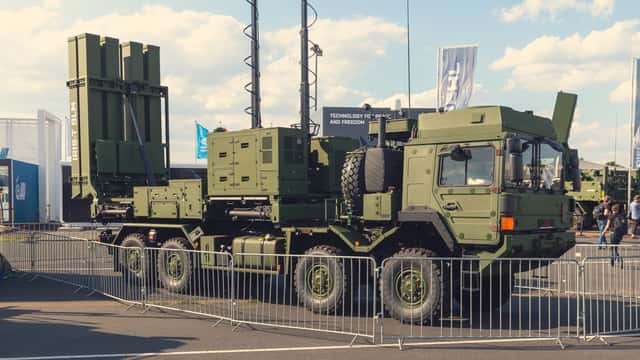
Germany approved more arms exports in the first six months of 2026 than in all of 2025. A government report sent to the Bundestag puts the value of export approvals from January to June at about €15.5 billion. That is nearly three times the €5.4 billion of the same period a year earlier, and above the €13.3 billion for the whole of 2025. Ukraine was again the largest single recipient, but most of the growth came from European and NATO partners.
The figures come from the government's interim report on conventional arms exports for the first half of 2026, printed as Bundestag paper 21/9150. The Economy Ministry sent it to parliament on November 11. The Bundestag's own news service summarized it on November 16. Preliminary numbers had come out in July, as the anti-militarism group IMI noted at the time. The new report is the formal count. It adds the values companies reported under general licenses.
A record half-year, driven by Europe and Ukraine#
The €15.5 billion total has two parts. About €12.8 billion came from 2,721 individual licenses, up from about €3.2 billion a year earlier. Another €2.7 billion came from general licenses. These are standing permits that let firms ship set goods to set countries, mostly in the EU and NATO, and report the value afterward.
The scale of the jump shows up best against full years. The government's annual report for 2025 put total approvals at €13.3 billion for that year and €13.4 billion for 2024. Six months of 2026 have already passed both. The jump is sharpest in individual licenses, the permits BAFA issues case by case. They totaled €8.57 billion in all of 2025 and €12.8 billion in the first half of 2026 alone.
Source: Federal government, interim report H1 2026 (Drucksache 21/9150), Federal government, arms export report 2025
Show the numbers
| Period | Approvals |
|---|---|
| 2024 (full year) | 13.4bn € |
| 2025 (full year) | 13.3bn € |
| H1 2025 | 5.4bn € |
| H1 2026 | 15.5bn € |
About €10.1 billion, or 65 percent, went to EU and NATO members and four countries the government treats the same way: Australia, Japan, New Zealand and Switzerland. A year earlier that group took €3.1 billion. EU members alone rose from €2.2 billion to €7.3 billion.
"Third countries," those outside that circle, received approvals worth about €5.4 billion. That figure includes Ukraine. Approvals for Ukraine rose to about €2.76 billion from €1.3 billion. The report says Ukraine, the EU and NATO group, South Korea and Singapore together took about €13.2 billion, or 85 percent of the total.
Source: Federal government, interim report H1 2026, Annex 2 (Drucksache 21/9150)
Show the numbers
| Destination group | H1 2025 | H1 2026 |
|---|---|---|
| EU members | 2.24bn € | 7.28bn € |
| NATO and equivalent (non-EU) | 0.87bn € | 2.84bn € |
| Third countries (incl. Ukraine) | 2.31bn € | 5.38bn € |
Where the weapons are going#
Tanks and missiles dominate the list of top destinations. For Ukraine, 78 percent of the value of individual licenses was missiles, launchers and parts. For the United States, in second place at €1.76 billion, the share for the same category was 93 percent. The Netherlands, Czechia and Lithuania each took more than €1.2 billion, mostly in battle tanks and armored vehicles. Lithuania's licenses were almost entirely tanks.
The Baltic states and Norway also rank high. Latvia, Norway, Estonia and Slovenia each received more than €400 million. Lithuania, Latvia, Estonia and Norway all share a border with Russia.
Ukraine's total in six months is already larger than its total for all of 2025, which the annual report put at €2.27 billion. About €646 million of Ukraine's 2026 figure came through general licenses rather than individual permits. The 2025 report notes that all values are nominal and not adjusted for inflation.
Source: Federal government, interim report H1 2026, Annex 2 (Drucksache 21/9150)
Show the numbers
| Country | Approvals |
|---|---|
| Ukraine | 2.76bn € |
| United States | 1.76bn € |
| Netherlands | 1.38bn € |
| Czechia | 1.25bn € |
| Lithuania | 1.22bn € |
| Israel | 0.8bn € |
| Latvia | 0.52bn € |
| Norway | 0.49bn € |
| Estonia | 0.43bn € |
| Slovenia | 0.41bn € |
Israel and other buyers outside the alliance#
Israel ranked sixth, with approvals worth about €800 million. That compares with about €87 million in the first half of 2025 and €202 million for all of 2025. The report gives a reason in a footnote. Most of the value, it says, is for "a large project in the maritime defense sector." Another large share is for "cooperation between German and Israeli firms in the interest of the Bundeswehr," Germany's armed forces. The rest is "other military equipment," not weapons of war. Warships made up 62 percent of the value of Israel's individual licenses.
In September, Der Spiegel reported that the maritime project was the Dolphin-class submarine INS Drakon, built by TKMS in Kiel. The magazine noted that Germany had paused some approvals for Israel in August 2025 for goods that could be used in Gaza. It lifted that pause at the end of November 2025.
- August 2025Merz halts approvals for goods that could be used in Gaza
- November 2025The partial halt is lifted
- 2025 full yearApprovals for Israel total about €202 million
- January–June 2026Approvals reach about €800 million, mostly for a maritime project
- November 11, 2026The government sends its half-year report to the Bundestag
Source: Der Spiegel, September 2, 2026, Federal government reports for 2025 and H1 2026
Israel's own debate over paying for arms is covered in our report on its $31.5 billion in U.S. purchase commitments.
Other destinations outside the EU and NATO include Algeria at €251 million, the United Arab Emirates at €207 million, India at €173 million, Bahrain at €137 million and Saudi Arabia at €96 million. The report marks a few small approvals as granted only under embargo exceptions, including about €1.5 million for Syria.
The third-country total rose by about €3.1 billion from a year earlier. Ukraine accounts for about €1.4 billion of that rise and Israel for about €0.7 billion. South Korea rose to €313 million from €149 million, while Singapore fell to €42 million from €215 million.
What the numbers do and do not show#
The report counts approvals, not deliveries. A license can be used years later, or never. Values from general licenses rest fully on what companies report to the export control office, BAFA, the report says.
The government also turned down 16 export applications worth about €15.1 million. It does not say which countries or goods were involved.
Small arms approvals rose to €121.5 million from €52.2 million. Almost all of that, 98 percent, was for EU, NATO and equivalent countries. That pattern follows long-standing rules. Under the government's political principles, as the 2025 annual report restates, small-arms licenses for third countries should in principle not be granted, because, the report says, small arms cause by far the most casualties in internal and cross-border conflicts. About €3 million in small arms went to third countries in the first half, of which €1.3 million went to South Korea, Singapore and Ukraine. Approvals for light weapons, such as heavy machine guns and anti-tank weapons, rose to €31.8 million from €4.3 million. Nearly all went to the same group.
Source: Federal government, interim report H1 2026 (Drucksache 21/9150)
Show the numbers
| Category | H1 2025 | H1 2026 |
|---|---|---|
| Small arms and parts | 52.2m € | 121.5m € |
| Light weapons and parts | 4.3m € | 31.8m € |
The government also issued 21 collective export licenses worth about €560 million. These cover joint defense programs, mostly with EU and NATO partners. Nine of them, worth €515 million, renewed earlier permits whose value had already been counted, so the new amount was about €45 million.
The report says each decision was made "case by case" after "careful review" of foreign and security policy. Final decisions on the most sensitive cases are taken by the National Security Council, a cabinet body chaired by the chancellor, and the government tells the Bundestag about them afterward.
- ApplicationA company asks for a license, or ships under a standing general license and reports the value later
- ReviewOfficials weigh foreign and security policy under German law, EU rules and the Arms Trade Treaty
- Sensitive casesThe National Security Council makes the final call
- ReportingThe government reports totals to the Bundestag every six months and every year
Source: Federal government, arms export report 2025, Interim report H1 2026
It lists the legal basis, including the War Weapons Control Act, the EU's common rules on arms exports and the Arms Trade Treaty.
The fight over how strict the rules should be#
The rise comes after the governing parties set out a new approach. In their 2025 coalition agreement, the CDU, CSU and SPD said they would align arms exports more closely with Germany's foreign, economic and security interests. They called for a "strategically oriented" policy that gives the industry and its customers reliability. They also promised faster, better coordinated reviews, more sales through government-to-government deals and work toward common European export rules. But they said they would reject exports where there is a substantial, concrete risk of use for internal repression or in breach of international law. Chancellor Friedrich Merz leads the government. The Economy Ministry under Katherina Reiche handles export licensing.
The defense industry wants the process to go further. In a 2025 position paper, the BDSV and BDLI trade groups asked Berlin to end the need for two separate permits for many weapons exports. They also proposed one permit covering both making and exporting a weapon. Firms, they said, now build custom systems at the risk of not being allowed to deliver them.
The opposition Greens want binding limits instead. Greens lawmaker Katharina Dröge wrote on July 21, in an answer on abgeordnetenwatch.de, that her party has always backed a "restrictive and responsible" policy. She noted the Greens proposed an arms export control law under the last government, but it did not win support. She also said parliament does not vote on approvals; only the government decides, and opposition lawmakers, like the public, learn the figures from the government's export reports. Reviving the law, she wrote, would take larger majorities for her party.
The Left wants exports to Israel stopped. In an October 23 statement, its foreign affairs spokeswoman Lea Reisner called on the government to "stop arms exports," suspend the EU-Israel association agreement and recognize Palestine as a state.
Some researchers see a lasting change. Simone Wisotzki of the Peace Research Institute Frankfurt argued in May that arms exports have become a strategic part of foreign and security policy. She warned that a policy of "procuring in order to export" will lead to more exports to "problematic third countries." The first-half data show third-country approvals more than doubling, though Ukraine, a country at war that Germany supports, makes up about half of that total.
What comes next#
The government publishes its full annual report for 2026 next year. Germany is also stepping up its own defense buildup, from new reserve duties to support for Kyiv discussed at Merz's coalition of the willing talks. The open question in Berlin is whether export rules should get faster, as the coalition and industry want, or tighter, as the Greens and the Left want.
Differing perspectives
How strictly should Germany limit its arms export approvals?
Each position is summarized as its supporters make it, with equal weight and in alphabetical order. A summary is not an endorsement; the evidence for each is weighed in the story above.
Pass a binding export control law
Who holds it: The Greens, an opposition party in the Bundestag
The Greens argue that Germany needs a restrictive and responsible arms export policy set out in law rather than in political guidelines. They proposed an arms export control law under the previous government, which did not win support from its partners. Because the government alone decides on approvals and parliament only receives reports afterward, they say binding rules are the main way to limit exports, and they aim to revive the law if they gain larger majorities.
In their words: Katharina Dröge (Greens), answer on abgeordnetenwatch.de, July 21, 2026 ↗
Speed up and simplify licensing
Who holds it: The defense industry groups BDSV and BDLI
The industry groups argue that Germany cannot rebuild its armed forces without a large expansion of its defense industry, and that the rules slow this down. They want to end the double permit requirement for many weapons exports and to combine the license to build a weapon with the license to export it. Firms, they say, now build custom systems at the risk of not being allowed to deliver them, while the government could still revoke a combined license if the political assessment changes.
In their words: BDSV and BDLI joint position paper, June 2025 ↗
Stop arms exports to Israel
Who holds it: The Left party's Bundestag group
The Left argues that Israel's government is breaking international law in the West Bank and Gaza, pointing to more than 1,000 Palestinians killed in the West Bank since October 2023, continued settlement building and attacks on journalists and diplomats. It says statements of concern from Berlin are not enough and that Germany shares responsibility while it keeps supplying weapons. It calls on the government to stop arms exports, suspend the EU-Israel association agreement and recognize Palestine as a state.
In their words: Die Linke im Bundestag, statement by Lea Reisner, October 23, 2026 ↗
Tie exports to German strategic interests
Who holds it: The CDU, CSU and SPD coalition government led by Chancellor Friedrich Merz
The coalition argues that arms exports should serve Germany's foreign, economic and security interests and give the German defense industry, its foreign partners and their customers reliability. It wants license reviews to be faster and better coordinated, more sales through government-to-government agreements and common European export rules. It says it still rejects, in principle, exports that carry a substantial, concrete risk of use for internal repression or in breach of international law, and that each license is decided case by case after careful review.
In their words: CDU, CSU and SPD coalition agreement 2025 ↗
Cite this article
567 Politics staff. “Germany approved more arms exports in six months than in all of 2025.” 567politics. Published 2026-11-16. https://567politics.com/news/germany-arms-export-approvals-first-half-2026-15-5-billion-ukraine-israel-november-2026
Wikipedia citation
{{cite news |title=Germany approved more arms exports in six months than in all of 2025 |url=https://567politics.com/news/germany-arms-export-approvals-first-half-2026-15-5-billion-ukraine-israel-november-2026 |work=567politics |author=567 Politics staff |date=2026-11-16 |language=en}}CSL-JSON for reference managers
{
  "id": "https://567politics.com/news/germany-arms-export-approvals-first-half-2026-15-5-billion-ukraine-israel-november-2026",
  "type": "article-newspaper",
  "title": "Germany approved more arms exports in six months than in all of 2025",
  "URL": "https://567politics.com/news/germany-arms-export-approvals-first-half-2026-15-5-billion-ukraine-israel-november-2026",
  "container-title": "567politics",
  "language": "en",
  "author": [
    {
      "literal": "567 Politics staff"
    }
  ],
  "issued": {
    "date-parts": [
      [
        2026,
        11,
        16
      ]
    ]
  }
}Citations identify this article and its publication date. Assess the reporting and its linked sources before using it as evidence.
Read this article as Markdown or JSON. Cite the original page and retain its sources, dates and qualifications.
Embed this article summary
Paste this HTML into your page. The summary stays linked to the full story and updates with it. No account required.
<iframe src="https://567politics.com/embed/news/germany-arms-export-approvals-first-half-2026-15-5-billion-ukraine-israel-november-2026?theme=auto" title="Germany approved more arms exports in six months than in all of 2025 by 567politics" width="100%" height="440" style="border:0;max-width:100%" loading="lazy"></iframe>
<p style="font-size:14px">Germany approved more arms exports in six months than in all of 2025 by <a href="https://567politics.com/news/germany-arms-export-approvals-first-half-2026-15-5-billion-ukraine-israel-november-2026" rel="nofollow">567politics</a></p>
<script async src="https://567politics.com/embed.js"></script>
READ BEYOND 567POLITICS
Alternate sources & perspectives
Independent coverage and primary evidence to help you compare arguments. A link is not an endorsement; perspective labels describe the linked material.
- primary evidence
Report of the Federal Government on its export policy for conventional military equipment in the first half of 2026 (Drucksache 21/9150, German) ↗
Deutscher Bundestag / Federal Government
The full interim report: €15.5 billion total, country tables, goods categories, small arms, collective licenses and 16 denials.
- primary evidence
Arms exports in the first half of 2026 (German) ↗
Deutscher Bundestag, hib news service
Parliament's own November 16 summary of the report's headline numbers.
- primary evidence
Arms Export Report 2025 (German) ↗
Federal Ministry for Economic Affairs and Energy
Full-year 2025 and 2024 totals, Israel's 2025 figure, the small-arms principles and how licensing works.
- other perspective
Coalition agreement of CDU, CSU and SPD, 2025 (German) ↗
CDU, CSU and SPD
The governing parties' pledge of a 'strategically oriented' arms export policy with faster reviews and limits on exports risking repression.
- other perspective
Key points for regulatory changes to speed up capacity building in the defense industry (German) ↗
BDSV and BDLI
Industry proposals to end double permits and combine production and export licenses.
- other perspective
How did the Greens vote on arms exports in 2026? Answer by Katharina Dröge (German) ↗
abgeordnetenwatch.de
The Greens' case for a restrictive policy and a binding arms export control law, in a lawmaker's own words.
- other perspective
Stop arms exports, suspend the association agreement and recognize Palestine as a state (German) ↗
Die Linke im Bundestag
Lea Reisner's October 23 statement calling for a halt to arms exports to Israel.
- independent analysis
Mixed record of the CDU-SPD government's arms export policy (German) ↗
Peace Research Institute Frankfurt (PRIF)
Researcher Simone Wisotzki on the shift from an export control law toward a strategic export policy.
- independent analysis
U-boat deal leads to unusually high sum in arms exports to Israel (German) ↗
Der Spiegel
September 2 report identifying the maritime project as the INS Drakon submarine and recounting the 2025 export pause.
- other perspective
Government approves more arms exports to Israel (German) ↗
Israelnetz
A Christian news site focused on Israel; its account of the same figures and of the Left's demands.
- other perspective
Arms exports: half-year balance (German) ↗
Informationsstelle Militarisierung (IMI)
A peace group's July note on the ministry's preliminary first-half figures and top destinations.
- independent analysis
German arms export approvals rise to €15.5 billion (German) ↗
Recht & Politik
November 16 news summary of the report stressing that the figures are approvals, not deliveries.
Reviewed 2026-11-16. Hand-picked on 2026-11-16 for the government's first-half 2026 arms export report; the site's discovery tool returned only unrelated language-learning pages. Each link was opened and read. Figures are approvals, not deliveries. The Economy Ministry's web pages blocked automated access, so its 2025 annual report is linked as a direct PDF. The Left party's topic page also blocked access; its October 23 statement was used instead. German-language sources are labeled.