How companies use H-1B hiring to keep wages down
Lower wage floors, outsourcing and employer-linked visas can give companies leverage over pay—and polling shows many voters distrust how firms use the program.
H-1B hiring can hold down wages when it gives employers a cheaper way to fill a job, weakens a worker’s ability to negotiate or increases competition for the same work. Those effects can harm both U.S. workers and the people hired on visas. They do not require every visa holder to be low paid, and they do not establish that the program reduces wages for every American.
The strongest case concerns the rules and incentives employers face. A legal wage floor can be below what a firm would otherwise have to offer. A worker whose status depends on sponsorship may face extra costs in moving jobs. A company can also shift work to a contractor with a different pay structure.
Each mechanism needs its own evidence. A pay gap between groups, a proven wage violation and an estimate of what wages would have been without immigration answer different questions. Collapsing them into one statistic overstates what researchers know.
- Hiring optionsA company can recruit through sponsorship or an outside staffing firm
- Bargaining conditionsPay floors and the costs of changing sponsors shape workers’ options
- Employer leverageThe firm may face less pressure to raise offers or retain staff with higher pay
- Possible outcomePay can be lower than it would otherwise be; this is a mechanism, not a measured effect for every job
A wage floor is not the wage an employer would otherwise offer#
H-1B is not a legal exemption from wage protections. The Labor Department defines the required rate as the higher of the local prevailing wage or the employer’s actual wage for similarly qualified workers doing the specific job. The actual-wage comparison is not simply an average of everyone in an occupation. Department of Labor H-1B glossary.
That leaves a policy question: is the floor high enough to remove the incentive to hire for lower labor costs? Compliance with a minimum does not prove a firm paid the amount needed to attract a worker in an unrestricted hiring market.
For example, suppose a firm would need to offer more money to persuade another qualified worker to join. If sponsorship allows it to fill the role at a lower lawful rate, the firm saves money. This is an illustration of the mechanism, not a claim about a measured national pay gap.
The Economic Policy Institute’s May 2020 analysis found that 60% of H-1B positions certified in fiscal 2019 were assigned to the two lowest prevailing-wage levels. Those levels were below the local occupational median. EPI argued that the system let employers legally reduce labor costs and called for higher floors. EPI’s analysis of wage levels.
Source: Economic Policy Institute, May 2020
Show the numbers
| Assigned level | Share |
|---|---|
| Level 2 | 46% |
| Other levels | 40% |
| Level 1 | 14% |
The chart is historical. It does not describe the mix of jobs approved in 2026. Labor-condition certifications also do not all become approved visa petitions or completed hires. Their assigned levels cannot be read as a count of workers whose wages were stolen.
There is a serious objection to using the median as the test. The National Foundation for American Policy argues that a local occupational median includes people with far more experience than a new graduate. Its March 2025 brief warns that a blanket median requirement could price younger international graduates out of U.S. jobs. NFAP’s wage-requirements analysis.
That objection means comparisons should match experience, duties, location and compensation. It does not settle whether existing rules prevent cost-driven hiring. The dispute is over what makes a fair benchmark, rather than whether employers should be allowed to break wage law.
Sponsorship and outsourcing can shift bargaining power#
A worker’s best protection against a poor offer is often the ability to take a better one. Employer sponsorship can complicate that choice. The AFL-CIO’s Department for Professional Employees describes H-1B as employer-controlled and calls for greater freedom to change jobs while workers await permanent status. It also seeks stronger protection against retaliation for reporting violations. DPE’s February 2026 reform fact sheet.
This does not mean H-1B workers can never change employers. The economic concern is the extra friction around a move. If finding another sponsor is harder than finding another job, an employee may be less willing to challenge pay or working conditions. How large that effect is depends on the worker, the employer and the available alternatives.
The first person harmed can therefore be the visa holder. A system that makes some workers less able to negotiate may also weaken the bargaining position of other people competing for the same roles. This is an explanation of a possible channel, not a claim that every sponsored worker accepts worse terms.
Outsourcing introduces another layer. The company where work is performed may buy a service from a staffing firm instead of employing the people directly. That can change which workers are used for pay comparisons and who is responsible for meeting visa obligations.
In its December 2021 report on wage theft, EPI argued that contractor arrangements weakened safeguards by separating sponsored employees from the client company’s workforce. It cited a Labor Department investigation at Southern California Edison that found no wrongdoing under the rules applied. EPI viewed that outcome as a failure of the rules, not proof that the agency had found an illegal replacement scheme. EPI’s outsourcing analysis.
The distinction matters. Cutting labor costs through a lawful contract can be controversial without being fraud. A fake job, forged document or failure to pay a required wage raises a different issue. 567politics’ report on documented H-1B fraud and public opinion examines that boundary.
There are proven examples of abuse. In a 2021 visa-fraud case, staffing operator Kishore Kumar Kavuru admitted leaving sponsored workers unpaid for months while seeking real placements. He also admitted false job claims and charging workers for petitions in violation of Labor Department rules. These admissions show how sponsorship can be used against workers; they do not establish how common such conduct is. Justice Department sentencing announcement.
Added labor supply can restrain pay even as the economy grows#
Wage pressure does not require fraud. If firms can recruit more people to do the same work, they may face less pressure to raise offers. But that simple effect is only part of the economy. New workers also help firms produce more, develop products and hire people with complementary skills.
A study by John Bound, Gaurav Khanna and Nicolas Morales illustrates that tradeoff. Their April 2017 paper used a model calibrated to the 1994–2001 U.S. economy. In its simulations, U.S. computer scientists’ wages would have been 2.6% to 5.1% higher in 2001 without the high-skilled immigration examined.
The same model found overall gains for U.S. natives, lower IT prices and higher IT output and profits. These are model-based comparisons with an alternative economy, not observed pay cuts for named workers. They are not an estimate of the current H-1B program’s effect. The authors’ paper.
A wage can rise in dollars and still be held below what it would otherwise have reached. That is why a high salary, by itself, does not disprove wage pressure. Conversely, an observed gap between two groups does not prove that immigration caused it.
| Evidence | What it measures | What it cannot establish alone |
|---|---|---|
| Offered wage or assigned level | Terms in a filing | Actual pay or a causal wage effect |
| Pay comparison | Differences between workers | Whether immigration caused the gap |
| Enforcement finding | A specific violation | National prevalence |
| Economic model | An estimated alternative outcome | A current observed pay cut |
The table explains evidence types; it does not rank all studies using them. A strong comparison needs to account for the question being asked, the sample, the period and the assumptions.
More recent research supplies an important counterweight. A Richmond Fed working paper, revised in March 2025, examined the 2007 H-1B lottery using Census employer-worker data. Parag Mahajan, Nicolas Morales, Kevin Shih, Mingyu Chen and Agostina Brinatti found that lottery wins helped firms expand and survive. They found no net displacement of native-born college-educated workers at the firm level, while noting differences among narrower groups. Study and methods.
Firm growth does not prove that every incumbent gets a raise. Nor does a model showing pressure on one occupation prove that total employment falls. The studies examine different outcomes and use different methods, so their results should not be forced into a single verdict.
In an October 2025 Richmond Fed brief, Morales explicitly acknowledged possible wage pressure on native graduates who compete most directly with H-1B workers. He also argued that broader gains can outweigh those costs. He identified complementary work, lower prices and the risk that restrictions push production abroad. Those are the author’s views, not an official Federal Reserve policy position. Morales’s economic brief.
Voters see wage suppression, but still support H-1B#
Distrust of employer practices is not the same as opposition to skilled immigration. The Honest Poll found a plurality of likely voters chose wage suppression over genuine shortages as companies’ main use of H-1B. A separate question found majority support for the program.
Source: The Honest Poll, October 4–6, 2026
Show the numbers
| Response | Share |
|---|---|
| Hold down wages | 46% |
| Fill genuine shortages | 35% |
| Not sure | 19% |
Source: The Honest Poll, October 4–6, 2026
Show the numbers
| Response | Share |
|---|---|
| Support | 58% |
| Oppose | 29% |
| Not sure | 13% |
The pollster surveyed 939 registered voters, including 780 likely voters, October 4–6, 2026, using an online panel and SMS with demographic and political weighting. It reports a full-sample margin of error of 3.4 points; subgroup uncertainty is higher. The public release names no outside sponsor. The toplines download was unavailable during review.
Rasmussen also found majority approval in June 2026. Its self-funded telephone and online survey covered 1,107 likely U.S. voters on June 3–4 and 7, with a reported margin of error of three points. Approval was 62%, disapproval 25%, and 13% were unsure. Its description framed H-1B as temporary work in specialty occupations. Rasmussen release and methodology.
These are different pollsters and questions, not a trend series. Voter beliefs cannot establish that a company broke wage rules or quantify the program’s effect on pay.
Reform depends on which source of wage pressure is being targeted#
Labor advocates favor higher pay floors, stronger recruitment and anti-displacement rules, audits and protection for workers who report abuse. DPE also supports greater worker mobility. These proposals target employer incentives and bargaining power, rather than treating foreign workers themselves as the problem.
Supporters of easier skilled hiring warn that blunt restrictions can block useful recruitment and shift activity abroad. NFAP argues for wage comparisons that reflect experience. That position still has to address how to prevent employers from labeling jobs too low or using sponsorship to secure unfair pay advantages.
The two concerns are not mutually exclusive. A policy can protect a sponsored worker’s pay and improve competition for U.S. workers. It can also be poorly designed, deterring legitimate hires without making enforcement more effective.
A higher application fee and a higher wage requirement do different things. A fee raises the employer’s cost of hiring, but does not itself put money into the employee’s paycheck. A wage rule changes the minimum paid to the worker. Our earlier coverage of the H-1B fee dispute provides background on that separate policy fight.
For readers comparing proposals, the useful questions are concrete. Does the rule change take-home pay? Does it help a worker leave a bad employer? Does it detect false job descriptions? Does it shift hiring overseas? A measure that addresses one of those problems may do little about another.
This is a debate about legal work, employer conduct and labor standards. 567politics’ legal-immigration guide separates admissions from border enforcement. Our reporting on online hostility and views of India also explains why criticism of a hiring system should not become a claim about an ethnic group.
The unresolved question is the present-day size and distribution of the effect. The evidence reviewed here identifies credible channels for wage pressure and documented abuse. It does not yield one reliable percentage by which H-1B hiring lowers all U.S. wages. A better estimate would need matched pay data, worker experience, job duties, employer type and credible comparisons over time.
Reporting note: Prepared with AI assistance from original research and public records reviewed November 12, 2026; no original interviews. Historical wage-level data and model results are labeled by period. No current nationwide causal wage estimate is claimed. The government-data connector has no H-1B wage series; original sources were reviewed directly.
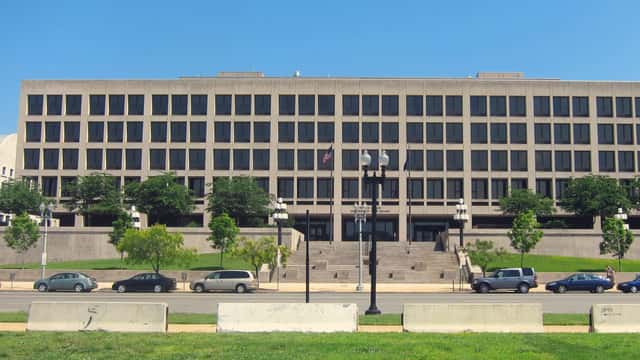
Lead photo: AgnosticPreachersKid / Wikimedia Commons, CC BY-SA 3.0. May 2010 file photograph of Labor Department headquarters, cropped to 16:9. The cropped photograph retains that license.

Differing perspectives
How should wage pressure associated with H-1B hiring be addressed?
Each position is summarized as its supporters make it, with equal weight and in alphabetical order. A summary is not an endorsement; the evidence for each is weighed in the story above.
Match wages to experience
Who holds it: National Foundation for American Policy
Wage rules should reflect a job’s duties and the worker’s experience. A blanket local-median standard can price out recent international graduates, disrupt legitimate hiring and encourage firms to move work abroad instead of creating U.S. jobs.
In their words: NFAP, March 2025 wage brief ↗
Raise standards and worker power
Who holds it: Department for Professional Employees, AFL-CIO
Strengthen wage floors, recruitment rules and protection against displacement. Regular audits, safeguards against retaliation and greater freedom to change jobs can help ensure the program serves U.S. professionals and sponsored workers as well as employers.
In their words: DPE, 2026 reform proposals ↗
Weigh direct competition against broader gains
Who holds it: Economist Nicolas Morales
Workers competing directly with skilled immigrants may face wage pressure, while other workers and consumers benefit from firm growth, complementary jobs and lower prices. Restrictions should be evaluated for those broader effects and the risk of offshoring.
In their words: Richmond Fed economic brief, October 2025 ↗
Cite this article
567 Politics. “How companies use H-1B hiring to keep wages down.” 567politics. Published 2026-11-12. https://567politics.com/news/how-h1b-hiring-can-hold-down-wages-employer-power-evidence-november-2026
Wikipedia citation
{{cite news |title=How companies use H-1B hiring to keep wages down |url=https://567politics.com/news/how-h1b-hiring-can-hold-down-wages-employer-power-evidence-november-2026 |work=567politics |author=567 Politics |date=2026-11-12 |language=en}}CSL-JSON for reference managers
{
  "id": "https://567politics.com/news/how-h1b-hiring-can-hold-down-wages-employer-power-evidence-november-2026",
  "type": "article-newspaper",
  "title": "How companies use H-1B hiring to keep wages down",
  "URL": "https://567politics.com/news/how-h1b-hiring-can-hold-down-wages-employer-power-evidence-november-2026",
  "container-title": "567politics",
  "language": "en",
  "author": [
    {
      "literal": "567 Politics"
    }
  ],
  "issued": {
    "date-parts": [
      [
        2026,
        11,
        12
      ]
    ]
  }
}Citations identify this article and its publication date. Assess the reporting and its linked sources before using it as evidence.
Read this article as Markdown or JSON. Cite the original page and retain its sources, dates and qualifications.
Embed this article summary
Paste this HTML into your page. The summary stays linked to the full story and updates with it. No account required.
<iframe src="https://567politics.com/embed/news/how-h1b-hiring-can-hold-down-wages-employer-power-evidence-november-2026?theme=auto" title="How companies use H-1B hiring to keep wages down by 567politics" width="100%" height="440" style="border:0;max-width:100%" loading="lazy"></iframe>
<p style="font-size:14px">How companies use H-1B hiring to keep wages down by <a href="https://567politics.com/news/how-h1b-hiring-can-hold-down-wages-employer-power-evidence-november-2026" rel="nofollow">567politics</a></p>
<script async src="https://567politics.com/embed.js"></script>
READ BEYOND 567POLITICS
Alternate sources & perspectives
Independent coverage and primary evidence to help you compare arguments. A link is not an endorsement; perspective labels describe the linked material.
- left argument
H-1B wage-level analysis, fiscal 2019 ↗
Economic Policy Institute
Historical certification data and the argument for higher wage floors; not actual payroll data.
- independent analysis
Economic effects during the 1994–2001 IT boom ↗
John Bound, Gaurav Khanna and Nicolas Morales
Model finds wage pressure on U.S. computer scientists alongside wider gains; not a current estimate.
- independent analysis
Firm outcomes from the H-1B lottery ↗
Federal Reserve Bank of Richmond
Study using 2007 lottery variation finds firm expansion without net firm-level displacement of native college graduates.
- other perspective
Experience and wage requirements ↗
National Foundation for American Policy
Argues that blanket median wage requirements can harm recent graduates and legitimate hiring.
- left argument
Union proposals for worker safeguards ↗
Department for Professional Employees, AFL-CIO
Wage floors, audits, anti-retaliation protection and worker mobility.
- primary evidence
Required-wage definitions ↗
U.S. Department of Labor
Distinguishes actual wage, prevailing wage and required wage.
- primary evidence
Voter views of employer wage practices and H-1B ↗
The Honest Poll
October 4–6, 2026 polling; charts use likely voters. Beliefs about employer motives are not measured wage effects.
- primary evidence
June 2026 approval of H-1B ↗
Rasmussen Reports
Likely-voter poll provides a separate check on program approval, not a directly comparable time trend.
Reviewed 2026-11-12. Original research and government guidance reviewed. The source-discovery service returned irrelevant candidates, so direct web research was used. NBER pages were blocked in the browser; the 2017 paper was verified on its author's site. Findings refer to their stated historical periods, not a current national wage estimate. No interviews were conducted. Updated with public-opinion charts and original polling methods; the Honest Poll toplines download was unavailable. Charts distinguish perceived employer motives from support for visas.