Israel's UTJ holds out as Shas, Religious Zionism and Otzma back Netanyahu before Herzog talks
Every party in Netanyahu's camp but United Torah Judaism will recommend him. Eisenkot says the PM has 46 backers; Netanyahu accuses rivals of courting the haredim.
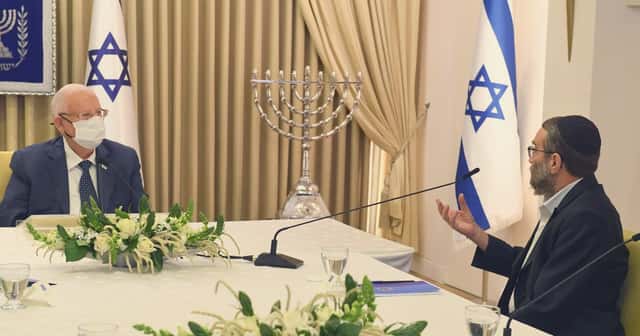
United Torah Judaism is now the only party in Prime Minister Benjamin Netanyahu's camp that has not said whom it will back to form Israel's next government. On Tuesday, Shas, Religious Zionism and Otzma Yehudit each said they would recommend Netanyahu when President Isaac Herzog begins his consultations on Wednesday. The ultra-Orthodox United Torah Judaism (UTJ) party, which holds seven seats, is leaning toward recommending no one, a party source told Haaretz.
That choice matters because neither camp has a majority on its own. Netanyahu's bloc won 53 of the Knesset's 120 seats and the opposition bloc led by Gadi Eisenkot won 48, according to the final count covered earlier by 567politics. The two Arab-led parties won 19. A government needs the support of 61 lawmakers.
Eisenkot said on Tuesday that Netanyahu now has the backing of only 46 lawmakers, Haaretz reported. It was the first time he had counted UTJ out of Netanyahu's bloc. Netanyahu, for his part, accused the opposition of hypocrisy. He said it was now courting the ultra-Orthodox parties after years of attacking them over military service.
Who has said what
Three parties in Netanyahu's camp made their decisions public on Tuesday.
Shas, which mainly represents Sephardi ultra-Orthodox voters, said its Council of Torah Sages had decided to recommend Netanyahu. According to Haaretz, the party cited his "clear and unequivocal commitment" to arrangements for the status of Torah students. Shas won six seats, down from 11 in the last Knesset.
In its statement, Shas also attacked the parties on the left. "The hypocrisy of the left-wing parties cries out to the heavens," the party said, as quoted by The Jerusalem Post. It accused those parties of a campaign of "vilification, defamation, and persecution" against the ultra-Orthodox and Torah students.
Religious Zionism said it would recommend Netanyahu as the head of the largest party and bloc. Haaretz reported that the party called for an end to "boycotts from the left" and for a "broad Jewish government" led by Netanyahu.
Otzma Yehudit, led by National Security Minister Itamar Ben-Gvir, also confirmed that it would recommend Netanyahu, according to Haaretz and the Jerusalem Post's live coverage. Otzma won seven seats.
On the other side, the five leaders of the opposition bloc agreed at a meeting in Herzliya on Tuesday that all of their parties would recommend Eisenkot. A separate 567politics report covered that meeting and the split over the Arab parties.
Where the numbers stand
The chart below shows the seats held by parties that have announced their choice and by those that have not. It uses the seat totals reported by Ynet and the opposition's announced backing for Eisenkot.
Source: Ynet seat totals, Haaretz, The Jerusalem Post
Show the numbers
| Group | Seats |
|---|---|
| Recommending Eisenkot | 48 |
| Recommending Netanyahu | 46 |
| Joint List and Ra'am | 19 |
| United Torah Judaism (undecided) | 7 |
The math is simple, but it leaves no easy path. Eisenkot's 48 plus UTJ's seven would come to 55. That is still six short of a majority, Ynet noted. Adding Shas would reach 61, but Shas has now recommended Netanyahu. Netanyahu's 46 plus UTJ would come to 53, eight short.
UTJ's choice
Netanyahu spoke on Tuesday morning with UTJ chairman Yaakov Asher, Haaretz reported. Even so, a party source told the paper that UTJ was still leaning toward making no recommendation to Herzog. The party is expected to reach a final decision on Wednesday, before its representatives meet the president.
The decision rests with the party's rabbis. Rabbis Dov Landau and Moshe Hillel Hirsch were expected to return from abroad around the time the consultations begin, according to The Jerusalem Post. The paper said UTJ may prefer not to recommend either candidate, so that it keeps as much room as possible for later talks.
A media adviser to Rabbi Landau's household, Avraham Grinzaig, declined on Sunday to commit the party to Netanyahu. "Whatever the rabbis decide, when it's relevant, that's what will happen," he said, according to Israel National News. He said Landau had not given a clear directive. He also warned that "in the upcoming weeks, there will be a lot of fake reports, nonsense, briefings, and stories."
The same report said Asher had met with fellow UTJ lawmakers Yitzhak Goldknopf and Meir Porush in Bnei Brak to coordinate the party's position. Entering the meeting, Porush said, "Gadi Eisenkot won't call us."
UTJ has hinted at a deal before. Last Thursday, a senior UTJ official told Ynet the party intended to offer to support a government led by Eisenkot if legislation granting draft exemptions were advanced. "We are offering him the premiership. That's better than being No. 2 or going to another election," the official said. No such deal has been announced.
Haredi sources described their position to the Jerusalem Post as a rare chance, because both blocs need them. "It is better for everyone to remain in suspense and uncertainty, and for each side to think that we have already reached an agreement with the other side," one source said. Another was more doubtful about a switch: "The chances that the rabbis will instruct us to join a government with the Left, headed by Eisenkot, are low."
Netanyahu's charge of hypocrisy
In a statement on Tuesday, Netanyahu accused Eisenkot, Naftali Bennett, Yair Lapid and Avigdor Liberman of courting the ultra-Orthodox parties, The Jerusalem Post reported. All four had opposed a draft law they said would give a blanket exemption.
"For four years, we saw unbridled attacks on the haredi sector, morning and evening, by the media and the left-wing bloc," he said. "Suddenly it is no longer an 'evasion law', but a 'soft draft law'; suddenly they are no longer 'parasites', 'draft dodgers', or 'destroyers of the state', but are given a clean slate, all for the left's lust for power."
He said Likud and the right-wing bloc were "the only ones who have acted and will act to regulate the status of Torah students." He also said his approach would make sure that "anyone who does not study Torah in a yeshiva will enlist in the IDF, enter as haredi and leave as haredi."
Separately, Likud accused the opposition of seeking to form a "dangerous government relying on terror supporters," according to the same report. Likud claimed that the Arab parties would not label Hamas and Hezbollah as terrorist groups. The Arab parties' responses to that claim were not part of the reports reviewed for this article.
Eisenkot's count and terms
Speaking after the opposition leaders met, Eisenkot said they were working toward a "national emergency government," Haaretz reported. He said they would also coordinate moves in parliament, including electing a new Knesset speaker and repealing laws he said threaten democracy. He predicted "false and ugly briefings" and attempts to undermine the result in the coming days.
The opposition leaders' joint statement called for "a Zionist government based on the four principles set out by Eisenkot," according to The Jerusalem Post. Those principles, which he set out on Saturday, include national service obligations and the need to remove Hamas's military and governing capabilities in Gaza.
The service principle is the main obstacle with the ultra-Orthodox parties. During the campaign, Eisenkot named mandatory military or national service as a condition for coalition partners, which conflicts directly with UTJ's demand for exemptions, Ynet reported.
Political sources told the Jerusalem Post that Eisenkot might still offer the ultra-Orthodox parties generous terms on the enlistment of yeshiva students, along with budget allocations. Eisenkot has not said so publicly.
Liberman's conditions
Liberman, whose Yisrael Beytenu party holds seven seats, has said he will recommend Eisenkot. He has ruled out both a government that depends on the Arab parties and a unity government with Netanyahu, The Jerusalem Post reported.
He has been more open toward the ultra-Orthodox parties. On Monday, he said he would "have no problem" with anyone who accepted his principles and supported a law requiring ultra-Orthodox men to enlist, according to the Post's report on the opposition meeting. His terms and UTJ's demand for exemptions point in opposite directions.
The Post also described a possible future dispute over a rotation for the premiership involving Liberman and Bennett. It stressed that this was a scenario, not a demand either man had made.
What Shas has signaled
Shas's recommendation of Netanyahu narrows Eisenkot's options. According to The Jerusalem Post, Shas leader Aryeh Deri has made clear that he does not want a return to the period when ultra-Orthodox parties sat in Yitzhak Rabin's government during the Oslo Accords. The party has continued to stress its commitment to the right.
An earlier 567politics report covered Netanyahu's call for a broad government and his direct appeal to Deri.
What comes next
Herzog's consultations begin on Wednesday at the President's Residence. By law, the president must consult the Knesset factions before choosing who gets the first chance to form a government. The Central Elections Committee said official results would be published on Wednesday, after an extra integrity review, Ynet reported.
The new Knesset is expected to be sworn in on November 10. Opposition leaders have said their first move would be to replace Speaker Amir Ohana, a Likud member, according to The Jerusalem Post.
The candidate Herzog chooses will initially have 28 days to form a coalition, with a possible 14-day extension, according to the Post's live coverage. If that fails, the process can reach a 21-day period in which a majority of 61 lawmakers can ask that another candidate be given the task, the Post reported. For the full timetable, see our explainer on the coalition talks.
Several outcomes remain possible:
- Eisenkot gets the first mandate and seeks a deal with UTJ, Shas or both.
- UTJ returns to Netanyahu's side, giving his bloc 53 seats, still short of a majority.
- Netanyahu and Eisenkot form a unity government. Likud sources told the Post that Netanyahu would agree to one, even if it was not his first choice.
- No one forms a government and Israel holds another election.
Some in Netanyahu's circle believe another election would not necessarily hurt him, the Post reported. The opposition leaders said in their joint statement that they aim to avoid one.
The dispute over the count itself is a separate story. Likud has alleged election interference, and the attorney general's office said on Tuesday that a joint Shin Bet and police team was continuing its probe. See our report on the certification dispute.
About this report
This report is based on statements by the parties and on reporting by Haaretz, The Jerusalem Post, Ynet and Israel National News, each opened in full. Seat totals follow Ynet's reported count, which Haaretz's tally of Netanyahu's 46 remaining backers matches. UTJ had not announced its decision at the time of writing. Read about how we report in our methodology, and compare the two countries' systems in Israel vs. the United States.
Differing perspectives
Whom should Israel's parties back to form the next government, and on what terms?
Each position is summarized as its supporters make it, with equal weight and in alphabetical order. A summary is not an endorsement; the evidence for each is weighed in the story above.
Back Eisenkot for a national emergency government
Who holds it: Yashar, B'Yachad, the Democrats, Yesh Atid's Yair Lapid
The opposition leaders say voters gave a clear mandate for change and against what they call the October 7 government. They want a Zionist government built on Eisenkot's four principles, including national service obligations, formed as quickly as possible to avoid another election, and they plan to put their Knesset majority to work.
In their words: The Jerusalem Post (joint statement of opposition leaders) ↗
Back Eisenkot, but no Arab-backed or Netanyahu government
Who holds it: Yisrael Beytenu leader Avigdor Liberman
Liberman is recommending Eisenkot for prime minister. He rules out a minority government that depends on Arab party support, even as a temporary administration before another election, and says he will not serve in a government with Netanyahu. His terms leave the ultra-Orthodox parties as the main route to a majority.
In their words: The Jerusalem Post ↗
Recommend Netanyahu and keep the right-wing bloc
Who holds it: Likud, Shas, Religious Zionism, Otzma Yehudit
Netanyahu says Likud and the right-wing bloc are the only ones who have acted to regulate the status of Torah students, by consensus with ultra-Orthodox leaders, while making sure those not studying in yeshivas enlist. He says opposition leaders who attacked the ultra-Orthodox for four years are now courting them out of a lust for power.
In their words: The Jerusalem Post (statements by Netanyahu and Shas) ↗
Wait for the rabbis before committing
Who holds it: United Torah Judaism
UTJ's representatives say no decision has been made and that the party's rabbinical leadership will make the final call. An aide to Rabbi Dov Landau says whatever the rabbis decide, when it is relevant, will happen, and warns that many reports about the party's choice in the coming weeks will be false.
In their words: Israel National News ↗
READ BEYOND 567POLITICS
Alternate sources & perspectives
Independent coverage and primary evidence to help you compare arguments. A link is not an endorsement; perspective labels describe the linked material.
- independent analysis
Israel election live updates, November 3 ↗
Haaretz
Shas, Religious Zionism and Otzma Yehudit recommendations; Netanyahu's call with UTJ chairman Asher; Eisenkot's count of 46 Netanyahu backers.
- right argument
Netanyahu accuses opposition of hypocrisy over haredim amid coalition talks ↗
The Jerusalem Post
Full text of Netanyahu's statement on the draft issue and Shas's statement recommending him.
- independent analysis
Eisenkot may get the mandate, but haredi parties hold the key ↗
The Jerusalem Post
Analysis of the haredi parties' leverage, Liberman's conditions and possible outcomes.
- other perspective
Eisenkot, opposition vow to form emergency government as soon as possible ↗
The Jerusalem Post
Joint statement of the opposition leaders and Liberman's terms for the ultra-Orthodox parties.
- other perspective
Rabbi Dov Lando's aide leaves door open to supporting Eisenkot ↗
Israel National News
UTJ's position in the words of Rabbi Landau's media adviser; internal party meeting.
- independent analysis
Netanyahu ally offers Eisenkot path to PM, demands Haredi draft exemption ↗
Ynet
UTJ official's earlier offer to Eisenkot and the near-final seat count.
- independent analysis
Israel Election 2026 live updates, November 3 ↗
The Jerusalem Post
Otzma Yehudit's recommendation, turnout and the coalition-formation timetable.
Reviewed 2026-11-03. Discovery search returned unrelated airline pages, so sources were chosen by hand and each was opened in full. Party statements were read as quoted by Haaretz and The Jerusalem Post; no party's own website statement was located. The Times of Israel live blog could not be opened from our tools. UTJ had not announced its decision at the time of review.