Spain's debates move to the TV Academy after the PP's RTVE veto. Dates and Podemos's seat are still open.
Sánchez and Feijóo will face off on a neutral signal any channel can air. Abascal's 4.8 million-viewer TVE interview drew fire from left and right alike.
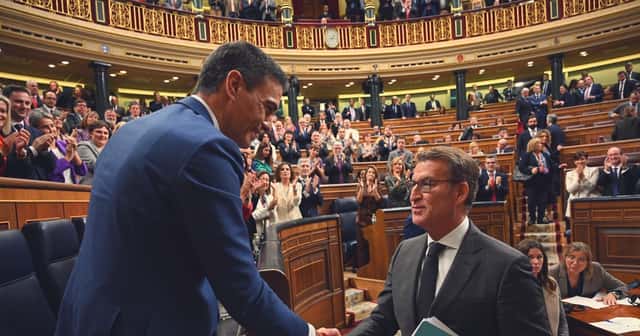
Spain's two main parties have agreed where their leaders will debate before the Nov. 29 general election, but not when. On Monday, Nov. 9, the Socialists (PSOE) and the People's Party (PP) accepted that the Academy of Television will host two debates. One will be a head-to-head between Prime Minister Pedro Sánchez and PP leader Alberto Núñez Feijóo. The other will add Santiago Abascal of Vox and Ada Colau of Frente Amplio. The deal ends a standoff over the PP's refusal to debate on public broadcaster RTVE. It leaves open two fights: the dates, and whether Podemos candidate Irene Montero gets a seat on stage.
The same night, a different broadcast showed what is at stake on public television. Abascal's interview on TVE's late-night show La Revuelta drew 4.8 million viewers, the program's most watched interview. It drew criticism from the government's partners and from the PP, for opposite reasons. Together, the two stories show how this campaign has become a fight over the referee as much as the match.
The Academy deal: a neutral signal any channel can carry#
Under the agreement, the Academy will produce a single "institutional signal" that any broadcaster can air live. That ends the question of which network "owns" the debate. The Academy's president, journalist María Casado, offered the same formula it used in 2008, 2011, 2015, 2016 and 2019. "The Academy of Television will once again produce and direct… an institutional signal of the debate that all interested media will be able to broadcast live," she said, as reported by elDiario.es via Europa Press. She called the Academy "always a meeting point and neutral space" for debate.
The deal came from the Socialists. RTVE reported that the PSOE first offered a split: one debate on RTVE and a second on Atresmedia or Mediaset, the two private groups. When the PP refused any debate run by the public broadcaster, the PSOE proposed the Academy for both. PP secretary general Miguel Tellado and PSOE organization secretary Rebeca Torró then told Casado they agreed.
Neither side gave up its underlying position. In a statement on Monday, the PSOE said: "Debating without exclusivity and without excluding any television channel, especially the public one, remains a non-negotiable principle," according to El Correo. The PP kept its objection to "a corporation whose president, senior management, managers and news chiefs are appointed by the prime minister," the paper reported.
Sánchez called the deal "good news." Speaking in an interview with the new channel La Séptima, he said, "What the PP was doing was vetoing public media." He denied that the PSOE had vetoed anyone. "It is the media who should demand that candidates debate," he added, as quoted by RTVE.
Why the PP would not debate on RTVE#
The PP's refusal dates to Friday, Nov. 6, when the party presented its campaign slogan. Party sources told elDiario.es that they wanted both debates on "private television" because, "unlike the public one, they are capable of guaranteeing neutrality." "We do not trust RTVE to moderate a debate," the same sources said. The party did leave some doors open. It said Feijóo could be interviewed on RTVE if in-house staff produced and ran the program. It also accepted an RTVE debate among parliamentary spokespeople.
The PP had backed proposals from Atresmedia and Mediaset, which it said had formally asked for debates soon after the snap election was called. PP sources told RTVE that Torró had been "inflexible" against the private networks. So the PP accepted the Academy on the condition that party campaign teams help design the format.
Dates, and who gets a podium#
The parties have not agreed dates. The PP wants to keep Nov. 16 for the Sánchez–Feijóo debate, the date Mediaset had planned. It wants the four-way debate on Nov. 26, three days before the vote, El Correo reported. Atresmedia had offered a four-way debate on Monday, Nov. 23. The campaign formally begins on Friday, Nov. 13. Casado said the Academy would host one debate or several "if they are agreed by consensus."
The guest list is the harder question. Frente Amplio, the left-wing platform led by Colau, said it would take part in "all" the debates. It still prefers RTVE for the four-way debate, but it accepted the Academy "if that helps move toward a consensus" that includes the four parties involved, RTVE reported. It called it "essential" that televised debates include "the four candidacies running across the whole country."
Podemos wants a fifth podium. Party leader Ione Belarra wrote on X that the Academy is "the most authoritative institution to organize the national election debate." She added: "Unlike Atresmedia, which was vetoing the participation of the republican alliance of Irene and Gabriel, we hope that respect for democratic pluralism prevails here." Gabriel Rufián is the spokesperson and candidate of ERC, the Catalan republican party. The PP, for its part, said Torró had "not been in favor" of including Podemos. It argued that Podemos "can be as much an heir of Sumar as Frente Amplio," according to RTVE.
The spectrum chart below places the parties competing for those podiums. Positions are dated editorial estimates, not measured scores.
The audience the debates are chasing#
Debate audiences in Spain have fallen sharply since 2008. According to Barlovento Comunicación data compiled by Business Insider España, the 2008 Zapatero–Rajoy debate drew 13 million viewers. It remains the most watched in that ranking. The 2011 debate drew 12 million. By November 2019, a five-way debate drew 8.6 million.
The only debate between Sánchez and Feijóo, on Atresmedia in July 2023, drew 5.91 million viewers. That was a 46.5% share, and El País called it the least watched debate on record. It aired in midsummer, when TV audiences are smaller. It was carried by one group rather than shared across channels, so the figures are not a like-for-like comparison.
Source: Business Insider España, Barlovento Comunicación data, El País (2023)
Show the numbers
| Debate | Viewers |
|---|---|
| Feb 2008: Zapatero vs Rajoy | 13M |
| Nov 2011: Rubalcaba vs Rajoy | 12M |
| Mar 2008: Zapatero vs Rajoy | 11.9M |
| Jun 2016: four-way | 10.4M |
| Dec 2015: Rajoy vs Sánchez | 9.7M |
| Dec 2015: four-way | 9.2M |
| Apr 2019: four-way | 8.8M |
| Nov 2019: five-way | 8.6M |
| Jul 2023: Sánchez vs Feijóo | 5.91M |
The figures help explain why a signal that every channel can carry appeals to the parties. A debate on several networks at once reaches more viewers than one on a single network.
Abascal on La Revuelta: a big audience and criticism from both sides#
On the same Monday night, Abascal sat down with host David Broncano on La Revuelta, TVE's late-night comedy show. The interview drew 4.8 million viewers, a 33.6% share, according to elDiario.es. That was three-tenths of a point below the record Sánchez set on RTVE, the outlet reported. Sánchez's interview on La Séptima drew more than 2 million viewers, a 14.2% share.
The show changed its studio audience for the Abascal interview, and Broncano later explained why, according to RTVE. Culture Minister Ernest Urtasun, number two on Frente Amplio's Barcelona list, called it "a serious moment" in an interview with RNE. He said viewers had seen "the far right in all its splendor" on public television. He also called it "absolutely unheard of" that Abascal brought "his own audience."
Health Minister Mónica García wrote on X that RTVE had "humanized" Abascal. She argued he would never extend the same treatment to trans people, migrants and others she said Vox dehumanizes. The Basque Nationalist Party's (PNV) spokesperson in the Basque Parliament, Joseba Díez Antxustegi, called it "terrible" that public television gave Abascal a platform.
Podemos aimed at the Socialists. Montero wrote on X that Abascal got "prime time" while Podemos was being kept "out of the debates." Belarra wrote that "Broncano would not have interviewed Abascal without the PSOE's approval." Rufián of ERC said Abascal had "eaten" the host. Broncano "tried" and "failed," he told Cadena SER, but he asked people not to "lynch" him.
The criticism from the right ran the other way. Madrid regional president Isabel Díaz Ayuso of the PP called the interview "a disgrace." She said its aim was to "feed the PP–Vox division" and then "demonize" Vox. She told Antena 3 that Feijóo should not appear on such programs, which she called "decoys and traps." Madrid Mayor José Luis Martínez-Almeida, also of the PP, defended Vox's appearance. He called it "an absolute outrage" for anyone to suggest that Spain's third-largest party should have no place on TVE. He also backed Feijóo's decision to stay off the public broadcaster for now.
Abascal told COPE radio that it had been more "a debate" than an interview. He said Broncano "had a hard time" because of "unacceptable pressure" from the governing left.
What the dispute shows about the campaign#
The fight over RTVE is part of a wider argument about public institutions in this campaign. The PP says the public broadcaster answers to Sánchez; the PSOE says the PP is boycotting public media. Both have accepted the Academy without settling that dispute.
The debates will also test positions already in play. Feijóo has said he would govern with Vox if he must, within stated red lines. The latest 40dB poll for El País and SER showed the PP and Vox with a combined majority while the PSOE closed to two points behind the PP. A four-way debate would put that possible coalition and its left-wing rivals on one stage.
The campaign opens as unions prepare Spain's first general strike since 2012 on Nov. 11. It also follows Óscar Puente's resignation as transport minister after the Urda train crash. Both are likely debate topics, once there is a date.
Research note#
This article draws on reporting by RTVE, elDiario.es, El Correo, Business Insider España and El País. Spanish quotations were translated for this article. The PP's position on RTVE comes from party sources quoted by elDiario.es and El Correo, not a named spokesperson. The Academy has not published formats or dates. Audience figures are average audiences from different measurement years and are not adjusted for season or the number of channels carrying each debate. Federal campaign-finance and dataset tools on this site cover only the United States and do not apply to this story.
Differing perspectives
Who should host Spain's 2026 general election debates, and which candidates should take part?
Each position is summarized as its supporters make it, with equal weight and in alphabetical order. A summary is not an endorsement; the evidence for each is weighed in the story above.
Give Irene Montero a podium
Who holds it: Podemos, led by Ione Belarra, with candidate Irene Montero
The Academy is the most authoritative body to organize the national debate, but it must respect democratic pluralism. Podemos says Atresmedia was excluding its alliance with ERC. It argues that Sánchez gives Vox visibility on public television while keeping Podemos out of the debates, and that Montero should appear alongside the PP, PSOE, Vox and Frente Amplio candidates.
In their words: RTVE (quoting Ione Belarra and Irene Montero) ↗
Include all four nationwide candidacies
Who holds it: Frente Amplio, led by Ada Colau
Televised debates must include the four candidacies running across the whole country, in a format that reflects the plurality of the current parliament. Frente Amplio prefers RTVE for the four-way debate but accepts the Academy if that helps reach a consensus. It has said its candidate will take part in every debate she is invited to.
In their words: RTVE (quoting Frente Amplio's statement) ↗
Keep the debates away from RTVE
Who holds it: People's Party (PP) leadership, backed by Isabel Díaz Ayuso and José Luis Martínez-Almeida
RTVE's president, managers and news chiefs are appointed by the prime minister, so the public broadcaster cannot be trusted to moderate a debate involving him. Private networks can guarantee neutrality and had formally requested debates early. The PP accepts the Academy as long as campaign teams help design the format, and it wants the head-to-head on Nov. 16.
In their words: elDiario.es (quoting PP sources) ↗
Share debates across public and private TV
Who holds it: Spanish Socialist Workers' Party (PSOE), Prime Minister Pedro Sánchez
Debates should be spread fairly between public and private broadcasters, and no channel should be shut out, least of all the public one. Faced with the PP's refusal to appear on RTVE, the Academy of Television offers a neutral signal that every outlet can carry freely. The PSOE says it has vetoed no one and that the PP's stance amounts to a veto of public media.
In their words: El Correo (quoting the PSOE statement) ↗
Cite this article
567 Politics staff. “Spain's debates move to the TV Academy after the PP's RTVE veto. Dates and Podemos's seat are still open..” 567politics. Published 2026-11-10. https://567politics.com/news/spain-election-debates-academia-television-rtve-veto-abascal-la-revuelta-november-2026
Wikipedia citation
{{cite news |title=Spain's debates move to the TV Academy after the PP's RTVE veto. Dates and Podemos's seat are still open. |url=https://567politics.com/news/spain-election-debates-academia-television-rtve-veto-abascal-la-revuelta-november-2026 |work=567politics |author=567 Politics staff |date=2026-11-10 |language=en}}CSL-JSON for reference managers
{
  "id": "https://567politics.com/news/spain-election-debates-academia-television-rtve-veto-abascal-la-revuelta-november-2026",
  "type": "article-newspaper",
  "title": "Spain's debates move to the TV Academy after the PP's RTVE veto. Dates and Podemos's seat are still open.",
  "URL": "https://567politics.com/news/spain-election-debates-academia-television-rtve-veto-abascal-la-revuelta-november-2026",
  "container-title": "567politics",
  "language": "en",
  "author": [
    {
      "literal": "567 Politics staff"
    }
  ],
  "issued": {
    "date-parts": [
      [
        2026,
        11,
        10
      ]
    ]
  }
}Citations identify this article and its publication date. Assess the reporting and its linked sources before using it as evidence.
Read this article as Markdown or JSON. Cite the original page and retain its sources, dates and qualifications.
Embed this article summary
Paste this HTML into your page. The summary stays linked to the full story and updates with it. No account required.
<iframe src="https://567politics.com/embed/news/spain-election-debates-academia-television-rtve-veto-abascal-la-revuelta-november-2026?theme=auto" title="Spain's debates move to the TV Academy after the PP's RTVE veto. Dates and Podemos's seat are still open. by 567politics" width="100%" height="440" style="border:0;max-width:100%" loading="lazy"></iframe>
<p style="font-size:14px">Spain's debates move to the TV Academy after the PP's RTVE veto. Dates and Podemos's seat are still open. by <a href="https://567politics.com/news/spain-election-debates-academia-television-rtve-veto-abascal-la-revuelta-november-2026" rel="nofollow">567politics</a></p>
<script async src="https://567politics.com/embed.js"></script>
READ BEYOND 567POLITICS
Alternate sources & perspectives
Independent coverage and primary evidence to help you compare arguments. A link is not an endorsement; perspective labels describe the linked material.
- independent analysis
PSOE y PP acuerdan celebrar los debates electorales en la Academia de Televisión ↗
RTVE
How the deal was reached, with statements from Frente Amplio, Podemos and Sánchez. RTVE is itself a party to the dispute.
- independent analysis
PSOE y PP pactan que la Academia de Televisión organice los debates electorales a dos y a cuatro ↗
El Correo
Quotes the PSOE statement and the PP's objection to RTVE's leadership; gives the PP's proposed dates of Nov. 16 and Nov. 26.
- independent analysis
La Academia de TV acepta organizar los debates electorales del 29N ante el veto de Feijóo a RTVE ↗
elDiario.es
María Casado's statement on the institutional signal and the broadcasters' competing date proposals.
- right argument
El PP mantiene su veto a un debate electoral con Feijóo en RTVE (live blog, Nov. 6) ↗
elDiario.es
The PP's stated case: private networks can guarantee neutrality and 'we do not trust RTVE to moderate a debate.'
- independent analysis
La entrevista de Abascal en 'La revuelta' provoca las críticas del PP y los socios del Gobierno ↗
RTVE
Reactions from Urtasun, Mónica García, the PNV, Podemos, Rufián, Ayuso, Almeida and Abascal himself.
- independent analysis
El ranking de los últimos debates electorales expone el hartazgo de los votantes ↗
Business Insider España
Average audience of every televised general-election debate from 1993 to November 2019, using Barlovento Comunicación data.
- independent analysis
El debate Sánchez-Feijóo domina la noche televisiva pero fue el menos visto de la historia ↗
El País
Audience of the July 2023 Atresmedia debate: 5.91 million viewers, a 46.5% share.
Reviewed 2026-11-10. Hand-picked from pages opened on Nov. 10, 2026; discover_politics_sources returned only general pages about Spain. The Academy of Television's statement, the PSOE note and Frente Amplio's statement are known only through the press reports listed; no original release from the Academy or the parties was located. The PP's RTVE position comes from unnamed party sources. Left-wing arguments (Frente Amplio, Podemos, government ministers) and right-wing arguments (PP leaders) are both carried in the RTVE reports rather than in separate opinion pieces. Audience figures come from Barlovento Comunicación via Business Insider España (2019) and from El País (2023).