Greenwald announces Flávio Bolsonaro interview on his departure from Brazil and money questions
The Miami recording is due November 6. Greenwald says it covers foreign assistance, financial investigations and Moraes. Here is the public record behind it.
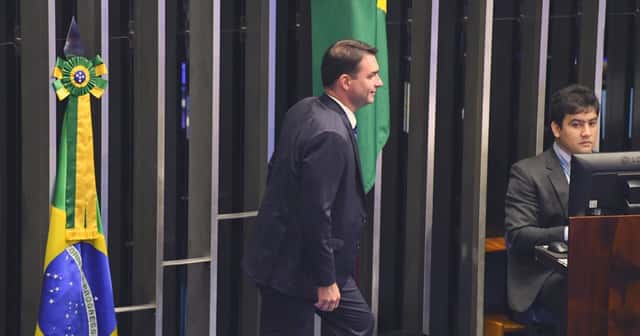
Glenn Greenwald says he has interviewed Flávio Bolsonaro in Miami about the defeated Brazilian presidential candidate’s departure from his country, possible foreign assistance and the financial investigations surrounding him.
In a November 5 post on X, Greenwald said the conversation would be released the following day through Folha de S.Paulo, with English-subtitled versions on his Substack and YouTube. His list of subjects included banker Daniel Vorcaro, corruption investigations and Supreme Federal Court Justice Alexandre de Moraes.
The announcement gives Bolsonaro another platform to explain himself after losing Brazil’s October 25 presidential runoff and arriving in the United States. It also puts several testable questions on the table: who helped him travel, what the money under investigation was for, and what evidence supports his challenge to the election.
Greenwald’s post is an announcement of a recorded interview. It does not provide Bolsonaro’s answers. This article therefore examines the public record behind the promised subjects, rather than attributing statements to an interview that Greenwald says will appear on November 6.
A defeated candidate seeking an audience abroad#
Flávio Bolsonaro, the son of former president Jair Bolsonaro, represents Rio de Janeiro in Brazil’s Senate. The Senate’s official profile lists his term as running from 2019 to 2027. An earlier institutional biography records four terms in the state legislature before he entered the federal chamber.
He has an electoral record of his own as well as a famous family name. His presidential defeat does not erase the voters who supported him. Nor does that support give him the authority to declare himself the winner of an election he lost.
The Superior Electoral Court’s published account of the result gives President Luiz Inácio Lula da Silva 64,256,232 votes, or 51.79% of valid votes. Bolsonaro received 59,826,041, or 48.21%. The difference was 4,430,191 votes.
Our reports on the first round and the runoff result explain how the contest reached that point. The Miami interview concerns what Bolsonaro does with that defeat, and how he answers the separate questions about his conduct.
What he has already said about leaving Brazil#
In his October 28 letter, reproduced by Congresso em Foco, Bolsonaro denied that he had fled Brazil and portrayed his departure as an escape from political persecution. He thanked Donald Trump and Javier Milei, challenged the election and said he intended to lead the opposition from abroad.
That is his stated political explanation. It does not independently establish that the investigations are politically directed or that the vote was fraudulent. It does identify the account against which his subsequent statements can be compared.
A separate interview has already produced another version of his travel account. CNN Brasil reported on November 5, summarizing his interview with The New York Times, that he claimed to have planned the departure with his wife and denied receiving help from governments. CNN reported that he declined to reveal the operational details. Those statements come from CNN’s account of the Times interview, not from Greenwald’s unreleased recording.
There is a clear distinction between saying why he left and explaining how he did it. A claim of fear addresses motive. Travel documents, bookings, payments and communications could help establish the arrangements. One account does not settle the other.
Foreign assistance: identify the actor and the action#
The question of outside help is especially sensitive because it concerns both private political allies and governments.
AFP’s reporting carried by the Buenos Aires Times quoted U.S. Secretary of State Marco Rubio saying on October 31 that the U.S. government had not been directly involved in Bolsonaro’s arrangements to leave Brazil. Rubio said Trump had decided to allow him to enter the United States.
The same report described U.S. media accounts linking Trump adviser Jason Miller to the charter aircraft. It also reported the airline head’s statement that an intermediary had paid through a U.S. bank account. Those are attributed reports about the arrangements, not a finding by this article that a government organized the departure.
This distinction is central to assessing any new answer. Assistance from an individual would be different from assistance directed by a state. Permission to enter a country is also different from organizing travel out of another one.
A useful explanation would name the relevant people, identify what each did and give a timeline. It would also distinguish what Bolsonaro personally arranged from what others may have arranged for him. Broad claims that he had either “no help” or “government help” need that level of detail to be assessed fairly.
Vorcaro: the financing questions have a specific subject#
Greenwald’s reference to Vorcaro concerns an existing controversy over financing for “Dark Horse,” a film about Jair Bolsonaro.
The Associated Press reported in May that Flávio Bolsonaro denied wrongdoing after reports that he had asked the banker for money for the production. The subject is therefore not simply whether the two men knew one another. It concerns the purpose and handling of financial support.
In September reporting on police and prosecutor documents, Folha said investigators identified Flávio as a direct participant in discussions with Vorcaro about funding the film. The newspaper also reported that investigators described Eduardo Bolsonaro as managing money raised for the production. These are reported investigative allegations, not convictions.
Any account of the case needs to separate what documents show from what investigators infer. It also needs to include the response of the people concerned. Asking for private financing is not, by itself, proof of a crime. A finding of unlawful conduct would depend on the source, purpose, handling and legal treatment of the transactions.
The film-financing issue should also remain distinct from campaign donations. A payment connected to a film cannot automatically be counted as money given to a presidential campaign. This article does not establish a campaign-finance total from the reported transactions.
The dispute over Moraes does not answer the financial case#
Moraes is another subject Greenwald says he addressed. Bolsonaro’s criticism of the justice is part of his wider claim that Brazil’s judicial system is being used against him.
CNN Brasil’s November 5 report described investigations involving the film and suspected financial wrongdoing. It also reported that Bolsonaro had not been formally accused of a crime in the proceedings discussed. His position must be described with that distinction intact: investigation is not conviction.
Our earlier account of his departure covers the passport order and the events surrounding his exit. The follow-up on his first week in Florida examines his response and the political fallout.
Criticism of a judge can raise legitimate questions about procedure. It does not, on its own, refute evidence in a financial inquiry. Equally, the existence of an inquiry does not prove that every procedural decision was justified. Those questions should be examined separately, with the relevant decisions and responses attached.
The election challenge has a numerical test#
Bolsonaro’s objections include the extension of voting hours on runoff day. That decision can be checked against the courts’ own accounts.
The Supreme Federal Court said Justice Cristiano Zanin extended voting until 7 p.m. in places where voting machines had remained open after the usual 5 p.m. closing time. Its account cited transport problems raised by both presidential campaigns.
The electoral court subsequently reported 34,393 votes recorded after 5 p.m.. That is less than 1% of Lula’s winning margin. Even assigning every one of those votes to Lula would not account for the gap.
This comparison addresses the recorded late votes. It cannot measure every person who may have been deterred by transport failures. Nor does it decide a separate allegation about campaign conduct. It does show why the existence of a late extension is insufficient, by itself, to demonstrate that the wrong candidate won.
The burden of explaining a different result rests on evidence connecting a claimed irregularity to the outcome. An assertion that the count was impossible is not that evidence.
His own party has drawn a different conclusion#
The political divide is not simply between Bolsonaro’s supporters and Lula’s.
CNN Brasil reported on October 29 that Liberal Party president Valdemar Costa Neto said the party had not approved Bolsonaro’s letter. The party recognized the result proclaimed by the electoral court. Valdemar said the priority was to move the party forward.
That leaves Bolsonaro with two audiences. He can try to retain loyal supporters through his account of persecution. He also needs to explain why political allies who backed his candidacy should follow his challenge rather than accept the result and continue opposition through Brazil’s institutions.
An interview can help him present that case. It cannot replace the evidence needed to sustain it.
What the recording may add#
In a reply on X, Greenwald emphasized what a video interview can convey beyond a written account:
The recording may let viewers examine complete answers and follow-up questions. Its value will depend on what Bolsonaro says, what is challenged and what can be checked against documents.
For now, the new fact is that Greenwald says the interview has taken place and is scheduled for release on November 6. The election totals are public. Bolsonaro’s denials and political claims are public. The promised conversation offers another opportunity to test those claims against the record.
Reporting note: This article was prepared on November 5 from the announcement and the linked sources. It does not claim to have reviewed Greenwald’s full interview. Summaries of Portuguese sources are 567politics translations.
Differing perspectives
How should Bolsonaro’s political allies respond to his rejection of the runoff result?
Each position is summarized as its supporters make it, with equal weight and in alphabetical order. A summary is not an endorsement; the evidence for each is weighed in the story above.
Accept the proclaimed result and rebuild opposition
Who holds it: Liberal Party president Valdemar Costa Neto
The PL leadership recognizes the result proclaimed by the electoral court and wants to move the party forward. Valdemar said the party had not approved Bolsonaro’s letter or departure, while expressing understanding of his difficult situation. This approach keeps the party engaged in ordinary political opposition rather than adopting his claim to the presidency.
In their words: Valdemar Costa Neto’s remarks reported by CNN Brasil, October 29 ↗
Continue challenging the election and courts
Who holds it: Flávio Bolsonaro
Bolsonaro argues that the voting extension and alleged campaign abuses undermined the election. He portrays the judicial response as persecution and says he intends to lead the opposition from abroad. His position is that accepting the proclaimed result would leave serious grievances unaddressed and that supporters should continue seeking remedies.
In their words: Bolsonaro’s October 28 letter, reproduced by Congresso em Foco ↗
Cite this article
567 Politics staff. “Greenwald announces Flávio Bolsonaro interview on his departure from Brazil and money questions.” 567politics. Published 2026-11-05. https://567politics.com/news/flavio-bolsonaro-glenn-greenwald-miami-interview-brazil-departure-vorcaro-november-2026
Wikipedia citation
{{cite news |title=Greenwald announces Flávio Bolsonaro interview on his departure from Brazil and money questions |url=https://567politics.com/news/flavio-bolsonaro-glenn-greenwald-miami-interview-brazil-departure-vorcaro-november-2026 |work=567politics |author=567 Politics staff |date=2026-11-05 |language=en}}CSL-JSON for reference managers
{
  "id": "https://567politics.com/news/flavio-bolsonaro-glenn-greenwald-miami-interview-brazil-departure-vorcaro-november-2026",
  "type": "article-newspaper",
  "title": "Greenwald announces Flávio Bolsonaro interview on his departure from Brazil and money questions",
  "URL": "https://567politics.com/news/flavio-bolsonaro-glenn-greenwald-miami-interview-brazil-departure-vorcaro-november-2026",
  "container-title": "567politics",
  "language": "en",
  "author": [
    {
      "literal": "567 Politics staff"
    }
  ],
  "issued": {
    "date-parts": [
      [
        2026,
        11,
        5
      ]
    ]
  }
}Citations identify this article and its publication date. Assess the reporting and its linked sources before using it as evidence.
READ BEYOND 567POLITICS
Alternate sources & perspectives
Independent coverage and primary evidence to help you compare arguments. A link is not an endorsement; perspective labels describe the linked material.
- primary evidence
Greenwald announces Miami interview ↗
Glenn Greenwald on X
Read on X, November 5; announces release November 6, not a transcript of the interview.
- primary evidence
Greenwald replies about video format ↗
Glenn Greenwald on X
Read as a reply in the original conversation; embedded as context for format.
- primary evidence
Senator Flávio Bolsonaro official profile ↗
Brazilian Federal Senate
Term and office verified against official institutional record.
- primary evidence
TSE account of the runoff result ↗
Superior Electoral Court of Brazil
Official vote totals; winning margin calculated by subtraction.
- primary evidence
Full October 28 letter ↗
Congresso em Foco, reproducing Flávio Bolsonaro
His own explanation, persecution allegations and stated opposition strategy; allegations not adopted as fact.
- independent analysis
November 5 account of New York Times interview ↗
CNN Brasil
CNN’s account of the Times interview, clearly attributed as secondary reporting rather than direct review of that interview.
- independent analysis
Rubio on U.S. involvement ↗
AFP / Buenos Aires Times
Rubio’s denial of direct government involvement and attributed reports about private flight assistance are distinguished.
- independent analysis
Police findings reported on Dark Horse financing ↗
Folha de S.Paulo
Accessible headline and introduction report on investigative documents. Article does not claim direct examination of the underlying case file or establish guilt.
- independent analysis
Bolsonaro denies wrongdoing over banker financing ↗
Associated Press
May reporting supplies denial; investigative allegations kept distinct from convictions and campaign donations.
- primary evidence
Voting extension ruling and explanation ↗
Supreme Federal Court of Brazil
Court explanation of eligible still-open polling places and transport issues raised by both campaigns.
- primary evidence
TSE count of votes recorded after 5 p.m. ↗
Superior Electoral Court of Brazil
34,393 late votes; comparison with 4,430,191-vote margin is original arithmetic and does not purport to count deterred voters.
- other perspective
Valdemar distances party from letter and departure ↗
CNN Brasil
Directly reported PL leader remarks, recognizing result and prioritizing ordinary opposition.
Reviewed 2026-11-05. Reviewed November 5, 2026 against Greenwald’s announcement, official electoral and court records, Bolsonaro’s letter and reporting from CNN Brasil, AFP, Folha and AP. The full Greenwald interview had not been released when this article was prepared. Film financing is distinguished from campaign donations. Portuguese summaries are translated by 567politics. No direct outreach was conducted.