H-1B extensions could face more scrutiny. DHS’s own analysis does not predict more denials
A real proposal would end required deference to earlier approvals, but comments remain open through November 13 and no final rule is in force.
A proposal to remove deference to earlier immigration approvals is real, and it could make work-visa extensions more burdensome. But the claim that H-1B extensions will become significantly harder needs a distinction: DHS predicts more evidence requests, while its historical analysis found no corresponding increase in denial rates. The proposal is not a final rule. Comments are due before midnight Eastern time at the end of November 13, 2026. DHS proposal, October 14.
The X account Expose H1B Fraud, @JobsNowPaper, posted the claim on November 12 at 7:01 p.m. Eastern. It described tighter scrutiny and curbing abuse as the objective, then urged comments before November 13. The substance tracks the proposal’s stated purpose, but the deadline includes November 13 itself. The promise of harder extensions is a forecast, not an observed result.
The immediate question is whether a previously approved, materially unchanged case should start with a presumption that the earlier eligibility decision remains sound. DHS wants to remove that starting point. Immigration-law advocates say the existing exceptions already allow officials to investigate problems without routinely reopening settled questions.
What would change—and what would stay#
DHS proposes deleting 8 CFR 214.1(c)(5). That provision generally gives weight to an earlier eligibility determination when a Form I-129 request involves the same parties and underlying facts. It already permits a different decision when the earlier approval contained a material error, circumstances or eligibility rules materially changed, or new adverse information emerged. Proposal, sections II and III.
That is not automatic renewal. Petitioners still have to provide required evidence and establish eligibility. An earlier approval does not compel approval of a later request that fails the requirements. The dispute concerns how officers approach previously decided questions, rather than whether employers must support their filings.
The proposed deletion would remove mandatory deference, but it would not forbid an officer from considering an earlier approval where relevant. Describing the change as erasing all previous approvals would therefore go beyond the text. DHS also says the proposal does not substantively change eligibility for the immigration benefit. Proposal, sections III and III.E.
Although the post focuses on H-1B, the proposal covers Form I-129 benefit requests more broadly. The form serves several temporary-worker classifications, including L-1 and O-1. This is not a rule directed at one nationality, and the document does not establish misconduct by workers merely because they seek extensions. Proposal, sections II.C and III.
| Question | Current framework | Proposed change |
|---|---|---|
| Earlier eligibility decision | Deference with exceptions | No required deference |
| Evidence of current eligibility | Still required | Still required |
| Earlier approval as relevant evidence | May be considered | May still be considered |
| Status of this change | Existing regulation applies | Notice of proposed rulemaking |
The table summarizes the October 14 notice; it does not predict a decision in any individual case.
The policy has changed several times. USCIS introduced deference guidance in 2004, rescinded it in 2017 and restored it in 2021. DHS placed the policy into regulation in its December 2024 modernization rule. The present proposal would reverse that regulatory choice. DHS’s policy history, section II.D.
- USCIS introduces deference guidance
- USCIS rescinds the guidance
- USCIS restores deference policy
- DHS publishes the rule codifying deference
- DHS publishes the proposed removal
- Public-comment deadline, before midnight Eastern at the end of the day
This question belongs to the debate over lawful admissions and continued status, rather than border crossings. The 567politics legal-immigration issue guide separates those policy choices. Our coverage of the H-1B fee dispute concerns a separate restriction; a fee and an evidentiary review rule operate differently.
More paperwork is supported; more denials are not established#
DHS estimates that removing deference could produce roughly 6,044 additional requests for evidence each year across the affected Form I-129 population. An evidence request asks the filer to supply more information before the agency decides. It is not itself a denial or a finding of fraud. Regulatory analysis, tables 2–4.
The estimate starts with an average of 208,429 affected petitions annually in fiscal 2022–2025. DHS applies an estimated 2.9-percentage-point increase in evidence-request rates. These are petitions, not a count of unique workers, and the estimate covers more than H-1B alone. Some amended cases are excluded because the agency says it cannot reliably separate them.
To estimate the policy effect, DHS compares changes in affected petitions with changes in a comparison group over earlier periods with and without deference. The affected group’s evidence-request rate rose from 18.9% to 23.4%; the comparison group’s rate rose from 31.4% to 33.0%. Subtracting those changes yields the 2.9-point estimate. Table 3 and methodology.
Source: DHS proposed rule, Table 3
Show the numbers
| Period | Affected petitions | Comparison petitions |
|---|---|---|
| With deference | 18.9% | 31.4% |
| Without deference | 23.4% | 33% |
DHS applied the same method to denial rates and found no corresponding change. Its regulatory analysis therefore does not project an effect on denial rates. That is a significant limit on reading the post as a prediction that substantially more people will lose their extensions. It does not prove that every future case will end as it would under the current rule. DHS analysis, section IV.A.
The government nevertheless expects delays and uncertainty. It reports a 64-day difference between petitions with and without evidence requests, using the average of annual median processing times for fiscal 2022–2025. That comparison is not a promise that every extension would take 64 extra days. It describes historical processing and is used to illustrate costs that DHS does not fully price. Unquantified costs, section IV.A.
The headline annual cost estimate of $133,987 is also narrow. It values the assumed extra work responding to additional evidence requests, using ten minutes per response. DHS separately acknowledges unquantified preparation costs, processing delays and uncertainty for employers and workers. Presenting that dollar figure as the proposal’s complete economic impact would omit those qualifications. Table 4 and accompanying analysis.
The disagreement is over whether added scrutiny improves decisions#
DHS argues that deference can discourage officers from fully examining a case. If an earlier decision was mistaken, assuming it was correct may help the mistake persist. The agency wants each filing evaluated on its own current evidence, with the petitioner clearly responsible for demonstrating eligibility. It frames that change as protecting program integrity and U.S. workers. DHS’s explanation, section III.
The department also cites higher combined fraud-or-noncompliance findings among sites visited in later years with deference. For H-1B extension sites, it reports 22.39% in fiscal 2022–2025, compared with 16.77% in fiscal 2018–2020. For L-1A, it reports 24.46% and 18.37%, respectively. Section III.C and notes 14–16.
| Sites visited for extension cases | FY 2018–2020 | FY 2022–2025 |
|---|---|---|
| H-1B: fraud and/or noncompliance | 16.77% | 22.39% |
| L-1A: fraud and/or noncompliance | 18.37% | 24.46% |
These are findings among administrative and targeted site visits, not a representative national fraud rate. They combine fraud with noncompliance. DHS acknowledges that other factors may have contributed. A higher finding rate in selected inspections cannot, by itself, establish that deference caused more fraud.
That distinction follows the evidence standard in 567politics’ reporting on documented H-1B fraud: proven misconduct, enforcement totals and program-wide prevalence are different claims. Our analysis of employer power and H-1B wages likewise distinguishes wage-policy objections from violations. This proposal’s evidence does not measure a resulting wage gain for American workers.
The American Immigration Lawyers Association and American Immigration Council oppose removal in a joint comment dated November 11 and posted November 12. They argue that unchanged cases need predictable treatment and that existing exceptions preserve scrutiny. They point to DHS’s denial-rate finding as evidence that added paperwork would impose costs without demonstrating better outcomes. Joint comment.
Their alternative request is a longer comment period and more justification. Their central concern is reliance: employers and workers organize staffing and personal plans around consistent treatment of materially unchanged cases. Approval after a delay does not erase the disruption of waiting.
DHS answers that the absence of a denial-rate change does not measure the full value of fact-finding. Petitioners may answer evidence requests successfully; officers may reach the same result after a fuller review. That is a plausible explanation, but more evidence requests alone do not quantify improved accuracy. Conversely, stable aggregate denial rates cannot prove that every additional inquiry was unnecessary. Proposal, note 13.
The strongest supported conclusion is narrower than either certainty: the agency identifies a mechanism for greater scrutiny and estimates an added procedural burden. The record reviewed here does not establish how much fraud the change would prevent or how many otherwise approved extensions would ultimately be denied.
November 13 is a comment deadline, not an effective date#
The notice directs comments to Regulations.gov under docket USCIS-2026-0529. They may be submitted on November 13, before midnight Eastern at the end of that day. Emailing officials or mailing letters is not the submission method designated in the notice. Official submission instructions.
DHS asks commenters to identify the provision they address, explain the recommended change and supply supporting information. The notice also warns that submissions are generally public, including personal information voluntarily supplied. Participation does not require agreement with the agency or with the account that shared the proposal.
A comment deadline does not put a proposed change into force. Readers should distinguish this notice from any later final rule and its effective date. As reviewed on November 12, the cited document remains a proposal; the post is substantially accurate about its direction but too categorical about its eventual consequences.
Reporting note: Prepared with AI assistance from original public documents and linked research; no interviews were conducted. The original X post was verified directly. It is one selected post, not a representative measure of public opinion. The government-data connector has no relevant deference series, so the published DHS analysis was reviewed directly. AILA and Council arguments are advocacy positions. No individual immigration outcome is predicted.
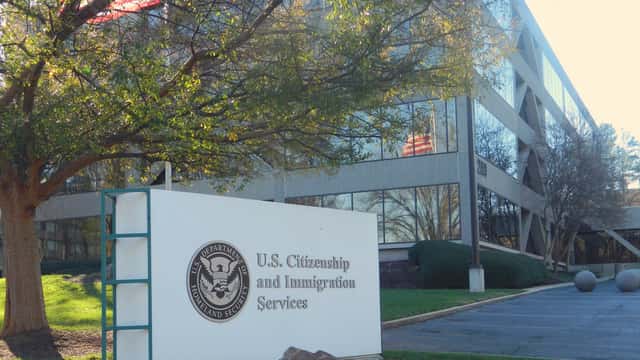
Lead photograph: USCIS office exterior in the Northlake area of DeKalb County, Georgia, December 30, 2012; a file image, not the site of a new event. Gulbenk / Wikimedia Commons, CC BY-SA 3.0, cropped to 16:9. The cropped photograph retains the same license.

Differing perspectives
Should USCIS remove required deference to earlier approvals in materially unchanged worker petitions?
Each position is summarized as its supporters make it, with equal weight and in alphabetical order. A summary is not an endorsement; the evidence for each is weighed in the story above.
Remove required deference
Who holds it: Department of Homeland Security and USCIS
DHS argues that each petition should receive a full review of current evidence without a required presumption favoring an earlier decision. It says deference can discourage questions, perpetuate mistakes and weaken fraud detection. The agency considers stronger fact-finding worthwhile even when petitioners ultimately establish eligibility and denial rates do not change.
In their words: DHS, October 14 proposed rule ↗
Retain deference with existing exceptions
Who holds it: American Immigration Lawyers Association and American Immigration Council
The organizations argue that existing exceptions already let officers address errors, changed circumstances and new adverse information. They say reopening unchanged cases adds expense, delays and uncertainty without a demonstrated improvement in outcomes. Consistent treatment supports employers’ staffing plans and workers’ lives while leaving the burden of proving eligibility with petitioners.
In their words: AILA and American Immigration Council, joint comment ↗
Cite this article
567 Politics. “H-1B extensions could face more scrutiny. DHS’s own analysis does not predict more denials.” 567politics. Published 2026-11-13. https://567politics.com/news/h1b-extensions-deference-proposal-fact-check-november-13-2026
Wikipedia citation
{{cite news |title=H-1B extensions could face more scrutiny. DHS’s own analysis does not predict more denials |url=https://567politics.com/news/h1b-extensions-deference-proposal-fact-check-november-13-2026 |work=567politics |author=567 Politics |date=2026-11-13 |language=en}}CSL-JSON for reference managers
{
  "id": "https://567politics.com/news/h1b-extensions-deference-proposal-fact-check-november-13-2026",
  "type": "article-newspaper",
  "title": "H-1B extensions could face more scrutiny. DHS’s own analysis does not predict more denials",
  "URL": "https://567politics.com/news/h1b-extensions-deference-proposal-fact-check-november-13-2026",
  "container-title": "567politics",
  "language": "en",
  "author": [
    {
      "literal": "567 Politics"
    }
  ],
  "issued": {
    "date-parts": [
      [
        2026,
        11,
        13
      ]
    ]
  }
}Citations identify this article and its publication date. Assess the reporting and its linked sources before using it as evidence.
Read this article as Markdown or JSON. Cite the original page and retain its sources, dates and qualifications.
Embed this article summary
Paste this HTML into your page. The summary stays linked to the full story and updates with it. No account required.
<iframe src="https://567politics.com/embed/news/h1b-extensions-deference-proposal-fact-check-november-13-2026?theme=auto" title="H-1B extensions could face more scrutiny. DHS’s own analysis does not predict more denials by 567politics" width="100%" height="440" style="border:0;max-width:100%" loading="lazy"></iframe>
<p style="font-size:14px">H-1B extensions could face more scrutiny. DHS’s own analysis does not predict more denials by <a href="https://567politics.com/news/h1b-extensions-deference-proposal-fact-check-november-13-2026" rel="nofollow">567politics</a></p>
<script async src="https://567politics.com/embed.js"></script>
READ BEYOND 567POLITICS
Alternate sources & perspectives
Independent coverage and primary evidence to help you compare arguments. A link is not an endorsement; perspective labels describe the linked material.
- primary evidence
Removing Deference to Prior USCIS Determinations of Eligibility ↗
DHS / Federal Register via Government Publishing Office
Original proposal, deadline, current exceptions, historical comparisons and estimated costs; establishes what DHS proposes, not proven future effects.
- other perspective
Joint comment opposing the end of deference ↗
American Immigration Lawyers Association and American Immigration Council
Opposition filing dated November 11, posted November 12; argues for retaining existing exceptions and predictable treatment.
- independent analysis
DHS proposal explained for nonimmigrant worker extensions ↗
EY
October 15 professional explanation confirming Form I-129 scope and the comment deadline; secondary context, not separate evidence of outcomes.
Reviewed 2026-11-12. The required source-discovery search returned generic USCIS pages rather than useful story-specific results. Focused research verified the original Federal Register proposal, the AILA/Council joint filing and an EY explanation. USCIS's live policy-manual page returned 403; the regulation and policy history were checked in the published proposal. The original X post was inspected directly. No representative opinion survey on this proposal was located or used. These sources describe agency reasoning, organized opposition and professional analysis, not a representative sample of workers.