Ninth Circuit votes 6-5 on Election Day to let DOJ resume ballot demands and prosecution warnings
An 11-judge court reinstated a stay of Judge Thompson's order after polls opened, the third conflicting ruling in about 12 hours. Five judges dissented.
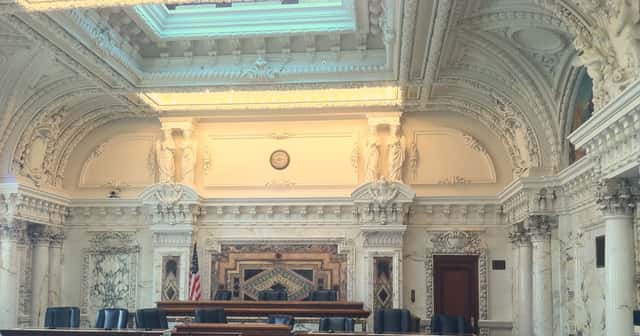
The U.S. Court of Appeals for the Ninth Circuit voted 6-5 on Tuesday morning, Nov. 3, to let the Justice Department and the Department of Homeland Security go back to asking election officials to set aside ballots from people the government has flagged as possible noncitizens, and to warning them about federal prosecution. The vote came after the polls had opened on Election Day. It was the court's third conflicting order in the case in about half a day.
The unsigned order from an 11-judge en banc court reinstates a Nov. 2 ruling by a three-judge panel. That ruling paused a temporary restraining order issued on Oct. 30 by U.S. District Judge Trina L. Thompson in San Francisco. "A majority of the en banc court has voted to reinstate the three-judge panel's order filed on November 2, 2026," the order says. It stays in place "pending further order of the court."
Five judges dissented. Chief Judge Mary H. Murguia wrote that election officials now face two rulings from the same court that point in opposite directions.
This is a new turn in a case 567 Politics has followed closely. We covered Thompson's original order, the government's appeal, and the late-night en banc vote that briefly restored Thompson's order. This story covers what changed Tuesday and what it means as ballots are counted.
Twelve hours of orders
The case is Service Employees International Union v. U.S. Department of Justice, No. 26-7303. The plaintiffs are the Service Employees International Union, the American Federation of State, County and Municipal Employees, the League of United Latin American Citizens, and the NAACP. The defendants are the Justice Department, Attorney General Todd Blanche, Homeland Security, and Homeland Security Secretary Markwayne Mullin.
- Oct. 13Justice Department sends California and Los Angeles County a list of about 20,000 "likely noncitizens" with a 48-hour deadline
- Oct. 16Department letter warns county officials they "risk becoming aiders and abettors"
- Oct. 29Unions and civil rights groups sue in San Francisco
- Oct. 30Judge Thompson grants a restraining order; a separate Ninth Circuit panel rules for California in United States v. California
- Nov. 2Supreme Court denies the government's California application; Thompson denies a stay; a three-judge panel grants one, 2-1
- Nov. 2, 10:23 p.m. PacificFull court orders rehearing en banc and vacates the panel's stay
- Nov. 3, morningEn banc court votes 6-5 to reinstate the stay
Source: U.S. Court of Appeals for the Ninth Circuit, Courthouse News Service
Judge Mary Murguia's dissent lays out the background. On Oct. 13, the Justice Department sent letters to California and Los Angeles County demanding that officials review, within 48 hours, a list of about 20,000 registered voters that federal agencies had identified as "likely noncitizens." Both refused, citing doubts about the list's accuracy. Murguia wrote that those doubts "have been borne out and acknowledged by counsel for the government in this very case."
On Oct. 16, a department letter to Los Angeles County cited two federal laws: 18 U.S.C. 611, which makes noncitizen voting in federal races a crime, and 18 U.S.C. 2, which covers aiding and abetting. "If persons knowingly tabulate ballots cast by individuals identified by federal agencies as noncitizens, they risk becoming aiders and abettors to a federal crime," the letter said, according to the dissent. While that case was pending, the dissent says, the department used uniformed Homeland Security officers to deliver letters to county officials across California.
Thompson's order barred the departments from threatening, intimidating or coercing officials to stop processing those ballots, and from threatening prosecution if they did not comply. The appeals panel noted that it runs for "an initial period of seventeen days" and requires the government to notify every letter recipient and disclose pending subpoenas and warrant applications. On Monday, Thompson declined to pause her own order. "Defendants' conduct has left election workers with ongoing fear and concern about performing their ordinary duties," she wrote, according to Courthouse News Service.
At a hearing that day, Courthouse News reported, Thompson asked Assistant U.S. Attorney Kenneth Kao whether the list had "a high error rate." Kao answered, "I think that's a fair statement," and pointed to the department's attempts to work with California on verifying it.
What the reinstated panel ruling says
Judge Carlos T. Bea wrote the Nov. 2 panel ruling, joined by Judge Consuelo M. Callahan. Murguia dissented. The ruling is now back in force. It treats Thompson's order as a preliminary injunction that the appeals court can review, because it runs longer than the usual 14-day limit for restraining orders and requires the government to take action.
On the merits, the panel said Thompson was "likely wrong" on both of her legal grounds. Section 11(b) of the Voting Rights Act bars intimidating anyone for helping others vote, but it has no express private right to sue, the panel said, and the law leaves enforcement to the attorney general. The panel also said courts presume the word "person" in a statute does not include the federal government. It described what the departments did as "core Executive functions": they sent letters asking states to adopt the administration's preferred policy, warned them about federal law, and opened investigations.
On the Constitution's Elections Clause, the panel said the states' power over their elections was "unaffected" because California refused the request, the Ninth Circuit backed that refusal, and the Supreme Court declined to step in. The California case decided whether a state must sequester ballots, the panel wrote, while this one asks "only whether the Government can make such a request in the first place." Finally, it found that the government would suffer irreparable harm from being barred from asking, while the plaintiffs faced "at most" the possibility of a future prosecution that they could challenge if it came.
The concurrence
Judge Eric D. Miller, joined by Judge Daniel P. Bennett, wrote separately. He began by endorsing the other side's main precedent. "I fully agree with the decision in United States v. California," he wrote. "Under that decision, many of the positions taken by the federal government in its recent communications to state election officials may have little merit."
But he said a trial court "does not generally have the authority to enter an injunction prohibiting the Department of Justice from expressing its views about criminal statutes, even if the court determines that those views are incorrect." He agreed with the panel that the Voting Rights Act provision does not supply that authority.
Miller also answered the dissent's argument about timing. The Supreme Court's 2006 decision in Purcell v. Gonzalez warns lower courts against changing election rules close to an election. If Purcell did not stop "last night's order granting rehearing en banc and vacating the panel's stay," he wrote, "it is difficult to see how Purcell could bar this morning's order undoing that action."$
The dissents
Murguia, joined by Judges Ronald M. Gould, John B. Owens, Holly A. Thomas and Roopali H. Desai, said the court's two recent decisions "cannot be reconciled." Calling the government's letters mere requests, she wrote, "ignores the reality that these 'request[s]' are made on pain of prosecution."$
"As the en banc court majority reinstates the stay on the morning of Election Day," she wrote, "state and local election officials and workers must choose between complying with two conflicting opinions of our court: follow our decision in California and risk prosecution by the United States or accede to the Defendants' demands and risk violating state law."
She pointed to the Justice Department's own manual, which says the department should not take "overt criminal investigative measures . . . involving alleged ballot fraud" until an election is over. She concluded that if the government cannot dictate election procedures directly, it "likewise cannot dictate them by subjecting vulnerable election workers to baseless—but chilling—threats of federal prosecution."
Desai, writing for the same five judges, focused on the timing. "In the span of twelve hours in the middle of an ongoing election and on the literal eve of Election Day, our court issued three conflicting orders," she wrote. The majority, she said, took "the extraordinary step" of granting a stay "just after the polls open on Election Day." She argued that the court "could have—and should have—considered alternative approaches, including modifying or narrowing the scope of the district court's temporary restraining order."
The vote can be read from the order. Eleven judges were on the en banc court and five joined the dissents, leaving Judges Bea, Bennett, Miller, Kenneth K. Lee, Lawrence VanDyke and Eric Tung in the majority.
What the parties have said
The government's position is set out in its emergency stay motion, which said Thompson's order "improperly interferes with the government's efforts to stop unlawful voting by noncitizens and its investigations of potential criminal violations of federal voting laws." After the panel's Monday-night stay, First Assistant U.S. Attorney Bill Essayli wrote on X that "conducting criminal investigations is a core function of the executive branch, not the judiciary," Fox News reported. The same report quoted Acting Deputy Attorney General Trent McCotter: "We will continue pursuing every available legal avenue to protect the integrity of our elections and ensure federal law is enforced."
The plaintiffs argued in their opposition to the stay that the letters, agent visits and public statements amounted to a campaign to intimidate election workers. At Monday's hearing, their lawyer Danielle Leonard called the federal list "completely unreliable," according to Courthouse News. As of 7:15 p.m. Eastern on Tuesday, 567 Politics had not found a public statement from SEIU or the other plaintiffs on the en banc vote. When Thompson issued her order, SEIU's April Verrett called it "a victory for the workers who make our elections possible and the communities they serve."
What it means tonight
The practical effect is narrower than the back-and-forth suggests. California does not have to sequester the flagged ballots. The Ninth Circuit held on Oct. 30 in United States v. California that the federal government cannot force it to, and on Nov. 2 the Supreme Court denied the government's emergency application without any noted dissent. What Tuesday's order changes is whether federal officials may keep asking, and keep warning officials about prosecution, while that is the law.
Other orders also still constrain federal agencies. In Washington, U.S. District Judge Tanya Chutkan has barred Homeland Security and the Justice Department from sending more noncitizen voter lists to election officials. The Justice Department has also announced charges against 63 people it says committed election crimes, and it has monitors in 126 jurisdictions today.
The appeal itself is not over. The en banc order is an interim step that applies "pending further order of the court," and Thompson's restraining order, though stayed, has not been withdrawn. The case also continues in her courtroom, where a hearing had been set for Nov. 13. California's deadline for receiving mail ballots is Nov. 10, so the dispute over how officials handle the flagged ballots will continue through the count.
Differing perspectives
Should federal officials be free to ask election officials to set aside flagged ballots and warn them of prosecution while votes are counted?
Each position is summarized as its supporters make it, with equal weight and in alphabetical order. A summary is not an endorsement; the evidence for each is weighed in the story above.
Keep the restraining order in place until the count ends
Who holds it: Chief Judge Mary Murguia and Judges Gould, Owens, H.A. Thomas and Desai, dissenting
The dissenting judges say the court's ruling in United States v. California and Tuesday's order cannot be reconciled, because the federal requests come with the threat of prosecution. Election workers are left choosing between following state law and risking prosecution, or giving in and risking a violation of state law. They note the Justice Department's own manual discourages overt ballot-fraud investigations before an election ends, and say the court could have narrowed Thompson's order instead of lifting it after the polls opened.
In their words: U.S. Court of Appeals for the Ninth Circuit, en banc order and dissents ↗
Let federal officials request and investigate
Who holds it: U.S. Department of Justice, Department of Homeland Security and Attorney General Todd Blanche
The government says Thompson's order improperly interferes with its efforts to stop unlawful voting by noncitizens and to investigate possible federal crimes. It says Homeland Security compares immigration and voting records to identify likely ineligible voters, and that asking officials to pause or segregate those ballots is lawful. It argues the Voting Rights Act gives private groups no right to sue the government, that the Elections Clause does not limit prosecutors, and that warning officials about aiding illegal voting is ordinary law enforcement.
In their words: Government's emergency stay motion, Ninth Circuit ↗
Restore the order protecting election workers
Who holds it: SEIU, AFSCME, LULAC and the NAACP, the plaintiffs in the case
The plaintiffs say federal officials have run a sustained campaign to intimidate election officials, workers and voters, using letters that warn workers they could become aiders and abettors, visits by federal agents, and public statements about jail. They argue the threats pressure workers to abandon state counting rules, and that eligible citizens' ballots could go uncounted as a result. They say a court order is needed to stop that pressure during the count.
In their words: Plaintiffs' opposition to stay, via Democracy Docket ↗
READ BEYOND 567POLITICS
Alternate sources & perspectives
Independent coverage and primary evidence to help you compare arguments. A link is not an endorsement; perspective labels describe the linked material.
- primary evidence
Order of the en banc court reinstating the stay, with concurrence and dissents (Nov. 3, 2026) ↗
U.S. Court of Appeals for the Ninth Circuit
The 6-5 order, Judge Miller's concurrence, and the dissents by Chief Judge Murguia and Judge Desai.
- primary evidence
Three-judge panel order granting stay (Nov. 2, 2026) ↗
U.S. Court of Appeals for the Ninth Circuit
Judge Bea's ruling, now reinstated, on the Voting Rights Act and Elections Clause claims.
- right argument
Government's emergency motion for stay pending appeal ↗
U.S. Department of Justice, via CourtListener
The administration's case that its ballot requests and prosecution warnings are lawful law enforcement.
- left argument
Plaintiffs' opposition to stay pending appeal ↗
SEIU, AFSCME, LULAC and NAACP, via Democracy Docket
The unions' and civil rights groups' account of what they call a campaign to intimidate election workers.
- independent analysis
Ninth Circuit lifts block on DOJ action over 'unreliable' voter list ↗
Courthouse News Service
Courtroom reporting from the Nov. 2 hearing before Judge Thompson, including the exchange on the list's error rate.
- independent analysis
Divided En Banc Ninth Circuit Panel (Again) Blocks District Court Order ↗
Election Law Blog (Rick Hasen)
Election law scholar's quick read of the order, highlighting Judge Miller's concurrence.
- other perspective
9th Circuit block on California noncitizen voter probe lifted, then restored in legal boomerang ↗
Fox News
Includes statements from First Assistant U.S. Attorney Bill Essayli and Acting Deputy Attorney General Trent McCotter.
Reviewed 2026-11-03. discover_politics_sources returned only unrelated results (recipes, toll-road and software pages), so these sources were chosen by hand; each page or filing was opened and checked on Nov. 3, 2026.