Steve Feinberg, Cerberus and Epstein: what the records show about the Pentagon official
Business emails and a continuing Cerberus services agreement raise distinct questions about Feinberg’s financial ties and Pentagon safeguards.
Steve Feinberg runs much of the Pentagon’s daily business after building Cerberus Capital Management into a major investment firm. His move into government has put two sets of records under scrutiny. One concerns Cerberus in the Epstein files. The other sets rules for his ties to his former firm. They raise questions about financial networks and public power, but establish different things.
An April 2015 email from investor Andrew Farkas to Jeffrey Epstein discusses $200 million in Cerberus financing. Feinberg was not a sender or recipient. The exchange does not establish a payment to Epstein or Feinberg’s involvement in his sexual crimes. Email record, EFTA00696327–329, reproduced by POGO on DocumentCloud.
The current government record documents a continuing services arrangement with Cerberus. Feinberg’s signed amendment and the agency’s compliance assessment sit alongside congressional demands for stronger safeguards.
Feinberg’s role in the administration#
The Pentagon’s current biography identifies Feinberg as deputy secretary of war and chief operating officer. He manages daily work and carries out the secretary’s priorities. It records his swearing-in on March 17, 2025. He also chaired the President’s Intelligence Advisory Board from 2018 to January 2021 during Donald Trump’s first term. Official biography.
That position gives his business background practical importance. The deputy is a senior manager inside the department, rather than an outside adviser offering occasional recommendations. Decisions about purchasing, production capacity and the use of private investment can affect both military readiness and commercial opportunities.
Cerberus announced on March 14, 2025, that Frank Bruno would lead the firm after Feinberg’s confirmation. Its statement praised its co-founder’s experience and thanked him for building the business. The company described its investment strategies as spanning credit, property and private equity. Feinberg’s former firm and his government office are therefore separate organizations, even while their relationship remains a subject of oversight. Cerberus succession announcement.
Reuters reported in September that Feinberg had pushed direct investments in companies and loans to contractors. He also asked firms to speed up production and provide clearer pricing. Pentagon spokesman Sean Parnell defended his work. Bloomberg subsequently reported that administration allies had backed away from replacing him, describing his importance to defense investment and supply-chain efforts. Those reports concern his standing and policy responsibilities; they do not resolve the Epstein questions. Reuters, published by Navy Times, Bloomberg, September 23.
What connects Cerberus to the Epstein records?#
POGO’s February 6 investigation reported finding Feinberg’s name in at least 20 documents and Cerberus in 360 files. It described business correspondence, bank-compliance concerns and whistleblower allegations. Those are POGO’s counts and characterization of its review, not a count independently reproduced for this article. A file count cannot measure the closeness of a personal relationship. POGO investigation.
The Farkas exchange provides a narrower, inspectable example. On April 15, 2015, he told Epstein: “I have $200mm now from each of harvard and cerberus.” The thread concerns a proposed meeting, financing and a bid timetable. It shows Farkas discussing Cerberus backing with Epstein. It supplies no bank confirmation, completed investment contract or explanation of Feinberg’s personal role.
The figure is Farkas’s statement about his financing, made to Epstein. It cannot establish that Epstein received the Cerberus money, or that combining the Harvard reference would produce a $400 million payment to him. This article has not audited those funds.
| Record | What it supports | What remains unproven here |
|---|---|---|
| Farkas’s April 2015 email | He discussed Cerberus financing with Epstein | A payment to Epstein |
| POGO’s document review | The firm appears across several types of records | A personal relationship measured by file count |
| January 2026 ethics amendment | Continued administrative services | Improper influence over a particular award |
| Warren’s July oversight letter | A demand for stronger safeguards | A finding that a contract was corrupt |
Sources: Farkas exchange, POGO, ethics agreement, Warren’s letter.
Why an appearance in the files needs context#
The Justice Department’s January release drew on several investigations and included material submitted to the FBI by members of the public. DOJ warned that the production could contain false submissions. That warning requires checking each item; it does not establish that a particular email is false. DOJ release statement.
A person can appear as an author, recipient, subject of a complaint or name in an attachment. Those roles carry different evidentiary weight. A whistleblower’s allegation may warrant investigation, but publication in a government archive does not convert it into an agency finding. A bank’s risk classification also needs its own context and supporting records.
POGO said the Pentagon declined to comment on the Epstein-related questions it posed, and Cerberus did not respond to its request. Those were responses to POGO’s reporting at that time. We did not obtain a new response or independently authenticate every document behind its wider allegations.
Our review of Steve Witkoff’s Epstein-related references applies the same distinction between an indirect mention and evidence of direct contact. Feinberg’s case should be assessed on its own documents, with neither guilt nor exoneration inferred from proximity to another name.
The continuing Cerberus arrangement is documented#
Feinberg’s January 6 amendment says he could not find a suitable outside provider for services he had intended to move away from Cerberus by April 15, 2026. He extended accounting and tax-related services, paying customary fees, and agreed to pay the full cost of health-plan participation for himself and his wife. The revised arrangement sets no new end date.
A January 7 cover letter from ethics official Danica Irvine says she reviewed the amendment and continued to consider him compliant with applicable conflict laws and regulations. The documents establish both the continuing arrangement and the agency’s assessment. Signed agreement and amendment, pages 1–3.
Paying a service provider does not establish ownership of that firm. The agreement’s terms and any official decisions affecting the provider can still be examined. That scrutiny should identify the specific financial interest or appearance concern involved.
In written confirmation answers, Feinberg pledged to divest his Cerberus interests. He said that could include transfers to irrevocable trusts benefiting adult children, with neither him nor his wife retaining a financial interest. He also promised screening to implement recusals and protect confidence in his impartiality. These were his commitments, rather than this article’s audit of their completion. Senate confirmation record, printed pages 115–124.
The Pentagon’s defense and Warren’s challenge#
Parnell told Reuters in September that Feinberg had fully divested and recused himself from executive-branch business involving Cerberus. He denied a conflict of interest. Hegseth also publicly defended his deputy’s performance. That is a substantive response to the present-day ethics criticism, though it does not answer the historical Epstein-related questions. Reuters report and Pentagon response.
Senator Elizabeth Warren$ argues for stronger safeguards. Her July 27 letter sought a full break with Cerberus, recusals lasting his entire Pentagon tenure, no waivers, and public information about Golden Dome contract recipients and values. It also asked who screens his work. She asked what role he plays in choosing contractors. These were oversight demands, not adjudicated findings of misconduct. Original letter.
The letter contains an important qualification. Warren reported that NetCentrics told her staff it had been sold in December 2024 and no longer had Cerberus ties. She said accurate statements would ease her concern about that company. Her remaining questions named North Wind, Stratolaunch and Red River Technology. A current account should preserve that distinction rather than repeat an older list unchanged.
The broader dispute concerns whether legal safeguards provide enough public assurance. Federal impartiality rules address certain business relationships and allow agency review of participation in specific matters. Applying those rules requires facts about the relationship and decision at issue. A general denial and a general suspicion each leave questions that records can answer. Federal impartiality regulation.
What further disclosure could establish#
For the Epstein-related question, useful evidence would identify direct correspondence, meetings, contracts or transfers involving Feinberg himself. For the Pentagon question, useful evidence would show the scope of his recusals, any authorizations, contract decisions and how staff screened his participation. Each inquiry needs records matching its claim.
Our Kushner foreign-money ledger similarly separates reported financing from verified payments and personal income. That distinction is particularly important when a large sum in a business email becomes the basis for a claim about an official.
The reviewed record establishes Feinberg’s senior government role, his former leadership of Cerberus, a Cerberus financing reference in correspondence with Epstein, and an ongoing services arrangement disclosed to ethics officials. It does not establish his participation in Epstein’s crimes. Scrutiny is strongest when it specifies which connection is documented and which question remains open.
Reporting note: Sources reviewed November 5, 2026. This is a focused review, not a search of every Epstein file or an audit of private accounts. The Farkas exchange was read in POGO’s three-page reproduction, EFTA00696327–329. Broader archive counts and allegations remain attributed to POGO. No new interview or response was obtained. Our editorial standards explain the treatment of allegations, evidence and uncertainty.
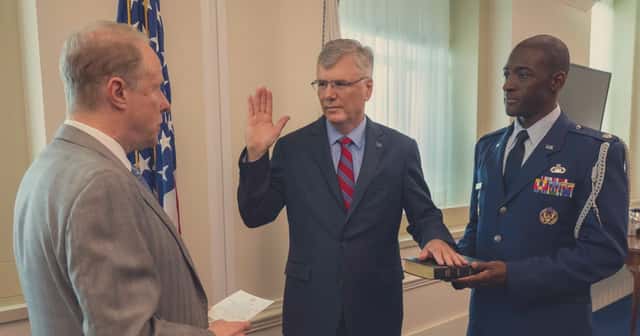
Photo: Steve Feinberg administers the oath to Troy Meink at the Pentagon, May 16, 2025. Senior Airman Madelyn Keech / U.S. Department of Defense; official DVIDS source, public domain. Cropped for display. The appearance of U.S. Department of War (DoW) visual information does not imply or constitute DoW endorsement.
Differing perspectives
What safeguards should govern Feinberg’s continuing ties to Cerberus?
Each position is summarized as its supporters make it, with equal weight and in alphabetical order. A summary is not an endorsement; the evidence for each is weighed in the story above.
End continuing ties and expand public oversight
Who holds it: Senator Elizabeth Warren
Warren seeks a complete break with Cerberus, recusals lasting Feinberg’s full Pentagon service, no waivers and disclosure of Golden Dome recipients and values. Her approach would make the separation stricter and easier for Congress and the public to examine, including who screens his work and how awards are decided.
In their words: July 27, 2026 oversight letter ↗
Rely on divestment, screening and established ethics rules
Who holds it: Steve Feinberg’s written confirmation position
Feinberg committed to divesting Cerberus interests and using screening to implement required recusals. He defended existing ethics restrictions as sufficient to protect the public interest and promised consultation with ethics officials when concerns arose. This approach relies on compliance with defined rules while allowing him to carry out his government responsibilities.
In their words: Senate confirmation questions and answers, 2025 ↗
Cite this article
567 Politics staff. “Steve Feinberg, Cerberus and Epstein: what the records show about the Pentagon official.” 567politics. Published 2026-11-06. https://567politics.com/news/steve-feinberg-cerberus-epstein-records-pentagon-ethics-november-2026
Wikipedia citation
{{cite news |title=Steve Feinberg, Cerberus and Epstein: what the records show about the Pentagon official |url=https://567politics.com/news/steve-feinberg-cerberus-epstein-records-pentagon-ethics-november-2026 |work=567politics |author=567 Politics staff |date=2026-11-06 |language=en}}CSL-JSON for reference managers
{
  "id": "https://567politics.com/news/steve-feinberg-cerberus-epstein-records-pentagon-ethics-november-2026",
  "type": "article-newspaper",
  "title": "Steve Feinberg, Cerberus and Epstein: what the records show about the Pentagon official",
  "URL": "https://567politics.com/news/steve-feinberg-cerberus-epstein-records-pentagon-ethics-november-2026",
  "container-title": "567politics",
  "language": "en",
  "author": [
    {
      "literal": "567 Politics staff"
    }
  ],
  "issued": {
    "date-parts": [
      [
        2026,
        11,
        6
      ]
    ]
  }
}Citations identify this article and its publication date. Assess the reporting and its linked sources before using it as evidence.
READ BEYOND 567POLITICS
Alternate sources & perspectives
Independent coverage and primary evidence to help you compare arguments. A link is not an endorsement; perspective labels describe the linked material.
- primary evidence
Feinberg’s official biography ↗
Pentagon
Current duties and prior service.
- primary evidence
Cerberus leadership succession ↗
Cerberus Capital Management
Company’s own announcement.
- primary evidence
Farkas–Epstein email, EFTA00696327–329 ↗
DOJ records, reproduced by POGO
Financing reference; three pages read.
- primary evidence
Amended ethics agreement ↗
Office of Government Ethics
Signed amendment and compliance assessment.
- primary evidence
Confirmation hearing and written answers ↗
U.S. Senate Armed Services Committee
Feinberg’s divestment and recusal commitments.
- left argument
July oversight letter ↗
Senator Elizabeth Warren
Safeguard demands; NetCentrics qualification.
- independent analysis
Pentagon leadership and Cerberus response ↗
Reuters / Navy Times
Includes Pentagon’s defense.
- independent analysis
Feinberg wins allies’ backing ↗
Bloomberg News
September report; accessible opening reviewed.
- independent analysis
Cerberus in the Epstein files ↗
POGO Investigates
Archive investigation; counts remain attributed.
- primary evidence
DOJ explains January document release ↗
U.S. Department of Justice
Scope and false-submission warning.
- primary evidence
Federal impartiality rule ↗
Electronic Code of Federal Regulations
Business relationships and participation review.
Reviewed 2026-11-05. Focused review of identified sources, not an exhaustive Epstein archive search. Official biography was read in the browser after web retrieval failed. The three-page Farkas exchange was read in POGO’s DocumentCloud reproduction, EFTA00696327–329; it does not establish a payment to Epstein. Wider archive counts and allegations are attributed to POGO, not independently reproduced. Senate and OGE documents were reviewed directly. Reuters and Bloomberg are separate publishers. Discovery returned irrelevant leads and they were excluded. No new outreach or private-account audit was performed. Feinberg had no mapped campaign-finance profile; Warren’s partial 2026 PAC snapshot supplied no established contributor connection to this dispute; the attempted FEC candidate-page retrieval failed. No funding amount or donor-based inference is reported. Unrelated government datasets were excluded.