Trump says Republicans would have won "in a landslide" with him on the ballot; the record says otherwise
The president accepted the midterm results, pledged to work with Democrats and posted a "VETO" hat within the same hour. His counterfactual cannot be tested, but in 2018, with higher approval, his party still lost 41 House seats.
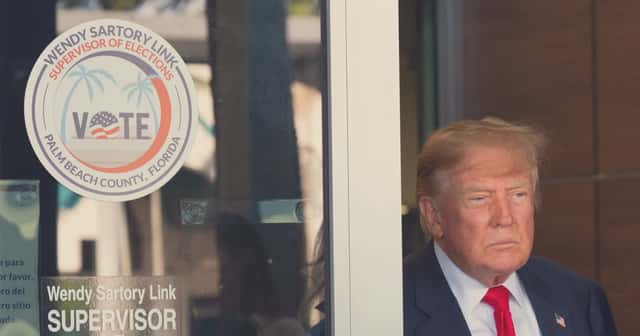
President Trump's first reaction to a midterm in which his party lost the House, the Senate and the Texas governorship was a counterfactual. "I wasn't on the Ballot and if I was, we would have won IN A LANDSLIDE! Thank you for your attention to this matter," he wrote on Truth Social on Tuesday night, in what CNN's Kaitlan Collins described as his first post in three hours, per Forbes and Collins's post on X. Within hours he had told The New York Times he was "absolutely willing to accept those results," posted a picture of a red MAGA hat bearing the single word "VETO," said he would become a "political pundit," and blamed Texas Gov. Greg Abbott's loss on Abbott becoming a "RINO," per RTE and The Korea Times.
This story sets out what the president and his aides said, what the historical record says about presidents and midterms, what the exit polls say about his role in the vote, and how each side is reading the result. The claim at the center, that his presence on the ballot would have reversed the outcome, cannot be tested. But the evidence around it can be.
What Trump and the White House said, in order
Trump spent the campaign's final weeks asking Republicans to vote as if he were running. "I'm just asking everybody to pretend that I'm on the ballot," he told Fox News host Sean Hannity on Monday night, adding, "If our people vote, we win in a landslide," per Newsweek. He had used the same line since opening the Republican midterm convention in Dallas in September, per Newsweek's earlier report. On Monday afternoon, closing his tour at the Reflecting Pool in Washington, he acknowledged that sitting presidents often lose midterms and said, "we gave this a very strong shot," per CBS News.
| When | Where | What he said |
|---|---|---|
| Mon., Nov. 2 | Fox News, Hannity | "Pretend that I'm on the ballot"; "we win in a landslide" |
| Tue. evening | Truth Social | Fox News ratings "way down... because they are AGAINST me!" |
| Tue. night | Truth Social | "I wasn't on the Ballot and if I was, we would have won IN A LANDSLIDE!" |
| Tue. night | New York Times interview | "I am absolutely willing to accept those results" |
| Tue. night | Truth Social | Photo of a MAGA hat reading "VETO" |
Sources: Newsweek, RTE, The Korea Times. We could not open the Truth Social posts or the Times interview directly; the wording is as carried by those outlets and by Aaron Rupar's transcription, which includes the sign-off "President DONALD J. TRUMP."
In the Times interview, Trump also said, "We'll work with the Democrats, and we'll, you know, look forward to working with them," and "We'll probably work something out," per RTE and The Korea Times. In a statement to CBS News he congratulated Democrats, per TheWrap.
The "VETO" image and the pledge to work with Democrats arrived within the same hour. An interview Trump gave CBS News's Robert Costa, published Tuesday evening before the results, explains how he sees the two fitting together. "I have the ultimate power — it's called 'veto,'" he said when asked about a Democratic Congress, adding: "Historically, you veto for a couple of months and then they come and say, 'We've got to make a deal.'" He also said the Supreme Court's decision in Trump v. Slaughter "gives the president tremendous powers that it never had before," per CBS News. Asked in that interview whether he would accept the results, he said only, "We'll have to see"; the "absolutely willing to accept" line came later, to the Times.
An unnamed White House official gave AFP the administration's reading. "The White House mood is defiant," the official said. "Candidate quality matters, and President Trump did a better job promoting many of the candidates on the ballot" than they did themselves. The official predicted that "anyone who voted Democrat today is going to have a serious case of buyer's remorse" when gas prices fall after the Iran conflict is resolved, said "Buckle up," and said the president's "resolve to stop the Radical Left is only going to become stronger," per RTE.
What the results were
Democrats were projected to win the House, which we covered as Jeffries moved toward the Speaker's gavel, and the Senate, after flipping six seats in North Carolina, South Carolina, Kansas, Texas, Iowa and Ohio, with Maine following after midnight when Susan Collins conceded$. In Texas, Gina Hinojosa defeated Abbott, the first Democrat elected governor there since 1990. Final seat counts were not available on any page we could open at 2 a.m. Eastern.
What history says about presidents and midterms
The American Presidency Project at the University of California, Santa Barbara, keeps the standard table of seats gained or lost by the president's party in every midterm since 1934. In 21 of the 23 midterms from 1934 through 2022, the president's party lost House seats. The three exceptions were 1934, 1998 and 2002. The average loss over 1934 to 2014 was 27 House seats and 4 Senate seats, per the American Presidency Project's table and its 2018 analysis.
Source: American Presidency Project
Show the numbers
| Midterm | House seats |
|---|---|
| 2006 Bush | −30 |
| 2010 Obama | −63 |
| 2014 Obama | −13 |
| 2018 Trump | −41 |
| 2022 Biden | −9 |
Trump's own first midterm is the most direct comparison. In 2018, with his approval among voters at 45 percent in the exit poll, Republicans lost 41 House seats while gaining two in the Senate, per the American Presidency Project. He was not on the ballot then either, and his party lost the House. The project's analysis of its own data finds that two things predict the size of the swing: the president's approval rating and how many seats his party must defend. Lower approval means larger losses, per the 2018 analysis.
Trump's Monday remark that sitting presidents often lose midterms is therefore accurate. His Tuesday post does not contradict it, but it adds a claim the record cannot support or refute: that a ballot line with his name on it would have changed the arithmetic. Presidents are never on midterm ballots, so there is no comparison set. The closest proxy is the 2018 result, when a more popular Trump still lost the House.
What the exit polls say about his role
The networks' shared exit poll, run by SSRS, put Trump's job approval among people who voted at 38 percent, which CBS called the lowest for a president in a midterm in its series: George W. Bush stood at 43 percent in 2006, Barack Obama at 44 in 2010, Trump at 45 in 2018 and Joe Biden at 44 in 2022. In NBC's early read, 43 percent said one reason for their vote was to express opposition to Trump and 16 percent said support, against 26 percent voting to support him in 2018. Our report on the exit polls has the sources and caveats; the figures were preliminary and are being reweighted to the actual count.
Those numbers cut two ways. They show voters did treat the president as a factor, which supports the Democratic reading. They also show that 57 percent did not vote to oppose him, and that both parties were viewed unfavorably by majorities, which supports the White House view that the night was not a mandate for anyone. What they do not show is any group of Trump supporters who stayed home because his name was absent. The exit poll surveys people who voted, not people who did not.
Unemployment, the one economic series we could verify directly, was 4.2 percent in September 2026, seasonally adjusted, the latest month available, after a range of 4.0 to 4.5 percent since January 2025, per the BLS civilian unemployment rate series LNS14000000, retrieved November 4, 2026. October data were unavailable because of the 2025 lapse in appropriations and had not been released. That series alone does not explain the vote; the exit polls' finding that three-quarters of voters rated the economy poorly turned mostly on prices.
The Republican argument, and the argument among Republicans
The White House's case rests on candidate quality and on Trump's absence from the ballot. The strongest version is that Republicans who ran closest to the president's message did better than those who distanced themselves, and that turnout in a midterm never matches a presidential year. Trump's attack on Abbott fits that frame: he said the governor "wouldn't have lost" had he not become a "RINO," per The Korea Times. The weakness is that Abbott had campaigned as a Trump ally, and the claim offers no evidence that a different posture would have changed Texas voters' minds. It is a conclusion asserted after the fact rather than an explanation; the fallacy, if one wants a name, is post hoc reasoning.
Other Republicans named the war. Senate Majority Leader John Thune said on September 28 that the Iran war had overtaken "everything else" for voters and that affordability and energy costs were shaping campaigns, per the Washington Examiner. Our exit poll report noted that most voters, including about a quarter of Republicans, said the United States made the wrong decision on military action in Iran, per CBS. We found no Republican officeholder on the record by 2 a.m. endorsing the "landslide" counterfactual, and none rejecting it either; the party's leaders had not issued statements on any page we could open.$
The Democratic argument
Democrats had embraced Trump's framing before the vote. On ABC's This Week on September 13, House Democratic Leader Hakeem Jeffries said: "Mr. President, we don't have to pretend. You are actually on the ballot," listing the economy, the cost of living, Iran, gas prices, health care and tariffs, per Newsweek. On election night Jeffries posted that "MAGA extremists are on the run from sea to shining sea," per TheWrap, which carried the post's link.$
The Democratic reading has the exit polls on its side as far as they go: 62 percent disapproval and 43 percent voting to oppose. Its weak point is the same data's verdict on Democrats, with 54 percent viewing the party unfavorably in CBS's numbers. A rebuke of the president is not the same as an endorsement of the opposition, and the votes that produced the Democratic majorities came in part from people who like neither side.
Reading the "landslide" claim
Three features of the statement deserve separate treatment. First, it is unfalsifiable: no midterm has ever had a president on the ballot, so no evidence can confirm or refute it. That is a logical limit, not a factual error. Second, the record that does exist points the other way. Trump's 2018 approval was seven points higher among voters than in 2026, and his party still lost 41 House seats. Third, the claim was paired within hours with an acceptance of the results, a pledge to work with Democrats and a "VETO" image that his CBS interview frames as the opening move in a negotiation. Readers can hold all three as statements of intent; none is a prediction we can check yet.
The Fox News post is a separate claim: that the network's ratings were "way down... because they are AGAINST me!" We found no ratings data on any page we could open and cannot evaluate it. The "buyer's remorse" prediction from the White House official is a forecast about gas prices after an Iran settlement, and our coverage of the Qeshm Island strikes found the talks' outcome open.
What people were saying online
We set out to sample reactions on X and in r/politics, r/Conservative, r/neoliberal and r/moderatepolitics between 1 a.m. and 2 a.m. Eastern on November 4. Reddit's listings were blocked to our tools, and X's explore pages refused automated access. Our permalink-verification tool failed on every X link we tried, so the posts below are quoted as a search engine indexed them, without engagement counts.
Reporters' accounts carried the Truth Social post within a minute of each other: Kaitlan Collins, Aaron Rupar, Philip Lewis and the Washington Examiner's Rachel Schilke, who noted that Trump "told voters at many rallies to vote as if he was on the ballot," per her post. A reporter identifying as Christopher Salas relayed the White House official's "defiant" quote, per his post. Deadline's account framed the post as "avoiding the fact that midterms are almost always a referendum on the incumbent," per its post. An Indian news account, News Algebra, headlined it "Trump concedes," which the post itself does not say, per its post. We found no indexed post from a Republican officeholder endorsing or disputing the claim, and we are not quoting ordinary users whose wording and location we could not confirm. These are selected online reactions, not a measure of public opinion.
What remains unknown
Final seat margins in both chambers, and whether any race is close enough for a recount.
Whether the president will act on the "VETO" image, and on what. Democrats take the majorities in January.
Republican leaders' response. Neither Thune nor Speaker Mike Johnson$ had issued a statement on any page we could open.
The Fox News ratings claim and the gas-price forecast, both of which await data.
Sources and method
Reported between 1 a.m. and 2 a.m. Eastern on November 4, 2026. Pages we opened: Forbes, RTE and The Korea Times (both carrying AFP), Newsweek, TheWrap, CBS News's election live blog and its Robert Costa interview, the Washington Examiner, the American Presidency Project's midterm table and 2018 analysis, and the BLS unemployment series. Axios, Mediaite, Yahoo, CNN, NBC News, The Hill, Politico and Truth Social were blocked to our fetch tool; the Times interview is quoted as carried by AFP. Reddit and X could not be opened or verified. Our standards for sourcing, polls and corrections are on our methodology page.
Differing perspectives
Were the 2026 midterm results a verdict on President Trump, or on the candidates and the calendar?
Each position is summarized as its supporters make it, with equal weight and in alphabetical order. A summary is not an endorsement; the evidence for each is weighed in the story above.
A loss driven by candidates and his absence from the ballot
Who holds it: President Trump and White House officials speaking to AFP
The president argues that he was not on the ballot and that if he had been, Republicans would have won in a landslide. The White House adds that candidate quality matters and that the president did a better job promoting many Republican candidates than they did for themselves. On this view, midterm turnout never matches a presidential year, voters who back Trump personally did not all turn out for other names, and some candidates, including Texas Gov. Greg Abbott, lost by drifting from the president's message. They also argue that the verdict is temporary: once the Iran conflict is resolved and gas prices fall, Democratic voters will regret their choice.
In their words: President Donald Trump, Truth Social post of November 3, 2026 ↗
A referendum on Trump's record
Who holds it: House Democratic Leader Hakeem Jeffries and Democratic leaders
Democrats argue that the president was on the ballot in every way that mattered, as Jeffries said in September: the economy, the cost of living, the Iran war, gas prices, health care and tariffs were all his record. They point to exit polls putting his approval among voters at 38 percent and showing 43 percent voted partly to oppose him, and to the loss of the House, the Senate and governorships in states such as Texas. On this view, voters answered the president's own request to treat the midterm as an extension of his presidency, and the answer was to hand Congress to the opposition as a check on him.
In their words: Hakeem Jeffries on ABC's This Week, September 13, 2026, as reported by Newsweek ↗
The Iran war and prices decided it
Who holds it: Senate Majority Leader John Thune and Republicans who stressed affordability during the campaign
Some Republican leaders argued before the vote that the Iran war had overtaken everything else for voters, and that affordability and energy costs were shaping tight races across the country. On this view, the party's problem was neither candidate quality nor the president's name on the ballot but a specific set of conditions: a war that polls showed most voters opposed, gas prices that voters blamed on it, and a cost of living that three-quarters of voters rated poorly. The remedy is to end the conflict and bring prices down, which would change the environment before 2028 regardless of who is on the ballot.
In their words: Sen. John Thune's remarks of September 28, 2026, as reported by the Washington Examiner ↗
The normal midterm penalty, scaled by approval
Who holds it: Political scientists including John T. Woolley and Gerhard Peters of the American Presidency Project
Scholars who track every midterm since 1934 argue that the president's party almost always loses seats, an average of 27 in the House and 4 in the Senate, and that the size of the loss tracks two things: the president's approval rating and how many seats his party must defend. On this view, a president with approval in the high 30s among voters should expect losses at or above the historical average, as happened to Obama in 2010 and to Trump himself in 2018, when he was not on the ballot either. The result is neither a personal rejection nor a quirk of candidates; it is the pattern the data predict, and the counterfactual about a ballot line cannot be tested against it.
In their words: American Presidency Project, University of California, Santa Barbara ↗
READ BEYOND 567POLITICS
Alternate sources & perspectives
Independent coverage and primary evidence to help you compare arguments. A link is not an endorsement; perspective labels describe the linked material.
- primary evidence
Seats in Congress gained or lost by the president's party in midterm elections ↗
American Presidency Project, UC Santa Barbara
The standard table of House and Senate seat changes at every midterm since 1934.
- independent analysis
Presidents and midterm elections: what historical data suggest ↗
American Presidency Project (John T. Woolley and Gerhard Peters)
Finds that presidential approval and seats defended predict midterm losses; the structural reading of the result.
- right argument
Trump: 'I wasn't on the Ballot and if I was, we would have won IN A LANDSLIDE!' ↗
Donald Trump (Truth Social)
The president's own framing of the losses; blocked to our tools, wording confirmed via Forbes, Newsweek and reporters' transcriptions.
- right argument
Trump says he is prepared to use 'tremendous powers' if Democrats take Congress ↗
CBS News (Robert Costa)
Pre-results interview in which Trump describes the veto as 'the ultimate power' and vetoes as a path to deals; context for the 'VETO' post.
- independent analysis
Trump deflects blame for election rout but accepts result ↗
RTE (carrying AFP)
Carries the Times interview quotes, the Abbott remark and the White House official's 'defiant' comments.
- left argument
Hakeem Jeffries says Trump is 'actually on the ballot' in midterms ↗
Newsweek
Jeffries' September case that the election was a referendum on Trump's record, in his own words from ABC's This Week.
- right argument
Thune says Iran war trumps 'everything else' in midterm warning to Republicans ↗
Washington Examiner
The Senate majority leader's pre-election view that the war and prices, not candidates, were shaping the races.
- primary evidence
Early 2026 exit polls: CBS News exit poll page ↗
CBS News
Exit poll figures on Trump approval and voters' motives, as cited in our earlier exit poll report; preliminary and subject to reweighting.
- other perspective
Republicans are privately blaming Trump, even if they won ↗
Politico
Reported intra-party criticism over tariffs and the Iran war before the vote; blocked to our tools, so unverified beyond its summary.
Reviewed 2026-11-04. Reviewed between 1 a.m. and 2:30 a.m. Eastern on November 4, 2026. The automated discovery search surfaced the CBS News Costa interview, which we opened, and a Politico report that Republicans were privately blaming Trump before the vote, which was blocked to our tools and is listed as unverified. Truth Social, The New York Times, Axios, Mediaite, CNN, NBC News and The Hill were blocked; Trump's posts and his Times interview are quoted as carried by AFP (via RTE and The Korea Times), Forbes and Newsweek. Reddit and X could not be opened or verified. Missing: on-the-record statements from Republican congressional leaders after the results, the full Times interview, and Nielsen data on the Fox News ratings claim.