Voters’ corruption concerns put Kushner’s business ties and pro-Israel donor access under scrutiny
Polls show broad concern about self-dealing. Here are the documented conflicts, competing responses and laws that could apply to Kushner.
Voters’ concern about corruption was visible well before the November 3 election. Surveys found broad unease about officials using public power for private gain. The AP Voter Poll then found that more than half of midterm voters called government corruption crucial to their congressional vote. AP’s election analysis
The business interests surrounding Jared Kushner give that concern a concrete focus. He has combined diplomatic work with leadership of an investment business backed by foreign capital. His Israeli investments raise a separate question about financial interests alongside Middle East policy. Large pro-Israel political donations and other administration officials’ family business ties add further issues of access and oversight.
Those relationships merit examination on their own terms. A foreign investment, a campaign contribution and a payment to an official are different transactions. None can simply be added to the others as a total for corruption. The legal questions depend on who paid, who benefited, what power was exercised and what evidence connects them.
Allegations and concerns at a glance#
This table summarizes the claims discussed in this article and linked coverage. A concern, a legal theory and a proven violation are different findings. Status reflects this article’s November 6, 2026 review.
| Allegation or concern. | Supporting record. | Response. | Status in this review. |
|---|---|---|---|
| Foreign investment could influence Kushner’s diplomacy. | Senate Finance letter: Saudi PIF committed $2 billion to Affinity. | Kushner says the investment was commercial and denies trading official favors. | Investment documented; corrupt exchange not established. |
| Public authority exercised without a lawful appointment. | CREW complaint challenges his diplomatic role. | Kushner describes compliant volunteer service; his lawyer disputes the suit. | Civil constitutional claim; no merits ruling identified. |
| Required financial disclosures not filed. | CREW complaint alleges a filing duty. | Kushner says ethics lawyers reviewed his arrangements. | Coverage and filing duty disputed; allegation is not a penalty finding. |
| Israeli investments could conflict with diplomatic duties. | CNN traces Affinity → Phoenix → defense-related investments. | Kushner denies directing those holdings or diplomacy for private gain. | Indirect investment overlap; policy-for-payment exchange not established. |
| Pro-Israel donor money may buy unequal access. | FEC filing and White House transcript show donations and recognition. | Support for shared policies is a competing explanation. | Access documented; purchased policy or Israeli-government funding not established. |
| Family development approvals could reflect preferential access. | Albanian government statement distinguishes Sazan and mainland land. | Government defends the process; Ivanka describes active development work. | Improper approval or personal government payment not established. |
| Lutnick’s rare-earth deal could benefit his family’s firm. | Senators’ letter identifies Cantor’s parallel financing role. | Cantor denies negotiating the federal financing and says Lutnick divested. | Overlap documented; corrupt bargain not established. |
Three polls show concern, with different questions#
The Brennan Center’s survey toplines provide a clear measure of registered voters’ views. Asked how much of a problem corruption was in U.S. politics and government, 62% called it very big and 30% moderately big: 92% combined.
The survey covered 2,000 U.S. registered voters from April 28 to May 6, 2026. It used a Verasight web panel matched to voter records and reported uncertainty of plus or minus 2.2 percentage points. The sponsor is an advocate for government and campaign-finance reform. Its published questions let readers assess both the findings and their framing.
A UMass Amherst poll asked about the amount of corruption people believed existed in the federal government. It found 75% saying a great deal and 22% some. That is 97% seeing at least some corruption, rather than 97% calling all government corrupt.
UMass surveyed 1,000 respondents August 21–26, 2026, using a matched, weighted online sample. It reported a 3.5-point margin of error. The national public sample differs from Brennan’s registered-voter sample. Its findings also showed partisan disagreement about which institution was most corrupt. Broad agreement that corruption exists does not mean agreement about who is responsible.
The AP Voter Poll asks a more directly electoral question. More than half called corruption crucial to their vote for Congress, slightly above the share saying the same about living costs. AP described a survey of more than 100,000 voters.
Its methodology combines phone and online interviews with polling-place interviews, using probability and nonprobability samples. Interviews ran October 22–November 3 in most states and began October 19 in Alaska. The full-sample reported sampling margin was 0.6 points; subgroup uncertainty is larger.
These results reinforce one another as evidence of concern. They cannot be averaged into one percentage because the populations and questions differ. Nor do they prove how many voters changed sides because of Kushner, Israel policy or any individual controversy. Our report on corruption concerns and Carlson’s criticism examines that distinction.
Kushner’s foreign-backed business is the strongest starting point#
The financial relationship is more precise than the slogan that a foreign government gave Kushner billions. A September 2024 Senate Finance letter identifies a $2 billion commitment by Saudi Arabia’s Public Investment Fund to Affinity Partners.
That is investment capital committed to a fund, not a $2 billion personal gift. Management fees earned by the business are another category. Personal income requires still more information about ownership, expenses and distributions. Those distinctions do not remove the conflict concern. They explain the actual financial incentive.
Our Kushner foreign-money ledger separates sovereign investments, disputed fee estimates, property transactions and proposed projects. It also distinguishes Jared’s firm from businesses run by other family members.
The oversight concern is that continuing relationships with foreign investors may overlap with a diplomat’s public responsibilities. It calls for investor terms, records of official work and clear safeguards. It does not require assuming that every investor requested a favor.
Senator Ron Wyden$ has made a much stronger accusation in public. His March 19 X post described Kushner as corrupt while sharing news of an inquiry. That is the senator’s judgment, not a court finding.
The post helps show how a prominent critic frames the issue. Its language cannot substitute for evidence of a particular unlawful act.
Israel: an identifiable investment overlap, with limits#
Kushner’s Israeli business interests warrant scrutiny alongside his Gulf funding. CNN’s October reporting examined Affinity’s stake in Phoenix Financial, a large Israeli financial company with investments in defense-related businesses. CNN also reported a sale of part of Affinity’s Phoenix stake during 2026.
This is an indirect chain of interests. Owning shares in a financial company is different from directly owning every business it invests in. It can still create financial exposure that matters when assessing public duties.
The responses are substantive. CNN reported that the White House said Kushner’s business activities were separate from his diplomacy. Phoenix said its value mainly reflected operating performance. Kushner’s lawyer said he had reduced contact with Phoenix management as his public work expanded.
Kushner’s own October response denies directing Phoenix’s investments in the defense-related companies. He also denies taking diplomatic action to benefit himself, Affinity or any investor.
A claim of undue influence needs to go further than identifying the investment. Which policy decision affected the interest? What did Kushner do? Did he know the likely financial effect, and what safeguards applied? Investment records and official communications could help answer those questions.
The source material establishes an overlap worth examining. This review does not establish that Israel’s government directed Kushner’s business, or that he altered U.S. policy in exchange for Israeli money.
Pro-Israel donor access is a separate channel#
Political money provides another documented example of potential influence. Preserve America PAC’s October 15, 2024 FEC report, pages 6–7 lists four Miriam Adelson contributions totaling $95 million during July–September.
The recipient was a pro-Trump outside group. The record does not show $95 million paid personally to Trump. It is a dated filing, not a reconciled total of all later amendments, refunds or spending.
There is also direct evidence of access. At a December 2025 White House reception, Trump invoked Adelson’s financial backing while inviting her to speak. The official transcript supports that connection between money and recognition. His spoken dollar claim is not the verified total used here.
The strongest reform argument is that such financial backing can give a wealthy supporter access unavailable to most citizens. The strongest defense is that donors may support candidates because they already share their policies. A donation followed by policy agreement does not alone establish which caused which.
Our Adelson document review sets out the contributions, policy chronology and disputed claims in more detail.
A U.S. donor’s support for Israel must also remain separate from Israeli government funding. The FEC bars foreign-national election funding and foreign participation in election-spending decisions. Whether that rule was broken requires evidence of the source or direction of funds. Religion, nationality or support for a foreign policy does not establish it.
This distinction makes scrutiny more useful. It lets readers ask about donor power and lobbying without asserting a hidden foreign transaction that the records do not show. Our guide to Israel-related political money explains the separate channels.
Other family ties: Ivanka’s business role and Lutnick’s former firm#
Ivanka Trump should be assessed through her own business actions. In a May 2026 interview, she described working with her husband on a Mediterranean development. That supports scrutiny of her role in the project. It does not make her responsible for every act attributed to him.
The Albanian government’s June statement distinguished the Sazan state-island proposal from privately purchased mainland land at Zvërnec. It defended the approval process and said Sazan remained state property. This is the government’s account, rather than an independent audit.
The questions concern terms, approvals, public value and whether family access affected the process. A development budget is not a government payment to the family. Nor is a proposed project proof that the advertised investment was spent.
A separate example involves Commerce Secretary Howard Lutnick. Senators Van Hollen, Warren and Wyden questioned Commerce’s USA Rare Earth deal because Cantor Fitzgerald, now led by his sons, handled private fundraising alongside the federal package.
NIST’s June announcement confirms final agreements for up to $277 million in incentives and up to $1.3 billion in loans. The policy case is stronger domestic minerals supply.
Cantor’s ownership announcement described transactions intended to remove Lutnick’s ownership and economic interests. The firm has also denied a role in negotiating the government financing, as reported in July. Those responses belong alongside the senators’ allegations.
Our Lutnick article examines the records. The shared question is whether formal separation from a business also provides adequate safeguards when close relatives retain interests.
Which laws could apply to Kushner?#
The legal issues differ from the polling question. Voters can regard a relationship as corrupt even when it has not been proved unlawful. A legal claim must satisfy the requirements of a specific law.
Appointment and public financial disclosure#
The most concrete current court challenge is CREW’s October 14 complaint. It alleges that Kushner exercises government authority without a lawful appointment and has not filed required financial disclosures. It seeks court orders, not a criminal conviction.
The complaint also argues, in the alternative, that the government cannot avoid those rules by handing public power to a private person. These are the plaintiff’s theories. This review did not identify a merits ruling resolving them.
The Appointments Clause generally requires presidential nomination and Senate consent for principal officers. Congress may provide other appointment methods for inferior officers. It would be wrong to say every adviser needs Senate confirmation.
The Justice Department’s January 2025 officer-status opinion identifies two central questions: a continuing federal position and significant authority under U.S. law. For Kushner, the dispute concerns the power he actually exercises, not simply the title he uses.
Financial disclosure has its own coverage rules in 5 U.S.C. §13103. Some officials who are not constitutional officers still must file. The absence of a salary does not by itself settle whether a person falls within a covered category.
Section 13106 provides penalties for knowing and willful failures and false reports. The duty to file must first be established. A missing report does not automatically prove the mental state needed for a penalty. CREW’s demand for disclosure should not be relabeled a criminal charge.
Financial conflicts: 18 U.S.C. §208#
Section 208 generally bars a covered executive official from taking part personally and substantially in a particular matter affecting a known financial interest. It reaches certain interests of a spouse or an organization the official serves, as well as personal holdings.
A corrupt bargain is not required for that prohibition. The core question is participation in a matter despite the disqualifying interest. Waivers and exemptions can matter.
The Office of Government Ethics explains that the financial effect must be direct and predictable. A broad claim that regional peace, war or economic growth could affect investments is not a complete legal analysis.
For Kushner, investigators would need to establish coverage, his participation, the relevant interest, knowledge and the effect of the particular matter. Records of recusals or a valid waiver could change the assessment. The reviewed material does not establish all those elements.
Foreign-agent registration and service#
In an October 24, 2024 letter, Wyden and Jamie Raskin$ requested a special counsel inquiry into possible Foreign Agents Registration Act violations. That request is an established oversight action. It is not proof that DOJ opened a case or found a violation.
DOJ’s FARA guidance explains that the law turns on an agency relationship and specified activities in the United States. These can include political work or representing a foreign principal before officials. Foreign investment alone does not prove that relationship.
The commercial exemption also needs examination. Calling an activity business does not automatically resolve whether its purpose and direction qualify. Contracts, instructions and actual conduct would matter.
A related law, 18 U.S.C. §219, restricts public officials acting as foreign agents required to register, subject to a specified exception. Registering under FARA would not necessarily make simultaneous public service lawful. Both statutes have requirements that must be proved separately.
Bribery and foreign emoluments#
18 U.S.C. §201 covers corrupt exchanges involving things of value and official conduct. Its public-official definition includes some people acting on behalf of the United States, so a volunteer label is not a complete answer under this statute either.
To establish an official-act bribery theory, prosecutors would need a corrupt exchange tied to a qualifying act. The Supreme Court’s McDonnell decision holds that arranging a meeting or providing access is not, standing alone, such an act. An agreement to use official power can present a different case.
A large investment following government service can justify inquiry. Timing and size alone do not establish a bribe. This review has not established a quid pro quo involving Kushner.
The Foreign Emoluments Clause is a separate constitutional restriction on covered officeholders accepting specified benefits from foreign states without congressional consent. Applying it would require analysis of Kushner’s status, the source and nature of a benefit, timing and any consent. It is not itself a criminal statute carrying a prison sentence.
Kushner’s response, and the evidence still needed#
Kushner says his investments were commercial, that the Saudi commitment followed his first government service, and that no agreement linked it to his official actions. He says government and outside ethics lawyers reviewed his volunteer work. He denies using diplomacy for private benefit. His published response
His October X post is included alongside the critic’s post so readers can examine the public responses.
The strongest defense asks for proof of a specific act rather than guilt inferred from business ties. The strongest oversight case asks for the disclosures and records that would allow such conduct to be tested. These arguments deserve comparable scrutiny.
The next useful evidence would include dated investor agreements, official instructions, disclosures, ethics advice and communications around specific decisions. Those records could support a claim, narrow it or contradict it.
The polls show a public demand for integrity. The examples show why conflicts and access deserve attention. Whether any individual broke a law remains a separate question that must be answered with the law’s requirements and the evidence for each.
The money in context: Affinity fees and Fortune 500 CEO pay#
The closest sourced measure of money earned by Kushner’s investment business is fee revenue. It is not his personal salary. Garcia and Wyden estimated that Affinity collected more than $60 million from foreign investors in calendar 2025, including $39 million from Saudi Arabia. Those are lawmakers’ estimates, not an audited account of Kushner’s personal earnings.
The Saudi amount is part of the foreign-client total. The bars overlap and must not be added. The $60 million bar shows only the stated lower threshold; the estimate was more than that amount. The source does not establish that every foreign client was a government.
Source: Garcia–Wyden letter, March 19, 2026
Show the numbers
| Fee category | Estimated annual firm revenue |
|---|---|
| All foreign clients — more than $60m | $60,000,000 |
| Saudi government — included above | $39,000,000 |
For scale, the next graphic shows four CEOs’ fiscal-2025 pay as reported in company proxy statements. The firms appear on the 2025 Fortune 500 list. These are selected examples, not an average or ranking of all 500 CEOs.
Salary is only one part of CEO compensation. The total includes salary plus stock awards and other reported items. The two series must not be added. Stock awards are generally valued under disclosure rules, rather than representing cash taken home that year.
Source: Microsoft proxy, Apple proxy, ExxonMobil proxy, Walmart proxy
Show the numbers
| CEO in reported period | Salary | Total compensation |
|---|---|---|
| Satya Nadella — Microsoft | $2,500,000 | $96,496,790 |
| Tim Cook — Apple | $3,000,000 | $74,294,811 |
| Darren Woods — ExxonMobil | $2,058,000 | $32,998,628 |
| Doug McMillon — Walmart | $1,511,539 | $27,408,854 |
| CEO in reported period | Fiscal year ended | Salary | Reported total pay |
|---|---|---|---|
| Nadella, Microsoft. | June 30, 2025. | $2,500,000. | $96,496,790. |
| Cook, Apple. | September 27, 2025. | $3,000,000. | $74,294,811. |
| Woods, ExxonMobil. | December 31, 2025. | $2,058,000. | $32,998,628. |
| McMillon, Walmart. | January 31, 2025. | $1,511,539. | $27,408,854. |
Walmart’s fiscal-2025 period ended early in calendar 2025. The other periods also differ from one another and from Affinity’s calendar year. The names describe the CEO in each reported period, not a claim about who holds the job today.
The $39 million Saudi fee estimate exceeds the reported total compensation of Woods and McMillon, while falling below Cook’s and Nadella’s totals. It also exceeds each listed base salary. That comparison shows dollar scale. It does not show that Kushner personally earned more than those executives: business revenue pays expenses and other people before any owner distribution.
What can be traced to Kushner personally?#
A fund’s investment capital, its management company’s fees and its owner’s income are separate amounts. The sources reviewed here do not establish a personal compensation total attributable to foreign-government clients, or an amount paid in exchange for official actions. Unknown income is not zero income, and it should not be plotted as zero.
- Investor capitalSaudi PIF’s $2 billion commitment belongs to the investment arrangement; it is not a $2 billion salary.
- Management feesLawmakers estimate $39 million in Saudi fees to Affinity for 2025; this is business revenue.
- Costs and allocationsExpenses, staff pay, ownership terms and distributions affect what the owner receives.
- Personal benefitNo verified dollar total from these clients is established here; no official-favor payment is proved.
Source: Senate Finance investor letter, Garcia–Wyden fee estimate
Kushner denies that investments rewarded his public service or that he used diplomacy to benefit his firm. He also disputes an earlier historical fee estimate. The graphics preserve those limits: they do not classify investment commitments as earnings or label all foreign-client money as payments from dictators.
Laws and legal theories: what would have to be proved#
This is a reference to the issues raised in this coverage, not a list of established violations. Each law has its own coverage rules and proof requirements. The status column reflects the evidence reviewed on November 6, 2026.
| Law or legal theory. | What it requires. | Possible connection. | What remains unproved or disputed. |
|---|---|---|---|
| Appointments Clause, Article II — constitutional. | A lawful appointment for an officer exercising significant federal authority in a continuing role; the method depends on the office. | CREW challenges Kushner’s diplomatic authority. | Whether his actual role is a covered office and how it must be filled; not every adviser needs Senate confirmation. |
| Private nondelegation — constitutional theory. | Limits on delegating governmental power to private parties. | CREW’s alternative claim if Kushner is treated as a private citizen. | What power was delegated and whether the arrangement is unlawful; civil claim, not a criminal charge. |
| 5 U.S.C. §§13103–13105 — financial disclosure. | Covered officials must file specified financial reports. | CREW alleges Kushner failed to file reports required for his role. | Coverage, filing duties, timing and any applicable exceptions. |
| 5 U.S.C. §13106 — enforcement. | Knowing and willful false reporting or failure to report required information; sanctions differ by conduct. | Possible enforcement only if a reporting duty and required mental state are established. | Missing reports alone do not prove willfulness; CREW’s suit is not a prosecution. |
| 18 U.S.C. §208 — financial conflicts. | A covered official’s personal, substantial participation in a particular matter affecting a known personal or specified related financial interest. | Affinity interests alongside Kushner’s government work. | Covered status, the matter, direct and predictable financial effect, knowledge and any waiver or exemption; no bribe is required. |
| FARA, 22 U.S.C. §§611–621 — foreign-agent disclosure. | A qualifying agency relationship and covered U.S. activities, with no applicable exemption. | Wyden and Raskin requested an inquiry into foreign-backed business ties. | Foreign capital alone does not prove agency; instructions, activities and exemptions matter; criminal violations require the relevant mental state. |
| 18 U.S.C. §219 — foreign representation by officials. | A public official acts as a foreign agent required to register, or as a specified foreign-entity lobbyist; a statutory exception exists. | Conditional issue if both public-official status and covered foreign representation are established. | Neither predicate is established here; registering does not automatically cure a prohibited dual role. |
| 18 U.S.C. §201(b) — federal bribery. | A corrupt exchange involving a thing of value and covered official conduct. | A proposed policy-for-investment theory would need transaction-specific proof. | No such bargain established here; access alone is not an official act under McDonnell. |
| Foreign Emoluments Clause, Article I — constitutional. | A covered officeholder accepts a prohibited benefit from a foreign state without congressional consent. | State-linked benefits during a covered period of service. | Covered office, benefit, state source, timing and consent; not itself a criminal statute carrying a prison term. |
Rules relevant to the other examples#
| Law or rule. | Requirement. | Example. | Evidence limit. |
|---|---|---|---|
| 52 U.S.C. §30121 — foreign election funding. | Bars prohibited foreign-national funding and direction of election spending. | Questions about sources of political money. | A pro-Israel U.S. donor is not evidence of Israeli-government funding; no violation established here. |
| 5 C.F.R. §§2635.502 and 2635.702 — staff ethics. | Impartiality and restrictions on using public office for private gain, for covered employees. | Lutnick’s former firm and family interests. | Coverage, specific conduct and any authorization matter; adult children’s interests are not automatically imputed under §208. |
Reporting note: Reviewed November 6, 2026. This article uses published polling, statutes, executive-branch guidance, a court complaint, financial filings and public responses. It does not claim access to private bank records or a complete court docket. No new response was solicited. X search and X’s embed service verified Wyden’s post, authorship and date; Kushner’s post was checked against the embed service earlier in this reporting. These are selected statements, not a public-opinion sample. The article distinguishes civil and constitutional claims from possible criminal theories and does not report an established violation by Kushner in these matters.
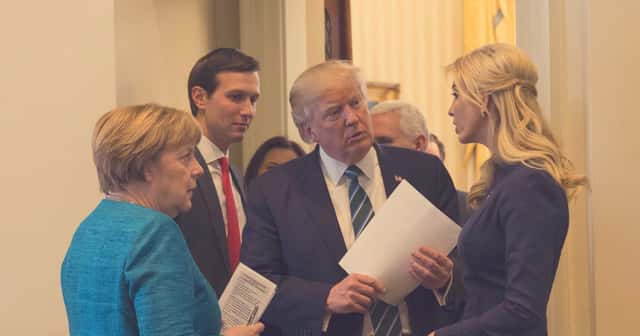
Photo: Jared Kushner and Ivanka Trump with Donald Trump and Angela Merkel at the White House, March 17, 2017. Official White House photograph by Shealah Craighead, public domain via Wikimedia Commons. Archival image; cropped for display.

Differing perspectives
How should Kushner’s foreign business ties, diplomatic role and concerns about political influence be judged?
Each position is summarized as its supporters make it, with equal weight and in alphabetical order. A summary is not an endorsement; the evidence for each is weighed in the story above.
Judge commercial investments and diplomatic conduct through specific evidence
Who holds it: Jared Kushner
Kushner denies using his diplomatic work to benefit himself, his firm or investors. He says the investments were commercial and ethics lawyers reviewed his volunteer service. He asks critics to identify a specific decision and a financial benefit connected to it, rather than treating foreign capital or business relationships as proof of corrupt conduct.
In their words: Kushner’s public response, October 8, 2026 ↗
Require disclosure and lawful appointment before exercising public power
Who holds it: Citizens for Responsibility and Ethics in Washington
CREW argues that Kushner exercises substantial government authority and should meet the appointment and disclosure rules that apply to that work. It seeks court orders to enforce those safeguards. Its case is that the public needs records and lawful structures to assess conflicts, rather than relying solely on assurances of good conduct.
In their words: CREW complaint, October 14, 2026 ↗
Cite this article
567 Politics staff. “Voters’ corruption concerns put Kushner’s business ties and pro-Israel donor access under scrutiny.” 567politics. Published 2026-11-06. https://567politics.com/news/voter-corruption-polls-kushner-trump-israel-influence-potential-laws-2026
Wikipedia citation
{{cite news |title=Voters’ corruption concerns put Kushner’s business ties and pro-Israel donor access under scrutiny |url=https://567politics.com/news/voter-corruption-polls-kushner-trump-israel-influence-potential-laws-2026 |work=567politics |author=567 Politics staff |date=2026-11-06 |language=en}}CSL-JSON for reference managers
{
  "id": "https://567politics.com/news/voter-corruption-polls-kushner-trump-israel-influence-potential-laws-2026",
  "type": "article-newspaper",
  "title": "Voters’ corruption concerns put Kushner’s business ties and pro-Israel donor access under scrutiny",
  "URL": "https://567politics.com/news/voter-corruption-polls-kushner-trump-israel-influence-potential-laws-2026",
  "container-title": "567politics",
  "language": "en",
  "author": [
    {
      "literal": "567 Politics staff"
    }
  ],
  "issued": {
    "date-parts": [
      [
        2026,
        11,
        6
      ]
    ]
  }
}Citations identify this article and its publication date. Assess the reporting and its linked sources before using it as evidence.
Read this article as Markdown or JSON. Cite the original page and retain its sources, dates and qualifications.
Embed this article summary
Paste this HTML into your page. The summary stays linked to the full story and updates with it. No account required.
<iframe src="https://567politics.com/embed/news/voter-corruption-polls-kushner-trump-israel-influence-potential-laws-2026?theme=auto" title="Voters’ corruption concerns put Kushner’s business ties and pro-Israel donor access under scrutiny by 567politics" width="100%" height="440" style="border:0;max-width:100%" loading="lazy"></iframe>
<p style="font-size:14px">Voters’ corruption concerns put Kushner’s business ties and pro-Israel donor access under scrutiny by <a href="https://567politics.com/news/voter-corruption-polls-kushner-trump-israel-influence-potential-laws-2026" rel="nofollow">567politics</a></p>
<script async src="https://567politics.com/embed.js"></script>